
How I Became Aware of the Magic of a Small, Effortless Step

Of all self-motivational games I designed and played so far, the 5 Minute Perseverance Game is one of my favorite.
First of all, the rules are utterly simple. You take a project or activity in the game. You have to pursue the project for at least five minutes a day. If you do it, you earn a point. If you don’t, then you lose the point to your procrastinating self. And if you persevere for less than five minutes, you got half a point with the other half going to the procrastinating part of yourself.
Second, it was the first one I “designed” after being inspired to turn my favorite activity into games, writing.
After seeing how much it helped others to melt their procrastination, I even wrote and published a little book with the same title and an explicit subtitle, 5 Minute Perseverance Game: Play Daily for a Month and Become the Ultimate Procrastination Breaker.
An unforgettable discovery
But there were some tasks that I couldn’t make progress with, even with my 5 Minute Perseverance Game. Five minutes still felt overwhelming, although I wasn’t aware of that then. I simply put off doing them and was angry with myself for being unable to persevere with such simple tasks for even five minutes a day. Then Robert Maurer’s simple observation opened my eyes.
Even the small signs that you are resisting the small step are an indication that the step is too big. — Robert Maurer, One Small Step Can Change Your Life: The Kaizen Way
So I took the advice to heart and started reducing the time I’d spend on each step from five minutes to two, then to one, and even to a matter of seconds.
Sharing Self-Gamification with others required more attentive and non-judgmental observation of what I was doing, as well as analysis of my game results. They were quite revealing. The results of my self-motivational games in August 2017 were both surprising and incredibly enlightening.
In that month, I decided to make an attempt to gamify most of my life. Until then I was gamifying various projects and activities, but other areas remained untouched, both by the game and by my attention. So I made a list of all the projects and activities I thought I wanted, liked, or needed to be doing in that month. I came up with twenty-one various projects and activities. Among them were: writing four different books, posting chapters of three of them as blog posts, blogging on other topics, pitching new projects, taking care of my family, household, health, reading books, answering e-mails, and many others.
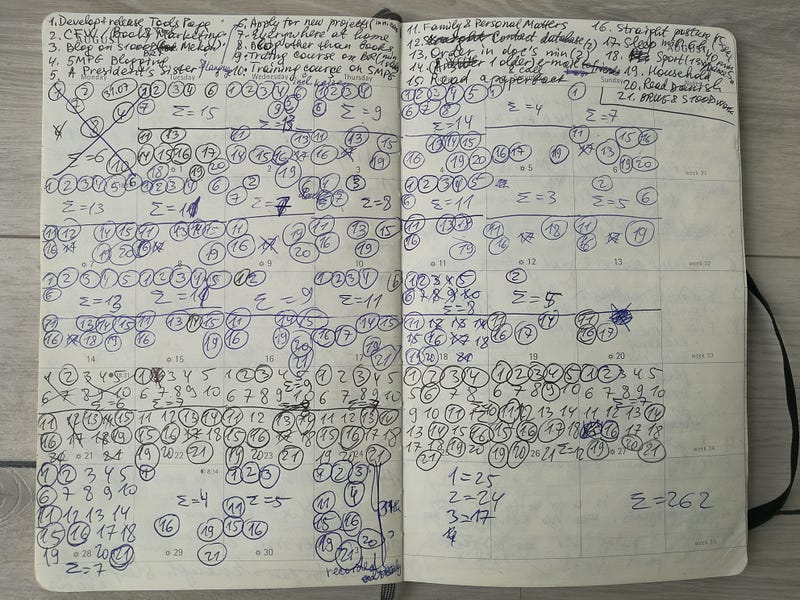
The rule for each project game was that if I did the minimum amount set for a particular project on any day of that month (this might be to write a sentence or a paragraph, read a page or a chapter in a book, or complete a short task), then I would record a point for that project on that day. I could earn only one point per project per day, giving a maximum of thirty-one points per project in that month (August). The goal was to achieve the minimum in as many of the twenty-one projects and activities each day as possible.
Before taking a closer look at the results, I had the idea that I would have achieved more points for the projects I preferred doing.
I also thought that I never managed to attend to any one project on every single day of the month. So for August, I thought that I would not be able to gather thirty-one points on a project or an activity.
But I did.
There was another surprise too. I hadn’t expected to fail to gather even a single point on a project.
But that happened too.
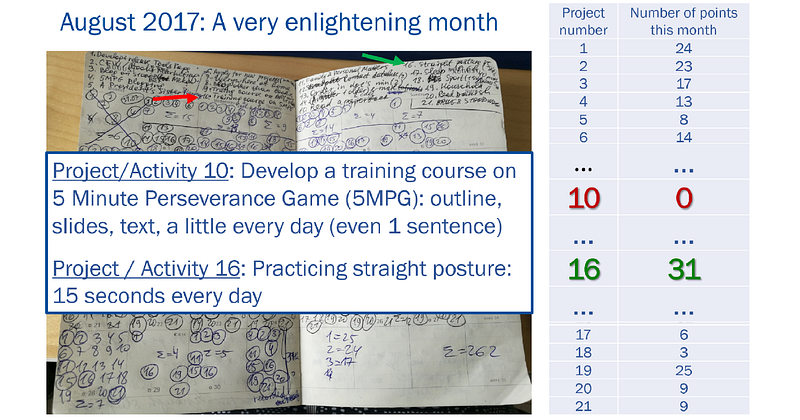
That was exactly what happened with project 10 and activity 16. I gathered zero and thirty-one points correspondingly.
When I looked closer at what these were, I was utterly dumbfounded.
Here they are:
- Project 10: Develop a training course on 5 Minute Perseverance Game (5MPG): outline, slides, text, a little every day (even one sentence would be enough for a point),
- Activity 16: Practicing straight posture: 15 seconds every day.
Practicing straight posture was something I dreaded. I initially tried doing it for a full five minutes a day and failed. I figured I mustn’t care about it that much, because I always used to sit and walk around like a question mark. But since I often had it pointed out that I should straighten my posture, including by my pediatrician many years ago, I grudgingly attempted to develop the habit of keeping a straight posture.
After reading Robert Maurer's claim that even a few seconds on an activity every day could help to turn it into a habit, I gave it a try without really believing it would work. So my surprise was tremendous when I saw that I had managed to do it every single day of August 2017.
On the other hand, the project I thought I was very passionate about, number 10, didn’t get me a single point. That was, teaching a game I called the 5 Minute Perseverance Game. That “game” was the first framework I used to turn my life into games. At that point, I had the basic idea for the course (which was published a year later and the material of which served as the basis also for this article), but the concept was yet to crystallize — that only happened several months later, towards the end of 2017.
Now in retrospect, I see that what I was doing then would ultimately contribute to the project. I might not have written down a sentence for the course’s outline or created a slide, but I continued playing my games and blogging about my experiences. In doing so I learned more and more about the Self-Gamification process, and a year later as I worked on the slides and the script of that very course, the steps that had seemed overwhelming in August 2017 were easy and fun to make in May 2018.
Unless I tried to get ahead of myself and concentrated on the finish line. Then the process stalled and I felt powerless again.
But at that time, I was already testing the tools of awareness and making steps as short as a few seconds, and had various game designs to record my progress in points. So as soon as the alarm for being overwhelmed and upset went off, I saw that I had a choice between staying disconcerted and stuck in complaint (and the possibility of fleeing into escape-to activities), or getting curious about how I could use those Self-Gamification tools.
As I continued using these tools, I saw a drastic change both in my attitude toward the task at hand and the actual progress I made in those initially stalling activities.
I was also delighted to experience how enormous challenges, problems, and questions could be broken down into tiny, digestible, and easily processed components.
This experience showed me the accuracy of what Robert Maurer said about the size of step to take in a project — that if there is even the slightest feeling of being overwhelmed, however small, then the step is still too big.
The activity with the straight posture was anything but preferred by me, but still, I managed to attend to it every day, because standing or sitting up straight and counting slowly from one to fifteen was effortless. Beyond that, halfway through the month, I noticed myself automatically straightening up even after I’d achieved the planned fifteen seconds and a point for that day. That boosted my motivation, and straight posture became one of the first activities I took on in the mornings of the following days.
And the online course on Self-Gamification remained untouched during August 2017, even if I considered it to be something I very much wanted to do. But preparing the material for the course meant too much effort at that time, so I ran away from it and instead chose to do something else.
A note to this article: The part, following the short intro and titled “An unforgettable discovery,” is an excerpt from Self-Gamification Happiness Formula: How to Turn Your Life into Fun Games.
Thank you for reading!
If you enjoyed reading the story above, you might also like this one:
P.S. To stay in touch, join my e-mail list, Optimist Writer.
About the author:
Victoria is a writer, instructor, and consultant with a background in semiconductor physics, electronic engineering (with a Ph.D.), information technology, and business development. While being a non-gamer, Victoria came up with the term Self-Gamification, a gameful and playful self-help approach bringing anthropology, kaizen, and gamification-based methods together to increase the quality of life. She approaches all areas of her life this way. Due to the fun she has, while turning everything in her life into games, she intends never to stop designing and playing them.


