
Writing Was My First Game
And it won’t be my last
How I started turning my life into games
Today, I gamify my life and help others turn their lives into fun games. But it wasn’t planned. It happened more or less by itself.
The very first part of my life that I gamified — even before I knew what gamification meant — was writing.
Being an avid reader, I started to wonder if I could write something interesting too. I started diving into books and blogs about the craft of writing, and I found out what many aspiring writers hear when they begin their adventure: that writing is a difficult job. I would certainly agree with that. Undoubtedly, writing a book is not a one-day assignment. It takes weeks, months, or even years.
That is why at first I decided to write short pieces and share them on my blog.
But there was a story inside me that wanted to be told. One that couldn’t be told in just a short blog post. It needed an entire book. And being dear to my heart — it was the story of my late father trying to locate the family he lost during World War II — the story kept reminding me that I needed to tell it.
So, like many people before me, I realized I wanted to write that book with my whole heart. And like so many others too, I felt I didn’t have the time to do it.
What was I to do?
I decided I would start writing it without putting any pressure on myself to finish it. I would just test out how it felt to write, and see where it might lead.
I wrote a few chapters, then shared them with a friend and my niece. They loved what they read. But then I stopped writing the story. Reasons for it were plenty, and all the typical culprits. Full-time job, a family with a small child, voluntary work, the story being too sad, and my telling of the story too slow, thinking it wasn’t good enough, etc., etc.
Joining a writing course with my dear friend and best-selling author Menna van Praag helped to boost my energy for writing again. Every month for about a year I sent her three pages of the story and then got her feedback both in written form and on the phone during a one-hour telephone seminar, together with her other students.
Just a few months into the course, and particularly in between the monthly phone calls, my writing energy would ebb again. My fellow students and I complained to Menna that we just couldn’t find the time to write, so Menna suggested playing a game. She proposed that each of us write for just a few minutes a day for a month, and share our experiences in the Facebook group created by one of the students.
It was a fantastic experience. We cheered each other through the process, and my writing just flew. Sometimes I only wrote for five minutes or less, but still, it was progressing. In the subsequent months, I forgot about the game, but I continued to write.
Sharing the writing game with others
In 2015, even with two small children, I managed to finish my first book: revising it, having it professionally edited, and then publishing it. Doing all of it in small steps between taking care of my family, maintaining a household, and blogging.
At the end of that year, I published another book. Shortly before that, I joined a writers’ club in Aalborg, Denmark, where I live. At that time I was already working on several writing projects in parallel, continuing the voluntary work in a technical community, moved to a new house with my family, and had started a business. At some point, my fellow writers in the writers’ club asked me how I managed to pursue so many projects in parallel, along with taking care of a business and a family with two small children.
As I was contemplating how to summarize and explain how I did it, I recalled the game introduced to me by Menna. So, I suggested that my friends give it a go. I organized a Facebook group called “Procrastination Breakers Club” where we played this game with rounds going for one month.
The rules of the game were straightforward. We had to introduce the project we wanted to take into the game. It didn’t have to be writing; it could be learning a language, practicing a musical instrument, planning a big event, such as a wedding, working out, renovating a house, or anything else that we wanted or had to do but didn’t think we had time for. Then we had to pursue the project for at least five minutes a day. If we did it, we earned a point. If we didn’t, then we lost the point to our procrastinating selves. And if we persevered for less than five minutes, we got half a point with the other half going to the procrastinating part of ourselves.
At the end of the month we counted up our points, and if it was a writing project we also counted the words we had written.
That first round of the game I moderated for the Procrastination Breakers’ Club was one of the most significant revelations in my life as a writer. In that month I wrote more than six thousand words, by writing for five minutes a day, sometimes more (but never longer than twenty minutes) and sometimes less. Six thousand! If I continued to write the book at the same pace, I would have a full manuscript within a year. By writing for only five minutes a day!
Many traditionally published authors sign contracts with publishers where they commit to writing one book a year. So, by writing in small chunks every day, I would be able to write a manuscript a year and manage such terms too.
That was one of the most beautiful discoveries for me as a writer.
I didn’t proceed with that book further but finished writing and published several other books of various lengths that year and in the years after.
And another marvelous thing happened. During one of the rounds of our game, a writer friend wrote me a personal message on Facebook. She told me that a sentence I often like quoting and which I mentioned at the writers’ panel we both attended helped her to break her writer’s block. She was late with sending a book manuscript to her publisher, and it seemed unlikely that she would manage to get it done. The sentence she referred to was: “You can’t edit an empty page.” [“You can’t edit a blank page.” — Nora Roberts]
I was delighted when she shared this experience with me, and I invited her to play the game with us. She accepted the invitation.
She commented on the page of our group that the game was helping her, and she expressed her surprise with much color and enthusiasm. Sometime later she posted a message with multiple exclamation marks announcing that she had finished the manuscript and sent it to her publisher.
This author’s name is Sasha Christensen, and she is an award-winning Young Adult fantasy author in Denmark. She allowed me to quote her and even suggested that I put the cover of her book (the one she’d been struggling to finish) on my website. Before sending the picture, she wrote, “This [book] is the one you helped break my block on, btw ;).”
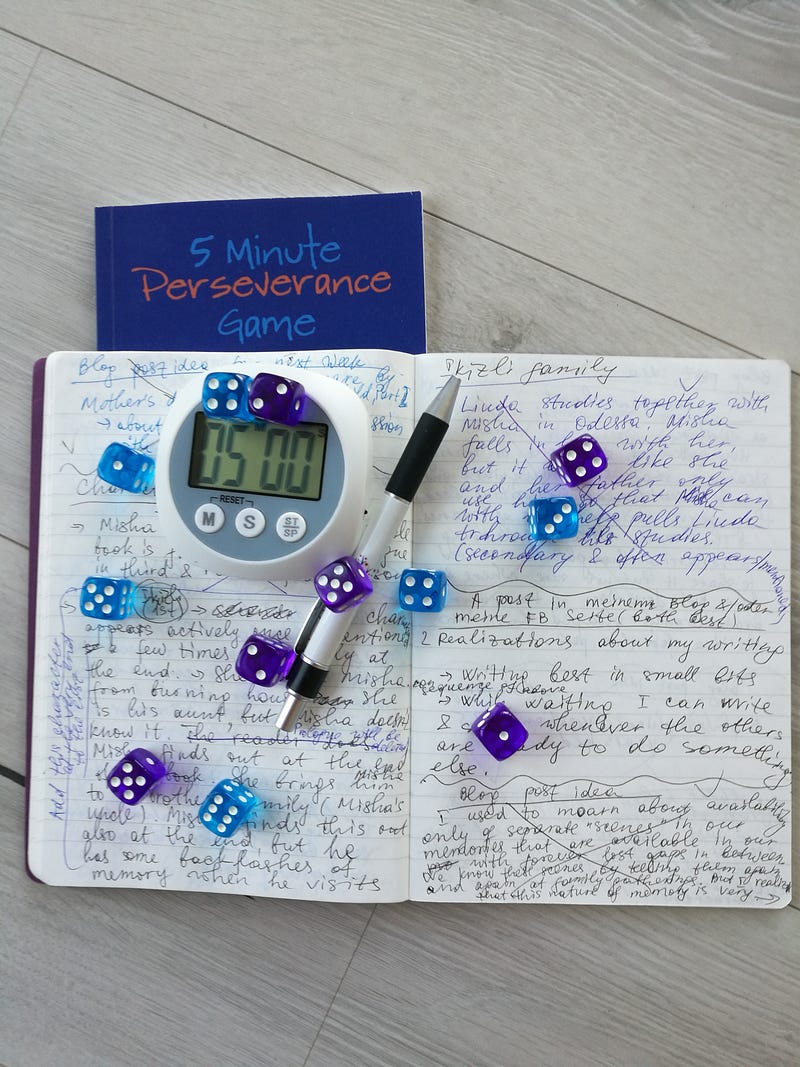
Seeing the effect the game could have, and how much fun could come of it, I decided to dedicate a little book to it, which I named 5 Minute Perseverance Game: Play Daily for a Month and Become the Ultimate Procrastination Breaker. The board game I got from my husband as a gift for Christmas the previous year inspired me to structure this little book as if it were the description for such a game. Writing this little book was a unique and fun experience in itself.
This was an excerpt from my book Self-Gamification Happiness Formula: How to Turn Your Life into Fun Games. I hope you enjoyed reading it, and it inspired you to turn your writing into a fun and engaging, for you, game. I invite you to check out the other resources on Self-Gamification here: victoriaichizlibartels.com/gameful-life/.

Are you struggling to motivate yourself to start the day, to work on a project, or maintain a healthy habit? Do you think that happiness is hard earned and reserved only for the ”chosen ones”?
This book will show you that happiness is close by and available to everyone. It will show you how to not take life too seriously and still be excellent in all you want or have to do.
Read the book and learn how to motivate yourself by practicing self-gamification — a unique self-help approach to implementing game design elements into your life.
Master three skill sets to be successful in your self-motivational game design, your projects, and your life:
- See yourself, the world around you, and your thought processes non-judgmentally, as an anthropologist would do.
- Identify your dreams and goals, and take action, one small and effortless step at a time, the kaizen way.
- Apply gamification, that is see and treat whatever you are up to as a game: design, play, and improve your (life) games, and learn to appreciate every step on the way by giving yourself points, badges, stars, and other small symbolic rewards.
Answering the questions and completing the various exercises in the book will allow you to practice the three skill sets of self-gamification as you go along.
Apply anthropology, kaizen, and gamification together to practice self-gamification, a unique approach that will help you turn happiness into a lifestyle.