
Helping Kids Prepare for Back to School
Tips for making the transition easier, especially for kids who struggle

Embrace Ambivalence
It’s okay for our children to not be excited about going back to school. A lot of advice suggests talking it up, talking about how wonderful school will be.
Yeah, don’t do that.
There’s nothing wrong with mentioning some of the positives, things you genuinely know your child will enjoy about school, but be honest with them. For one thing, most kids don’t enjoy everything about school, and some kids hate a lot of things about it.
Talking about back-to-school as though it were the best thing ever might put undue pressure on your child, making them feel as though they should be happy about going back, and there’s something wrong with feeling anxious about it.
There’s not. All feelings are valid.
For kids who really have a horrible time at school, telling them this will be the best time of their lives is a dangerous message to send. I was relentlessly bullied every day of elementary school from start to finish. High school was better socially, but still really awful.
Telling someone like me those are the best days of our lives is a horrifying thought.
Life beyond the school walls
I’m nearly 40, and my life has only gotten better since leaving public education. I’m Autistic and ADHD. I did not make friends or fit in. I was not well-liked. The traditional education system — and its neuronormative expectations — does not work for most neurodivergent students.
Neurodivergent and disabled children are the most frequent victims of bullying. Whereas approximately 25% of non-disabled and neurotypical youth experience bullying, children with disabilities are twice as likely to be victimized.
It’s estimated that 60% of Autistic children and 40% of children with ADHD experience bullying in school. Even worse, we’re often blamed for our own victimization. We’re given the message — either directly or indirectly — that we “bring it on ourselves” by being different.
I want students (especially kids like me), to know if this is not the time of their lives, that’s okay. There is a lot of life after school, and there are many places where people like us can find our cohorts and discover a community where we do fit in.

Even better, we can find spaces where it doesn’t matter whether or not we “fit in”, we’re accepted — even appreciated — for being oddballs. We’re not expected to conform to anything, all that is expected of us is to be our authentic selves.
Foster connections
Especially for younger students, it’s important to help foster a connection between themselves and the adults who will be part of their lives five days per week for the next 10 months.
Some ways parents can do this are:
- Ask the school for some basic information about your child’s teacher, such as their interests (non-invasive details such as their favourite sport, movie, or activity), with the hope that they share a common interest with your child.
- A common interest can be a helpful ice-breaker for when they are getting to know one another during the first few weeks of school.
- Provide your child’s teacher with a brief overview highlighting some of your child’s interests, strengths, areas of struggle, and which supports or approaches work best for them at school.
- More detailed information should be provided in their education plan (their IEP or SSP, for example), but a single-page overview is less overwhelming for a teacher who is working on getting to know a classroom of new students.
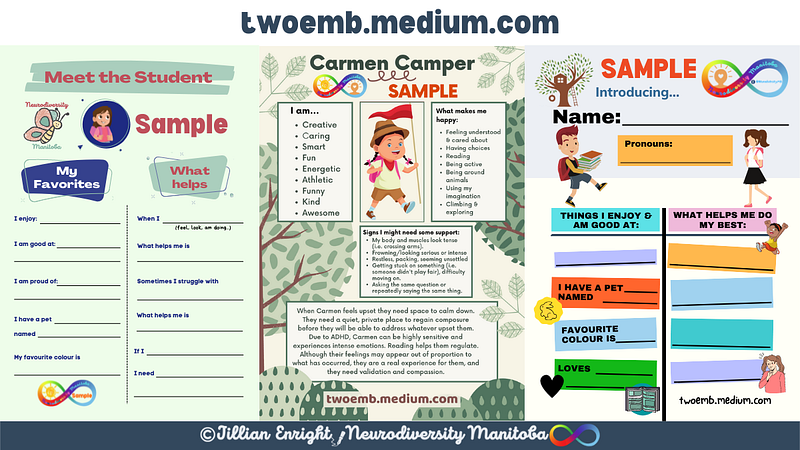
Ways teachers & school staff can foster connections with students:
- Greet students using their names. Take care to use their correct pronouns and to pronounce their names properly — if you mispronounce their name or misgender them, quietly apologize and thank them for reminding you.
- Ask students about themselves. Non-invasive but genuine questions, such as their favourite sport, movie, or activity. Show genuine interest in learning about them and things they care about.
- Engage in self-care and set healthy boundaries. There’s a lot of pressure on teachers and school staff and many curriculums are only becoming more demanding. There are fewer resources and greater expectations for teachers each year. I know it’s easy to say from the outside looking in, but try your utmost to set healthy boundaries with yourself and your administration early on, setting realistic expectations.
- Take time to be playful and relaxed with students. When you engage in self-care, you’ll be more patient and more able to let your playful side show. Take a little time out of each day to do something fun or low-key with your class, and to talk to your students about something other than their school work.
Change Starts At The Top
A plea to administrators and policy-makers
Please, please make the following a high priority:
- Increasing and improving supports and resources available to your students and school staff.
- Prioritizing student social-emotional learning and mental health, ensuring to provide adequate training and professional development to your staff.
As the saying goes, administrators cannot get blood from a stone. I’ve mentioned this before, but it’s worth saying again: schools need better funding in order to meet the needs of their students.
Fellow parents, if you have any emotional energy left once you have your children ready for back to school, perhaps you can take some time to advocate for your local public schools.
Politicians listen to the largest groups with the loudest voices: the more voters they see care about an issue, the more likely they are to take notice. Let your voice — and your child’s voice — be heard.
© Jillian Enright, Neurodiversity MB

When you join medium, as a member you’ll have access to unlimited reads for only $5 per month. If you use my referral link, I’ll earn a small commission, and you’ll earn my undying gratitude.
Related Stories
References
Lung, F. W., Shu, B. C., Chiang, T. L., & Lin, S. J. (2019). Prevalence of bullying and perceived happiness in adolescents with learning disability, intellectual disability, ADHD, and autism spectrum disorder: In the Taiwan Birth Cohort Pilot Study. Medicine, 98(6), e14483. https://doi.org/10.1097/MD.0000000000014483


