
Back to School: The final count down
Tips to make the transition easier on your whole family

Are you excited, or nervous?
The answer is C, all of the above.
When you picture back-to-school, do you envision mornings filled with chaos, yelling, rushing, frustration, and stress? That’s what our mornings used to look like a few years ago when our son first started school.
I won’t lie and tell you that every morning in our household is picture-perfect now, because they’re definitely not. I don’t particularly like mornings. I need time — and caffeine — to get going, and even then I am certainly not sunshine and rainbows. More like thumb tacks and hot sauce.
That said, our mornings have improved exponentially, with a few straightforward and practical adjustments. Starting our days in a more relaxed and less stressful manner gets us in the right frame of mind for work and school, but getting to that point really starts the night before.
Lunch prep
Make lunches with your kids the night before. It will save you time and stress in the mornings, and will instil a sense of responsibility and competence in your children, which boots their self-confidence.
When our son packs his own lunch, he’s more likely to remember what’s in it, more likely to pack things he likes, and more likely to actually eat them.
Like me, if he doesn’t eat, he’ll get hangry. This sets him up for a less successful afternoon at school, and also sets us up to have a grumpy child with low blood sugar coming home on the school bus. That’s no fun for anybody.
It’s also an important life skill to teach children how to prepare balanced meals for themselves, and it can be fun to walk through it together. Although they may resist at first, I find that children tend to feel a sense of pride, accomplishment, and independence when they do things for themselves.
Organization systems
Don’t go out and buy a brand new $100 kitchen organization system. It’s not necessary, and you’ll likely use it religiously for a few weeks and then stop using it anyway. What is most effective will differ for every family, but I suggest sticking with something very simple and easy to use.
I created a checklist for my son outlining the items to include in his lunch. As long as he includes one from each category, he has free rein:
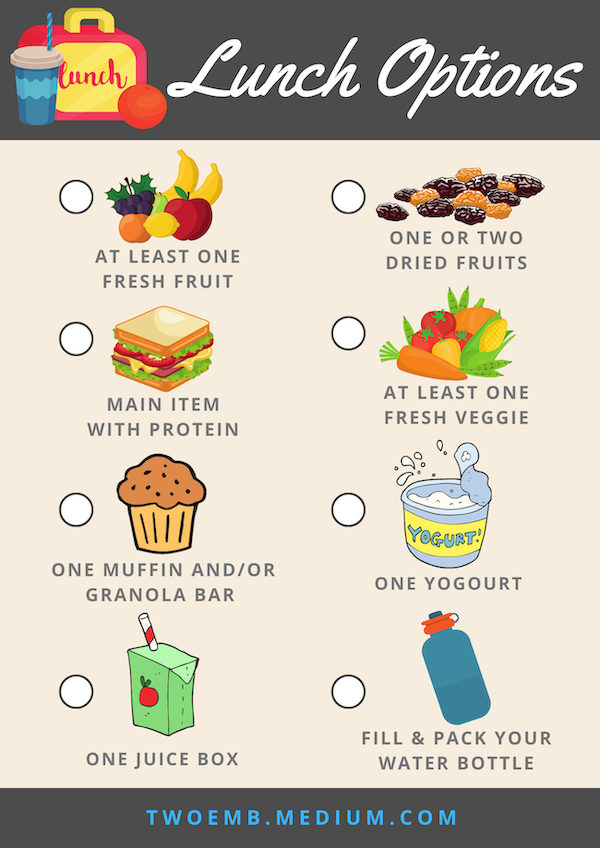
This may seem like a lot of food, but he doesn’t eat it all. Because he is so easily distracted from eating, I like to ensure he has a lot of variety to choose from so that we know he’ll at least eat something that he has packed.
I need to ensure he has quick-and-easy things to choose and eat because he gets so busy playing or reading during his lunch break that he runs out of time and won’t end up eating much.
I am also not a morning person myself, so I definitely prefer to get lunches and backpacks ready the night before. I feel rushed enough in the mornings, I want to make them as easy as possible for all of us.
Routines
Some families maintained a fairly consistent routine all summer, especially if both parents in the household worked full time while their children attend summer camps or daycare. Other families may have a stay-at-home parent and their routines might shift dramatically from Summer to Fall.
If your bed time and morning routines remained pretty much the same, then you’re ahead of the game. If they don’t, that’s okay too, flexibility is what summer break is all about.
Before we worry about the morning routine, we really need to have a solid bed-time routine in place — for both parents and children, honestly.
If I don’t get enough sleep, I am way off my game in the morning. My son is very sensitive to that, and if I am cranky and less patient, he will follow suit. If I rush him or get frustrated, this makes him feel flustered, and he ends up taking longer to do anything I ask him to do.
Our Bed Time Routine:
- No screens after 6 pm
- Pack our lunches for tomorrow
- Last call for evening snack between 7-7:30 pm
- Brush teeth and reading in bed between 7:30-8pm
- Lights out between 8–8:30 pm
Some families find it helpful to pick out clothes for the following day as well. Luckily our son doesn’t have much trouble with this in the mornings, so we don’t worry about it, but it can certainly be helpful for children who have trouble choosing what to wear.
Morning routine
Have I mentioned that I am most assuredly not a morning person? I like a slow and quiet start to my days. That isn’t really possible unless I wake up at 6am, and I’m also not willing to do that, so I just accept that mornings will be a little chaotic.
We have, however, found some ways to make that chaos manageable:
Technology: We have used routine apps, schedulers, and home assistants to help keep us on track and somewhat on time in the mornings.
My son and I both have ADHD, a symptom of which is poor time awareness, called time blindness (Wilson et al., 2013), so having a home assistant remind us that we have twenty minutes until we need to leave has been a huge help.
Visual schedules: When you’re half asleep and in a rush, it’s easy to forget things, so having visual reminders can really help. Again, for both children and adults! Have I already mentioned I dislike mornings? Yes?
I created visual schedules of our morning routines, for both my son and myself. In order for these to be effective, it’s important to place them somewhere you will definitely see them, such as right by the front door — or for me, right by my coffee maker!
It is also important that these schedules or reminders are visually appealing and eye-catching, so that you won’t simply walk right by them without even noticing. It may help to use different colours for different days to prevent habituation, and to have pictures of what the finished product looks like for reference.
Be realistic
If you hate mornings like I do, don’t try to go from dragging yourself out of bed at 7:29am to saying you’re going to seize the day and get up at 5:30am. Make gradual changes and adjustments that fit with your lifestyle and preferences.
When creating a morning routine, don’t try to scrap everything and start from scratch, because radical or unrealistic changes are less likely to stick. Take a look at what you do currently, or what you did over the past school year. Note where things usually go well and where they don’t, then develop practical strategies for addressing those bumps in the road.
Keep your expectations of yourself, and of your children, fair and realistic. Be considerate and empathetic to their experience as well as your own.
Prioritize
A simple yet important expectation we established has really helped reduce friction and frustration in the mornings: my son needs to have his morning routine completed before he moves on to other things.
My son absolutely loves to read, he would essentially read all day long if he could, which is a good thing for the most part. However, those of us with ADHD also have difficulty with set-shifting, also known as transitions: we can get hyperfocused on a task or activity, and have trouble disengaging to refocus our attention onto something else.
If I allowed my son to read in the mornings before being ready for school, he would never make it to school. So, rather than have truancy officers at our door, I created another checklist. When my son asks me if he can play or read, I ask him to check over his list to ensure it is complete, and then he can choose to play or read until it’s time to go.
This also helps motivate him to get his routine finished, because the earlier he’s done, the more time he’ll have to read or play before he has to leave.
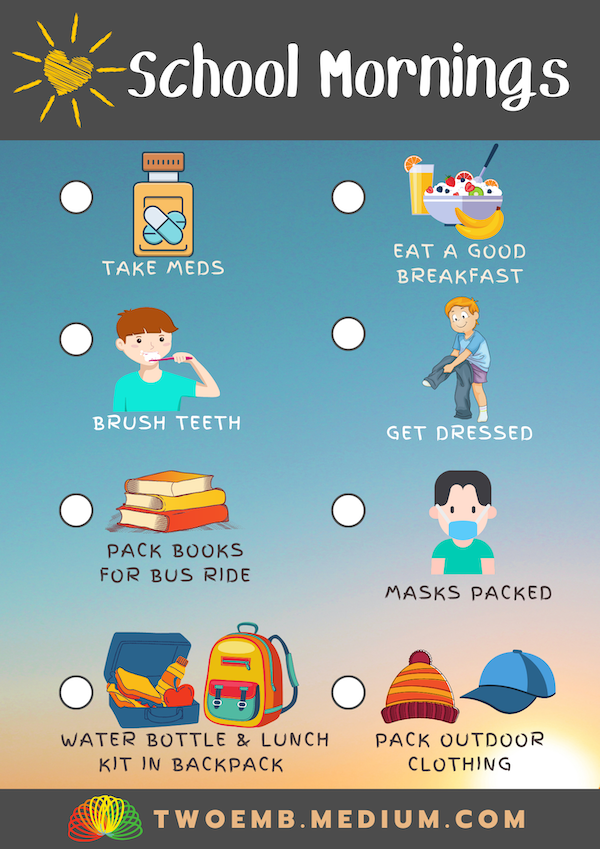
Yes, I do like checklists. I am extremely forgetful, so they can be helpful reminders — except when I forget where I put them, and then I have yet another thing to try to remember, which is why I print them on brightly coloured paper and laminate them.
I also like providing my son checklists because then I don’t feel like such a nag. I don’t have to repeat the same reminders time and again, I can simply ask him to check his own list. This puts some of the responsibility on him, which helps him develop a life skill, and gives him some independence.
Pick Your Battles
I think we can all agree that we’ve had a stressful enough 2020 and 2021 so far, yeah? Virtual learning, dealing with covid shut-downs and pandemic anxieties, and being apart from their friends have all likely taken a toll on our children.
The past year and a half has definitely had an impact on adults as well, so let’s make things a little easier on ourselves wherever we can.

If you don’t have to be at work by a specific time in the morning, let your child be a little late for school once in a while. Don’t let it become a habit, but if your child is clearly having a really rough morning, it’s much better to let them work through it with you at home before going to school.
Yes, learning about responsibility and getting to school on time are important life skills, but if we’ve learned anything over the past year or two, it’s that our lives probably need more balance and we’re actually more productive when given some flexibility.
How successful will your child be at school that day if they spent the morning being rushed, getting yelled at, or arguing with their parents or siblings? Whenever we have the ability to do so, let’s slow things down and prioritize our relationships, mental health, and family dynamics.
In Summary
You can start setting yourself and your children up for success right now, by implementing the following routines:
- Help your child make their own lunch each day, whether packing it for summer camp, or making their own lunch at home.
- Get organized. A calm adult helps their child feel calm. When we’re stressed and hurried, we’re more likely to be cranky with our children, and we’re less skillful in our interactions.
- Visual schedules! Checklists! Whatever works to gradually transition the responsibility over to your child, help them develop strategies that work for them. Less nagging and yelling mean a better start to the day.
- Develop routines. Work on healthy bedtime routines, both for adults and children, to set yourself up for success the following day.
- Pick your battles and prioritize your family’s relationships and mental health over academics, rigid structure, or getting to school on time.
- Enjoy what’s left of the summer. Spend quality time together and make room in your schedule for fun.
What is your advice for fellow parents for helping their children prepare for back to school?
Related Story Series

References
Kocielnik, R., & Hsieh, G. (2017). Send Me a Different Message: Utilizing Cognitive Space to Create Engaging Message Triggers. In Proceedings of the 2017 ACM Conference on Computer Supported Cooperative Work and Social Computing (CSCW ‘17). Association for Computing Machinery, New York, NY, USA, 2193–2207. DOI: https://doi.org/10.1145/2998181.2998324
Luna-Rodriguez, A., Wendt, M., Kerner auch Koerner, J. et al. (2018). Selective impairment of attentional set shifting in adults with ADHD. Behavioural and Brain Functions, 14, 18. https://doi.org/10.1186/s12993-018-0150-y
Wilson, T. W., Heinrichs-Graham, E., White, M. L., Knott, N. L., & Wetzel, M. W. (2013). Estimating the passage of minutes: deviant oscillatory frontal activity in medicated and unmedicated ADHD. Neuropsychology, 27(6), 654–665. https://doi.org/10.1037/a0034032


