
CALL: How to Grow A Knowledge Enterprise
A Model of Building Knowledge Enterprise Activity and The Path of Creative Life

This morning Maurizio Goetz asked me the following question:
How do you make sense of an emergent topic or emergent field?
In fact, I have written an amazing book for answering this question.
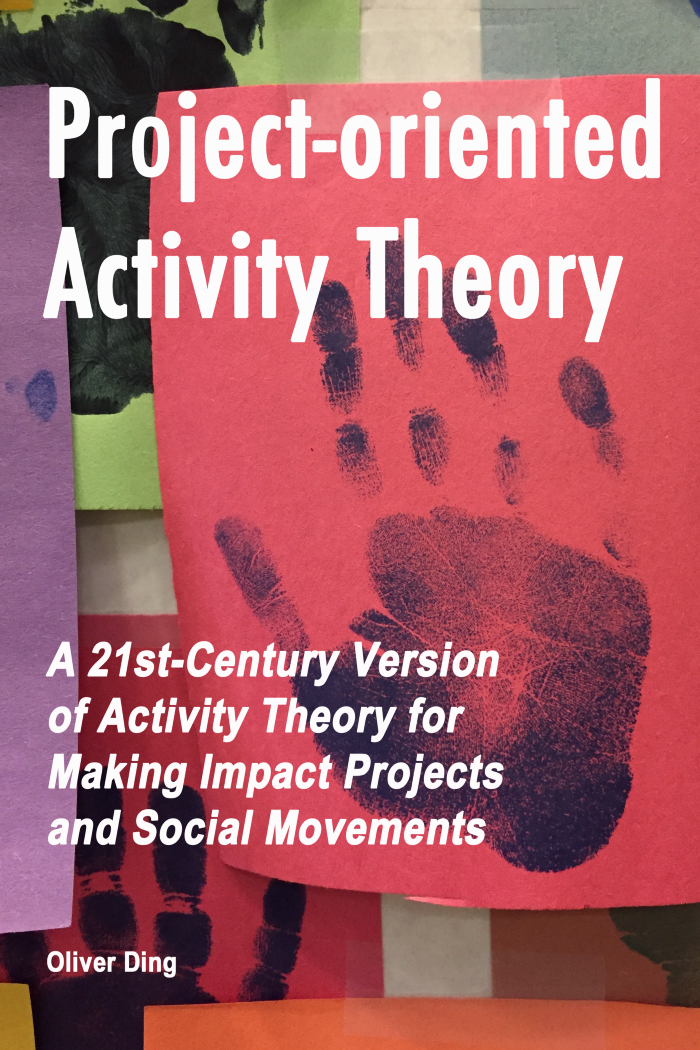
You can find an introduction to Project-oriented Activity Theory here.
The core of the book is the following long article:
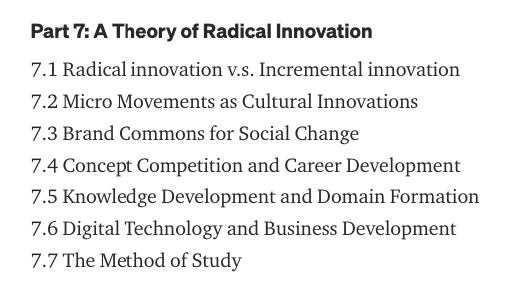
You can start from Part 7, especially 7.4 “Concept Competition and Career Development” and 7.5 “Knowledge Development and Domain Formation”.
This topic is one of my favorite topics. Many of my projects are related to knowledge building and development. These projects can be understood as producing knowledge about producing knowledge.
I use “CALL for META” to organize my related projects around the meta-knowledge direction.
This article aims to introduce two models of the meta-knowledge direction:
- A Model of Building Knowledge Enterprise Activity
- The Path of Creative Life
I also shared some canvases for knowledge creators.
Contents
Part 1: Building Knowledge Enterprise
1.1 A Model for Building Knowledge Enterprise 1.2 The Primary Theme of A Knowledge Enterprise 1.3 The Uniqueness of A Knowledge Center 1.4 The Platform Genidentity of Knowledge Community
Part 2: The Path of Creative Life
Part 3: Canvases for Knowledge Creators
3.1 The Creative Work Canvas 3.2 The Knowledge Discovery Canvas 3.3 The Life Discovery Canvas 3.4 The Thematic Space Canvas Family
Part 1. Building Knowledge Enterprise
In the past four months, I worked on the Slow Cognition Project and its core is Thematic Space.
Last month, I made a new personal board on Milanote. The last section of the board shows a model and six books. See the screenshot below.
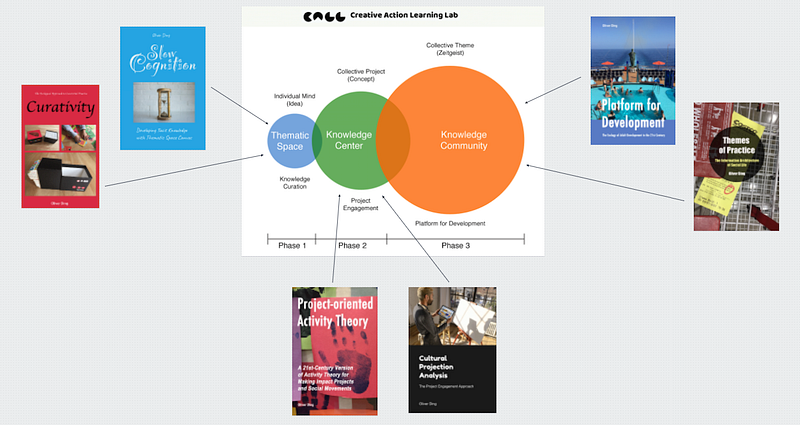
The above screenshot refers to a new mission of CALL:
Building a supportive ecosystem for knowledge creators.
The mission considers Building Knowledge Enterprise Activity as the core of the supportive ecosystem.
1.1 A Model for Building Knowledge Enterprise
Originally, I developed the following model for the Activity Analysis project. Later, I realized that it can be a general model for building knowledge enterprise activity. The model aims to answer a related question:
How to grow a knowledge enterprise?
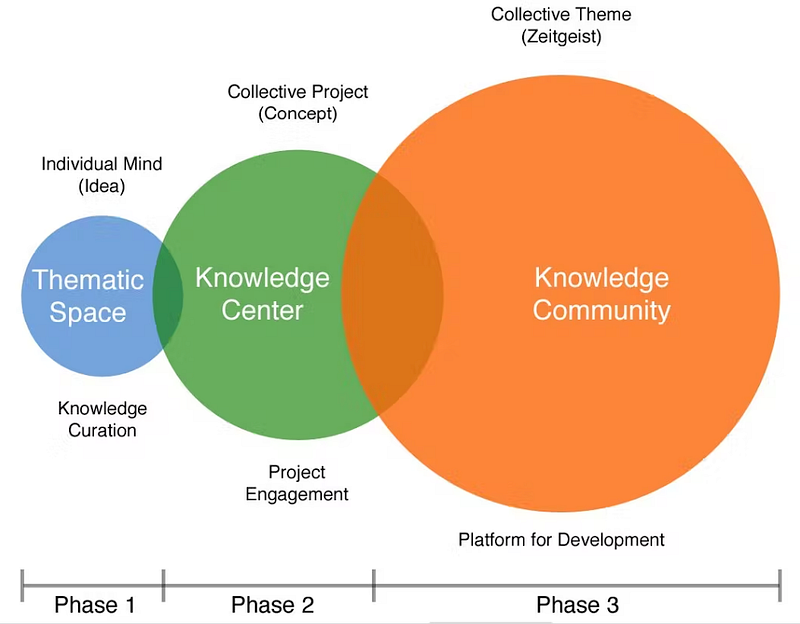
The model is inspired by Project-oriented Activity Theory. Each phase refers to a focus. The three-phase development is inspired by the following diagram which is one of a series of diagrams in the book.
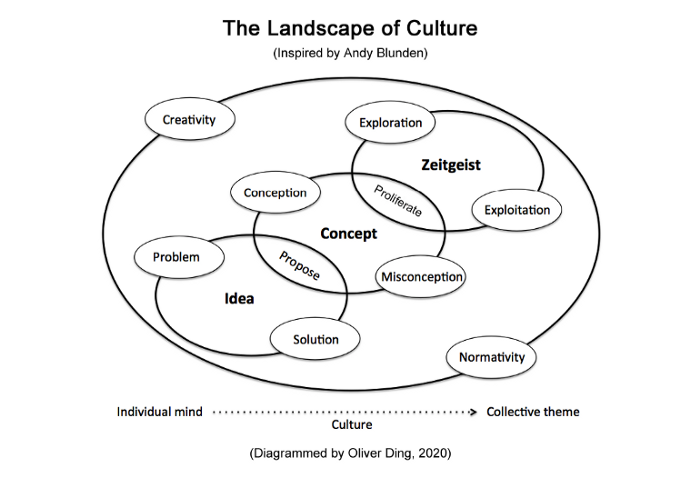
I used the above diagram to explain the concept of “culture” from the perspective of Project-oriented Activity Theory. It zooms out to a large view that connects the Individual mind (Idea) and Collective theme (Zeitgeist) through Collective Projects (Concept).
Not all ideas lead to a real concept which means a social practice from the perspective of Project-oriented Activity Theory. Though Blunden’s approach focuses on “the formation of a project with a concept of the problem is an original and creative social act”, I think the non-problem idea could develop into a real concept too. Cultural Innovations can be driven by problem-solution ideas and play-for-fun ideas too.
I personally believe that the journey of epistemic development is for fun first and for labor second. Why? You don’t have to continuously develop your mind in order to master some work-related activities.
The above diagram also mentions three knowledge frameworks I am working on:
Each knowledge framework could be adapted to support one phase of the Building Knowledge Enterprise (BKE) Activity.
1.2 The Primary Theme of A Knowledge Enterprise
Each Knowledge Enterprise is defined by a unique theme and it should be developed by its founders with a unique perspective.
For example, Activity Theory is a successful knowledge enterprise and its primary theme is “Activity”. Its founder Aleksei N. Leontiev developed an activity-theoretical approach to psychological science.
The Knowledge Curation framework is for the development of a unique thematic space. For example, the following diagram is my “Platform” thematic space.
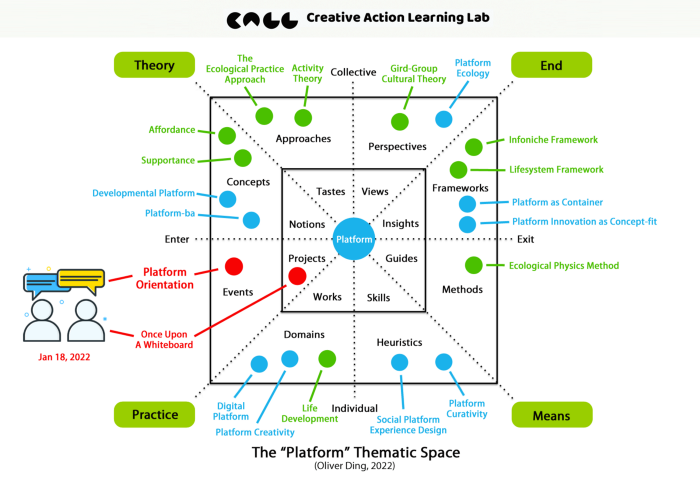
In the past several years, I worked on the theme of “Platform” and developed several concepts, frameworks, and tools. Finally, I wrote a book titled Platform for Development in 2021.
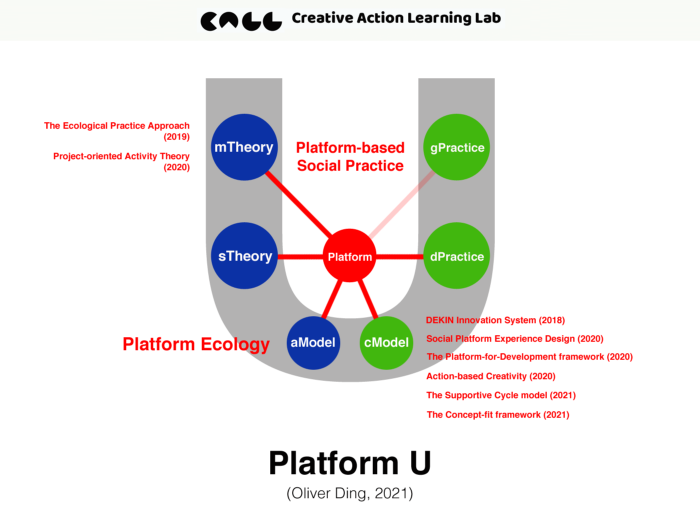
The Knowledge Curation framework offers a series of tools for developing thematic spaces. For example, the above Theme U diagram is an important tool for watching the landscape of a theoretical theme.
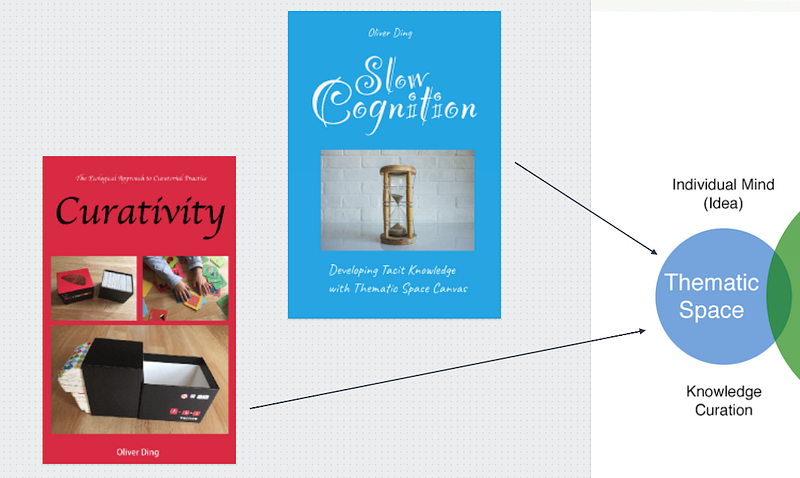
I’d like to recommend two books for phase I.
- Curativity: The Ecological Approach to General Curation Practice (2019)
- Knowledge Discovery: Developing Tacit Knowledge with Thematic Space Canvas (2022)
Curativity offers a new theory called Curativity Theory. One of its applications is the Knowledge Curation framework.
Knowledge Discovery is the outcome of the Slow Cognition project (Phase I).
1.3 The Uniqueness of A Knowledge Center
While Phase 1 is about an individual mind, Phase 2 is about a collective project.
A knowledge center is a collective project that aims to develop a certain unique knowledge. A “center” should have its own uniqueness in order to establish its identity and theme. Otherwise, there is no need to build a “center”.
For a high degree of uniqueness, we can look at the following examples:
- Santa Fe Institute
- Niche Construction Theory
- CSDT (Center for Self-Determination Theory)
- CRADLE (Center for Research on Activity, Development and Learning)
- Presencing Institute (Theory U)
The above examples refer to several unique and well-known theoretical approaches in their fields. In order to understand the diversity of uniqueness, I adopt the Four C model of creativity study for the present discussion.
There are other traditional pair ideas called “Big-C” and “little-c” in the field of creativity research. “Big-C creativity” refers to what people call “Genius” who create famous creative achievements such as music, paints, inventions, theories, etc. On the other hand, “little-c creativity” pays attention to creative behavior in everyday life. For example, making waffle art, using cardboard boxes for sliding, decorating a place for a birthday party, etc.
One, Two, Three… Two is always not enough for understanding a complex thing. In 2009, James C. Kaufman and Ronald A. Beghetto proposed two additional categories: “Pro-c” and “mini-c” (Kaufman & Beghetto, 2009). Now, we have the following Four-C model of creativity.
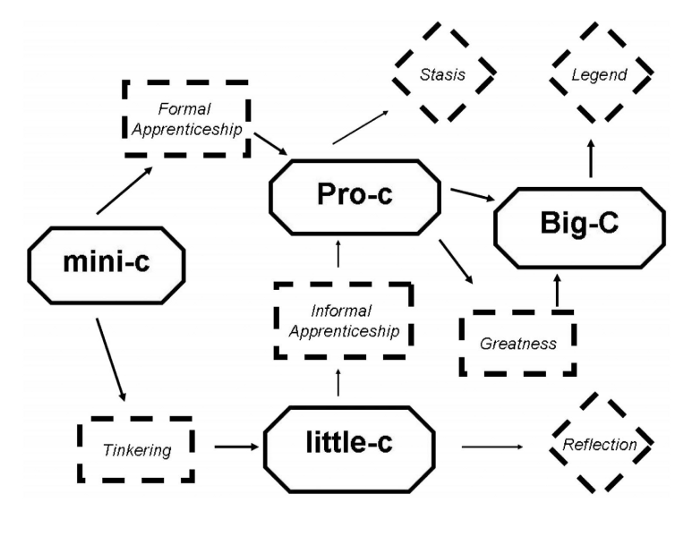
Beghetto and Kaufman defined the Mini-c as the novel and personally meaningful interpretation of experience, actions, and events. Since we have the little-c idea, why do we need a similar concept? Researchers argued there is a gap between creative insights and experiences in the learning context and little-c situation. For example, a child learns how to draw 3D shapes in her art class and uses the skill to create drawings of buildings in new ways. A student discovers that he can use her love of history books to improve her vocabulary on tests. The most important point of Mini-c creativity is that it focuses on the process without outside judgment.
The aim of “Pro-c” is to give credit to “amateur” creators and professional creators who are successful but have not reached a level of prominence as eminent creators achieved. This category is a wide spectrum. On the one hand, most professional workers can be classified as Pro-c. On the other hand, we see many “amateur” creators have the potential to be more creative than some of their “professional” counterparts. We should give these “amateur” creators credit based on their products and not judge them by their main source of income.
The Four C model is not a simple typology of creativity. Instead, Beghetto and Kaufman offered a framework for conceptualizing and classifying various levels of creative expression and pointed to potential paths of creative maturation. The above diagram presents detailed relations between different development levels. Beghetto and Kaufman described a creative landscape of daily life: “As part of this process of enjoying creativity in everyday life, the creator may stumble upon the domain that he or she feels an initial pull of passion. With years of acquired expertise and advanced schooling, the creator may move onto the stage of Pro-c. Although he or she will still have mini-c insights, the creator has now achieved professional-level status and is capable of working on problems, projects, and ideas that affect the field as a whole. The creator may continue to create at the Pro-c level throughout her or his entire life, with specific peaks occurring at different ages based on the domain. After many years have come and gone, the creator may achieve a lasting Big-C contribution to a field or the creator may have passed away, and history will make the final judgment as to whether he or she has entered the pantheon of Big-C or is long-forgotten.”
We can apply the model to discuss the degree of uniqueness of “Knowledge Center” too.
A related issue is the degree of influence of the “Knowledge Center”. However, I consider “Knowledge Center” as a small-scale level. If a “Knowledge Center” establishes a high degree of influence, it becomes a “Knowledge Community”. In other words, the “Knowledge Center” is the seed stage of the “Knowledge Community”.
The Project Engagement Project offers a series of tools for building a collective project. You can find more details here. The Project Engagement Toolkit is based on my 2021 book Project-oriented Activity Theory (draft).
The Project Engagement Toolkit is a project-oriented toolkit for theory-based reflection and study. A significant aspect of the toolkit is it connects the following two theoretical approaches of Activity Theory together and offers a series of tools for practitioners in the age of projectification.
- The Activity System Model (Yrjö Engeström, 1987)
- Activity as Formation of Concept (Andy Blunden, 2010, 2012, 2014)
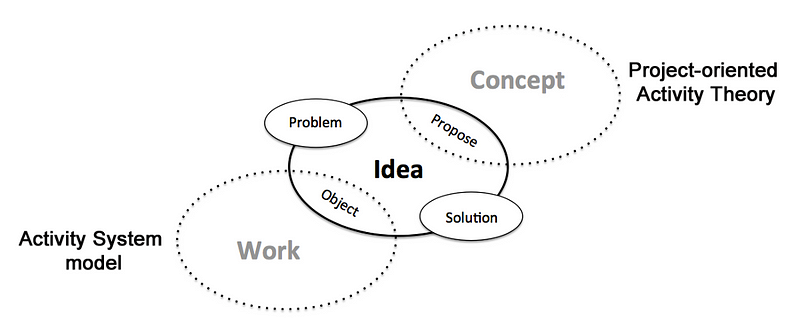
While Engeström’s model is perfect for dealing with traditional work projects, Blunden’s approach considers collaborative projects as the foundation of social movements and cultural innovation.
By curating the above two approaches together, the toolkit offers a cross-boundary solution for achieving a balance between individual impact and collective impact. In this way, the toolkit could lead us to an innovative way of connecting personal life themes and cultural themes in order to build a sustainable society together.
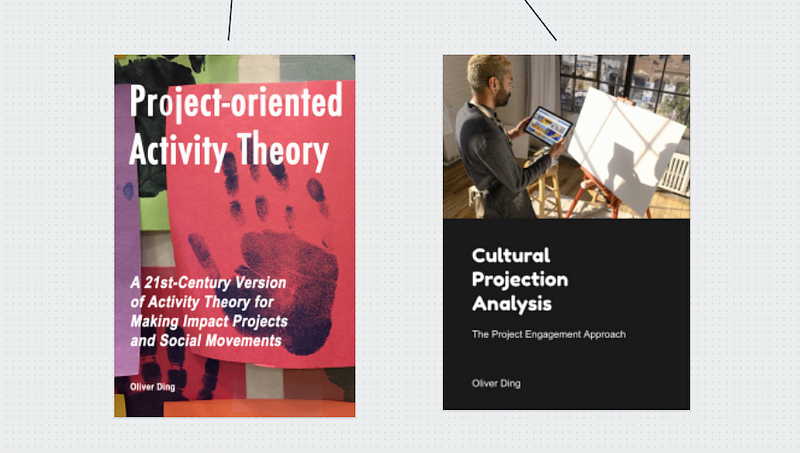
I’d like to recommend two books for phase 2.
- Project-oriented Activity Theory (2021)
- Cultural Projection Analysis (2022)
While Project-oriented Activity Theory (2021) introduces a brand new theoretical approach to human activity, Cultural Projection Analysis (2022) focuses on a particular research method for the Project Engagement approach.
I am working on the Cultural Projection Analysis project.
1.4 The Platform Genidentity of Knowledge Community
Phase 3 is building a Knowledge Community. The difference between Knowledge Center and Knowledge Community is Scope and Scale. A knowledge center may only have less than 15 members while a knowledge community may have thousands of members.
Since Knowledge Community is the larger-scale version of Knowledge Center, we face a challenge:
How can it keep its uniqueness over time?
Kurt Lewin’s concept of Genidentity is perfect to answer this question. Though Genidentity is originally for discussing the difference between various branches of science and their dynamic development, it is about a “typology of identity” from my perspective.
What’s Genidentity? Let’s quote a short piece from Wikipedia:
- As introduced by Kurt Lewin, genidentity is an existential relationship underlying the genesis of an object from one moment to the next.
- What we usually consider to be an object really consists of multiple entities, which are the phases of the object at various times. Two objects are not identical because they have the same properties in common, but because one has developed from the other.
- Lewin introduced the concept in his 1922 Habilitationsschrift Der Begriff der Genese in Physik, Biologie und Entwicklungsgeschichte. It is today perhaps the only surviving evidence of Lewin’s influence on the philosophy of science. However, this concept never became an object of widespread discussion and debate on its own terms. Rather, it was extracted from its context by philosophers such as Rudolf Carnap, Hans Hermes, Hans Reichenbach, Adolph Grünbaum, and Bas van Fraassen who incorporated this concept into their own theories such as the topology of the universe or the axiomatization of mechanics.
- Lewin’s idea was to compare and contrast the concept of genidentity in various branches of science, thereby laying bare the characteristic structure of each and making their classification possible in the first place.
In 2017, I adopted the concept of “Genidentity” to discuss “the Life of Artifacts” in a private file named Activity as Container which is an early version of the Ecological Practice approach.
In 2019, I worked on the early version of Platform Ecology. I applied the concept of Genidentity to study digital platform design and development. Then I coined a new concept: Platform Genidentity.
I also developed an operational definition for the concept of Genidentity: A thing’s Genidentity is defined by Essential Differences with Situated Dynamics. In this way, we turn a philosophical concept into a practical concept for empirical research.
What’s the relationship between Platform Genidentity and Knowledge Center? I roughly thought that each Knowledge Center requires uniqueness and Platform Genidentity is about the uniqueness too. While Knowledge Center is more about spatial structures, Platform Genidentity is more about temporal dynamics.
What’s Platform Genidentity? I use two concepts to define it:
- Platform Core: a basic unit of a platform. For example, a Tweet, a YouTube video page, a Q&A page on Quora, etc.
- Platform-ba: a platform-based sociocultural field. For example, YouTube-ba is a YouTube-based sociocultural space. You can find more details here.
As mentioned above, we have an operational definition of the concept of Genidentity: A thing’s Genidentity is defined by Essential Differences with Situated Dynamics.
For Platform Ecology, we need to discover the sources of Essential Differences and Situated Dynamics. I think the sources are Platform Core and Platform-ba. However, they don’t work as a one-to-one mapping relationship. I want to claim the following model:
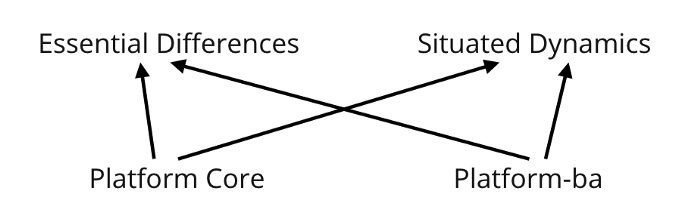
While the Platform-for-Development framework adopts the individual adult development perspective to discuss the “Platform — People” relationship, the Platform Genidentity framework adopts the platform owners’ perspective to discuss the “Platform — People” relationship.
The Platform-for-Development framework is a supportive approach for theory-based reflection and practice-based reflection. It has the following sub-frameworks:
- The Ecological Approach to Adult Development
- The Supportive Cycle
- The Developmental Project Model
- The Structure of the Developmental Platform
- The Platform-ba Model
- The Supportance Framework
- The Concept-fit Framework
You can find more details about the book and the framework here.
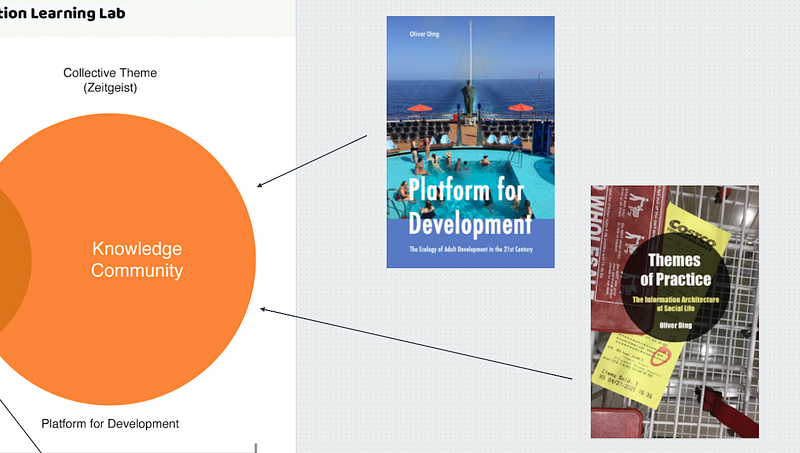
Again, I’d like to recommend two books for phase 3.
- Platform for Development: The Ecology of Adult Development in the 21st Century (2021)
- Themes of Practice: The Information Architecture of Social Life (2021)
The concept of “Knowledge Community” points to two themes: the “Knowledge” theme and the “Community” theme.
From the perspective of adult development, a knowledge community is a developmental platform for knowledge workers. Thus, we can apply the Platform-for-Development framework for building a knowledge community. It encourages the owners of a knowledge community to focus on offering valuable supportances for knowledge workers.
From the perspective of cultural development, a knowledge community is a connected hub of “Themes of Practice”. In 2019, I developed the idea “Themes of Practice” in order to discuss the “meaning” of the meaningful whole for my book Curativity: The Ecological Approach to Curatorial Practice. I realized the notion of “Theme” is a great tool for curating experiences and actions.
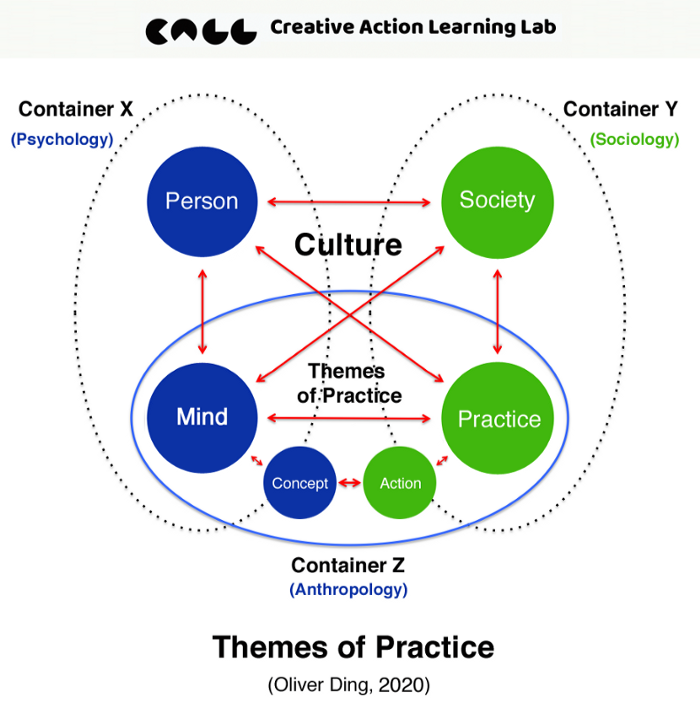
Anthropologist Morris Opler (1945) developed a theoretical “theme” for studying culture. Career counseling therapists and psychologists also developed a theoretical concept called “life theme.” If we put culture themes and life themes together, we see a “great debate” of social science: “individual — collective.” The above diagram visualizes the “concept network” or “idea ecology” of “Themes of Practice”.
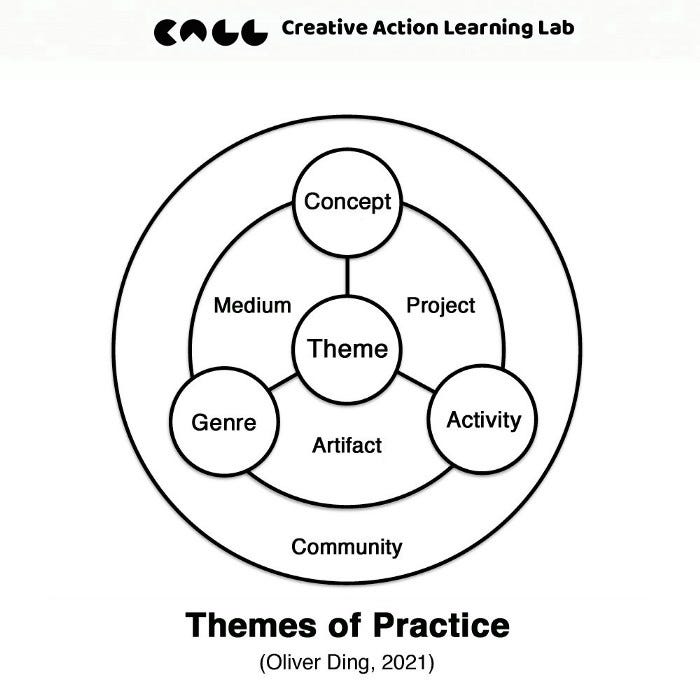
In 2021, I developed the Themes of Practice framework. See the above diagram. In fact, the above diagram was developed for discussing Career Themes. Based on the framework, I made the Career Themes Canvas, see the following example.
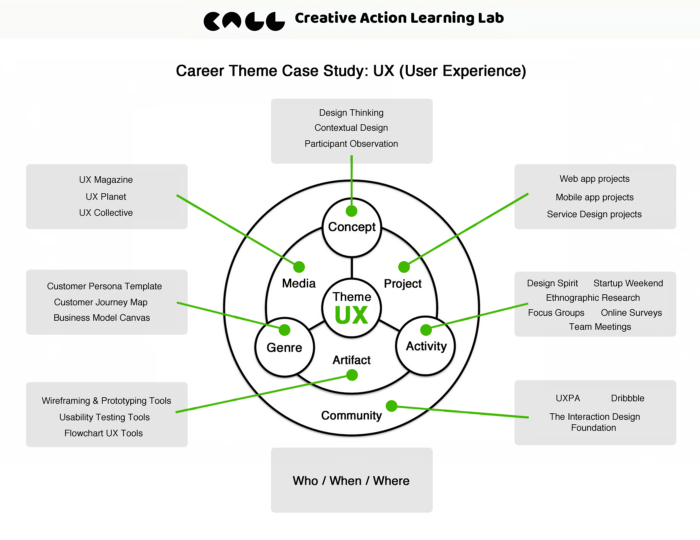
UX (User Experience) is not a job title, but a concept. UX designer and UX researcher are two related job titles. As a concept, UX (User Experience) can be seen as a career theme for UX designers and UX researchers. However, job titles are not the primary factor in discussing career themes. The concept of Career Themes pays attention to real-world practice. It’s reasonable to claim that UX is shared by Product Designers, Usability Testing Experts, Human Factor Researchers, Brand Managers, and Community managers as a career theme.
You can find more details here.
Part 2: The Path of Creative Life
Finally, I’d like to return to Maurizio Goetz’s question:
How do you make sense of an emergent topic or emergent field?
The above question can be understood as the “Exploitation — Emergence — Exploration” triad. Moreover, we can use the following diagram to build a model.
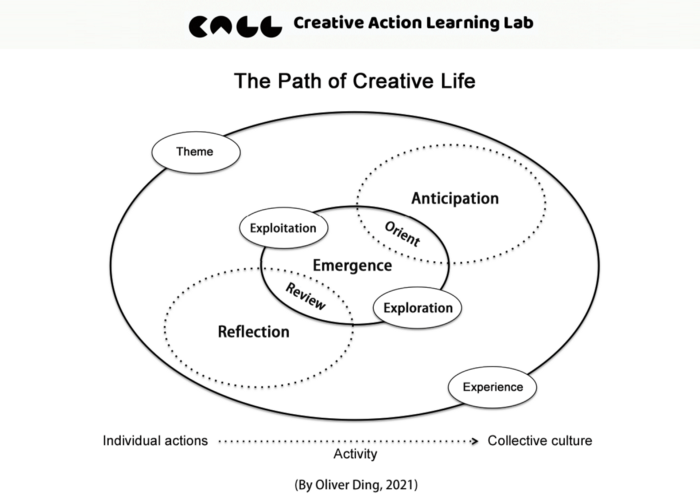
The core of the above diagram highlights three concepts:
- Exploitation
- Emergence
- Exploration
The pair of concepts of “Exploitation — Exploration” is inspired by James March. Though James March’s original paper is about organizational learning, I think it is very useful for the present discussion. According to James March, “It is clear that a strategy of exploitation without exploration is a route to obsolescence. It is equally clear that a strategy of exploration without exploitation is a route to elimination. But it is not clear where the optimum lies between those two extremes. The problem is partly one ignorance about the distribution of costs and benefits, but it is only partly that. A deeper problem is that specifying the optimum requires comparing costs and returns across time and space. An exploitation/exploration balance that is good in the short run is likely not to be good in the long run. And a balance that is good for the individual actor is likely not to be good in the long run for the community of actors. Thus, although we cannot specify the optimum balance, we know that that optimum depends on the time and space perspective taken. More specifically, the longer the time horizon and the broader the space horizon, in general, the more the optimum moves toward exploration.” (Explorations in Organizations, 2008, p.109)
There is no theory for finding the optimum balance. It all depends on the real practical situations. I also adopt the concept of Emergence for the present room. I was inspired by Henry Mintzberg’s ideas on strategic planning.
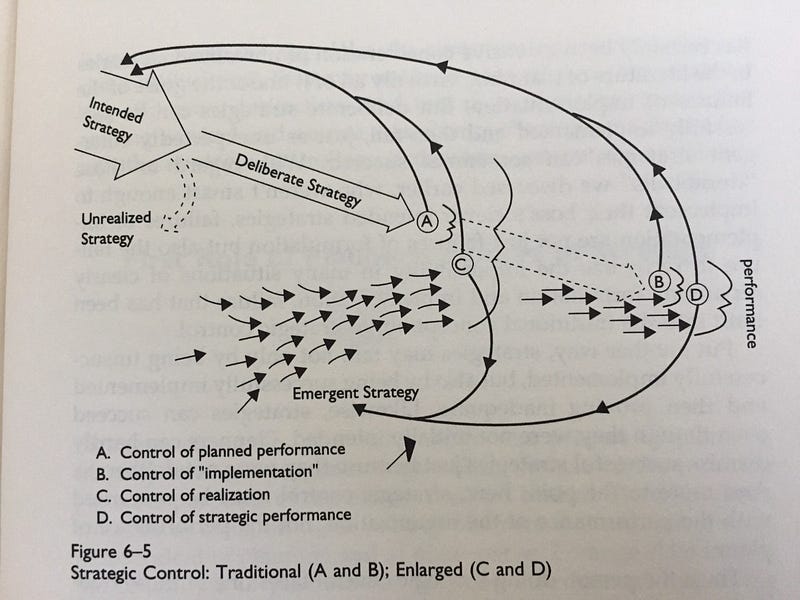
According to Henry Mintzberg, “…we believe, is that the concept of strategy formation has always been misconstrued, forcing strategic control to bypass one critical aspect — the possibility of emergent strategy. As shown in Figure 6–5, there is certainly the need to assess the performance of deliberate strategies (shown as B on the figure), and, stepping back (A), the need to assess the degree of realization of the strategies that were formally intended in the first place (in the words of Schended and Hofer’s book on strategic management, “whether (1) the strategy is being implemented as planned; and (2) the results produced by the strategy are those intended” [1979:18]). But before these must come another activity ( C ), namely the assessment of whatever strategies were, in fact, realized, whether intended or not. And the last activity must be enlarged (D) to encompass the assessment of the performance of all those strategies. In other words, strategic control must assess behavior as well as performance. Once again it must be appreciated that there is more to strategy formation than planning.”(1994, p.359)
By adopting the concept of Emergence, we can make a good balance between Exploitation and Exploration.
How to use the Path of Creative Life model? It can be applied to three different units of analysis:
- Individual: What’s my next primary theme?
- Team: What’s our next primary project?
- Culture: What’s the next primary platform?
These three units of analysis echo the above three phases:
- Phase 1: Thematic space -> Individual / Theme
- Phase 2: Knowledge center -> Team / Project
- Phase 3: Knowledge community -> Culture / Platform
By connecting the Building Knowledge Enterprise Activity model and the Path of Creative Life model together, we can offer knowledge workers a solution for intellectual career development.
Part 3: Canvases for Knowledge Canvas
In the past several months, I developed several canvases for knowledge creators.
3.1 The Creative Work Canvas
On Oct 22, 2021, I designed the following canvas for knowledge creators.
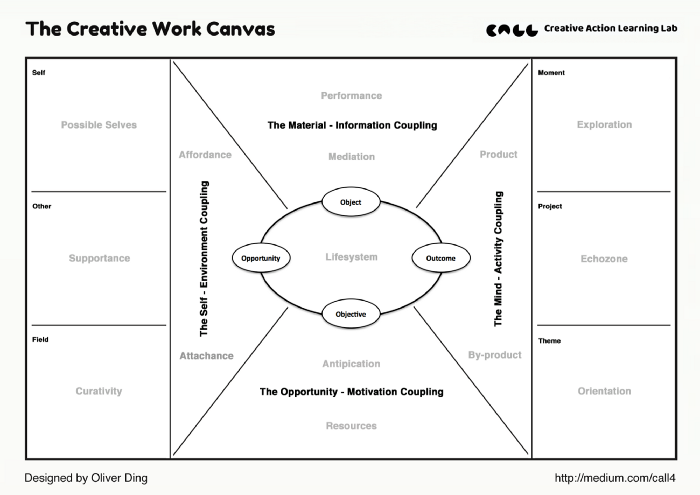
You can find more details here.
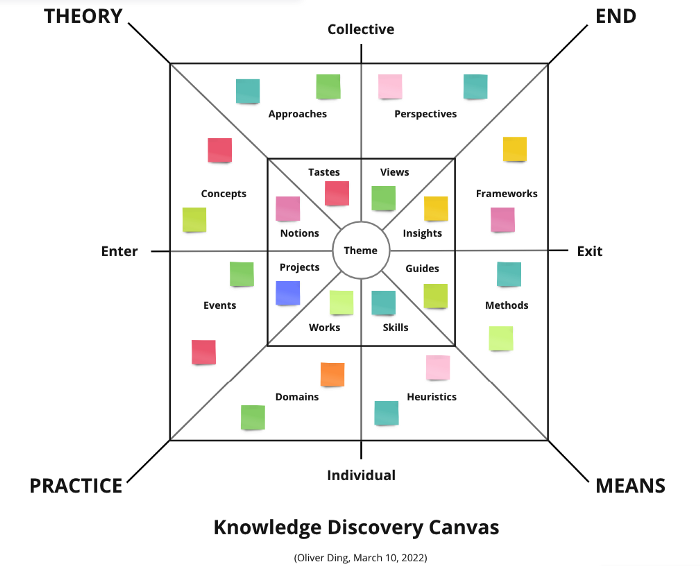
3.2 The Knowledge Discovery Canvas
On Jan 5, 2022, I developed Thematic Space Canvas. Later, I renamed it Knowledge Discovery Canvas.
3.3 The Life Discovery Canvas
On Feb 26, 2022, I developed Life Discovery Canvas for the Life Discovery Project.
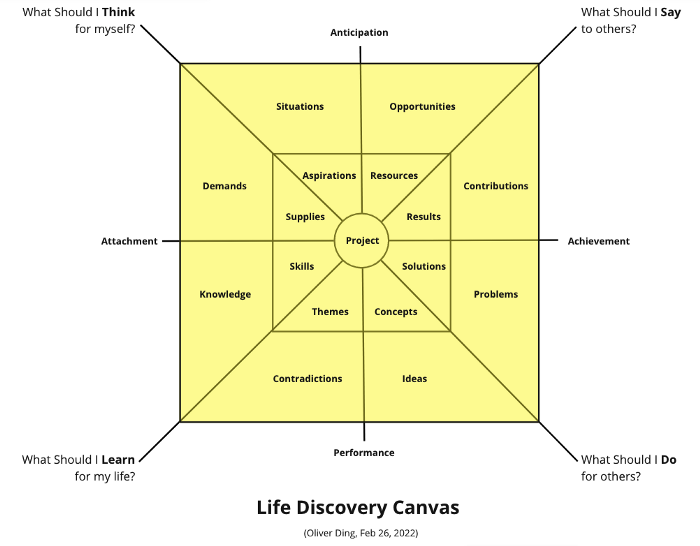
The canvas was based on the Project-centered Approach and the Life Discovery Toolkit. You can find more details here.
3.4 The Thematic Space Canvas Family
On March 11, 2022, I decided to use the term “Thematic Space Canvas” to name a meta-canvas and use “Knowledge Discovery Canvas” to rename the original Thematic Space Canvas.
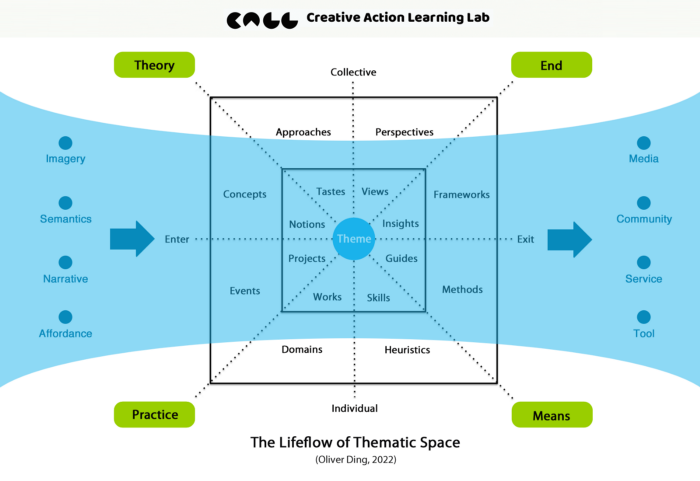
The following six canvases are members of the Thematic Space Canvas Family.
- The Thematic Space Canvas
- The Spark Space Canvas
- The Statue Space Canvas
- The Life Discovery Canvas
- The Optimal Context Canvas
- The Lifesystem Development Canvas
As the primary canvas of the Slow Cognition project, the Thematic Space Canvas also defines the spatial structure of the other five canvases.
Related Articles
- CALL: Annual Review (2020–2021)
- Personal Innovation as Career-fit
- D as Diagramming: Challenge as Opportunity
- D as Diagramming: From Sandwich to Containers
- Possible Practices: Attach, Detach, and Opportunities
- D as Diagramming: Strategy as Anticipatory Activity System
- Life-to-be-Owned: The Achievement Chain
- D as Diagramming: The Creative Work Canvas
I am also working on building a new website for the Platform Ecology project. You can save the following links:
- PlatformEcology.org
- Twitter: @PlatformEcology
- Linkedin: @PlatformEcology
You are most welcome to connect via the following social platforms:
Linkedin: https://www.linkedin.com/in/oliverding Twitter: https://twitter.com/oliverding Polywork: https://www.polywork.com/oliverding Boardle: https://www.boardle.io/users/oliver-ding


