
Explaining ADHD to Kids
A kid-friendly explanation of some of the most common ADHD symptoms
What do I tell my child?
A lot of parents wonder if they should even tell their child about their diagnosis, especially if they are quite young. While each family will have to make their own decision based on what they think is best for their child, my short answer is: yes.
A lot of parents ask if they should even tell their child about their diagnosis. My short answer is: yes.
Once you’ve had an opportunity to process the information yourself, and are confident in your knowledge about their diagnosis, tell your child. Chances are they already feel different and don’t understand why. This could help put things into perspective for them.
Many children blame themselves for being different, especially if they have been getting into trouble at school, at home, or in social situations. It’s important for neurodiverse children to understand they are not less than anyone else.
It is not their fault they’ve been struggling, they were simply born with a brain that works differently from many others — In fact, sometimes this will be a strength, as a unique brain can bring gifts as well as difficulties.
The good news is now that we know more about our differences, we can develop strategies which allow our strengths to shine through.
Remember to explain to your child that our differences come with both challenges and gifts; there will be both pros and cons to having a differently wired brain.
It is not their fault they’ve been struggling, they were born with a brain that works differently from others.
If you’re not sure how to explain the diagnosis to your child, seek the assistance of a professional. The clinician who performed your child’s assessment may be able to help you with finding developmentally-appropriate ways to discuss their findings with your child and can also provide further resources.
Here I’ll outline some of the most common symptoms or traits, and how they might manifest in children. Keeping in mind that every person with ADHD will experience their symptoms differently, and there are different presentations of ADHD.
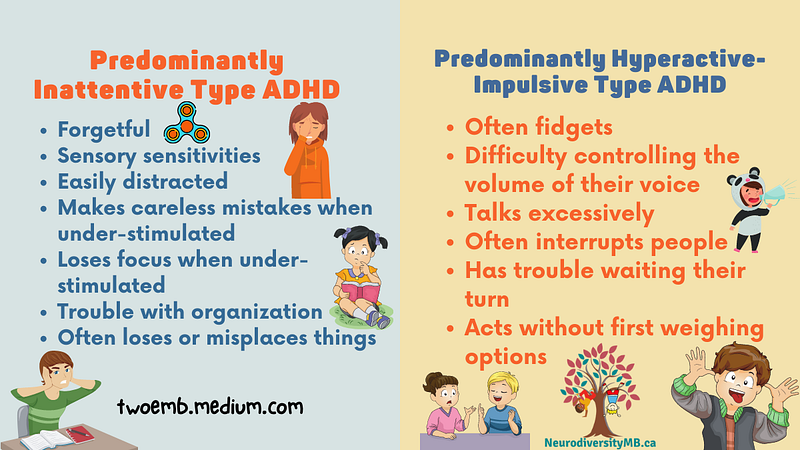
Kids with ADHD may struggle with a number of the following:
- Organization, planning, and time management
- Focus and distractibility
- Hyperactivity (I like to refer to it as passion and energy)
- Impatience
- Impulsivity
- Emotional regulation
Organization & Planning
People with ADHD may struggle with executive functions, particularly those involving organization, planning, prioritizing, and time awareness or time management.
How this might feel for a child with ADHD:
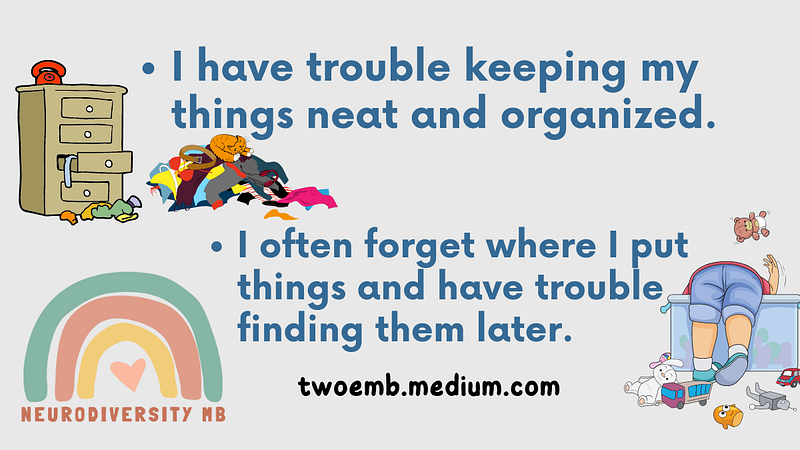
- I lose track of time easily and have trouble guessing how much time it will take me to do something.
- Sometimes I think something will be a lot harder than it really is, and I avoid it for as long as possible. Then when I finally do it, I realize it wasn’t so tough after all!
- Other times I think I can get something done quickly, but then it turns out it takes a lot longer than I expected, and I end up being late or making people wait for me when I didn’t mean to.
- I have trouble planning things out, especially if it’s a big task with a lot of steps. I may need help breaking them down into manageable parts.
- Sometimes I have trouble figuring out which task is most important to tackle first.
- I find prioritizing difficult, and prefer to do the fun stuff first.
Distractibility
It’s a common stereotype that people with ADHD are highly distractible and unfocused.
Certainly this may be the case for some people, but more often we’re not having difficulty paying attention — we’re just having difficulty attending to the thing on which we’re “supposed” to be focusing.
It’s more a matter of regulating our attention rather than not having an attention span. When a neurodivergent person is truly interested in something, they can hyperfocus, really zeroing in on the subject or task, sometimes concentrating for very long hours.
How distractibility might feel for a child with ADHD:
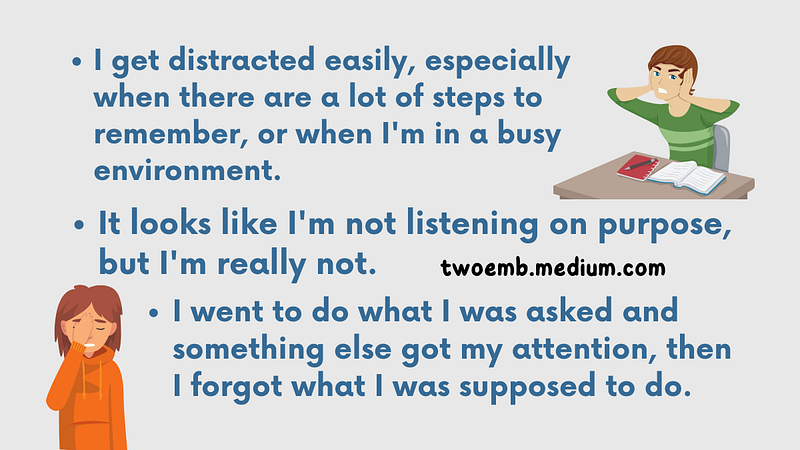
- I get distracted easily, especially when there are a lot of steps to remember, or when I’m in a busy environment.
- I looks like I’m not listening on purpose, but I’m really trying.
- I went to do what I was asked and something else got my attention, then I forgot what I was supposed to do.
The upsides
- People who are distractible may also be extremely observant
- We tend to notice patterns and other things that many people miss
- The ability to hyperfocus on things about which we are truly passionate
Passion & Energy
Another stereotype of kids with ADHD is that they’re always bouncing off the walls, totally hyperactive. Certainly, a lot of people experience symptoms of restlessness, hyperactivity, and difficulty sitting still — however, hyperactivity can look very different in different people.
Some people’s hyperactive is internalized, manifesting more as racing thoughts, even an overwhelming number of thoughts or ideas at once. Others are fidgety, but not running around or climbing all over the place.
Children with ADHD are not all the same, everyone’s behaviour and experiences will be different.
How passion and energy might feel for a child with ADHD:
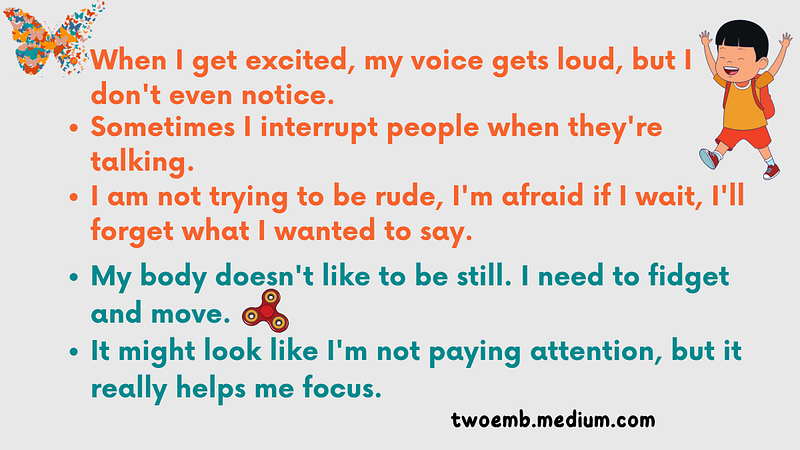
- When I get excited, my voice gets loud, but I don’t even notice.
- Sometimes I interrupt people when they’re talking. I am not trying to be rude, I’m afraid if I wait, I’ll forget what I wanted to say.
- My body doesn’t like to be still. I need to fidget and move. It might look like I’m not paying attention, but it really helps me focus.
Something I’ve noticed
In my personal and professional experience, I’ve also noticed that hyperactivity tends to increase when children are stressed, anxious, or — paradoxically — when overtired.
Impatience
Okay, this one certainly describes both myself and my son. We are definitely not patient people!
This may have something to do with the fact that ADHD brains process dopamine less efficiently than non-ADHD brains (you can click here to learn more about this if you’re interested).
How this might feel for a child with ADHD:
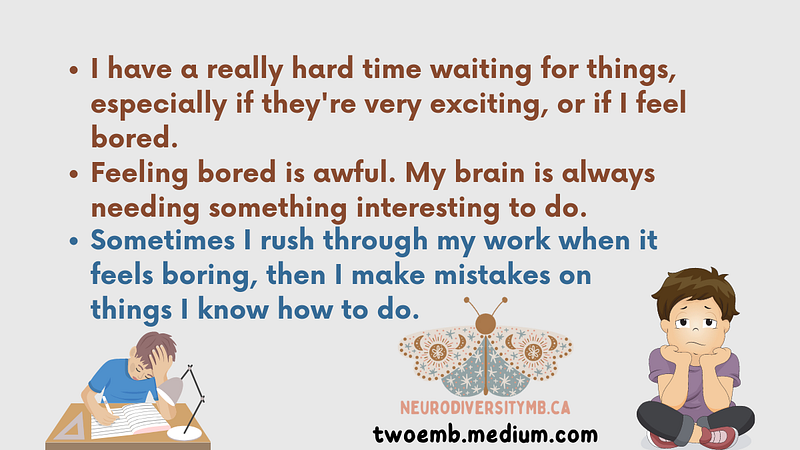
- I have a really hard time waiting for things, especially if they’re very exciting, or if I feel bored.
- Feeling bored is awful. My brain is always needing something interesting to do.
- Sometimes I rush through my work when it feels boring, then I make mistakes on things I know how to do.
Impulsivity
Similar to impatience, impulsivity is a key feature of ADHD, especially for those who are of the predominantly hyperactive-impulsive type. Also similar to hyperactivity, some people’s impulsivity is behavioural, and some is internal.
For example, some adults exhibit impulsive decision-making and are at higher risk for addictions such as shopping, gambling, and alcohol or drug abuse.
Others have impulsive thoughts and emotions, where they may internally jump to conclusions or have intense and sudden emotional reactions to things without slowing down to evaluate and consider the facts.
In fact, people with ADHD — including children — often have negative attribution bias, wherein they are more likely to assume a person had negative intentions when their motives are ambiguous. This can lead to other challenges, such as justice sensitivity and rejection sensitivity.
The most common conceptualization of impulsivity is the behavioural type: where people “act out” in silly or even aggressive ways and often find themselves in trouble as a result.
How this might feel for a child with ADHD:
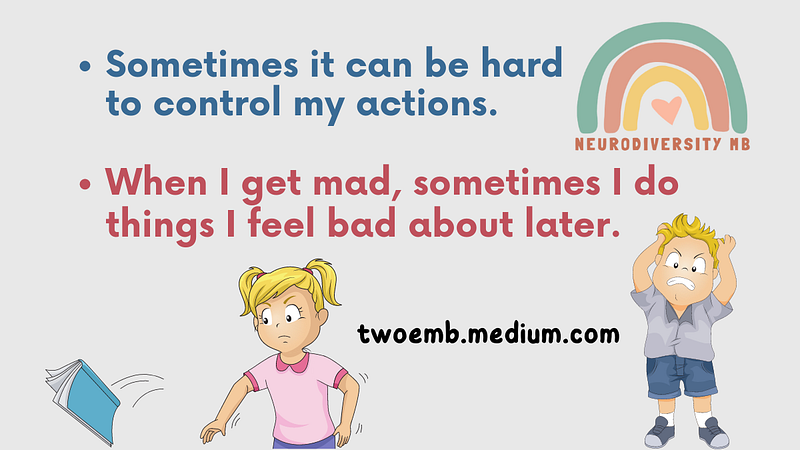
- Sometimes it can be hard to control my actions.
- When I get mad, sometimes I do things I feel bad about later.
- Sometimes I do silly things and think they’ll be funny, but they end up making others mad or upset.
Emotional intensity
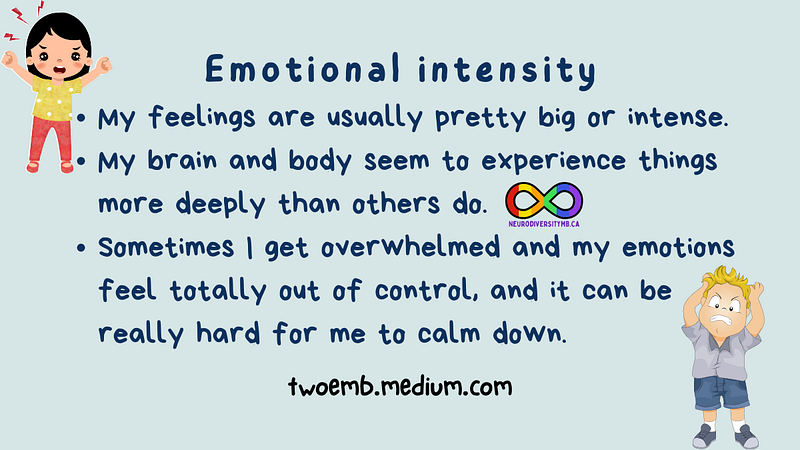
- My feelings are usually pretty big, sometimes they’re huge.
- My brain and body seem to experience things more deeply than others do.
- Sometimes I get overwhelmed and my emotions feel totally out of control, and it can be really hard for me to calm down.
- I need help learning how to identify when I’m starting to get upset, because I don’t always notice until I’m already really, really upset.
- Then I need help finding ways to calm myself down. Sometimes I need an adult to help me work through my big feelings.
Key take-aways
A very important benefit of better understanding how the ADHD brain works, and how it impacts children’s lives, is developing greater empathy and compassion toward behaviours that can be very frustrating at times.
“Compassion in parenting means being able to see your child where they are: with empathy and patience in the context of their cognitive, social, emotional, and physical development.” — Dr. Sharon Saline
Our children try so hard, but many kids with ADHD are constantly being put-down, criticized, or corrected. They are frequently told they are “too loud”, “too impatient”, or “too hyper”.
If people thought about the impact of those words before saying them, my hope is they would reconsider. Many of us have been hearing these messages repeatedly throughout our lives, which takes a significant toll on our self-concept and self-esteem.
Rather than putting children down, we need to build them up by helping them discover their strengths, and teaching them skills where they are lacking.
We also need to have fair and reasonable expectations of each child for their individual level of development, not for what is commonly expected of all children of the same age.
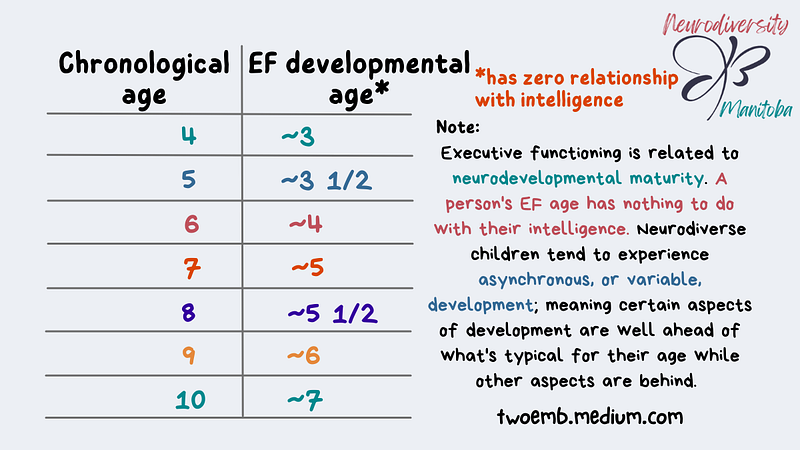
Regardless of ADHD or any other diagnosis, children do not develop at the exact same rate. Our brains continue maturing well into our late twenties (between 25–30 years of age), and the rate of change and maturation will be different for each person.
That said, there are identified challenges specific to ADHD. Our job as parents, and those who care for children, is to educate ourselves so as to better support and guide kids in a way that accentuates their strengths.
© Jillian Enright, Neurodiversity MB
Related Articles
Small self-promotion
If you’re here because you’re newly diagnosed or identified (whether self-identified or formally diagnosed) and want to learn more about Autism and ADHD, I hosted a webinar covering ADHD and Autism Essentials, which is now available for purchase and download on my website.

When you join medium, as a member you’ll have access to unlimited reads for only $5 per month. If you use my referral link, I’ll earn a small commission, and you’ll earn my undying gratitude.
If you’d prefer give a one-time tip, you can support my writing on Ko-Fi — also, it’s free to follow me on Facebook!
Learn more
References
Arain, M., Haque, M., Johal, L., Mathur, P., Nel, W., Rais, A., Sandhu, R., & Sharma, S. (2013). Maturation of the adolescent brain. Neuropsychiatric disease and treatment, 9, 449–461. https://doi.org/10.2147/NDT.S39776
Bondü, R., & Esser, G. (2015). Justice and rejection sensitivity in children and adolescents with ADHD symptoms. European Child & Adolescent Psychiatry 24, 185–198. https://doi.org/10.1007/s00787-014-0560-9
Saline, S. (2018). What Your ADHD Child Wishes You Knew: Working together to empower kids for success in school and life. TarcherPerigee.