
Difference between Mono and Flux in Spring WebFlux?
Understanding difference between Mono and Flux to write better reactive code in Spring WebFlux

Hello folks, if you are preparing for Java, Spring and Spring Boot interview then you know that how important are the questions like difference between X and Y.
This is the type of questions I have seen most of the times during interviews and preparing them not only give you edge over other candidates on interviews but also improve your understanding of underlying concepts.
In past few articles we have seen:
- difference between @Bean and @Compoenent
- difference between @RequestParam and @PathVariable,
- difference between @
Contorller - and @Controller vs @Service @Repository and in this article, we will see the difference between Mon and Flux in Spring.
If you don’t know, Spring WebFlux is a reactive web framework for building non-blocking, event-driven web applications. It provides two main types of reactive streams, Mono and Flux, which are used to represent a single value and a stream of values respectively.
While both Mono and Flux are used for processing asynchronous data, they have different characteristics and are suited for different use cases and that’s what you will learn in this article.
Now that we know the basics, its time to deep dive into Mon and Flux and see how they are used as well as learn key differences between Mono and Flux in Spring WebFlux and when to use each of them.
By the way, if you are new to Spring Framework and want to learn Spring in depth and looking for resources then you can also checkout following online courses:
- Spring Master Class — Beginner to Expert
- Spring & Hibernate for Beginners
- Learn Spring: The Certification Class
- Master Microservices with Spring Boot and Spring Cloud
All of these are top rated courses to learn Spring framework in depth but if you need free resources you can also checkout these free Spring framework courses:
What is Mono? How to use it? Example
In Spring WebFlux, Mono is a reactive type that represents zero or one value. It’s often used in scenarios where you want to return a single object, such as when retrieving data from a database or making an HTTP request.
Mono is also a key component of reactive programming in Spring, which allows applications to handle more requests with fewer resources.
Here is an example of creating a Mono object in Spring WebFlux:
Mono<String> mono = Mono.just("Hello World");In this example, we are creating a Mono object that contains a String with the value “Hello World”. The Mono.just() method is used to create the Mono object, which takes a single value as its argument.
This Mono object can be returned as the result of an HTTP request or used in other reactive programming scenarios.
It’s worth noting that Mono is non-blocking, which means that it allows other requests to be processed while waiting for the result.
This is in contrast to traditional blocking code, which waits for a response before moving on to the next task. Reactive programming with Mono is an effective way to create efficient and responsive applications.
Now that you know what is Mono, how many values it can return and when to use it, its time to see what is Flux, its twin brother in Spring web flux.

What is Flux? How to use it? Example
Flux is also a reactive streams library in Spring WebFlux that helps to handle asynchronous data streams in a non-blocking manner.
It is designed to handle zero to N elements and emits data asynchronously as soon as it becomes available.
Flux uses the Reactive Streams specification, which is a standard for building reactive applications. The Reactive Streams specification is based on four interfaces: Publisher, Subscriber, Subscription, and Processor.
Flux is an implementation of the Publisher interface and can be subscribed to by a Subscriber.
Here is a code example that shows how to create a Flux object in Spring:
Flux<String> flux = Flux.just("apple", "banana", "orange");

flux.subscribe(System.out::println);
In the above example, we have created a Flux that emits three elements: “apple”, “banana”, and “orange”. We have then subscribed to the Flux using the subscribe() method and passed in a lambda expression that prints each element to the console.
Flux can also be created from other sources such as Iterable, Array, or other reactive streams libraries. It provides various operators to transform, filter, and combine data streams.
By using Flux, you can write reactive code that can handle large amounts of data and perform operations on them in a non-blocking way.
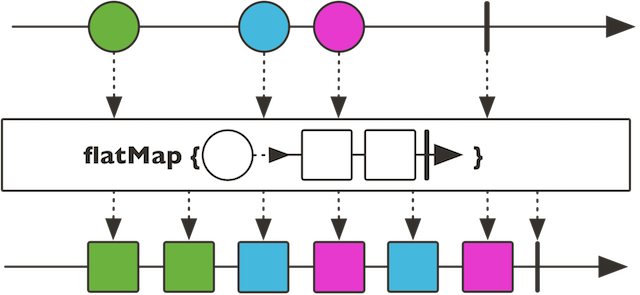
Now that we know what is Mono and Flux, its time to check out the difference between these two for interview purpose. You can also transform or convert Mono to Flux as shown below:
What is difference between Mono and Flux in WebFlux?
The main difference between Mono and Flux in Spring WebFlux is the number of elements that they can emit. A Mono is a reactive type that can emit at most one element, whereas a Flux can emit multiple elements.
In other words, a Mono represents a stream of zero or one element, whereas a Flux represents a stream of zero to many elements.
This difference is reflected in their respective APIs, where the Mono has methods like map, filter, and flatMap, similar to the traditional Optional class in Java, whereas the Flux has methods like concat, merge, and zip, which are used to combine multiple streams.
To understand the difference, consider a scenario where an API call is made to retrieve a user’s account balance from a bank. In this case, the balance will be a single value that can be returned in a Mono.
On the other hand, if we want to retrieve a list of recent transactions for the account, there can be multiple values, and a Flux is better suited for this scenario.
Here is another example of a Mono and a Flux:
// Mono example
Mono.just("Hello, world!")
    .subscribe(System.out::println);

// Flux example
Flux.just(1, 2, 3, 4, 5)
    .map(i -> i * i)
    .filter(i -> i % 2 == 0)
    .subscribe(System.out::println);
You can see that Mono returns a single values and Flux can return multiple values, that’s they main difference between them.
Java and Spring Interview Preparation Material
Before any Java and Spring Developer interview, I always use to read the below resources
Grokking the Java Interview: click here
I have personally bought these books to speed up my preparation.
You can get your sample copy here, check the content of it and go for it
Grokking the Java Interview [Free Sample Copy]: click here

If you want to prepare for the Spring Boot interview you follow this consolidated eBook, it also contains microservice questions from spring boot interviews.
Grokking the Spring Boot Interview
You can get your copy here — Grokking the Spring Boot Interview

Conclusion
That’s all about difference between Mono and Flux in Spring WebFlux framework. The use of Mono and Flux provides Java developers with a powerful and flexible way to handle asynchronous data streams.
While both Mono and Flux can be used for reactive programming, they have different use cases and behaviors.
As we have seen, Mono is used when you want to work with a single value, while Flux is used when you want to work with a potentially unbounded stream of values.
Mono is designed for simple use cases that require only a single value, such as retrieving data from a database or making a network call. Flux, on the other hand, is designed for complex use cases that involve streams of data, such as real-time data processing or event-driven systems.
Understanding the differences between Mono and Flux is important when building reactive applications with Spring WebFlux.
By selecting the appropriate type for your use case, you can ensure that your application is efficient, scalable, and responsive and also bug free.
By the way, if you are new to Spring Framework and want to learn Spring in depth and looking for resources then you can also checkout following online courses:
- Spring Master Class — Beginner to Expert
- Spring & Hibernate for Beginners
- Learn Spring: The Certification Class
- Master Microservices with Spring Boot and Spring Cloud
All of these are top rated courses to learn Spring framework in depth but if you need free resources you can also checkout these free Spring framework courses:
And, if you are preparing for Java and Spring interview then In my earlier articles, I have also shared 21 Software Design Pattern questions, 10 Microservice Scenario based questions, 20 SQL queries from Interviews, 50 Microservices questions, 60 Tree Data Structure Questions, 15 System Design Questions, and 35 Core Java Questions and 21 Lambda and Stream questions which you can use for your Java interview preparation.
There are a lots of frequently asked questions for Java developers in those articles.
And, if you are not a Medium member yet then you can join Medium here
Other Java and Spring Interview articles you may like to read:


