
Caravaggio, Bad-Boy of Baroque
Mad, bad and dangerous to know! Long before the Romantics made it fashionable, Caravaggio templated the tear-away artist.
In the first of Michelangelo Merisi da Caravaggio’s religious paintings, Stigmatisation of Saint Francis, the forms of Saint Francis and an angel are picked out from the darkness by a strong light from the upper left. Saint Francis has just received the wounds of Christ known as the ‘stigmata’, after his vision of Jesus crucified, and is being comforted. However, the wounds of Christ have not yet manifested on his body…
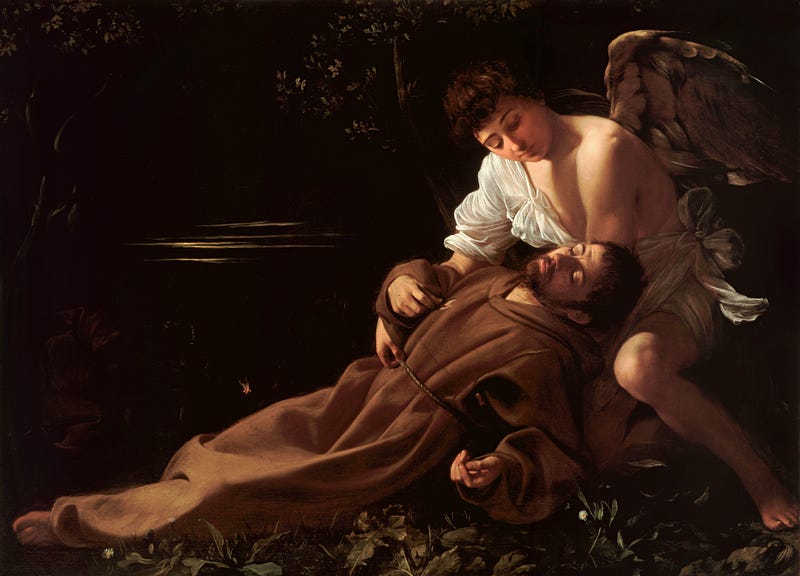
(c.1595) by Caravaggio [view license]If you look carefully at the dark half of the painting, you will see another, barely discernible figure. This is Brother Leo, a fellow monk, who witnessed the fateful moment. He describes a spectacular event as a fiercely glowing seraph with fiery wings and the face of Jesus appeared from a swirling starry portal in the sky and fired beams of light into the Saint’s hands, feet and heart. There was fire and fountains of blood, cries of anguish and joy, before Francis collapsed in a pool of his own blood…
The scene that Caravaggio gives us is undeniably dramatic, though a lot less explicit than the events described. He has chosen not to show the stigmata and the angel is portrayed as a very humanoid being. Caravaggio was not one to shy away from dramatising his subjects, so perhaps the choice to avoid depicting the miraculous happening and instead show us the ambiguous and more contemplative aftermath is an intellectual choice. He is placing the emphasis upon faith rather than proof.
Half of the composition is cast in darkness though dapples of sunlight penetrate the trees of a thick forest to reveal a path. This is symbolic of being shown ‘the way’, either by the ‘Light of God’ or the light of reason. Your choice of symbolism here depended on whether you were still entrenched in the Roman Catholic religious dictum, or if you were in the process of taking up the ‘rediscovered’ Humanist views.
The idea of light making sense of the world, & making formal elements apparent within a composition, are important features of Baroque art and this is carried further by the artists of the approaching Enlightenment period, the use of light in the works of Rembrandt and Vermeer, for example.
Caravaggio was the ‘bad boy’ of the late Italian Renaissance and more-or-less defines the Baroque style that followed. Baroque paintings were characteristically dramatic and composed from contrasts of dark shadow and light, the interaction of the two revealing form through the use of a technique known as chiaroscuro.
His art, though technically brilliant, was generally too bold and shocking for the tastes of the time and he seems to have deliberately antagonised figures of authority by the subjects he chose to portray and also, famously, for basing a painting of the Virgin Mary upon a portrait of a favourite whore.
In his day, Caravaggio was more famous for being a tear-away, brawler and eventually a murderer, having dealt a deathblow to an opponent during one of his many sword fights. He had already been in prison a few times and had always been gotten out by rich patrons. For this killing, apparently over the disputed result of a tennis match, he received a death sentence and had to make a quick getaway…
Consequently, for much of his important career, Caravaggio was on the run, either from the law or powerful personal enemies. This meant that he travelled far and wide, spreading his influence and techniques as he went.
When compared with the work of his contemporaries, his paintings seem very modern and the people he paints also conform to a much more modern aesthetic. Often, they appear idealised in their unblemished youth and beauty and have been a source of inspiration to many of today’s Fantasy artists. He also exerted an immediate and obvious influence on other painters in the Tenebrist style of the early Baroque, perhaps most notably in the works of Artemisia Gentileschi.
Like many of Caravaggio’s later works, the obviously posed arrangement of his 1608 painting of the Decapitation of John the Baptist creates the stage-like atmosphere of a tableau. Again, the stark single light source also helps evoke this theatrical effect.
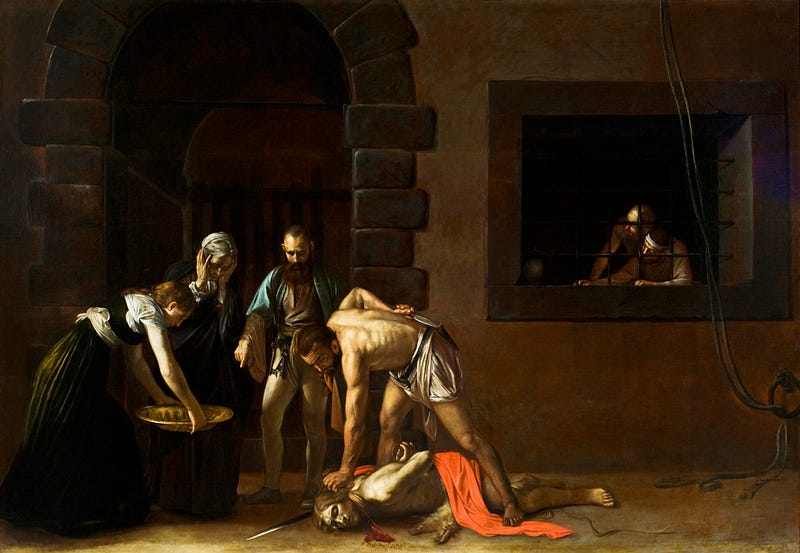
The executioner stands over the body in a way that nicely shows off his muscle groups, the maid presents the basket and the bearded man points to it, as if to say, “The head goes in there…” The older woman clutches her own head in an expression of horror, lending a little empathy to the situation.
The whole picture has a Classical feel and a Romanesque look to it and, as well as being Baroque, would fall into the category of Neoclassicism. Although the figures are well-observed, proportionally correct and naturalistic in many respects, their artificial postures also foreshadow a later style known as Mannerism which became fashionable in the Late Renaissance period.
The main group of figures is arranged to the left of the compostition leaving the right area fairly blank except for the two men who watch through a barred window. This is a link to, and a metaphor for, the viewers. We are simply onlookers like them, and are also ‘barred’ from any direct interaction, or potential intervention.
John the Baptist is laying dead on the floor, the swathe of the red cape suggestive of much blood, whereas the modest blood spatter at his throat forms Caravaggio’s signature ‘Michel Ang’, making this the only known work he proudly put his name to.
This article has been adapted from a version first published in my book Evolution of Western Art (questing beast books, 2012)


.jpg)
