
Marvels in Marble
Gian Lorenzo Bernini is among the greatest sculptors of the Baroque with a talent for storytelling in stone…
From childhood, Gian Lorenzo Bernini was trained by his sculptor father Pietro who, in 1606, accepted a prestigious Papal commission to provide marble relief statuary for the Cappella Paolina, Santa Maria Maggiore. The large Bernini family then moved to Rome where Gian Lorenzo’s ‘precocious talent’ was noticed by Scipione Borghese, the influential Cardinal and art aficionado who would become the artist’s patron.
To begin with, Gian Lorenzo collaborated on commissions with Pietro as a formidably talented duo, though it was the son who began to innovate their style by introducing such theatrical narrative. He didn’t want to merely represent stock characters but instead tell their stories by selecting the climatic moments of interactions when psychological states were in extremis. By the time he reached his mid-twenties Gian Lorenzo Bernini had a reputation as the spiritual successor to Michelangelo and his first ‘solo’ triumph is believed to be Apollo and Daphne, which he completed in 1625 for Borghese.
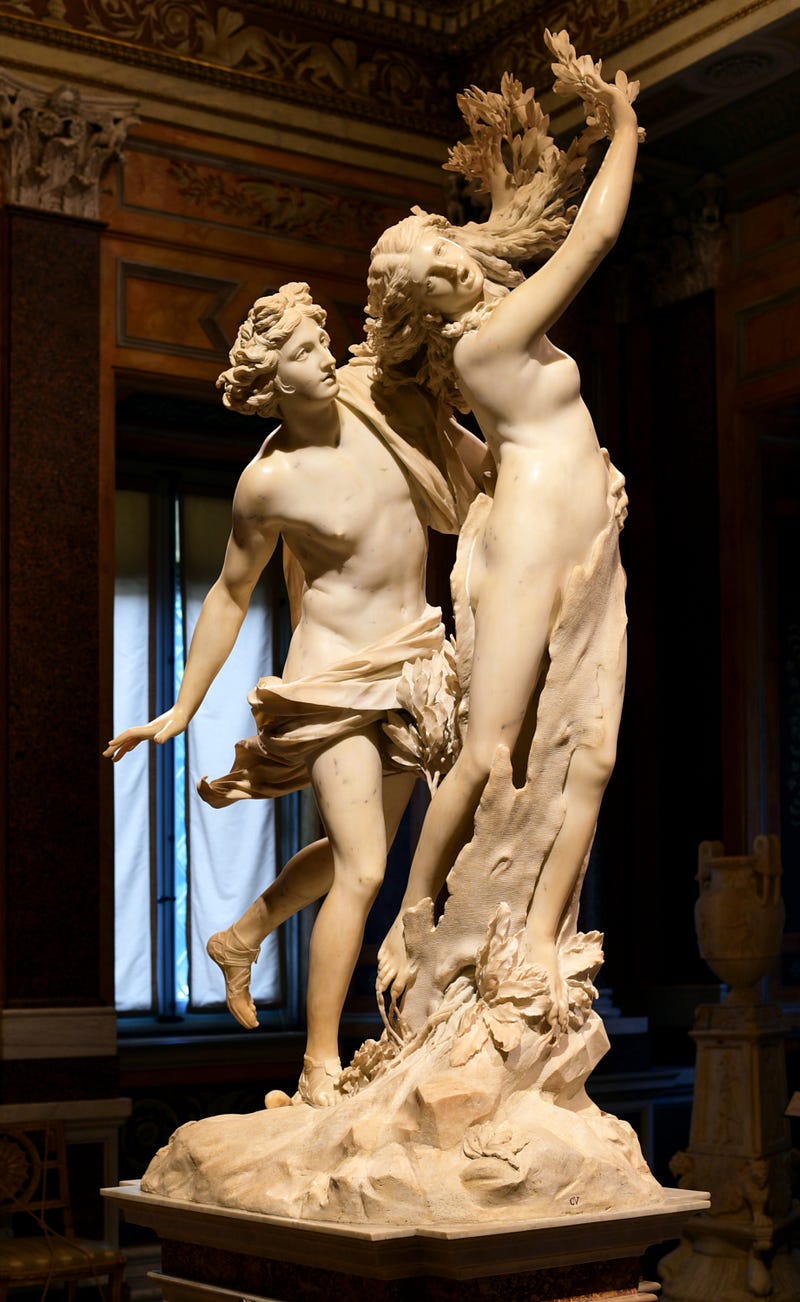
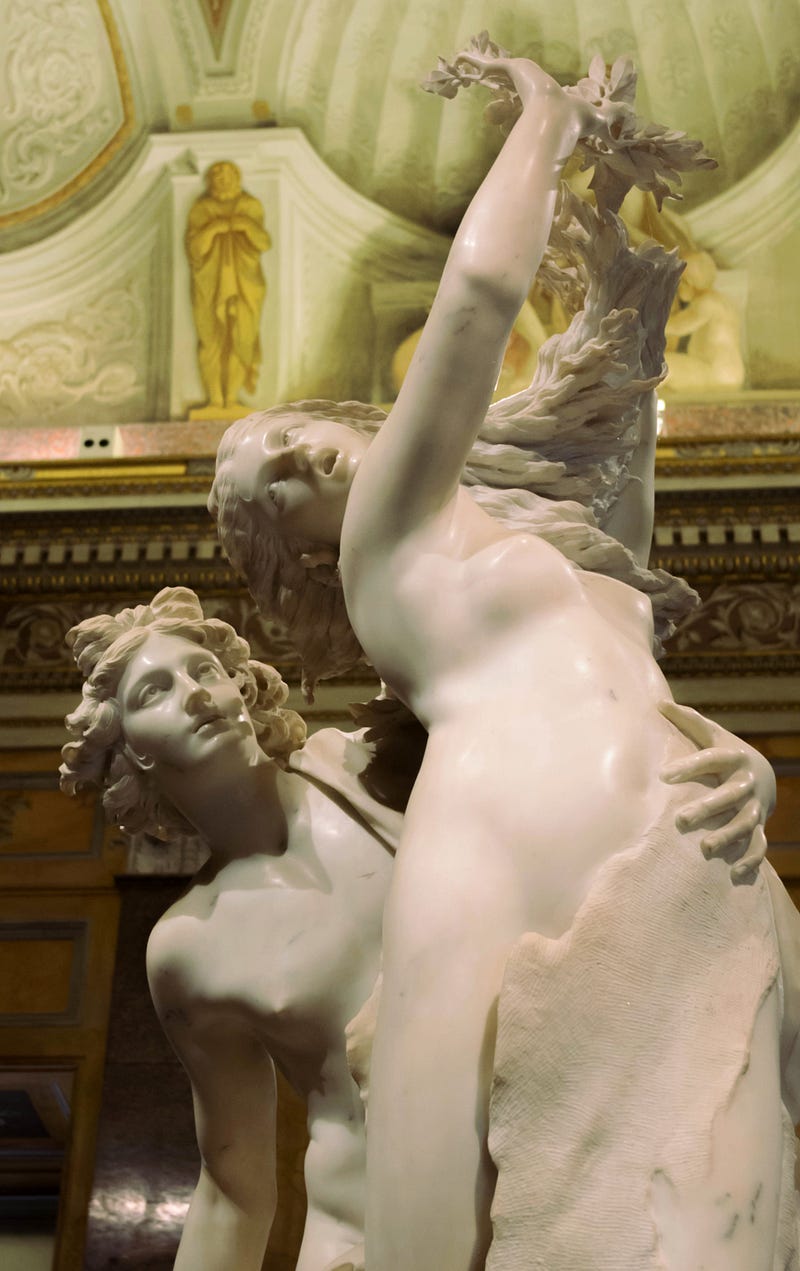
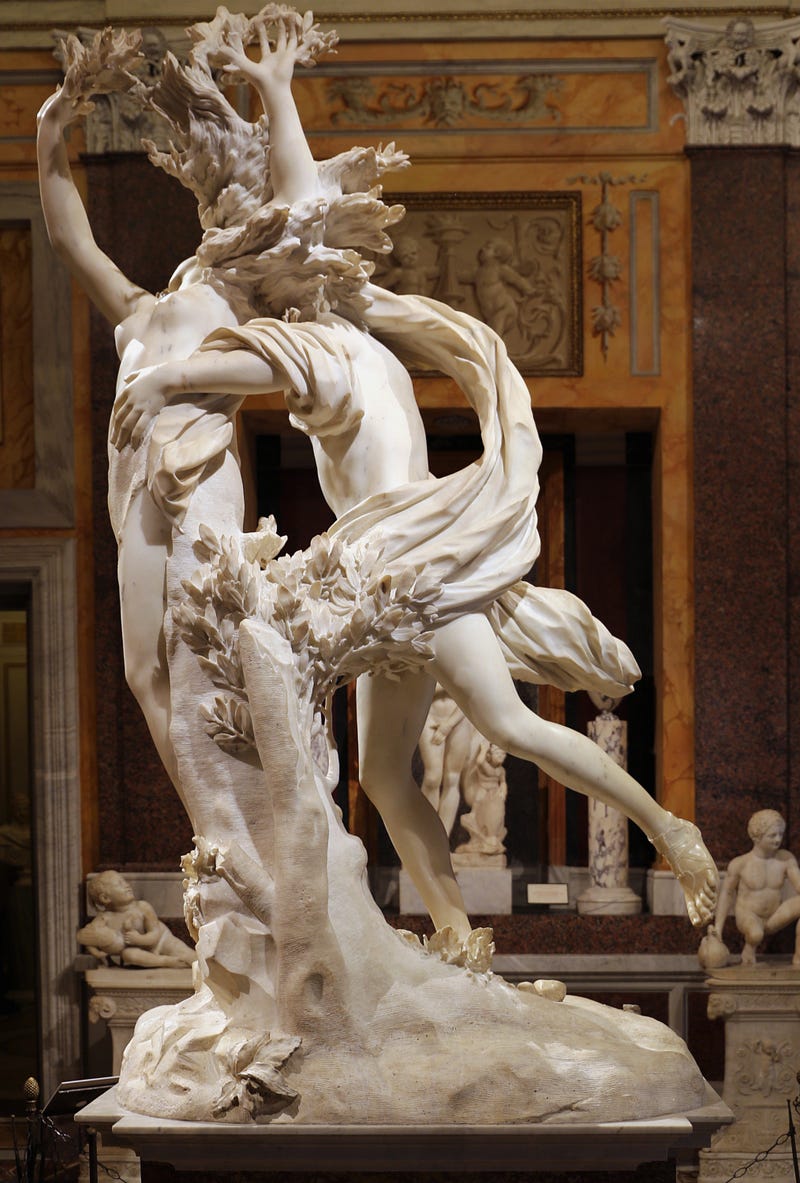
A moment of movement and transition captured in a dynamic statue of white Carrara marble that seems to be swirling, rustling and lifting into space as Daphne metamorphoses into a tree in order to escape the clutches of lustful Apollo. The diagonal rhythm of the limbs create a strong up-thrust and the swirl of Apollo’s tunic as it falls away implies dynamic motion that continues with Daphne’s hair billowing upward.
The moment is one described in the classical poem, Metamorphoses, by Ovid. In his retelling of the Greek myth, Apollo, the sun god, mocks Eros, the god of passion, for his inferior skills in archery. As revenge, Eros lets loose two of his magic arrows. One strikes young Apollo at the moment he sets eyes on the beautiful river nymph, Daphne. Alas, the arrow fired at Daphne was a specially prepared one that instilled a deep aversion to any lustful thoughts.
After a long pursuit and nearing exhaustion, the nymph prays to her father, Peneus the river god, to rescue her from her fate. Although he approved of the match, he relents and transforms her into a tree. Her toes root into the earth, her hair becoming green foliage, and her arms extending upward into spreading branches, leaves sprouting from her fingertips.
Yet Apollo is still besotted and loves her as a tree. He blesses her as the sacred Laurel and vows that the seasons shall not age her and she will always remain as beautiful. So the laurel was made evergreen. He promises to always wear a garland of her leaves as his crown, and to give her voice by making lyres of laurel wood. In some interpretations, this symbolises the possessing of nature by mankind, or the triumph of the masculine in dominating the feminine. Others see it as a rekindling of love for nature that had been threatened by physical, or material, avarice. In some versions of the tale, the tree nods her consent to this eternally chaste relationship, satisfied that ‘improper conduct’ is no longer an option.
Though commissioned by a cleric, the subject is clearly not a biblical one being a direct translation of a Pagan Greek myth. Whilst the bulk of his sculptural oeuvre was portrait busts of Cardinals and nobles, it was works like this that established Bernini as the foremost sculptor of the Baroque period. His work was admired both for its dynamic drama and for the fleshy naturalistic rendering of the idealised human form.
The term ‘baroque’ was adapted from a term meaning an irregular pearl — something that remains beautiful, but is not strictly formal in its geometry. Bernini’s large statues exemplify this as they are beautifully balanced, yet at the same informal, asymmetric, and naturalistic. Though working with hard, unmoving substances, Bernini manages to capture movement and the suppleness of flesh through acute observation and innovative composition.
Bernini also painted in oil and mastered several other media as a sought-after architect and early ‘urban planner’ for Rome. By the time he completed Apollo and Daphne, Maffeo Barberini aka Pope Urban VIII had commissioned him to design a new ciborium, or altar canopy, for the place of Saint Peter’s Tomb within Saint Peter’s Basilica, in the heart of Vatican City — the holiest job any European architect of the day could’ve hoped for!
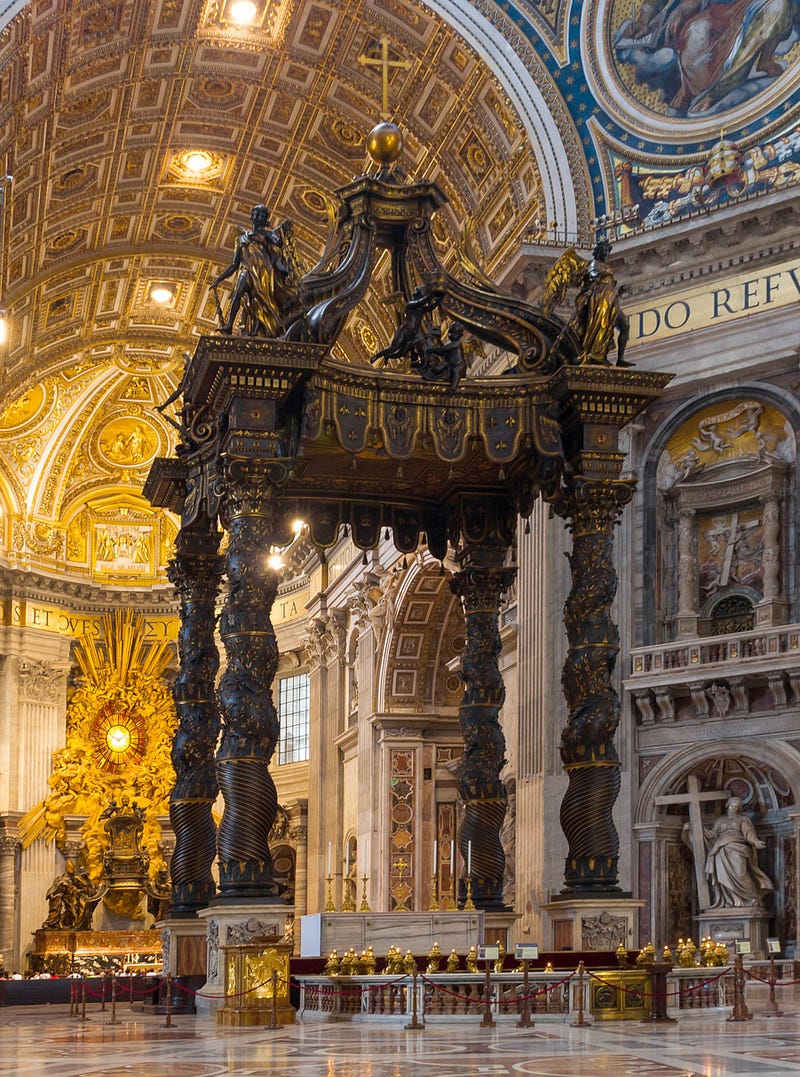
Bernini’s Baldacchino of Saint Peter’s Basilica, took more than a decade from initial concept to completion in 1634. The huge bronze canopy, supported by four massive Solomonic columns, stands over the high altar at the crossing directly below the great dome. A figure of an archangel is positioned at each of the four corners, some ninety feet above the altar. Ironically, the bronze used to cast the structure was, at least in-part, ‘recycled’ from classical Roman statuary and architectural detailing ‘acquired’ from ancient sites.
With this ambitious piece in gilded bronze, Bernini re-establishes the link between statues and architecture. Although cast in a vast scale, the top of the capital is only about half as high as the ceiling above it and, as the angels mediate between heaven and earth, so the structure acts as a mediator of the scale between the basilica and the worshippers within.
The commission to design this piece would’ve been one of the most prestigious there was at the time and indicates that Bernini was highly regarded by church officials and the Barberini family patrons who helped with the finance. Shortly after its completion, he went through a scandalous affair with Costanza Bonucelli, the wife of one of his workshop assistants. She was, in turn unfaithful to him by having an affair with one of his younger brothers. In a rage, he gave orders for her to be mutilated. Though he did not attack her himself, his servant carried out the order and slashed the woman’s face.
Because of his close association with the Papal family, Bernini was granted absolution of any crime on the condition he pay more attention to the pursuit of his faith, settle down, and get married. I suppose at a time of inquisitions, conspiracies, and cover-ups, this was nothing extraordinary. (Pope Urban VIII was presiding when Galileo Galilei was brought before the Roman Inquisition in 1633.) It seems by all accounts Bernini’s subsequent marriage to Caterina Tezio, arranged by the Pope, was a happy and stable one. He soon found himself with a large family to support but was never short of work from then on, and his opus was yet to come…
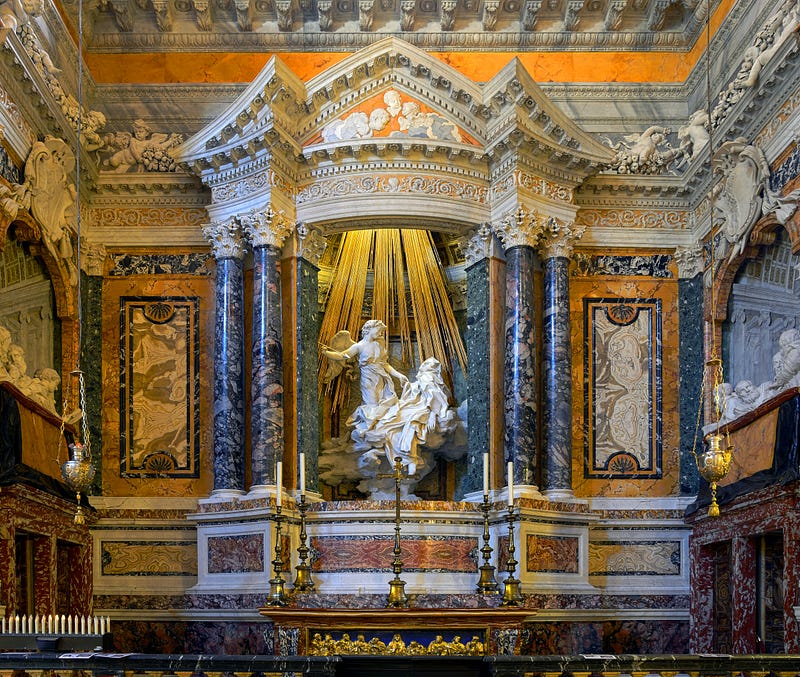
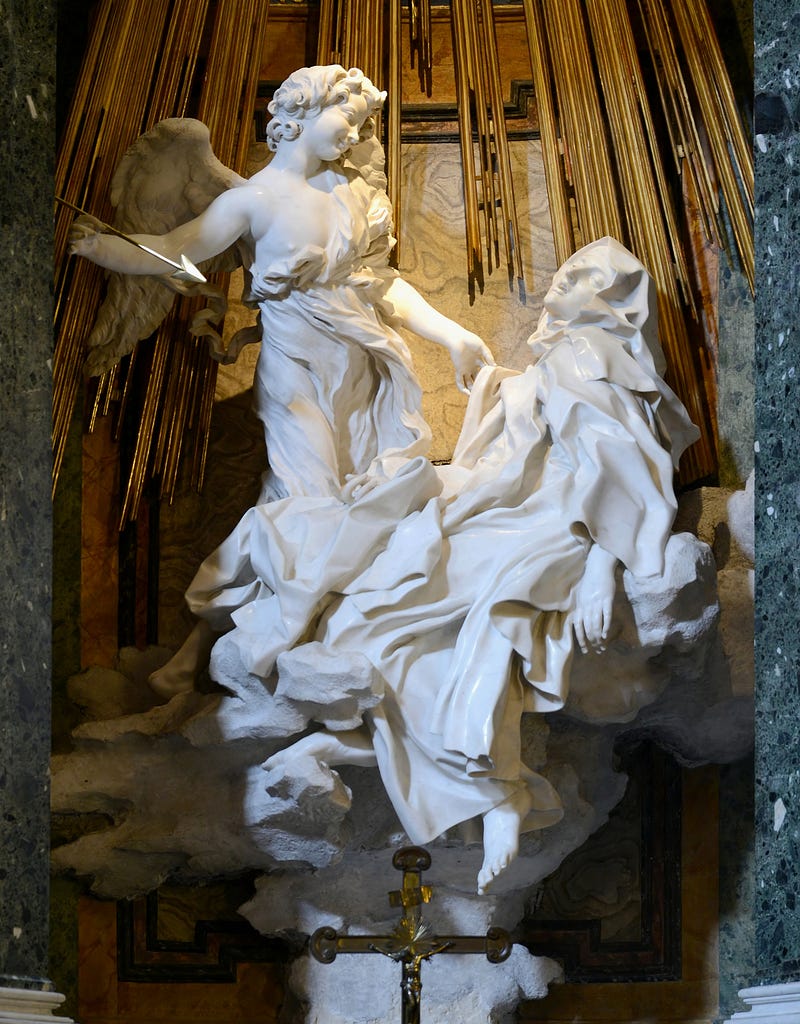
The Ecstasy of Saint Theresa, completed by Bernini in 1652, is generally cited as one of the greatest works in marble that challenges the dominance of earlier Renaissance masterworks. This statue, bearing strong visual parallels with Michelangelo’s Pietà, is the centrepiece of the Cornaro Chapel of the church of Santa Maria della Vittoria, Rome, and its size and form are partly dictated by its harmonious relationship with the surrounding architecture, also designed by Bernini.
He cleverly concealed a skylight in the domed recess housing the statue, so that the pure white marble seems to glow with its own supernatural fluorescence in the subdued light of the chapel. Illumination separating figures from darkness is a defining formal element of the Baroque and whereas Caravaggio established himself as the definitive painter of the style, Bernini redefines it for the three dimensional medium of sculpture.
It portrays the Carmelite Nun in the throes of religious ecstasy as she experiences one of her famous visions of an angel visiting upon her the spirit of God. Her descriptions of these visions talk of intense feelings that are at once both agonising and delicious, akin to being pinioned by a flame-tipped golden spear that leaves no bodily scar. Bernini has chosen to portray her in a swoon as the spear is withdrawn. Her body is in motion as she falls back, the stone folds of her robes swirl and ripple, her naked foot falls below the hem and her hand and face are expressing a joyous loss of self that many commentators have paralleled with sexual climax.
Like his earlier Apollo and Daphne, Bernini shows a woman in transition. Although carved from hard marble, the flesh and fabric appear flexible. The whole composition seems to lift from the rougher rocks at the base, representing the earthly realm. The body of Theresa is almost entirely concealed with her gowns, her physical being almost lost in the billowing folds. It is only the well-observed details of face, hand and foot that indicate her position and proportion.
Deliberately similar symbolism can be seen in The Kiss by Gustav Klimt, two and half centuries later and may also have influenced Aubrey Beardsley’s graphic approach to illustration.


.jpg)


