
Autism “Levels” Are Still Functioning Labels
Both are inaccurate and useless at best, harmful at worst
External and internalized ableism
The Autistic community has explained (and explained some more) how and why functioning labels are unhelpful, inaccurate, and often harmful.
Many just ignore us, but those who do listen seem to understand the words, but not the concept. Instead of using labels like “high functioning” and “low functioning”, we moved on to phrases like support needs and autism levels.
They’re the same damn thing.
Why are we so insistent on differentiating ourselves (or our children) from others who share our neurotype?
Let’s be honest with ourselves here: it’s ableism, plain and simple.
My son was was originally diagnosed with ADHD in 2019, and a few months later, I was given the same diagnosis. Since then, others have suggested he and I might be Autistic as well.
I’ve been researching autism and ADHD as special interests for the past five years and I’ve come to the same conclusion.
If you go back in my writing, you’ll find that many of my early articles refer to my son as twice exceptional, which is accurate: he is gifted as well as Autistic and ADHD.
Regardless of the term’s accuracy, why did I feel the need to frequently bring up his gifted intellect, even when it wasn’t immediately relevant to the story I was telling?
In hindsight, I can honestly confess there was an element of ableism involved. It was my way of saying, “he’s neurodivergent — but smart, don’t forget smart!”
As if other neurodivergent folks who haven’t had the privilege of an IQ test — the privilege an assessment done with a psychologist who really got them and provided appropriate accommodations — as if they aren’t just as brilliant, but perhaps without a piece of paper with a number on it to “prove” it?
Red herring, anyone?
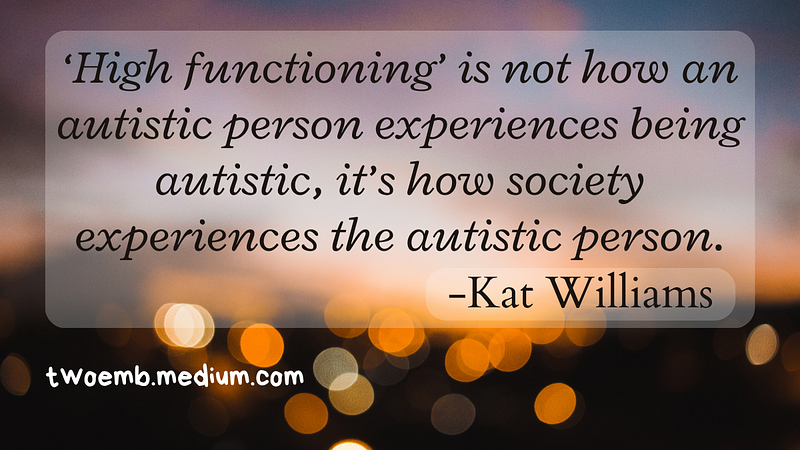
There are a few different schools of thought on this. I’ve read people are concerned about placing Autistics like me, who can “pass” as neurotypical when needed (or are taken more seriously because we may write, speak, or communicate well) in the same category as Autistics who need a lot more support in their day-to-day living.
The argument suggests including us under the same autism umbrella might minimize the level and intensity of support some people need because other Autistics don’t require the same types of accommodations or help.
On the other hand, considering people like me “level 1”, “high functioning”, “low support needs”, or whatever euphemism-du-jour is floating around, undermines and minimizes the supports I might need at times.
It also puts the spotlight on the wrong problem (as usual): the Autistics. We’re the problem because people can’t put us into neat little boxes or diagnostic categories.
We’re the problem, not the fact that Autistics (along with many other disabled and marginalized groups) can’t access the supports we need, and aren’t given the same opportunities as the majority population.
Yes, let us argue amongst ourselves about who gets which label, while the institutions which continue to oppress us continue doing so unfettered and unaccountable.
I’m sure they won’t mind.
Take me, for example
I have a license and drive a car. I am a parent. I run my own business. I am University educated.
People call this “high functioning”, but I call it privileged. I have white privilege and all that comes with it. I had the privilege of attending University. I had the privilege of accessing adequate supports and accommodations which allowed me to graduate with honours.
I have the good fortune to be married to a supportive spouse. I have the privilege of being able to communicate well through written and spoken words.
Many brilliant Autistics are minimally or non-speaking and have been ignored, dismissed, and misunderstood for much of their lives, simply because they didn’t have an effective way to communicate with those around them. Many have since gone on to write incredible memoirs, poetry, and articles, or have created beautiful works of art.
This potential always existed, yet non-speaking Autistics were considered low-functioning and thus it was assumed they did not have these capabilities. We pigeonholed them into their corresponding category, refusing to consider they might have more to share with the world, if only people made the effort to find alternative modes of communication.
There have been times in my life where I was also “low-functioning”. About 12–13 years ago, I went through what I now understand to be severe Autistic burnout.
I had seizures and complex medical issues due to undiagnosed Celiac disease, so I couldn’t drive and had to take a leave from my University program. My son wasn’t born yet, so I was not yet a parent. I had to go on disability because I was too sick to work. I became severely depressed and lethargic.
If it hadn’t been for my husband, I don’t know what might have happened. I could hardly care for myself, and some might say I truly couldn’t at that time in my life.
Based on our society’s view of success and functioning, I did not check any of the requisite boxes.
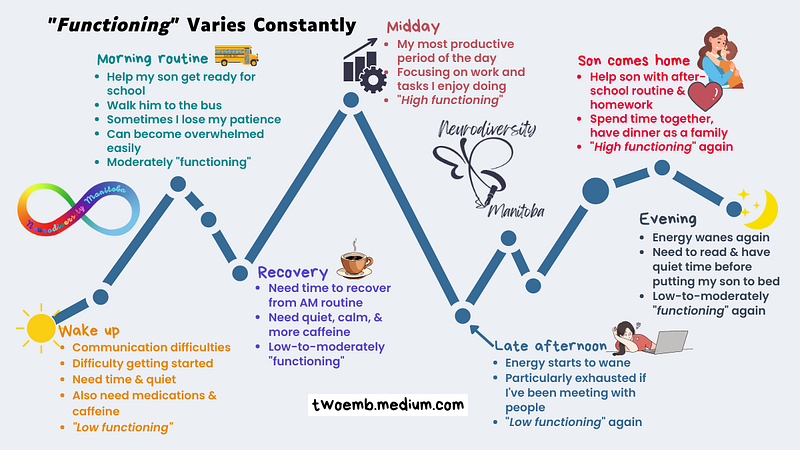
I fully understand that a severe illness which is eventually diagnosed and treated is not the same as a life-long disabling condition. My point is, I was “high support needs” at that time, and there have been plenty of times over the past decade where my functioning levels have fluctuated significantly.
Our outward appearances of success and functioning change constantly, depending on our circumstances, the level of support and understanding we receive, and the variations in our mental and physical health.
In the mean time
While we wait for the professional and popular communities to catch up with our reality, we’ll have to sort this out for ourselves (as usual).
Rather than focusing on levels and labels, why not get specific? Instead of saying I have low support needs, why can’t I just express those support needs whenever the situation calls for it? That would be a lot more helpful than a blanket overgeneralization anyway.
My particular sensitivities are being in busy or crowded environments, I’m socially anxious and awkward, I experience sensory overload easily, and I require clear and direct communication.
I am very forgetful, and I hate being interrupted when I’m focused on a task because I struggle with set-switching. (I could go on, because listing my pet-peeves would be therapeutic, but that’s not why I’m here and we haven’t got all day).
Understanding these things about me, and me knowing the strengths and struggles of someone else, might help us support and accommodate each other. It might make us better co-workers, collaborators, partners, or friends.
This way, we don’t have to force people into little boxes based on diagnostic criteria established by people who often don’t even have lived experience.
Instead, we can try to treat each other like human beings, all of whom need support and accommodation of some kind.
© Jillian Enright, Neurodiversity MB
When you join medium, as a member you’ll have access to unlimited reads for only $5 per month. If you use my referral link, I’ll earn a small commission, and you’ll earn my undying gratitude.
Related Stories
References
Williams, K. (2019). The Fallacy of Functioning Labels. National Centre for Mental Health NCMH. ncmh.info/2019/04/04/fallacy-functioning-labels


