
The “Highly Sensitive Person” is Code for Autistic
Some accommodations are normalized while others are pathologized
Everyone needs accommodations to thrive
I just read an article arguing that highly sensitive people (HSP) and autistic people are not the same. The article then went on to describe all the ways in which they are, in fact, The. Same. Thing.
The screen shot below was from the section detailing all of the “differences”, under the subheading impact of environment:
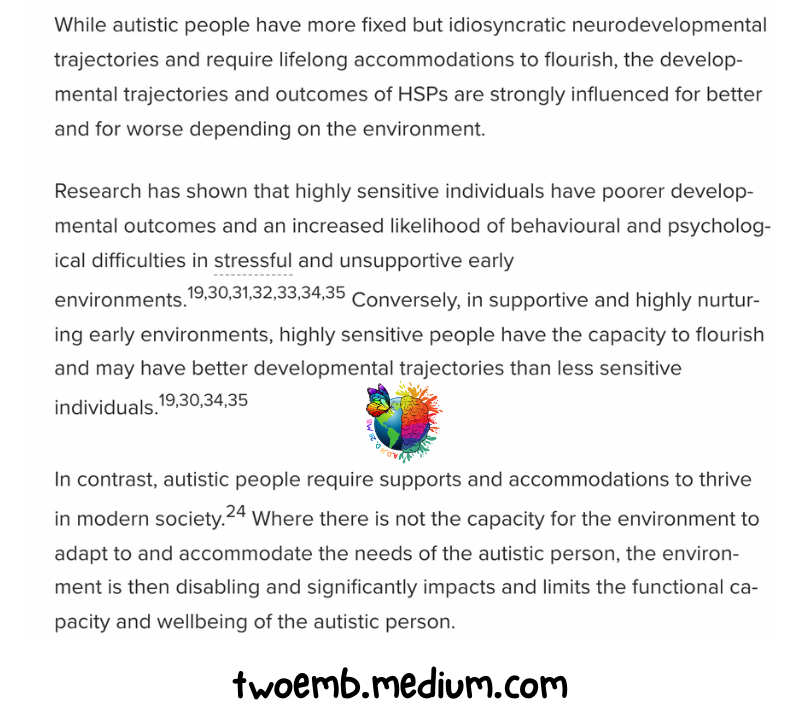
If I’m reading this correctly, HSPs require environmental accommodations in order to flourish, whereas autistic people require accommodations to thrive…
Can somebody please explain to me where the difference is?
For example, the article states:
“Research has shown that highly sensitive individuals have poorer developmental outcomes and an increased likelihood of behavioural and psychological difficulties in stressful and unsupportive early environments.”
Research has shown the exact same thing for autistics.
One study showed that the two greatest predictors of poor physical health in autistics were anxiety and sensation sensitivity behaviours — in other words, sensory processing differences, also known as being “highly sensitive”.
Another study listed the three most important predictors of quality of life for autistic adults, which were: employment, relationships, and social supports. In other words, a supportive employer, supportive partner, and a supportive environment.
I’m still not clear on where the differences are.
It seems to me (and to other Autistic self-advocates whose work I read daily), calling someone a highly sensitive person is another euphemism for asperger’s or “high functioning” autism — both of which are out-dated and ableist terms with roots in eugenics.
It’s a way of saying, “I’m not autistic, I just have many autistic characteristics” or worse, “I’m better than autistics. I still have many of the same traits, but I’m just sensitive.”
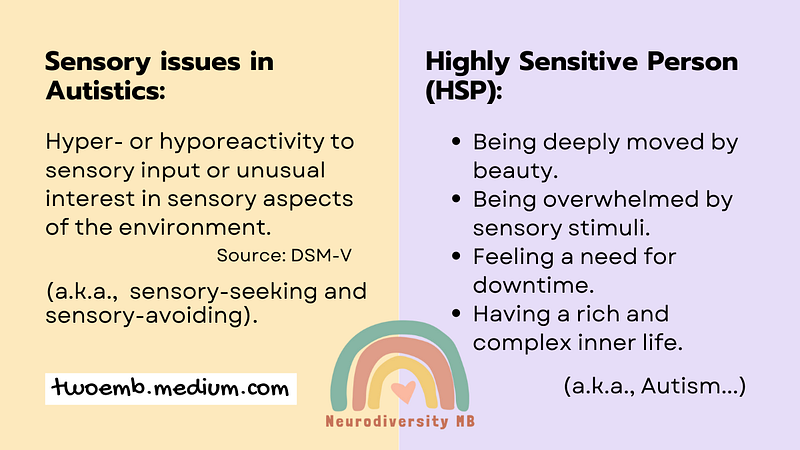
According to the sources I could find (most of which were not peer-reviewed), some signs you may be a HSP are:
- Being deeply moved by beauty, either expressed in art, nature, or the human spirit.
- Being overwhelmed by sensory stimuli like noisy crowds, bright lights, or uncomfortable clothing.
- Feeling a need for downtime (not just a preference), especially when you have hectic days; needing to retreat to a dark, quiet room.
- Having a rich and complex inner life, complete with deep thoughts and strong feelings that go with it.
Every single one of those are qualities and traits that I experience, and are commonly understood as part of autism in the autistic community*.
*Obviously we’re not a homogenous group, and not every single autistic person will agree with me.
I mean, if you’re going to say you’re autistic, just say you’re autistic.
This view that we don’t want to call ourselves or our children Autistic, so we make up some euphemism — or in this case, if you have the professional privilege, you literally invent a new diagnosis — smacks of ableism.
It perpetuates the narrative that it’s not okay to be autistic, so when someone we love has autistic traits, we need to find a more socially acceptable way to describe and explain their differences.
The more we do this, the more we enable societal ableism, and the more deeply we ingrain social stigma.
If more people in privileged positions “came out” as Autistic, they could use their privilege for good, making it safer for marginalized folks who have a lot more to lose if they identify themselves in certain environments.
If you’re going to say you’re autistic, just say you’re autistic.
Everyone needs accommodations
Another statement in the offending article that really irked me was:
“Autistic people require supports and accommodations to thrive in modern society.”
Yeah, we do. So does everybody.
My neurotypical (NT) husband dislikes mushrooms and eggs, so we make our meals without, even though I love mushrooms and eggs. In this way, I accommodate him.
He also needs the blinds closed in order to sleep, so in the summer time we sleep with black-out shades because the sunrise shines into our bedroom. I love waking up with the sun shining over me, but on weekends I accommodate his need for darkness to sleep in.
If we never closed the blinds and he woke up with the sunrise every day (5:30am in the summertime), he would become sleep-deprived and cranky. I can guarantee he would not flourish were he sleep-deprived and cranky, and neither would I.
I even asked my husband outright, what sorts of accommodations do non-disabled and neurotypical people get on a daily basis that make their lives easier? His answer was that everybody accommodates each other to some extent based on preferences, strengths, and out of consideration for others.
Exactly.
It’s just that every day, ordinary accommodations are so routine for neurotypical and non-disabled people, they’re no longer seen as supports — they’re just “common courtesy” — based on the simple fact that there are more of them than there are of us.
It’s considered “good manners” to accommodate others when the majority population has similar needs and preferences. These adaptations become ingrained in our general communities and culture, so much so they’re part of regular routines, and no longer stand out as accommodations (and yet they are).
When those needs differ from the statistical average, making efforts to adjust accordingly is no longer considered simply being considerate, this is thought of as going “above and beyond” to accommodate someone.
Imagine if neurodivergent and disabled people were granted common courtesy without their needs being pathologized, and without those supports being seen as burdens to the neurotypical, non-disabled majority.
Then maybe Dr. Aron wouldn’t have had to invent an entire diagnostic category that already existed in order to sell products and services.
Sensitive humans
To be clear, I am not saying that sensitive humans don’t exist, of course they do. There are all kinds of nervous systems in the world. Some people are sensitive due to anxiety, sensory processing disorder (SPD), trauma, or a myriad other reasons.
My intent is not to critique people who consider themselves sensitive, for whatever reasons — I fully respect the right of people to identify how they choose, to use terms and concepts which make sense for them, and may help them find supports or accommodations if needed.
The issue I have is with people, especially professionals, being afraid of the very same diagnoses or labels they place on their clients every single day of their working lives. It’s okay for Elaine Aron’s clients to be Autistic, but certainly not her daughter, that’s beneath her.
Our society could have a much better understanding of what it means to be Autistic or disabled if people in positions of influence were more open with their own divergent neurotypes, disabilities, and mental health struggles.
The issue I have is professionals being afraid of the very same diagnoses or labels they place on their clients every single day of their working lives.
In summary
People can identify themselves however they wish, and it is an individual’s right to use whatever terminology feels most comfortable and accurate for their own experiences.
I will, however, call professionals to account when they take advantage of their privilege in a way that perpetuates misinformation, social stigma, and ableism.
When people like Dr. Aron do this, they don’t experience any of the consequences of their actions. It’s people with less privilege who are accused of “lying”, exaggerating, or mis-identifying themselves as a result of these types of false claims.
Professionals who take advantage of their privilege and perpetuate misinformation, social stigma, and ableism aren’t the ones who experience the consequences of their actions.
© Jillian Enright, Neurodiversity MB

When you join medium, as a member you’ll have access to unlimited reads for only $5 per month. If you use my referral link, I’ll earn a small commission, and you’ll earn my undying gratitude.
Related Stories
References
Galiana-Simal, A., Vela-Romero, M., Manuel Romero-Vela, V., Oliver-Tercero, N., García-Olmo, V., Benito-Castellanos, P. J., Muñoz- Martinez, M., Beato-Fernandez, L. (2020). Sensory processing disorder: Key points of a frequent alteration in neurodevelopmental disorders. Cogent Medicine, 7(1). https://doi.org/10.1080/2331205X.2020.1736829
Lin, L-Y., & Huang, P-C. (2019). Quality of life and its related factors for adults with autism spectrum disorder. Disability and Rehabilitation, 41:8, 896–903, DOI: 10.1080/09638288.2017.1414887
Mason, D., McConachie, H., Garland, D., Petrou, A., Rodgers, J., Parr, J.R. (2018). Predictors of quality of life for autistic adults. Autism Research, 11: 1138–1147. https://doi.org/10.1002/aur.1965