avatarGunnar De Winter

Free AI web copilot to create summaries, insights and extended knowledge, download it at here

2058

Abstract

ng-alzheimers-disease-with-gut-microbes-4fcfe560a70f">risk for Alzheimer’s</a>, and even our <a href="https://readmedium.com/gut-microbes-and-human-personality-35621e7766b3">personality traits</a>. It also affects <a href="https://readmedium.com/the-cancer-microbiome-39644a13c6c3">our risk for cancer</a>, and our gut microbes might <a href="https://readmedium.com/gut-microbes-improve-chemotherapy-4cade0dba336">improve chemotherapy</a>. It too, however, feels the effects of age on our bodies.</p><h1 id="9c39">Harmony turns chaos</h1><p id="aed3">Us and our microbes have an intimate relationship, one that might start even before birth, given that our <a href="https://readmedium.com/mothers-microbes-shape-the-brain-of-their-unborn-children-7872370aeda9">mother’s microbes shape our brains</a>.</p><p id="84cd">After birth, our first years are generally <a href="https://www.nature.com/articles/nature11550">characterized by microbiome fluctuations</a> as we’re exposed to new food, people, and environmental factors that co-determine the diversity and presence of our microbial guests.</p><figure id="4b6a"><img src="https://cdn-images-1.readmedium.com/v2/resize:fit:800/0*0Oqzxj25WykqeNby.png"><figcaption>(Pixabay, OpenClipart-Vectors)</figcaption></figure><p id="d481">Later, as we move past the great bodily changes of puberty, our microbiome tends to settle down in a somewhat stable state. Of course, when we make substantial lifestyle changes, or are struck by disease, our microbiome will react. But in general, healthy adults have a reasonably stable collection of microbes in their gut. Preferably a diverse miniature community, as this is correlated with general health.</p><p id="3f64">To ensure that our body and our microbes have a cordial relationship, our immune system has to learn not to attack them. Or, as <a href="https://royalsocietypublishing.org/doi/10.1098/rstb.2019.0596#d1e467">a new study</a> notes:</p><blockquote id="bf03"><p>The sophisticated molecular cross-talk between microbiota and host immune system suggests the p

Options

ossibility of their coevolution. The physiological dependence of host metabolism on microbial communities and the emergence of the vertebrate adaptive immune system — itself largely shaped by commensal bacteria — may have been the key innovation to enable complex host–microbiota functional integration.</p></blockquote><p id="aa54">That same study — a review of the latest findings — also investigates what happens with that body-microbiome relationship as we grow old.</p><p id="20fd">As we age, a lot of cellular functions start to run less smoothly. DNA and protein damage begins to accumulate, organelles such as mitochondria start to sputter, and a low-grad systemic inflammation pervades our ailing bodies (called <a href="https://www.nature.com/articles/s41574-018-0059-4">inflammaging</a>, don’t think scientist dislike wordplay).</p><p id="4e20">All this, in turn, negatively affects the molecular messages our bodies exchange with our resident microbes. This results in dysbiosis — a microbiome ‘imbalance’ — and specific changes in the microbiome:</p><blockquote id="7941"><p>During aging, the relative abundance of microbial taxa typically associated with a young-adult, ‘healthy’ state — mainly <i>Firmicutes </i>— declines, while the proportion of <i>Bacteroidetes </i>and <i>Proteobacteria </i>increases.</p></blockquote><p id="7a5d">Then, a vicious cycle. Aging affects the microbiome, but the microbiome in turn affects how (un)healthily we age. Or, in more complicated terms:</p><blockquote id="17f5"><p>Together, the evolution of multicellular hosts and their microbial partners has led to the emergence of astonishing biological innovations, including a sophisticated adaptive immune system, which led to the opportunity to access a novel metabolic space — provided to the host by its commensal microbes — but also resulted in new modalities of homeostatic failure, which possibly characterize vertebrate-specific ageing dynamics.</p></blockquote><p id="a5b3">Be kind to your microbes, it might make you live longer.</p></article></body>

Aging and the Microbiome

Many bodily functions begin to falter as we reach old age. Our relationship with our microbiome suffers as well.
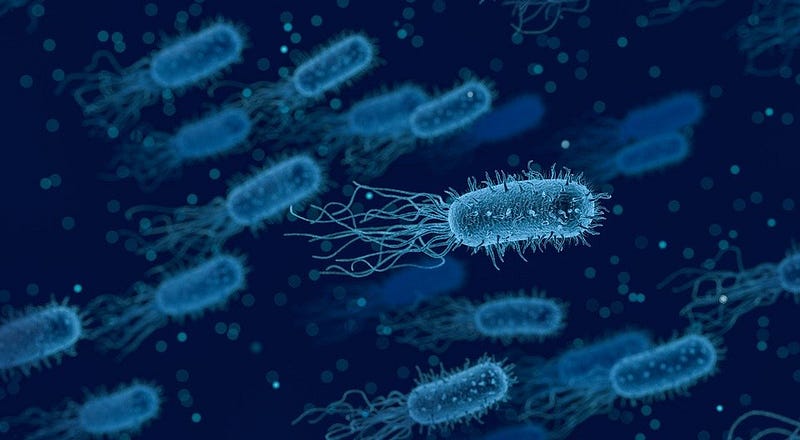
(Pixabay, qimono)

The effects of age

We’re all intimately familiar with aging. When we’re young, we see our parents and grandparents grow old and then, in the blink of an eye, we’re adults ourselves and feel the hand of father time gripping tighter each day.

As time ticks by, we begin to notice the ‘gradual deterioration of functional characteristics’ within ourselves. Still, it feels counterintuitive to call aging a disease. The case, however, has been made a few times by now. Whether you agree or not, it is uncontroversial to say that, in the vast majority of people, advanced age is a period marked by various aches and pains.

That point is that aging is a systemic process, a multi-factorial problem. In fact, in a previous post, we looked at how this leads some researchers towards implementing machine learning in aging research, and a later study indeed used machine learning to develop lifespan ‘clocks’. To make things even more complicated, the different parts of our body that are affected by age respond in a different way.

Age, however, does not only affect our body, but also its residents. Our gut microbiome influences how we process our food, our propensity for certain diseases, our risk for Alzheimer’s, and even our personality traits. It also affects our risk for cancer, and our gut microbes might improve chemotherapy. It too, however, feels the effects of age on our bodies.

Harmony turns chaos

Us and our microbes have an intimate relationship, one that might start even before birth, given that our mother’s microbes shape our brains.

After birth, our first years are generally characterized by microbiome fluctuations as we’re exposed to new food, people, and environmental factors that co-determine the diversity and presence of our microbial guests.

(Pixabay, OpenClipart-Vectors)

Later, as we move past the great bodily changes of puberty, our microbiome tends to settle down in a somewhat stable state. Of course, when we make substantial lifestyle changes, or are struck by disease, our microbiome will react. But in general, healthy adults have a reasonably stable collection of microbes in their gut. Preferably a diverse miniature community, as this is correlated with general health.

To ensure that our body and our microbes have a cordial relationship, our immune system has to learn not to attack them. Or, as a new study notes:

The sophisticated molecular cross-talk between microbiota and host immune system suggests the possibility of their coevolution. The physiological dependence of host metabolism on microbial communities and the emergence of the vertebrate adaptive immune system — itself largely shaped by commensal bacteria — may have been the key innovation to enable complex host–microbiota functional integration.

That same study — a review of the latest findings — also investigates what happens with that body-microbiome relationship as we grow old.

As we age, a lot of cellular functions start to run less smoothly. DNA and protein damage begins to accumulate, organelles such as mitochondria start to sputter, and a low-grad systemic inflammation pervades our ailing bodies (called inflammaging, don’t think scientist dislike wordplay).

All this, in turn, negatively affects the molecular messages our bodies exchange with our resident microbes. This results in dysbiosis — a microbiome ‘imbalance’ — and specific changes in the microbiome:

During aging, the relative abundance of microbial taxa typically associated with a young-adult, ‘healthy’ state — mainly Firmicutes — declines, while the proportion of Bacteroidetes and Proteobacteria increases.

Then, a vicious cycle. Aging affects the microbiome, but the microbiome in turn affects how (un)healthily we age. Or, in more complicated terms:

Together, the evolution of multicellular hosts and their microbial partners has led to the emergence of astonishing biological innovations, including a sophisticated adaptive immune system, which led to the opportunity to access a novel metabolic space — provided to the host by its commensal microbes — but also resulted in new modalities of homeostatic failure, which possibly characterize vertebrate-specific ageing dynamics.

Be kind to your microbes, it might make you live longer.

Science
Biology
Health
Aging
Future
Recommended from ReadMedium