avatarJillian Enright

Free AI web copilot to create summaries, insights and extended knowledge, download it at here

9354

Abstract

.</p><p id="be26">This can impact the five main senses (sight, <a href="https://readmedium.com/loud-introverts-unite-5a261dfe4f40">sound</a>, touch, taste, smell), but also three others: vestibular, <a href="https://readmedium.com/clumsy-or-is-it-adhd-156ed40927ab">interoception, and proprioception</a>. The last three I also cover <a href="https://readmedium.com/clumsy-or-is-it-adhd-156ed40927ab">here</a>.</p><p id="4912">Although there is <a href="https://doi.org/10.1007/s00787-020-01516-5">extensive evidence</a> demonstrating the co-occurrence of ADHD and SPD, the actual prevalence is unknown. One <a href="https://doi.org/10.5014/ajot.58.3.287">study from 2004 suggested</a> that as many as 40% of children with ADHD also have SPD, but it was based on parent reports and only included kindergarten-aged children. More research is definitely needed in this area.</p><p id="45fa">Interestingly, my son and I are similar but very different in this area. We both have sensory processing differences, but he is much more sensory-seeking, and I am much more sensory-avoiding. He is also a kid who likes to make noise, yet gets overwhelmed by loud environments.</p><p id="da29"><i>Go figure</i>.</p><p id="d738">In another ironic twist, I’m hard of hearing, but I don’t like noise. I love concerts and live music, but I get very overwhelmed by loud, chaotic environments.</p><p id="321a">I would say I am over-responsive to sight, touch, smell, and sound senses. I have an incredibly sensitive nose and am easily overwhelmed by crowds and busy places.</p><p id="6753">Although my son also gets overwhelmed by loud and busy spaces, he is generally more of a sensory-seeker. He enjoys intense sensory input, such as hanging upside-down, climbing, jumping, and banging — and when he’s gotten all of those sensory needs met, he gives the best snuggles in the world.</p><h2 id="c54c">Sleep Disorders</h2><p id="94e9">Not only are <a href="https://readmedium.com/sleep-disorders-in-adhd-autism-3586aad49c83">sleep disorders common with ADHD and Autism</a>, but sleep disorders are also worsened by sensory modulation issues.</p><p id="5adf">An <a href="https://doi.org/10.1016/j.sleep.2021.05.027">interesting study found</a> that 30% of children with ADHD but no sensory processing issues had sleep disorders, whereas 85% of children who had both ADHD and SPD also had disordered sleep.</p><p id="6873">The most common sleep disorder is <a href="https://doi.org/10.3389/fpsyt.2021.663889">insomnia</a>, which makes it hard to fall asleep, hard to stay asleep, or causes people to wake up too early and not be able to get back to sleep.</p><p id="0f68">Insomnia affects approximately 6–15% of the general adult population, but a recent study found that <a href="https://doi.org/10.3389/fpsyt.2021.663889">insomnia affects over 44% of adults with ADHD</a>.</p><p id="7000">This isn’t entirely surprising because the reticular activating system (RAS) is implicated in ADHD, a region of the brain that plays a role in <a href="https://doi.org/10.1038/npp.2009.120">regulating our sleep cycles</a>.</p><figure id="1e6e"><img src="https://cdn-images-1.readmedium.com/v2/resize:fit:800/1*1-ItztLnqzCSQezFnN_Pxg.png"><figcaption>Created by author</figcaption></figure><h1 id="035d">Autism and ADHD</h1><p id="2089">Last but definitely not least, Autistic people often have ADHD, and people with ADHD are often also <a href="https://www.cdc.gov/ncbddd/autism/hcp-dsm.html">Autistic</a>.</p><p id="c0c8">While it’s very difficult to establish a true prevalence rate because there are many undiagnosed and self-diagnosed people who wouldn’t be counted in the literature, it is estimated to be <a href="https://doi.org/10.1016/j.rasd.2021.101759">approximately 40</a><a href="https://doi.org/10.12998/wjcc.v7.i17.2420">–60%</a>.</p><p id="993c">I go back and forth on a daily basis, thinking my son and I must be autistic… but then again, no, it must be just ADHD.</p><p id="4a26">We are both formally diagnosed with ADHD and anxiety. We both have sensory issues, social issues, difficulty with change, and both definitely have <a href="https://www.spectrumnews.org/news/repetitive-behaviors-and-stimming-in-autism-explained/">stims</a>* (but everyone does, really, just some a lot more than others).</p><p id="cbb4">Stims are <a href="https://www.spectrumnews.org/news/repetitive-behaviors-and-stimming-in-autism-explained/">self-stimulatory behaviours</a> that are often repetitive and serve different purposes for different people.</p><p id="7085">Stims may help reduce anxiety, sensory overload, and just feel good. Stimming can help with emotional regulation and may also improve concentration and focus.</p><p id="2f40"><a href="https://readmedium.com/dsm-5-criteria-for-adhd-ca07985d18fc">Similar to ADHD</a>, there’s the <a href="https://www.cdc.gov/ncbddd/autism/hcp-dsm.html">DSM-V criteria</a>, and then there’s the actual lived experiences of human beings and their descriptions of what it’s like to have ADHD or to be Autistic.</p><p id="2639">I could write an entire article on the similarities between ADHD and Autism, but <a href="undefined">Jesse Meadows</a> already did a fantastic job of it, so I will defer to their expertise:</p><div id="d856" class="link-block"> <a href="https://jessemeadows.medium.com/whats-the-difference-between-adhd-and-autism-fcdea6b3973d"> <div> <div> <h2>What’s the difference between ADHD and autism?</h2> <div><h3>Research keeps finding more similarities.</h3></div> <div><p>jessemeadows.medium.com</p></div> </div> <div> <div style="background-image: url(https://miro.readmedium.com/v2/resize:fit:320/0*B5avX_IoUV-_WQ6r.jpg)"></div> </div> </div> </a> </div><h2 id="97e2">On a Personal Note</h2><p id="ceb4">If I’m being perfectly honest, I think my son and I <i>are</i> both <a href="https://readmedium.com/my-lightbulb-moments-dbbdefb0a110">Autistic</a>, but our <a href="https://readmedium.com/and-then-there-were-2-e-fce186c74d29">twice-exceptionality and ADHD</a> symptoms overshadow our autism.</p><p id="952c">When I ask colleagues for advice about this, they always ask whether a diagnosis would change the supports provided and whether the symptoms cause a significant impact on our “daily functioning”.</p><p id="f572">My doctor tried to give me that line when I asked about a referral for an ADHD assessment, but I had done so much reading on ADHD since my son had been diagnosed that I knew how to explain to him what I wanted and why. At that time I hadn’t done enough reading on Autism to understand the extensive overlap.</p><figure id="f636"><img src="https://cdn-images-1.readmedium.com/v2/resize:fit:800/1*nyj65suS1b57eEJc-wzBSw.png"><figcaption>Created by author</figcaption></figure><p id="3455">I don’t think that line of questioning is as helpful as intended, because if you’ve never been neurotypical and you’ve never lived in a world designed just for you, then how would you know what your ideal level of so-called daily functioning is?</p><p id="54c0">Whose definition of functioning are we using, anyway? The study of psychology was built on a foundation of “<i>weeding out</i>” abnormals (back in WWI) and “training” people to be as useful to the economy as possible, which benefits those already in power.</p><p id="9bf0"><i>But I digress…</i></p><p id="ab35">I hesitate to “come out” as <a href="https://readmedium.com/my-lightbulb-moments-dbbdefb0a110">Autistic</a>, though, because <a href="https://embrace-autism.com/introducing-autistic-impostor-syndrome/">imposter syndrome</a> is real. I don’t want to minimize the experiences of others, nor centre myself in a community to which I’m not 100% sure I belong.</p><p id="0bc4">I’m also an expert on ADHD, but not on Autism. The perfectionist in me is afraid to say something wrong, and I certainly do not want to spread misinformation.</p><p id="d8b2">I know I’m not alone in these feelings, which is comforting, and I am grateful to my fellow writers to share their experiences.</p><p id="6040">I will continue my journey of self-exploration and self-acceptance — for myself, and most of all, to show my son what it means to understand and embrace our divergent brains.</p><p id="6d27">© Jillian Enright, Neurodiversity MB</p><p id="ac42"><i>When you join medium, as a member you’ll have access to unlimited reads for only $5 per month. If you use <a href="https://twoemb.medium.com/membership">my referral link</a>, I’ll earn a small commission, and you’ll earn my undying gratitude.</i></p><figure id="bc2f"><img src="https://cdn-images-1.readmedium.com/v2/resize:fit:800/1*CJSg24mr-ZlpyFoVl4nCig.png"><figcaption></figcaption></figure><h1 id="0519">Related Stories</h1><div id="7ba6" class="link-block"> <a href="https://aninjusticemag.com/adhd-and-comorbid-conditions-49b2fcee0885"> <div> <div> <h2>ADHD, the Gift that Keeps on Giving!</h2> <div><h3>Also how Personality Disorders are sexist and gender-biased</h3></div> <div><p>aninjusticemag.com</p></div> </div> <div> <div style="background-image: url(https://miro.readmedium.co

Options

m/v2/resize:fit:320/1*[email protected])"></div> </div> </div> </a> </div><div id="6254" class="link-block"> <a href="https://readmedium.com/clumsy-or-is-it-adhd-156ed40927ab"> <div> <div> <h2>Clumsy, or is it ADHD?</h2> <div><h3>An explanation of some unexpected ADHD symptoms.</h3></div> <div><p>medium.com</p></div> </div> <div> <div style="background-image: url(https://miro.readmedium.com/v2/resize:fit:320/1*BmmltftbO8fQs6EhvuHELA.jpeg)"></div> </div> </div> </a> </div><div id="157c" class="link-block"> <a href="https://readmedium.com/loud-introverts-unite-5a261dfe4f40"> <div> <div> <h2>Loud Introverts Unite!</h2> <div><h3>Exploring the relationships between Neurodivergence, Social Anxiety, Sensory Processing Sensitivity, and Introversion.</h3></div> <div><p>medium.com</p></div> </div> <div> <div style="background-image: url(https://miro.readmedium.com/v2/resize:fit:320/1*OzYD1nefkG4aa9hGHKnPAg.jpeg)"></div> </div> </div> </a> </div><h2 id="8129">Reference</h2><p id="5ae6">Ahn, R. R., Miller, L. J., Milberger, S., & McIntosh, D. N. (2004). Prevalence of parents’ perceptions of sensory processing disorders among kindergarten children. <i>The American journal of occupational therapy : official publication of the American Occupational Therapy Association</i>, <i>58</i>(3), 287–293. <a href="https://doi.org/10.5014/ajot.58.3.287">https://doi.org/10.5014/ajot.58.3.287</a></p><p id="3e85">Brimo, K, Dinkler, L, Gillberg, C, Lichtenstein, P, Lundström, S, Åsberg Johnels, J. (2021). The co-occurrence of neurodevelopmental problems in dyslexia. <i>Dyslexia,</i> <i>27,</i> 277– 293. <a href="https://doi.org/10.1002/dys.1681">https://doi.org/10.1002/dys.1681</a></p><p id="5d18">Bush G. (2010). Attention-deficit/hyperactivity disorder and attention networks. <i>Neuropsychopharmacology : official publication of the American College of Neuropsychopharmacology</i>, <i>35</i>(1), 278–300. <a href="https://doi.org/10.1038/npp.2009.120">https://doi.org/10.1038/npp.2009.120</a></p><p id="8a21">Chung, P. J., Patel, D. R., & Nizami, I. (2020). Disorder of written expression and dysgraphia: definition, diagnosis, and management. <i>Translational pediatrics</i>, <i>9</i>(Suppl 1), S46–S54. <a href="https://doi.org/10.21037/tp.2019.11.01">https://doi.org/10.21037/tp.2019.11.01</a></p><p id="bcdb">Czamara, D., Tiesler, C. M., Kohlböck, G., Berdel, D., Hoffmann, B., Bauer, C. P., Koletzko, S., Schaaf, B… & Heinrich, J., <i>et al</i>. (2013). Children with ADHD symptoms have a higher risk for reading, spelling and math difficulties in the GINIplus and LISAplus cohort studies. <i>PloS One</i>, <i>8</i>(5), e63859. <a href="https://doi.org/10.1371/journal.pone.0063859">https://doi.org/10.1371/journal.pone.0063859</a></p><p id="b721">Dellapiazza, F., Michelon, C., Vernhet, C. <i>et al.</i> (2021). Sensory processing related to attention in children with ASD, ADHD, or typical development: results from the ELENA cohort. <i>European Child & Adolescent Psychiatry</i> <i>30</i><b>, </b>283–291. <a href="https://doi.org/10.1007/s00787-020-01516-5">https://doi.org/10.1007/s00787-020-01516-5</a></p><p id="0cfe">Fadeuilhe, C., Daigre, C., Richarte, V., Grau-López, L., Palma-Álvarez, R. F., Corrales, M., & Ramos-Quiroga, J. A. (2021). Insomnia Disorder in Adult Attention-Deficit/Hyperactivity Disorder Patients: Clinical, Comorbidity, and Treatment Correlates. <i>Frontiers in psychiatry</i>, <i>12</i>, 663889. <a href="https://doi.org/10.3389/fpsyt.2021.663889">https://doi.org/10.3389/fpsyt.2021.663889</a></p><p id="bed2">Ghanizadeh A. (2011). Sensory processing problems in children with ADHD, a systematic review. <i>Psychiatry investigation</i>, <i>8</i>(2), 89–94. <a href="https://doi.org/10.4306/pi.2011.8.2.89">https://doi.org/10.4306/pi.2011.8.2.89</a></p><p id="02e7">Gnanavel, S., Sharma, P., Kaushal, P., & Hussain, S. (2019). Attention deficit hyperactivity disorder and comorbidity: A review of literature. <i>World journal of clinical cases</i>, <i>7</i>(17), 2420–2426. <a href="https://doi.org/10.12998/wjcc.v7.i17.2420">https://doi.org/10.12998/wjcc.v7.i17.2420</a></p><p id="b4c3">Grinblat, N., & Rosenblum, S. (2021). Sleep quality, sensory processing abilities and work performance for adults with attention deficit hyperactive disorder. <i>European Psychiatry, 64</i>(S1), S553-S553. <a href="https://www.cambridge.org/core/journals/european-psychiatry/article/sleep-quality-sensory-processing-abilities-and-work-performance-for-adults-with-attention-deficit-hyperactive-disorder/89C685748CA32A9F2E04E84A093F8955">doi: 10.1192/j.eurpsy.2021.1475</a></p><p id="79c0">Haberstroh, S., & Schulte-Körne, G. (2019). The Diagnosis and Treatment of Dyscalculia. <i>Deutsches Arzteblatt international</i>, <i>116</i>(7), 107–114. <a href="https://doi.org/10.3238/arztebl.2019.0107">https://doi.org/10.3238/arztebl.2019.0107</a></p><p id="a7b6">Katzman, M. A., Bilkey, T. S., Chokka, P. R., Fallu, A., & Klassen, L. J. (2017). Adult ADHD and comorbid disorders: clinical implications of a dimensional approach. <i>BMC psychiatry, 17</i>(1), 302. <a href="https://doi.org/10.1186/s12888-017-1463-3">https://doi.org/10.1186/s12888-017-1463-3</a></p><p id="e0e0">Little, L. M., Dean, E., Tomchek, S., & Dunn, W. (2018). Sensory Processing Patterns in Autism, Attention Deficit Hyperactivity Disorder, and Typical Development. <i>Physical & Occupational Therapy In Pediatrics, 38</i>(3), 243–254. <a href="https://doi.org/10.1080/01942638.2017.1390809">https://doi.org/10.1080/01942638.2017.1390809</a></p><p id="9440">Mimouni-Bloch, A., Offek, H., Engel-Yeger, B., Rosenblum, S., Posener, E., Silman, Z., Tauman, R. (2021). Association between sensory modulation and sleep difficulties in children with Attention Deficit Hyperactivity Disorder (ADHD). <i>Sleep Medicine, 84</i>, 107–113. <a href="https://doi.org/10.1016/j.sleep.2021.05.027">https://doi.org/10.1016/j.sleep.2021.05.027</a></p><p id="756b">Mohammadi, M.-R., Zarafshan, H., Khaleghi, A., Ahmadi, N., Hooshyari, Z., Mostafavi, S.-A., Ahmadi, A., Alavi, S.-S., Shakiba, A., & Salmanian, M. (2021). Prevalence of ADHD and Its Comorbidities in a Population-Based Sample. <i>Journal of Attention Disorders, 25</i>(8), 1058–1067. <a href="https://doi.org/10.1177/1087054719886372">https://doi.org/10.1177/1087054719886372</a></p><p id="ab89">Mokobane, M., Pillay, B. J., & Meyer, A. (2019). Fine motor deficits and attention deficit hyperactivity disorder in primary school children. <i>The South African journal of psychiatry : SAJP : the journal of the Society of Psychiatrists of South Africa</i>, <i>25</i>, 1232. <a href="https://doi.org/10.4102/sajpsychiatry.v25i0.1232">https://doi.org/10.4102/sajpsychiatry.v25i0.1232</a></p><p id="abe2">Moukhtarian, T.R., Mintah, R.S., Moran, P. et al. (2018). Emotion dysregulation in attention-deficit/hyperactivity disorder and borderline personality disorder. <i>Borderline personality disorder and emotional dysregulation 5</i>(9). <a href="https://doi.org/10.1186/s40479-018-0086-8">https://doi.org/10.1186/s40479-018-0086-8</a></p><p id="4c63">Ostrolenk, A., Forgeot d’Arc, B., Jelenic, P., Samson, F., Mottron, L. (2017). Hyperlexia: Systematic review, neurocognitive modelling, and outcome. <i>Neuroscience & Biobehavioral Reviews, 79</i>, 134–149. <a href="https://doi.org/10.1016/j.neubiorev.2017.04.029">https://doi.org/10.1016/j.neubiorev.2017.04.029</a></p><p id="a766">Rong, Y., Yang, Chang-Jiang, Jin, Y., Wang, Y. (2021). Prevalence of attention-deficit/hyperactivity disorder in individuals with autism spectrum disorder: A meta-analysis. <i>Research in Autism Spectrum Disorders, 83;</i> 101759. <a href="https://doi.org/10.1016/j.rasd.2021.101759">https://doi.org/10.1016/j.rasd.2021.101759</a></p><p id="3dcb">Substance Abuse and Mental Health Services Administration. Impact of the DSM-IV to DSM-5 Changes on the National Survey on Drug Use and Health [Internet]. Rockville (MD):<i> Substance Abuse and Mental Health Services Administration</i> (US); 2016 Jun. Table 3.13, DSM-IV to DSM-5 Obsessive-Compulsive Disorder Comparison.Available from: <a href="https://www.ncbi.nlm.nih.gov/books/NBK519704/table/ch3.t13">https://www.ncbi.nlm.nih.gov/books/NBK519704/table/ch3.t13</a></p><p id="eb57">Wajszilber, D., Santiseban, J. A., & Gruber, R. (2018). Sleep disorders in patients with ADHD: impact and management challenges. <i>Nature and science of sleep</i>, <i>10</i>, 453–480. <a href="https://doi.org/10.2147/NSS.S163074">https://doi.org/10.2147/NSS.S163074</a></p><p id="fcd3">Wimberley, T., Agerbo, E., Horsdal, H. T., Ottosen, C., Brikell, I., Als, T. D., Demontis, D., Børglum, A. D… Dalsgaard, S., et al. (2020) Genetic liability to ADHD and substance use disorders in individuals with ADHD. <i>Addiction, 115</i>: 1368–1377. <a href="https://doi.org/10.1111/add.14910">https://doi.org/10.1111/add.14910</a></p></article></body>

ADHD: The Gift That Still Keeps On Giving

The relationships between ADHD and autism, learning disabilities, sensory processing disorder, and sleep disorders
A Brief Recap

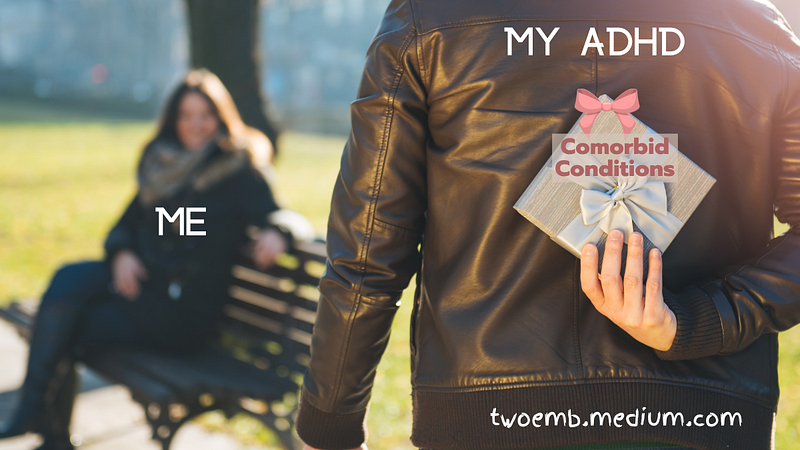
I wrote previously about the most common co-occurring conditions with ADHD, which are anxiety, depression, bipolar, addictions, and borderline personality (BPD).

Anxiety disorders are the most prevalent groups of comorbidities in people with ADHD, most commonly social anxiety, generalized anxiety, and Obsessive Compulsive Disorder (OCD).

Depression and Bipolar disorder (BD) are also highly comorbid with ADHD. Clinicians must be cognizant of cultural and methodological differences across continents when differentiating between these diagnoses, to prevent misdiagnosis, and to provide optimal care for both ADHD and BD.

ADHD, especially untreated ADHD, is a very strong risk factor for substance abuse and substance use disorders, something I’ve written about previously.

Borderline Personality Disorder (BPD) is thought to be the most prevalent personality disorder amongst people with ADHD, which is something that significantly impacted my own experience with seeking support, diagnosis, and treatment. (I wrote a separate piece on this as well).

You can read the first article on comorbidities here.

But wait, there’s more!

There are five more disorders and neurotypes that very commonly co-occur with ADHD. I will cover four of them here, and have written a separate article on the fifth.

  1. Learning and Writing Disabilities
  2. Developmental Coordination Disorder (DCD/dyspraxia)
  3. Sensory Processing Disorder
  4. Sleep Disorders
  5. Autism

October is both ADHD Awareness and Dyslexia Awareness Month, so it’s a perfect time to talk about how the two intertwine.

Learning and Writing Disabilities

While ADHD is not a learning disability in itself, it is highly comorbid with a number of learning and writing disabilities, the two most common being dyslexia and dysgraphia.

Dyslexia is a learning disorder that involves difficulty reading due to problems identifying speech sounds and learning how they relate to letters and words. Dyslexia affects areas of the brain that process language. It is estimated that between 25 and 40% of children with ADHD also have dyslexia.

Dysgraphia is a specific learning disorder causing difficulties producing written language. Students with dysgraphia have extreme difficulty getting their thoughts in order and then down on paper.

Dysgraphia is thought to affect as many as 60% of children with ADHD.

Dyscalculia is sometimes referred to as dyslexia in math, and causes difficulties learning number related concepts, as well as using the symbols and functions to perform math calculations.

It is not known exactly how many people with ADHD also have dyscalculia, but the comorbidity rate is estimated to be about 20%, where the estimated prevalence rate in the general population is around 7%.

Although there are other conditions which can be comorbid with learning disabilities (LDs), having a learning disability does not directly impact one’s intelligence.

People with LDs usually have average and above average intelligence, and that’s on traditional IQ testing and assessments. People with LDs often score higher than the average population in certain areas, such as visual-spatial processing (creativity) and verbal comprehension.

Having a learning disability does not impact one’s intelligence.

Hyperlexia

My son does not have dyslexia. In fact, he’s hyperlexic. Hyperlexia is a combination of advanced reading and comprehension skills, the early acquisition of reading skills without explicit teaching, and a strong orientation toward written material, generally in the context of a neurodevelopmental disorder.

In other words, hyperlexia is when a child starts reading early and surprisingly beyond their expected ability. Hyperlexic children can still have dyslexia (stealth dyslexia), dysgraphia, dyscalculia, or other learning disabilities.

My son was reading YA novels at age 7 and spends hours reading every day. In fact, we just got home from the library where he checked out the maximum number of books permitted.
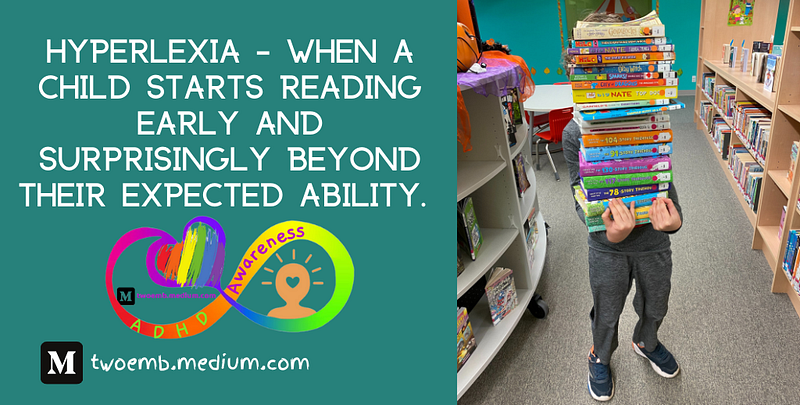
Photo by author

My son does struggle greatly with the physical act of writing but has not been diagnosed with dysgraphia.

Dysgraphia is a disorder of written expression, a neurological condition that causes language-based difficulties involved in constructing meaningful and effectively structured writing.

Children who have ADHD but not dysgraphia can still struggle with writing due to challenges with fine motor muscles, coordination, and working memory.

Similarly, I haven’t been diagnosed with dyslexia or dysgraphia, and I absolutely love to read. I enjoy writing, but I definitely have fine motor skill issues.

I wrote about experiences related to fine motor skills in an article called, “Clumsy, or ADHD?” and explained working memory in greater detail in an article about executive functions.

Sensory Processing Disorder

Sensory processing disorder (SPD) is a condition that affects how your brain processes sensory information. People can have under-active or over-active sensory processing, and they can be hyposensitive in some senses and hypersensitive in others.

This can impact the five main senses (sight, sound, touch, taste, smell), but also three others: vestibular, interoception, and proprioception. The last three I also cover here.

Although there is extensive evidence demonstrating the co-occurrence of ADHD and SPD, the actual prevalence is unknown. One study from 2004 suggested that as many as 40% of children with ADHD also have SPD, but it was based on parent reports and only included kindergarten-aged children. More research is definitely needed in this area.

Interestingly, my son and I are similar but very different in this area. We both have sensory processing differences, but he is much more sensory-seeking, and I am much more sensory-avoiding. He is also a kid who likes to make noise, yet gets overwhelmed by loud environments.

Go figure.

In another ironic twist, I’m hard of hearing, but I don’t like noise. I love concerts and live music, but I get very overwhelmed by loud, chaotic environments.

I would say I am over-responsive to sight, touch, smell, and sound senses. I have an incredibly sensitive nose and am easily overwhelmed by crowds and busy places.

Although my son also gets overwhelmed by loud and busy spaces, he is generally more of a sensory-seeker. He enjoys intense sensory input, such as hanging upside-down, climbing, jumping, and banging — and when he’s gotten all of those sensory needs met, he gives the best snuggles in the world.

Sleep Disorders

Not only are sleep disorders common with ADHD and Autism, but sleep disorders are also worsened by sensory modulation issues.

An interesting study found that 30% of children with ADHD but no sensory processing issues had sleep disorders, whereas 85% of children who had both ADHD and SPD also had disordered sleep.

The most common sleep disorder is insomnia, which makes it hard to fall asleep, hard to stay asleep, or causes people to wake up too early and not be able to get back to sleep.

Insomnia affects approximately 6–15% of the general adult population, but a recent study found that insomnia affects over 44% of adults with ADHD.

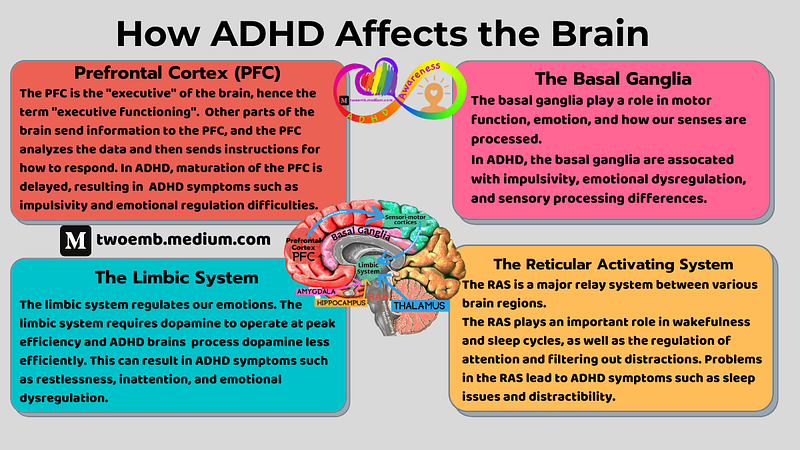
This isn’t entirely surprising because the reticular activating system (RAS) is implicated in ADHD, a region of the brain that plays a role in regulating our sleep cycles.
Created by author

Autism and ADHD

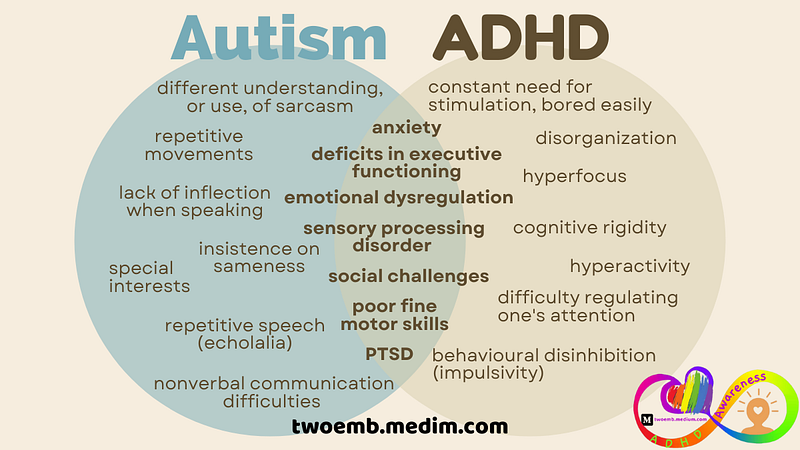
Last but definitely not least, Autistic people often have ADHD, and people with ADHD are often also Autistic.

While it’s very difficult to establish a true prevalence rate because there are many undiagnosed and self-diagnosed people who wouldn’t be counted in the literature, it is estimated to be approximately 40–60%.

I go back and forth on a daily basis, thinking my son and I must be autistic… but then again, no, it must be just ADHD.

We are both formally diagnosed with ADHD and anxiety. We both have sensory issues, social issues, difficulty with change, and both definitely have stims* (but everyone does, really, just some a lot more than others).

Stims are self-stimulatory behaviours that are often repetitive and serve different purposes for different people.

Stims may help reduce anxiety, sensory overload, and just feel good. Stimming can help with emotional regulation and may also improve concentration and focus.

Similar to ADHD, there’s the DSM-V criteria, and then there’s the actual lived experiences of human beings and their descriptions of what it’s like to have ADHD or to be Autistic.

I could write an entire article on the similarities between ADHD and Autism, but Jesse Meadows already did a fantastic job of it, so I will defer to their expertise:

On a Personal Note

If I’m being perfectly honest, I think my son and I are both Autistic, but our twice-exceptionality and ADHD symptoms overshadow our autism.

When I ask colleagues for advice about this, they always ask whether a diagnosis would change the supports provided and whether the symptoms cause a significant impact on our “daily functioning”.

My doctor tried to give me that line when I asked about a referral for an ADHD assessment, but I had done so much reading on ADHD since my son had been diagnosed that I knew how to explain to him what I wanted and why. At that time I hadn’t done enough reading on Autism to understand the extensive overlap.
Created by author

I don’t think that line of questioning is as helpful as intended, because if you’ve never been neurotypical and you’ve never lived in a world designed just for you, then how would you know what your ideal level of so-called daily functioning is?

Whose definition of functioning are we using, anyway? The study of psychology was built on a foundation of “weeding out” abnormals (back in WWI) and “training” people to be as useful to the economy as possible, which benefits those already in power.

But I digress…

I hesitate to “come out” as Autistic, though, because imposter syndrome is real. I don’t want to minimize the experiences of others, nor centre myself in a community to which I’m not 100% sure I belong.

I’m also an expert on ADHD, but not on Autism. The perfectionist in me is afraid to say something wrong, and I certainly do not want to spread misinformation.

I know I’m not alone in these feelings, which is comforting, and I am grateful to my fellow writers to share their experiences.

I will continue my journey of self-exploration and self-acceptance — for myself, and most of all, to show my son what it means to understand and embrace our divergent brains.

© Jillian Enright, Neurodiversity MB

When you join medium, as a member you’ll have access to unlimited reads for only $5 per month. If you use my referral link, I’ll earn a small commission, and you’ll earn my undying gratitude.

Related Stories

Reference

Ahn, R. R., Miller, L. J., Milberger, S., & McIntosh, D. N. (2004). Prevalence of parents’ perceptions of sensory processing disorders among kindergarten children. The American journal of occupational therapy : official publication of the American Occupational Therapy Association, 58(3), 287–293. https://doi.org/10.5014/ajot.58.3.287

Brimo, K, Dinkler, L, Gillberg, C, Lichtenstein, P, Lundström, S, Åsberg Johnels, J. (2021). The co-occurrence of neurodevelopmental problems in dyslexia. Dyslexia, 27, 277– 293. https://doi.org/10.1002/dys.1681

Bush G. (2010). Attention-deficit/hyperactivity disorder and attention networks. Neuropsychopharmacology : official publication of the American College of Neuropsychopharmacology, 35(1), 278–300. https://doi.org/10.1038/npp.2009.120

Chung, P. J., Patel, D. R., & Nizami, I. (2020). Disorder of written expression and dysgraphia: definition, diagnosis, and management. Translational pediatrics, 9(Suppl 1), S46–S54. https://doi.org/10.21037/tp.2019.11.01

Czamara, D., Tiesler, C. M., Kohlböck, G., Berdel, D., Hoffmann, B., Bauer, C. P., Koletzko, S., Schaaf, B… & Heinrich, J., et al. (2013). Children with ADHD symptoms have a higher risk for reading, spelling and math difficulties in the GINIplus and LISAplus cohort studies. PloS One, 8(5), e63859. https://doi.org/10.1371/journal.pone.0063859

Dellapiazza, F., Michelon, C., Vernhet, C. et al. (2021). Sensory processing related to attention in children with ASD, ADHD, or typical development: results from the ELENA cohort. European Child & Adolescent Psychiatry 30, 283–291. https://doi.org/10.1007/s00787-020-01516-5

Fadeuilhe, C., Daigre, C., Richarte, V., Grau-López, L., Palma-Álvarez, R. F., Corrales, M., & Ramos-Quiroga, J. A. (2021). Insomnia Disorder in Adult Attention-Deficit/Hyperactivity Disorder Patients: Clinical, Comorbidity, and Treatment Correlates. Frontiers in psychiatry, 12, 663889. https://doi.org/10.3389/fpsyt.2021.663889

Ghanizadeh A. (2011). Sensory processing problems in children with ADHD, a systematic review. Psychiatry investigation, 8(2), 89–94. https://doi.org/10.4306/pi.2011.8.2.89

Gnanavel, S., Sharma, P., Kaushal, P., & Hussain, S. (2019). Attention deficit hyperactivity disorder and comorbidity: A review of literature. World journal of clinical cases, 7(17), 2420–2426. https://doi.org/10.12998/wjcc.v7.i17.2420

Grinblat, N., & Rosenblum, S. (2021). Sleep quality, sensory processing abilities and work performance for adults with attention deficit hyperactive disorder. European Psychiatry, 64(S1), S553-S553. doi: 10.1192/j.eurpsy.2021.1475

Haberstroh, S., & Schulte-Körne, G. (2019). The Diagnosis and Treatment of Dyscalculia. Deutsches Arzteblatt international, 116(7), 107–114. https://doi.org/10.3238/arztebl.2019.0107

Katzman, M. A., Bilkey, T. S., Chokka, P. R., Fallu, A., & Klassen, L. J. (2017). Adult ADHD and comorbid disorders: clinical implications of a dimensional approach. BMC psychiatry, 17(1), 302. https://doi.org/10.1186/s12888-017-1463-3

Little, L. M., Dean, E., Tomchek, S., & Dunn, W. (2018). Sensory Processing Patterns in Autism, Attention Deficit Hyperactivity Disorder, and Typical Development. Physical & Occupational Therapy In Pediatrics, 38(3), 243–254. https://doi.org/10.1080/01942638.2017.1390809

Mimouni-Bloch, A., Offek, H., Engel-Yeger, B., Rosenblum, S., Posener, E., Silman, Z., Tauman, R. (2021). Association between sensory modulation and sleep difficulties in children with Attention Deficit Hyperactivity Disorder (ADHD). Sleep Medicine, 84, 107–113. https://doi.org/10.1016/j.sleep.2021.05.027

Mohammadi, M.-R., Zarafshan, H., Khaleghi, A., Ahmadi, N., Hooshyari, Z., Mostafavi, S.-A., Ahmadi, A., Alavi, S.-S., Shakiba, A., & Salmanian, M. (2021). Prevalence of ADHD and Its Comorbidities in a Population-Based Sample. Journal of Attention Disorders, 25(8), 1058–1067. https://doi.org/10.1177/1087054719886372

Mokobane, M., Pillay, B. J., & Meyer, A. (2019). Fine motor deficits and attention deficit hyperactivity disorder in primary school children. The South African journal of psychiatry : SAJP : the journal of the Society of Psychiatrists of South Africa, 25, 1232. https://doi.org/10.4102/sajpsychiatry.v25i0.1232

Moukhtarian, T.R., Mintah, R.S., Moran, P. et al. (2018). Emotion dysregulation in attention-deficit/hyperactivity disorder and borderline personality disorder. Borderline personality disorder and emotional dysregulation 5(9). https://doi.org/10.1186/s40479-018-0086-8

Ostrolenk, A., Forgeot d’Arc, B., Jelenic, P., Samson, F., Mottron, L. (2017). Hyperlexia: Systematic review, neurocognitive modelling, and outcome. Neuroscience & Biobehavioral Reviews, 79, 134–149. https://doi.org/10.1016/j.neubiorev.2017.04.029

Rong, Y., Yang, Chang-Jiang, Jin, Y., Wang, Y. (2021). Prevalence of attention-deficit/hyperactivity disorder in individuals with autism spectrum disorder: A meta-analysis. Research in Autism Spectrum Disorders, 83; 101759. https://doi.org/10.1016/j.rasd.2021.101759

Substance Abuse and Mental Health Services Administration. Impact of the DSM-IV to DSM-5 Changes on the National Survey on Drug Use and Health [Internet]. Rockville (MD): Substance Abuse and Mental Health Services Administration (US); 2016 Jun. Table 3.13, DSM-IV to DSM-5 Obsessive-Compulsive Disorder Comparison.Available from: https://www.ncbi.nlm.nih.gov/books/NBK519704/table/ch3.t13

Wajszilber, D., Santiseban, J. A., & Gruber, R. (2018). Sleep disorders in patients with ADHD: impact and management challenges. Nature and science of sleep, 10, 453–480. https://doi.org/10.2147/NSS.S163074

Wimberley, T., Agerbo, E., Horsdal, H. T., Ottosen, C., Brikell, I., Als, T. D., Demontis, D., Børglum, A. D… Dalsgaard, S., et al. (2020) Genetic liability to ADHD and substance use disorders in individuals with ADHD. Addiction, 115: 1368–1377. https://doi.org/10.1111/add.14910

Adhd
Psychology
Mental Health
Dyslexia
Autism
Recommended from ReadMedium