avatarSruthi Korlakunta

Free AI web copilot to create summaries, insights and extended knowledge, download it at here

5318

Abstract

-to-make-germans-laugh-eecfb10fc9cd">satire</a> and created some <a href="https://readmedium.com/what-do-we-do-in-a-crisis-like-this-37021172d689">comics</a> myself which were well received. I can proudly say <b>I am no more just a consumer of comedy</b>.</p><h2 id="88af">3. Social Media</h2><figure id="1ea0"><img src="https://cdn-images-1.readmedium.com/v2/resize:fit:800/1*2DAWi7_WMY2qtU-Abv_Tsg.jpeg"><figcaption>Photo by Glen Carrie on <a href="https://unsplash.com/s/photos/social-media">Unsplash</a></figcaption></figure><p id="475e">I was prey to Social Media. Mindless scrolling through pages of Facebook and Instagram to see what people are doing killed my time and sense of being.</p><p id="8228" type="7">Writing on Medium helped me find a positive writer’s support group and strategize effectively to improve my writing.</p><p id="9edf">I learned about SEO optimization, strategic approach to good writing, and learned what are doable goals based on other writer’s experiences on the internet. The difference between using social media to learn and mindless scrolling is the same as the difference between playing hop-scotch in pajamas vs training for a marathon.</p><p id="fee5">As for my speaking club and Data-science enthusiasm, Medium turned out to be a goldmine of learning. My writing and speaking complement each other. In both cases, I am trying to overcome the challenges of:</p><ul><li><b>Minimal Verbosity:</b> I’m cutting words faster than calories</li><li><b>Organization:</b> I write speeches and articles every week</li><li><b>Valuable contacts:</b> I recognize the importance of value-adding people and learn from them.</li></ul><p id="966f" type="7">Like Elon Musk said, If you can’t collaborate with your family, collaborate with your friends. If you cannot collaborate with your friends, get better friends.</p><ul><li>Believe it or not, My technology-averse mother is now a serious blogger and we make an amazing team!</li><li><b>Programming/Scripting: </b>Having contributed to the top publications in this area, I am motivated to take on more. The extremely high quality of articles on medium for Data Science also keeps me up-to-date.</li></ul><h1 id="57e4">Part 2: Defining Quantitative Targets</h1><p id="0c23">While setting goals, make sure that they should be achievable and <i>in your control.</i> I figured that on Medium, there is no direct relation to earnings and quality of the article or the publication.</p><p id="4dfb" type="7">Making earnings a goal is not sensible on Medium</p><p id="c5b3">since it’ causes are abstract and uncontrollable. It might depend on uncontrollable factors like the number of paying members viewing your article, your article being recommended by an active member, the activity of members that are reading your article, it’s topic, the number of tags it is curated under, etc. the list is enormous.</p><p id="7106" type="7">But, do your best at the influenceable factors.</p><p id="4244"><b>Here are some influenceable factors that are worth targeting:</b></p><h2 id="913a">Write More</h2><figure id="f044"><img src="https://cdn-images-1.readmedium.com/v2/resize:fit:800/1*i_1spSsgqvOHdMScxXK1FQ.png"><figcaption>My Word-count over months on Medium</figcaption></figure><p id="c33c">Here is a summary of the number of words I have written since the start of Medium-ing. Since my articles are also being read, I have ventured out of mini-articles under 500 words to bigger ones, while simultaneously cutting the bull-sh*t. (These stats are of course verifiable from my profile. The stats for June include two complete but unpublished drafts, of which the current article is a part).</p><h2 id="927e">Marketing Strategy</h2><figure id="3b41"><img src="https://cdn-images-1.readmedium.com/v2/resize:fit:800/1*w7ol0gqVuDmpHnbQX2FMrw.png"><figcaption>My stats on Medium — photo by author</figcaption></figure><p id="4209" type="7">Every upcoming bar on the My Stats chart above will be taller its left-side counterpart.</p><p id="7c9d">Good strategies are simple and verifiable. The above strategy streamlines my marketing goals for the articles. Earnings aside, I know exactly how much marketing is to be done on a given day to reach my goal number views. whether the views are internal or external does not matter to me. If I don’t make well on my target in a specific week, I try to average them out over the weekend or the week after.</p><h2 id="b788">Writing Quality</h2><figure id="9585"><img src="https://cdn-images-1.readmedium.com/v2/resize:fit:800/1*d5asj2t5eYv6lO8PX5duew.jpeg"><figcaption>Photo by Hannah grace on <a href="https://unsplash.com/s/photos/writer">Unsplash</a></figcaption></figure><p id="9a3c">The metric Read Ratio is an accurate reflection of the quality of your writing. views might come from marketing but a high read ratio is not something you can trick people into. Read ratio reflects two things:</p><ol><li>Length of the article</li><li>Writing Quality</li></ol><p id="4ce8">Length, because shorter articles might have a higher read-ratio despite their quality. If my articles have an appalling read ratio, It either means:</p><ol><li>The writing was not captivating enough to read on to the next line.</li><li>The verbosity was unnecessary, there are other mistakes in grammar/presentation which make the writ

Options

ing unappealing.</li></ol><p id="86a4">Read ratio is also my favorite parameter to watch because it does not depend on how many people click, how bad your title is or that it is not on a big publication.</p><p id="63f4" type="7">If only 10 viewers read your article (Strangers, since friends might do it out of love) and 9 out of 10 read it through, the quality of your writing is very high.</p><p id="f19a">To get a high read ratio you might have to:</p><ol><li>Learn to build tension in your writing (without clickbait of course)</li><li>Relate to the reader on a personal level</li><li>Write concisely</li><li>Be informative</li></ol><p id="6d1a">All of these are very deep skills that take time and growth to improve, unlike the number of views, which is just clicking on the share button. If you can hit both read ratio and views, bingo! <b>My highest earning article has the highest read-ratio for its word count and also the highest number of views.</b></p><h2 id="6a25">The True Score Metric</h2><figure id="8329"><img src="https://cdn-images-1.readmedium.com/v2/resize:fit:800/1*BB0rLsbNiQPmSWh9JRi82A.jpeg"><figcaption>Photo by Sigmund on <a href="https://unsplash.com/s/photos/score">Unsplash</a></figcaption></figure><p id="eef7">I invented the following <b>True score</b> for myself to give my read ratio more meaning. (This is purely my metric, not a standard) The score has two goals:</p><ol><li>To measure the actual success of your read ratio despite how long or short your article is.</li><li>To reward longer articles. Shorter articles have a goal of “not boring” the reader. <b>A good article should have both length and substance. </b>Also from my experience, shorter articles automatically have a higher read ratio</li></ol><p id="be50"><b>Here is how I calculate it:</b></p><ol><li><b>I divide all the article lengths with the word count of my largest article and express them as a proportion to my largest article.</b></li></ol><p id="9cef">N = (100 *<i> l ) / b</i></p><p id="88b6"><i>Proportional length of the article → N</i></p><p id="5e55"><i>Length of the article</i> → l</p><p id="faec"><i>Length of the largest article</i> → b</p><p id="8f25">My longest article, say of 1600 words, will get a score of 100. The shortest, say of 800 words, gets a 50. Now all my article lengths are below 100 and greater than 0.</p><p id="c738"><b>2. I define my True score as:</b></p><p id="4af7"><b><i>T</i> = r / 200 <i>— N</i></b></p><p id="35d1">Read-ratio of the article → r</p><p id="1d36">proportional length → <i>N</i></p><p id="5290">True Score →<i> T</i></p><p id="b83b">200 is a constant value I chose since it gives an intuitive curve for reading ratios. Take the following example:</p><p id="046f">If an article of the largest length (say 1600) has a read ratio of 80, my true score would be:</p><p id="b917">N = 100 * (1600/1600) = 100</p><p id="ed4a">T = 80 / (200–100) = 0.8</p><p id="003b">If an article of word length 200 has a read ratio of 80, my true score would be:</p><p id="b13d">N = 100 * (200/1600) = 12.5</p><p id="3d82">T = 80/ (200–12.5) = 0.42</p><p id="b36a">The read ratio is penalized by the small length of the article. For a 100% read ratio, here is what the true score values will look like at different lengths of the article:</p><figure id="439e"><img src="https://cdn-images-1.readmedium.com/v2/resize:fit:800/1*Y6RXAB_b8MYIQtXmRAXMxg.png"><figcaption>True Score: A read ratio of 100 normalized to the word-length — photo by author</figcaption></figure><p id="20d0">Notice that for the same read ratio, an article of a larger word-count gets a higher True score. In the above chart, for a read ratio of 100, my largest article gets a true score of 1 whereas the smallest article (here of proportional word length 10) gets a True score of 0.5.</p><p id="9862">Here are my Actual True Scores for various articles and How they fare on True Score:</p><figure id="1504"><img src="https://cdn-images-1.readmedium.com/v2/resize:fit:800/1*lY5GBC9Xi20do4UUYcTqlg.png"><figcaption>Word length, Read Ratio, and True Score for all my articles — photo by author</figcaption></figure><figure id="f1ab"><img src="https://cdn-images-1.readmedium.com/v2/resize:fit:800/1*VrBtPvtzm7yN0kyxK1flKA.png"><figcaption>The true score for all my articles — photo by author</figcaption></figure><p id="861b">My highest earning article is the last bar on the above chart. (I removed comics in this analysis which have a word length of 0). <b>It is also the second-highest True Score.</b> The bar with the highest true score has only 29 views (Wasn’t marketed/Waiting on Curation). It is safe to assume that despite the good quality of this article, it has not reached as big an audience. The second highest true-score has reached an audience of 2.5k and has an extremely high read-ratio of 60% — clearly reflected in the earnings it brought.</p><p id="6691" type="7">If you want to be a good writer, your goal should be to Improve your True Score and Views (Marketing + Quality of writing).</p><p id="1217">All said and done, the cliche is true — Write because you love to write. It is impossible to put a metric on well-spent time and the amount of learning you incur in the process. I strongly recommend that you continue reading and writing on medium and keep growing!</p></article></body>

An Analysis of My Journey on Medium

From a parasite to a creator, qualitative and quantitative changes
Photo by Clark Tibbs on Unsplash

In this article, I will talk about:

Part 1: How Medium Improved the quality of my hobbies.

Part 2: True Score Metric to measure the real success of your article on Medium.

The True Score metric introduced in this article will help you measure and the improvement in your writing despite not having enough views or earning.

Part 1: How Medium improved the quality of my hobbies

I started writing on Medium 3 months ago. Since then I have been curated multiple times under Data Science, Writing, Humor, and Machine Learning. I have been published multiple times in major publications like:

Towards Data Science

The Writing Cooperative

The Start-up

Data-Driven Investor

Illumination

The Haven

Be yourself

But the major takeaway from creating on Medium was that I was no more a parasite feeding off Instagram, Facebook, and the like. I was a creator. This is a powerful feeling. It is uncanny how the reward-feeling of publishing is extremely similar to getting a double-tap on Instagram or a Thumbs-up on Facebook. The difference on Medium is that this reward comes after hours of thought and productive action that goes into making a piece of writing insightful and read-worthy to a wider audience. Here are some of my “hobbies” before I set foot on Medium, note how most of them are pure consumption:

  1. Reading (I read about 30 to 40 books a year)
  2. Obsessively watching Stand-up Comedy in all languages I can
  3. Instagram, Linkedin, Facebook, repeat.
  4. Toastmaster Club: Speech-writing and Presenting
  5. Scripting with python

3 out of the 5 major activities that dominated my mind during the day-time were consumption intensive! Here is how Medium revolutionized every one of my hobbies to become more structured and productive:

Reading

Photo by Nong Vang on Unsplash

One could argue that reading is not pure consumption since it changes you as a person. Reading is different from active reading. Writing on Medium showed me how much or how little of what I read I retain and can reproduce in context. This is the measure of its effectiveness.

Medium turned me into an active reader. Waltzing through pages aimlessly is different from making notes, quoting, and elaborating with your opinion on what you read. I have since published reviews of about 10 books and wrote articles about the ideas that arose from the books as an inspiration. Active reading not only makes your comprehension better but channels your thought into the meta-

Why did the author write this? What methods did he use to collect this information? Why do I feel the way I feel about this book? How can I reproduce this effect?

2. Watching Stand-up Comedy

Photo by Jude Beck on Unsplash

I have been a life-long enthusiast of Humor and devoured the literature in this area. Turning off your brain and watching comedy is different from active listening and taking notes. Thanks to Medium, I wrote some pieces of satire and created some comics myself which were well received. I can proudly say I am no more just a consumer of comedy.

3. Social Media

Photo by Glen Carrie on Unsplash

I was prey to Social Media. Mindless scrolling through pages of Facebook and Instagram to see what people are doing killed my time and sense of being.

Writing on Medium helped me find a positive writer’s support group and strategize effectively to improve my writing.

I learned about SEO optimization, strategic approach to good writing, and learned what are doable goals based on other writer’s experiences on the internet. The difference between using social media to learn and mindless scrolling is the same as the difference between playing hop-scotch in pajamas vs training for a marathon.

As for my speaking club and Data-science enthusiasm, Medium turned out to be a goldmine of learning. My writing and speaking complement each other. In both cases, I am trying to overcome the challenges of:

  • Minimal Verbosity: I’m cutting words faster than calories
  • Organization: I write speeches and articles every week
  • Valuable contacts: I recognize the importance of value-adding people and learn from them.

Like Elon Musk said, If you can’t collaborate with your family, collaborate with your friends. If you cannot collaborate with your friends, get better friends.

  • Believe it or not, My technology-averse mother is now a serious blogger and we make an amazing team!
  • Programming/Scripting: Having contributed to the top publications in this area, I am motivated to take on more. The extremely high quality of articles on medium for Data Science also keeps me up-to-date.

Part 2: Defining Quantitative Targets

While setting goals, make sure that they should be achievable and in your control. I figured that on Medium, there is no direct relation to earnings and quality of the article or the publication.

Making earnings a goal is not sensible on Medium

since it’ causes are abstract and uncontrollable. It might depend on uncontrollable factors like the number of paying members viewing your article, your article being recommended by an active member, the activity of members that are reading your article, it’s topic, the number of tags it is curated under, etc. the list is enormous.

But, do your best at the influenceable factors.

Here are some influenceable factors that are worth targeting:

Write More
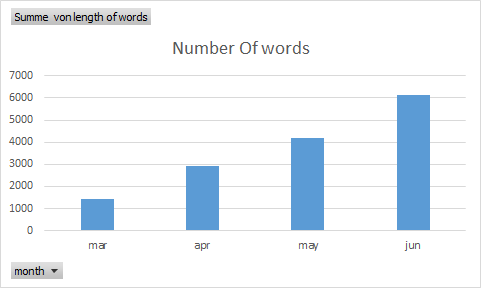
My Word-count over months on Medium

Here is a summary of the number of words I have written since the start of Medium-ing. Since my articles are also being read, I have ventured out of mini-articles under 500 words to bigger ones, while simultaneously cutting the bull-sh*t. (These stats are of course verifiable from my profile. The stats for June include two complete but unpublished drafts, of which the current article is a part).

Marketing Strategy
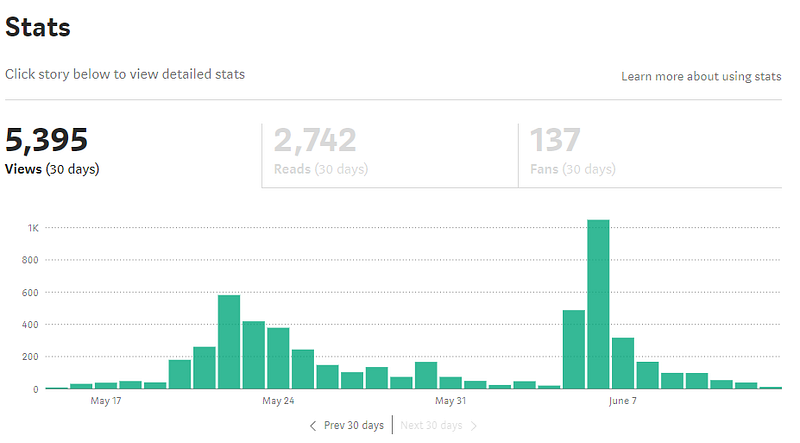
My stats on Medium — photo by author

Every upcoming bar on the My Stats chart above will be taller its left-side counterpart.

Good strategies are simple and verifiable. The above strategy streamlines my marketing goals for the articles. Earnings aside, I know exactly how much marketing is to be done on a given day to reach my goal number views. whether the views are internal or external does not matter to me. If I don’t make well on my target in a specific week, I try to average them out over the weekend or the week after.

Writing Quality
Photo by Hannah grace on Unsplash

The metric Read Ratio is an accurate reflection of the quality of your writing. views might come from marketing but a high read ratio is not something you can trick people into. Read ratio reflects two things:

  1. Length of the article
  2. Writing Quality

Length, because shorter articles might have a higher read-ratio despite their quality. If my articles have an appalling read ratio, It either means:

  1. The writing was not captivating enough to read on to the next line.
  2. The verbosity was unnecessary, there are other mistakes in grammar/presentation which make the writing unappealing.

Read ratio is also my favorite parameter to watch because it does not depend on how many people click, how bad your title is or that it is not on a big publication.

If only 10 viewers read your article (Strangers, since friends might do it out of love) and 9 out of 10 read it through, the quality of your writing is very high.

To get a high read ratio you might have to:

  1. Learn to build tension in your writing (without clickbait of course)
  2. Relate to the reader on a personal level
  3. Write concisely
  4. Be informative

All of these are very deep skills that take time and growth to improve, unlike the number of views, which is just clicking on the share button. If you can hit both read ratio and views, bingo! My highest earning article has the highest read-ratio for its word count and also the highest number of views.

The True Score Metric

Photo by Sigmund on Unsplash

I invented the following True score for myself to give my read ratio more meaning. (This is purely my metric, not a standard) The score has two goals:

  1. To measure the actual success of your read ratio despite how long or short your article is.
  2. To reward longer articles. Shorter articles have a goal of “not boring” the reader. A good article should have both length and substance. Also from my experience, shorter articles automatically have a higher read ratio

Here is how I calculate it:

  1. I divide all the article lengths with the word count of my largest article and express them as a proportion to my largest article.

N = (100 * l ) / b

Proportional length of the article → N

Length of the article → l

Length of the largest article → b

My longest article, say of 1600 words, will get a score of 100. The shortest, say of 800 words, gets a 50. Now all my article lengths are below 100 and greater than 0.

2. I define my True score as:

T = r / 200 — N

Read-ratio of the article → r

proportional length → N

True Score → T

200 is a constant value I chose since it gives an intuitive curve for reading ratios. Take the following example:

If an article of the largest length (say 1600) has a read ratio of 80, my true score would be:

N = 100 * (1600/1600) = 100

T = 80 / (200–100) = 0.8

If an article of word length 200 has a read ratio of 80, my true score would be:

N = 100 * (200/1600) = 12.5

T = 80/ (200–12.5) = 0.42

The read ratio is penalized by the small length of the article. For a 100% read ratio, here is what the true score values will look like at different lengths of the article:
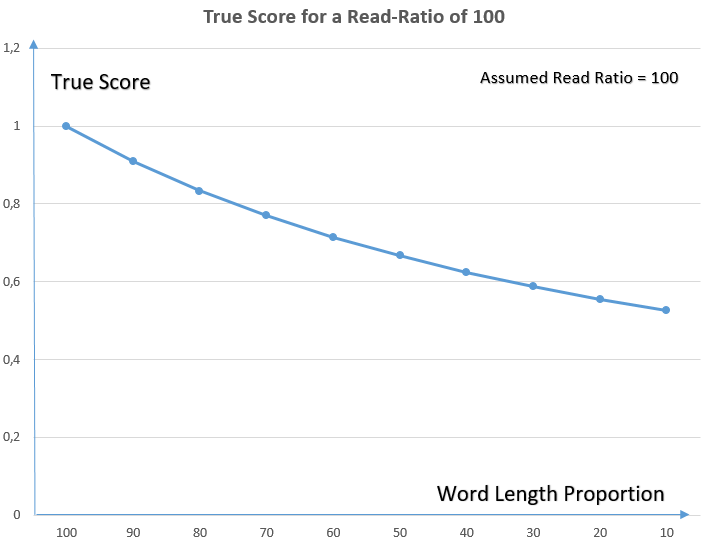
True Score: A read ratio of 100 normalized to the word-length — photo by author

Notice that for the same read ratio, an article of a larger word-count gets a higher True score. In the above chart, for a read ratio of 100, my largest article gets a true score of 1 whereas the smallest article (here of proportional word length 10) gets a True score of 0.5.

Here are my Actual True Scores for various articles and How they fare on True Score:
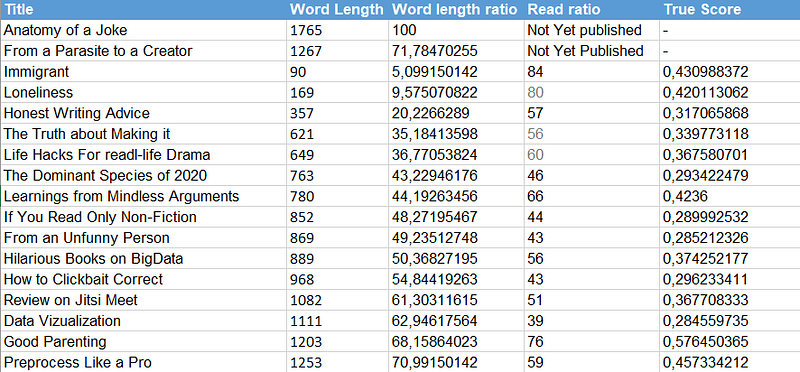
Word length, Read Ratio, and True Score for all my articles — photo by author
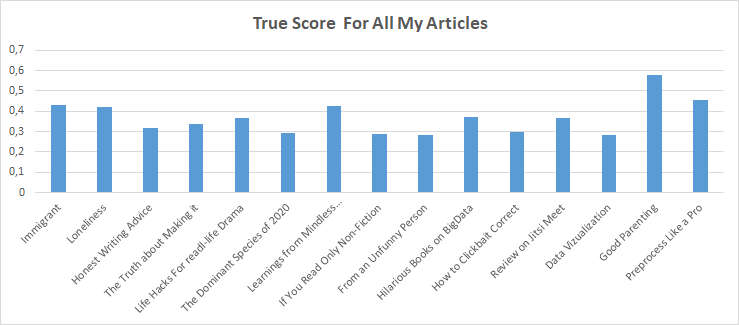
The true score for all my articles — photo by author

My highest earning article is the last bar on the above chart. (I removed comics in this analysis which have a word length of 0). It is also the second-highest True Score. The bar with the highest true score has only 29 views (Wasn’t marketed/Waiting on Curation). It is safe to assume that despite the good quality of this article, it has not reached as big an audience. The second highest true-score has reached an audience of 2.5k and has an extremely high read-ratio of 60% — clearly reflected in the earnings it brought.

If you want to be a good writer, your goal should be to Improve your True Score and Views (Marketing + Quality of writing).

All said and done, the cliche is true — Write because you love to write. It is impossible to put a metric on well-spent time and the amount of learning you incur in the process. I strongly recommend that you continue reading and writing on medium and keep growing!

Personal Growth
Writing Tips
Data Analysis
Productivity
Data
Recommended from ReadMedium