
5 Hilarious Books on Data Analytics Everybody Can Read
Bed-time stories for data-engineers

Today, nearly every profession involves Data Analytics of some form.
The following books are from professionals who ask questions that we probably should also be asking our numbers. Feel free to read them as bedtime stories too, they are brilliant and easy to read.
1. FREAKONOMICS — Rogue Economics
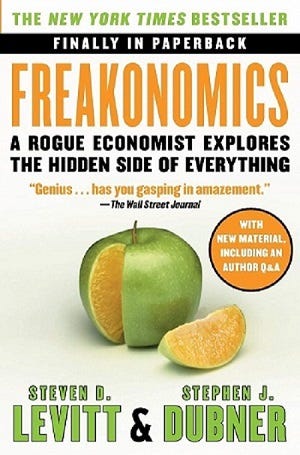
Levitt and Dubner are a delightful duo. While Levitt is a rogue economist and a human slide-rule. The book, written in Dubner’s witty tongue and Levitt’s research is a must-read for all data-lovers.
It offers a data based perspective on cause and effect relations to the most random topics such as:
- What do Sumo wrestlers and teachers have in common?
- What is the economic model of drug dealers?
- Does it matter what school you go to if you want to make it in life?
- Why are there Black names and white names, how do they play out in society?
The book won’t teach you how to data-analyze or do math. However, it will nudge you into asking the right questions. Read it. It is fun.
2. Everybody Lies — Really hilarious lies.
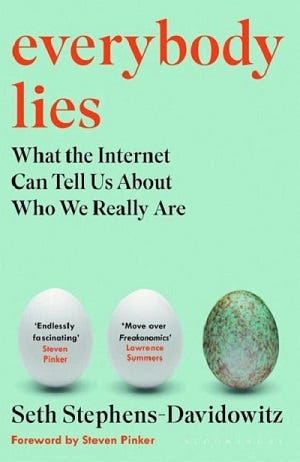
If you thought Freakonomics was entertaining, this might be even better.
This take on human beings based on google-searches throws a not-so-impressive light on humanity.
There is no arguing that google searches are honest. I wouldn’t type into google “How to pick my nose in public without being caught?” without genuinely being interested in the answer. People, in the confines of their bed and smartphone, are brutally honest about everything. Google knows!
Davidowitz analyses, among others, people’s sexual fantasies, their real and proclaimed voting habits, liberal (or extreme) ideologies, people’s genitalia-related insecurities, and all the things we are interested in (apparently).
3. Factfulness — Data Therapy
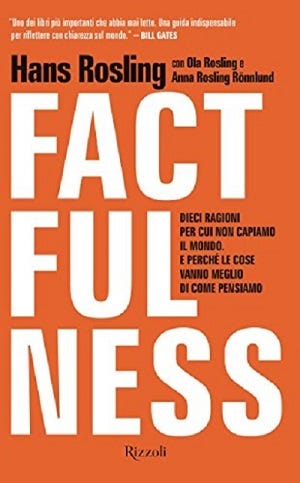
Factfulness is a data-based therapy for optimism.
Hans Rosling, a proven data visualization diva, having worked with the world bank, WHO, and who’s who of United Nations, left this piece of hope to the rest of the world days before he passed away.
Factfulness proves with brilliantly intuitive charts how amazing the world is. The number of children that are healthy today, the number of people not dying of hunger, reduced number of war-related deaths, and improving world education levels.
You name a parameter that is a benchmark for civilization, you have a chart for it that tells you we are at our ABSOLUTE PEAK in the history of existence.
There is an imminent need to recognize this and build on facts instead of on the purely devastating worldview offered by the media. The book is a must-read.
4. Fooled by Randomness — Being primate and living with it
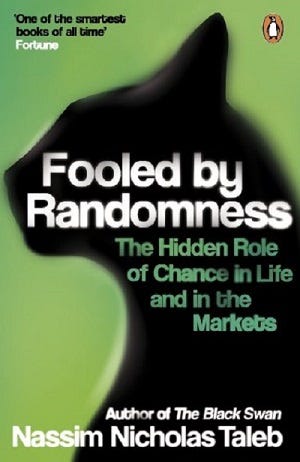
If you classify the rest of the books into the genre data science, this would be on the rack opposite under “anti-data-science”.
Nassim Taleb explores how misused data analysis is in his field, as a trader on the stock market — A field that is a minefield of surprises.
He makes valid arguments about how your wealth acquired by investing in stocks that “magically” went up has absolutely nothing to do with how awesome you are and goes on to statistically prove that the odds are that you are an idiot. He also briefly talks about how NOT to be one.
Taleb is deaf to the entire world, including his editor. That is also the tone assumed.
Although it is heavily data-based, the book talks only in the context of investments and stocks and occasional philosophy and mostly arrogance. It is a fun read.
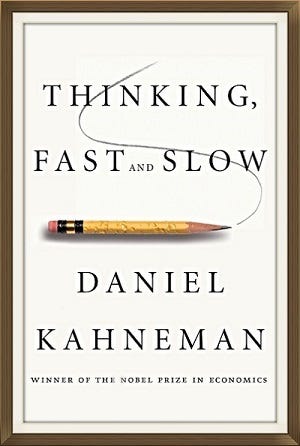
5. Thinking Fast and Slow — Why we do what we do
If these books were a Quentin Tarantino movie, you would immediately spot that they are all playing in the same universe and reference each other all the time.
Thinking Fast and Slow is the mother of all other works that talk about human behavior in number terms.
Kahneman also won the Nobel Prize for this economics-psychology masterpiece.
He divides the mind into a slow-thinking analytical brain (for example, while calculating 345x12), and a fast-thinking automatic one (deciding where to put the next step while taking a walk.)
Testing various specifics of human behavior on intuition, spending, risk-taking, assumptions in situations where our logic circuits are expected to come to play but don’t, it explains, very objectively and with all proof, the primates we are.