avatarDariusz Gross #DATAsculptor

Free AI web copilot to create summaries, insights and extended knowledge, download it at here

4809

Abstract

earchable database of ready-to-use 3D models that integrates with SketchUp. For everyone who develops or utilizes 3D models, 3D Warehouse is a fantastic resource and online community. You can use the 3D Warehouse to view and download models. It has more than 23 million registered members, each with its profile page with a collection of its designed models. You can use these freely available 3D models to add detail to your own SketchUp model.</p><p id="ca05"><a href="https://3dwarehouse.sketchup.com/"><b>Project Page</b></a><b> : </b>3D Warehouse</p><div id="9030" class="link-block"> <a href="https://readmedium.com/how-to-make-3d-models-from-a-single-image-d0eccc9209ba"> <div> <div> <h2>How to make 3D models from a single image</h2> <div><h3>New AI method to generate AR/VR scenes</h3></div> <div><p>medium.com</p></div> </div> <div> <div style="background-image: url(https://miro.readmedium.com/v2/resize:fit:320/1*84mr5Z89jZFkvFjYRShYNA.gif)"></div> </div> </div> </a> </div><h2 id="9bc3">🟠 Google Scanned Objects 1000+</h2><p id="8b7f"><b>Data Sets for Machine Learning, Computer Vision, and Robot Simulation</b></p><figure id="4e15"><img src="https://cdn-images-1.readmedium.com/v2/resize:fit:800/1*KFMJ0aF3CPMnX0eTBk8oqw.png"><figcaption></figcaption></figure><p id="0196">Interactive <a href="https://readmedium.com/how-a-neural-network-hallucinates-houses-from-a-single-image-c256c9df6178">3D simulations</a> have aided advances in robotics and computer vision, but recreating the wide range of situations required for deep learning necessitates a massive collection of photo-realistic 3D object models.</p><p id="aded">Providing a library of high-quality <b>3D object models</b> that can be included in physical and visual simulations to offer the essential diversity for deep learning is a significant challenge.</p><div id="dc74" class="link-block"> <a href="https://readmedium.com/how-a-neural-network-hallucinates-houses-from-a-single-image-c256c9df6178"> <div> <div> <h2>How a neural network hallucinates houses from a single image</h2> <div><h3>The synthesis of individual images has attracted much attention in computer vision and computer graphics. It brings a…</h3></div> <div><p>medium.com</p></div> </div> <div> <div style="background-image: url(https://miro.readmedium.com/v2/resize:fit:320/1*94rZxfzkFNz82XADcX84Sg.gif)"></div> </div> </div> </a> </div><p id="4e53">Google Scanned Objects (GSO) dataset1, a curated collection of over 1000 3D scanned everyday home objects for use in the Ignition Gazebo and Bullet simulators and other tools that can read the SDF model format; under a Creative Commons license.</p><p id="0a28">Real-world data collecting in 3D situations is complex because of the high cost and risk of robots and the inability of human labelers to derive 3D geometric attributes from photographs.</p><div id="580b" class="link-block"> <a href="https://readmedium.com/how-do-you-analyze-a-dataset-35783a577e58"> <div> <div> <h2>How do you analyze a dataset?</h2> <div><h3>Visualization for understanding — Computer Vision</h3></div> <div><p>medium.com</p></div> </div> <div> <div style="background-image: url(https://miro.readmedium.com/v2/resize:fit:320/1*NtE-NqY-VajBM03dIcRnow.jpeg)"></div> </div> </div> </a> </div><p id="9f37">Many of these restrictions may be mitigated by utilizing tools like Gazebo, Bullet, MuJoCo, and Unity to simulate robots and surroundings. Simulated environments can be safely modified, and semantic labels can be readily obtained from the simulation state. On the other hand, simulation is always a poor imitation of reality: handmade models of polygons and primitives do not match well with real things. Even if a scene is created from a 3D scan of an open area, the discrete items in the scan will behave as fixed backdrop scenery and will not respond to inputs in the same way that real-world objects would.</p><p id="90bc"><a href="https://app.ignitionrobotics.org/GoogleResearch/fuel/collections/Google%20Scanned%20Objects"><b>Project Page </b></a><b>: </b>Google Scanned Objects</p><h2 id="a57f">Data set limitations</h2><p id="f61e"><b>Each collection has a different purpose</b>. The datasets contain other visible objects, such as chairs, vehicles, or airplanes, from small to increasingly larger. Scan res

Options

olution also varies, and tiny objects may not be accurately represented. A wide variety of textures. Objects with high gloss or transparency cannot be represented perfectly. The 3D model has many limitations, which does not mean it can not be helpful. Using the collections intentionally and setting success metrics at the beginning of the project can save time and resources.</p><div id="2f44" class="link-block"> <a href="https://readmedium.com/how-does-3d-reconstruction-work-112c6505dc0b"> <div> <div> <h2>How does 3D reconstruction work?</h2> <div><h3>DPT + 3D Voxels — Vision Transformers DEMO</h3></div> <div><p>medium.com</p></div> </div> <div> <div style="background-image: url(https://miro.readmedium.com/v2/resize:fit:320/1*B9lR0SJTHcL_5Izs0px4og.png)"></div> </div> </div> </a> </div><p id="bf6b">I expect the variety, quality, and adaptability of scanned objects available for free today will contribute to the development of interactive simulation, synthetic perception, and learning by AI art robots.</p><h2 id="bb7c">Keywords: computer vision, Artificial Intelligence, datasets, Machine Learning, AI art, art, digital art, 3D, 3D models, 3D scan, Synthetic data,</h2><p id="9594">I invite you to explore the concept of “AI creativity” by reading and learning from the many articles found on 🔵 <a href="https://mlearning.substack.com"><b>MLearning.ai</b></a><b> </b>🟠</p><div id="5afe" class="link-block"> <a href="https://datasculptor.medium.com/membership"> <div> <div> <h2>Join Medium with my referral link - Dariusz Gross #DATAsculptor</h2> <div><h3>As a Medium member, a portion of your membership fee goes to writers you read, and you get full access to every story…</h3></div> <div><p>datasculptor.medium.com</p></div> </div> <div> <div style="background-image: url(https://miro.readmedium.com/v2/resize:fit:320/0*EVTwDioO26SyxuZD)"></div> </div> </div> </a> </div><ul><li><i>Check out my <a href="https://www.instagram.com/datasculptor/">instagram</a> with new material every week</i></li><li><i>If you enjoyed this, <a href="/@DATAsculptor">follow me on Medium</a> for more</i></li><li><i>Want to collaborate? Let’s connect on <a href="https://www.linkedin.com/in/dariusz-gross/">LinkedIn</a></i></li><li><a href="https://linktr.ee/datasculptor"><i>https://linktr.ee/datasculptor</i></a></li><li><i>3D Machine Learning generated model on <a href="https://sketchfab.com/degross">sketchfab</a></i></li></ul><blockquote id="8035"><p><i>Data Scientists must think like an artist when finding a solution when creating a piece of code. <a href="/mlearning-ai/tagged/art">Artists</a> enjoy working on interesting problems, even if there is no obvious answer.</i></p></blockquote><p id="1dfb">All our writers (<a href="https://www.getrevue.co/profile/mlearning_ai/members"><b>members</b></a>) receive the opportunity to be promoted on our social media, which increases the popularity of articles published on MLearning.ai</p><ol><li><a href="https://www.linkedin.com/company/mlearning-ai/">Linkedin</a> (<b>9.4K</b>+ ML-professionals)</li><li><a href="https://twitter.com/Mlearning_ai">Twitter</a> (4.8K+ followers)</li><li><a href="https://www.instagram.com/mlearning.ai/">Instagram</a> (2.2K + followers )</li><li><a href="/mlearning-ai/take-vr-tour-of-these-ml-stories-a7550340a6a2">Sketchfab</a> * — individual v<a href="/mlearning-ai/zahra-ahmads-vroom-1510367d679d">Roo</a>ML!</li><li><a href="https://www.facebook.com/Art.Machine.Learning">Facebook</a></li><li><a href="https://www.youtube.com/watch?v=-AXMoEiGdaI">Youtube</a></li><li><a href="https://podcasts.apple.com/pl/podcast/learning-better-and-faster/id1580007913">Apple Podcasts</a></li><li><a href="https://mlearning.substack.com">Substack</a></li></ol><p id="7c76">🔵 <a href="/mlearning-ai/mlearning-ai-submission-suggestions-b51e2b130bfb">Submission Suggestions</a></p><div id="9621" class="link-block"> <a href="https://readmedium.com/mlearning-ai-submission-suggestions-b51e2b130bfb"> <div> <div> <h2>Mlearning.ai Submission Suggestions</h2> <div><h3>How to become a writer on Mlearning.ai</h3></div> <div><p>medium.com</p></div> </div> <div> <div style="background-image: url(https://miro.readmedium.com/v2/resize:fit:320/1*ib0DX0UzRoFcNuZILb7rNA.jpeg)"></div> </div> </div> </a> </div></article></body>

Machine Learning Art

3 Best Websites to Download Free 3D Model

Synthetic data In Machine Learning
https://mlearning.substack.com

3D Models for Free — Royalty-Free & Creative Commons

Today, we will talk about the strange and beautiful things you can find in 3D data sets. So let me take you on a journey through what is free to download, a brief overview of the three immediately available model collections. Three different sets — 3 different applications. Skillful use of these resources can bring exciting results.

  • April 2022 — AI art tools update can be found ➡️ HERE ⬅️

In Machine Learning, what is synthetic data?

Synthetic data is information that is created artificially rather than by real-world occurrences. Synthetic data is generated algorithmically and used as a stand-in for production or operational data test datasets, mathematical model validation, and machine learning model training.

🔵 Sketchfab 600K+ Free Models

Data Sets for Game Developers, Artists, and World Builder

What is the purpose of Sketchfab? Sketchfab is a website for publishing, sharing, discovering, buying, and selling 3D, VR, and AR material.

Sketchfab uses WebGL, a standard rendering technology in most recent browsers, to show 3D models in real-time. You may use a smartphone, Google Cardboard, and a stereoscopic viewer to explore all Sketchfab models in Virtual Reality (VR).

To access the model in Virtual Reality mode, go to the model page and press the “View in VR” icon (in the top-right corner).

You may see our showroom in augmented reality as well.

🔵 3D Warehouse 4+ million models

Data Sets for Architects, Designers, and Simulation
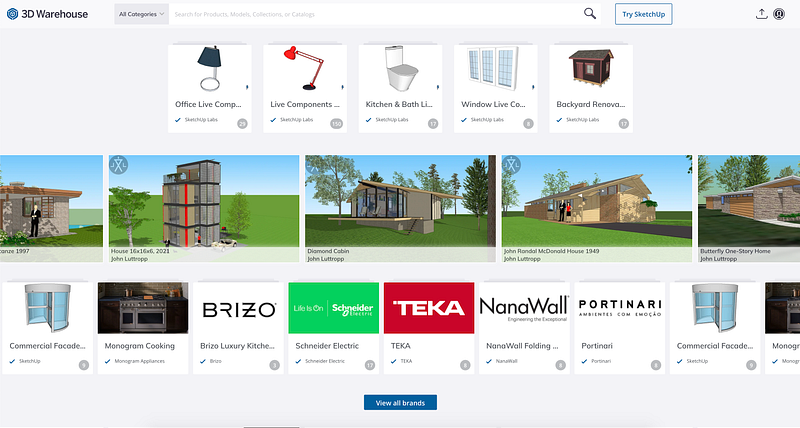
3D Warehouse is a website with a searchable database of ready-to-use 3D models that integrates with SketchUp. For everyone who develops or utilizes 3D models, 3D Warehouse is a fantastic resource and online community. You can use the 3D Warehouse to view and download models. It has more than 23 million registered members, each with its profile page with a collection of its designed models. You can use these freely available 3D models to add detail to your own SketchUp model.

Project Page : 3D Warehouse

🟠 Google Scanned Objects 1000+

Data Sets for Machine Learning, Computer Vision, and Robot Simulation
Interactive 3D simulations have aided advances in robotics and computer vision, but recreating the wide range of situations required for deep learning necessitates a massive collection of photo-realistic 3D object models.

Providing a library of high-quality 3D object models that can be included in physical and visual simulations to offer the essential diversity for deep learning is a significant challenge.

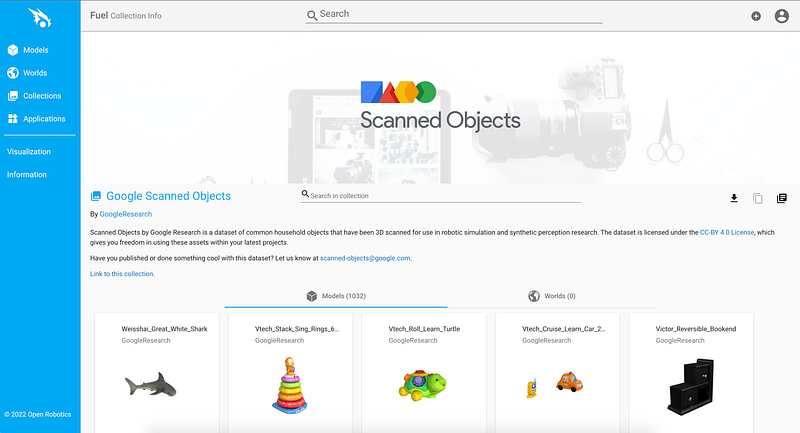
Google Scanned Objects (GSO) dataset1, a curated collection of over 1000 3D scanned everyday home objects for use in the Ignition Gazebo and Bullet simulators and other tools that can read the SDF model format; under a Creative Commons license.

Real-world data collecting in 3D situations is complex because of the high cost and risk of robots and the inability of human labelers to derive 3D geometric attributes from photographs.

Many of these restrictions may be mitigated by utilizing tools like Gazebo, Bullet, MuJoCo, and Unity to simulate robots and surroundings. Simulated environments can be safely modified, and semantic labels can be readily obtained from the simulation state. On the other hand, simulation is always a poor imitation of reality: handmade models of polygons and primitives do not match well with real things. Even if a scene is created from a 3D scan of an open area, the discrete items in the scan will behave as fixed backdrop scenery and will not respond to inputs in the same way that real-world objects would.

Project Page : Google Scanned Objects

Data set limitations

Each collection has a different purpose. The datasets contain other visible objects, such as chairs, vehicles, or airplanes, from small to increasingly larger. Scan resolution also varies, and tiny objects may not be accurately represented. A wide variety of textures. Objects with high gloss or transparency cannot be represented perfectly. The 3D model has many limitations, which does not mean it can not be helpful. Using the collections intentionally and setting success metrics at the beginning of the project can save time and resources.

I expect the variety, quality, and adaptability of scanned objects available for free today will contribute to the development of interactive simulation, synthetic perception, and learning by AI art robots.

Keywords: computer vision, Artificial Intelligence, datasets, Machine Learning, AI art, art, digital art, 3D, 3D models, 3D scan, Synthetic data,

I invite you to explore the concept of “AI creativity” by reading and learning from the many articles found on 🔵 MLearning.ai 🟠

Data Scientists must think like an artist when finding a solution when creating a piece of code. Artists enjoy working on interesting problems, even if there is no obvious answer.

All our writers (members) receive the opportunity to be promoted on our social media, which increases the popularity of articles published on MLearning.ai

  1. Linkedin (9.4K+ ML-professionals)
  2. Twitter (4.8K+ followers)
  3. Instagram (2.2K + followers )
  4. Sketchfab * — individual vRooML!
  5. Facebook
  6. Youtube
  7. Apple Podcasts
  8. Substack

🔵 Submission Suggestions

Ai Art
Machine Learning
Artificial Intelligence
Computer Vision
Data
Recommended from ReadMedium