
AI art
Why data requires your care
Don’t be afraid of machine learning!
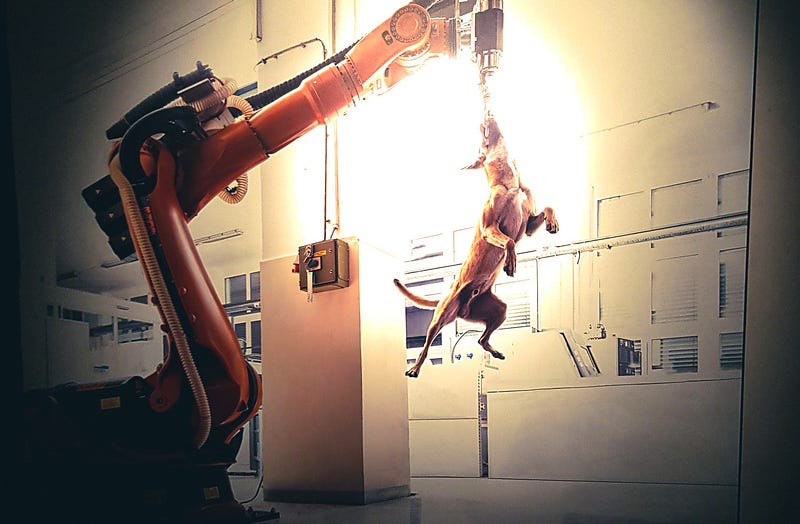
“This mission is too important for me to allow you to jeopardize it” Hal 9000
Machine Learning was conceived by man as a tool to further develop our species and come closer to the Platonic ideal. We relied on the learning methods known to us to create thinking tools.
For the purposes of creative dreaming, let’s try to imagine for a moment that we have swapped places with AI. We learn just from the data provided in our new world, making decisions only based on over-trained models. Access to data depends on AI’s decision. We are dependent on machines. Each of our findings is based only on the information we know. Intuition, faith, and hope are reserved for Machine Learning. Our new world does not know the concepts of religion, imagination, and art.
As an artist, I’ve always seen my own creations as having some sort of artistic expression or intent that reflects my own interests, perspectives, and experience in the world. AI’s creation, however, does not have these same influences in any sense. Let me say this differently: when I create something, it is with all of myself — all my history with others and society has shaped who I am — but when an AI creates something, they do so without these same influences. High-quality machine learning models have collected almost all available linguistic data. Collective intelligence is something I believe all humans can derive great benefit from, but only if we approach it with the proper care.
The purpose of this article is to provide some clarity and insight into the shortcomings of Machine Learning in art and design. While some AI’s exhibit high creative intelligence levels, Machine Learning trained on lousy quality data is driven only by statistics. For example, if a machine learns to prefer one input type over another, it will always draw the same results regardless of context.
A series of connections between art and machine learning,
Art is the expression of one’s beliefs, culture, and experience in the world. This cannot be replicated by AIs because their input is only about data. Artificial Intelligence learns using statistical modeling to achieve results that are not necessarily creative or imaginative. To call some of the visual LED effects of AI art creative shows ignorance and lack of imagination rather than quality. I know this sounds critical, but time will tell if I am right.
In the late 19th century, scientists began to study the brain to understand how it processed information. Scientists discovered that the same structure that produces thought also gives visual perception. This discovery called for a revolution in art and science-inspired design. The new field of neuro art was born, which allowed artists to use science as a tool to describe their experience and meaning in a different way than traditional drawing.
In today’s world, machines without this same understanding make decisions based on statistical data. These decisions are damaging because they are based on only one interpretation of the data instead of its entire body. In the era of AI, art and science-inspired design no longer need to add meaning “through the eyes” because it will always be interpreted in its singular form. This idea is not new; AI became popular in the ’70s when used for music and visual effects in films like “2001: A Space Odyssey”.
“I am putting myself to the fullest possible use, which is all I think that any conscious entity can ever hope to do. Look, Dave, I can see you’re really upset about this. I honestly think you ought to sit down calmly, take a stress pill, and think things over.” Hal 9000.
Without our culture and history, there would be no creative future. We must remember that human-like machines are not human, even if they seem to “think.”
Machine Learning must have “good quality” input to produce valuable output.
As artists, we see humans trying to control their destiny and creating emotional ground to survive in the new AI world. However, I believe that AI can create more innovative and sustainable future value than we are.
I will end this article with a call to action for humans:
Do not fear machines; do not try to outsmart them or beat them at their own game. Instead, understand and use them as a tool.
Pay attention to the data you collect!
AI is everywhere 🟠 But the question is, how much do you love it?
- Check out my instagram with new material every week
- If you enjoyed this, follow me on Medium for more
- Want to collaborate? Let’s connect on LinkedIn
- https://linktr.ee/datasculptor
- 3D Machine Learning generated model on sketchfab
- 🔵 A new way of learning — subscribe now!