
Data Driven Architecture
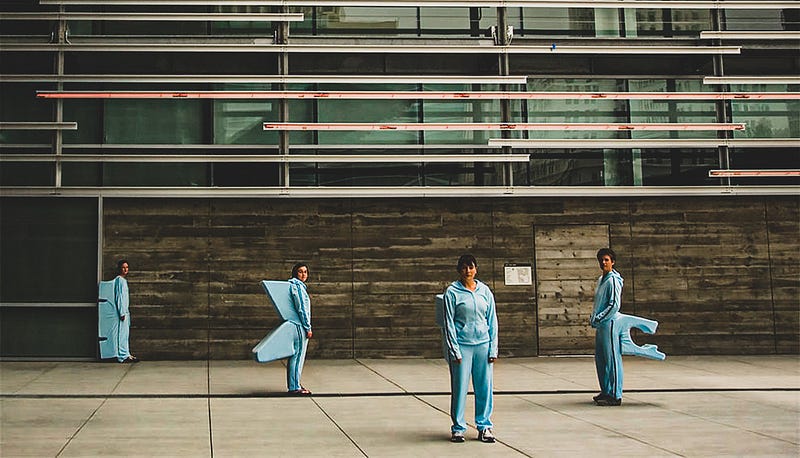
Dress right for hostile architecture
The Future of Design is Machine Learning
This blog post explores how machine learning can help architects to create a sustainable environment for our future.
A potential future of architecture, where AI artists can do more than simply provide human insight but actually generate ideas that humans would never have had otherwise.
Sarah Ross’s Archisuits are a hilarious and pointed look at soft bodies in complex spaces — all the ways the built environment is a mismatch for human needs.

“Archisuit lies forward of us while we remain still, watching it in wonderment. It reflects our culture, who we are, and where we belong within the community.”

The 2011 Ross suit design not only points to architectural flaws but is a perfect example of how art can lead architects out of the cul-de-sac in which they find themselves.
We usually rely on human intuition to develop ideas for buildings, but not anymore. So instead, AI artists are coming to brainstorm ideas for our complex design challenges and create new architectural masterpieces in the spirit of innovation and creativity.
With the ever-increasing development of machine learning, it can now be applied in the design process to automate and speed up our design process.
In the past, AI has been widely applied to solve a fundamental problem in engineering, but now it is gradually being deployed in fields such as medicine, education, and journalism.
Let’s look at how machine learning can generate potential ideas to solve this future design challenge.
As an AI artist, I can look at the digital terrain generated by a client and train my algorithm to identify the optimal paths and shapes. I can then export that digital terrain as an STL file which the architect could save on his mobile device, print it out, lift it and pass it to his coworkers in their office. They could use that as a reference sheet to help them make proposals for their clients.
Machine Learning can also be used to optimize the architecture and construction of a building, which means that AI. can help architects design eco-friendly buildings and free up the construction workers’ time to do other things, like reconstructing existing buildings.
The revolution will not be centralized. The future belongs to everyone.”
The greatest thing about machine learning is that it can help us predict changes that will happen in the next few years.
In this world where any progress can be made with AI, one thing remains constant: our need for creativity and innovation to thrive. They all require design from buildings and homes, cars and bridges, down to children’s toys. But, because of its ability to understand complex problems better than humans could ever hope to achieve on their own, it has arrived into a promising space that many people aren’t aware of yet but should know more about today — architectural design.
As the design world becomes increasingly technologically advanced, we’ve had to deal with what machines can and can’t do better than us. As designers, we need to accept that the “human touch” is an illusion — as our thoughts are manipulated and rendered through algorithms. This is a good thing — it means that one day, AI will be able to help us innovate our way in this creative field without the need for a human hand holding the sketchbook or knowing how to put two lines together.
AI is everywhere 🟠 But the question is, how much do you love it?
- Check out my instagram with new material every week
- If you enjoyed this, follow me on Medium for more
- Want to collaborate? Let’s connect on LinkedIn
- https://linktr.ee/datasculptor
- 3D Machine Learning generated model on sketchfab
- Substack


