avatarDariusz Gross #DATAsculptor

Free AI web copilot to create summaries, insights and extended knowledge, download it at here

3555

Abstract

figure><p id="e143"><b>GARF</b> is compared against several network topologies, including <b>PE-MLP</b>, <b>BARF, SIREN</b>. GARF solves for exact geometric transformations and neural picture representation using gaussian activations instead of cumbersome multi-dimensional parameter adjustment and model initialization.</p><div id="6c0f" class="link-block"> <a href="https://readmedium.com/how-to-edit-a-nerf-sculpture-6255e4974396"> <div> <div> <h2>How to edit a NeRF sculpture</h2> <div><h3>Geometry Editing of Neural Radiance Fields</h3></div> <div><p>medium.com</p></div> </div> <div> <div style="background-image: url(https://miro.readmedium.com/v2/resize:fit:320/1*op63MY-B_R0N8xf8hBmzCQ.gif)"></div> </div> </div> </a> </div><p id="2fd5"><b>The new method is extremely precise and devoid of the disadvantages of previous solutions, such as artifacts visible in the below photos.</b></p><figure id="18d4"><img src="https://cdn-images-1.readmedium.com/v2/resize:fit:800/1*mILRl6asYVdQAEiB_p_CfA.png"><figcaption></figcaption></figure><p id="fc76">The left scene was captured using iPhone. Top row: Rendered image and depth scene using an old method Bottom row: Rendered image and depth scene using <b>GARF.</b></p><div id="7cb8" class="link-block"> <a href="https://readmedium.com/how-to-make-3d-models-from-a-single-image-d0eccc9209ba"> <div> <div> <h2>How to make 3D models from a single image</h2> <div><h3>New AI method to generate AR/VR scenes</h3></div> <div><p>medium.com</p></div> </div> <div> <div style="background-image: url(https://miro.readmedium.com/v2/resize:fit:320/1*84mr5Z89jZFkvFjYRShYNA.gif)"></div> </div> </div> </a> </div><h2 id="5b7f">robots and self-driving cars</h2><p id="2a6a">By collecting 2D images or videotape footage of real-world things, the method might be used to educate robots and self-driving cars to grasp their size and shape. It might also be used in architecture and entertainment to quickly build digital replicas of real-world terrains that artists can rework and add to. The new method GARF makes it more efficiency.</p><div id="4ed4"><pre><span class="hljs-symbol">title:</span> GARF: Gaussian Activated Radiance Fields for High Fidelity Reconstruction <span class="hljs-keyword">and </span>Pose Estimation the authors :<span class="hljs-keyword">Shin-Fang </span>Chng, Sameera Ramasinghe, <span class="hljs-keyword">Jamie </span><span class="hljs-keyword">Sherrah, </span>Simon Lucey</pre></div><figure id="1105"><img src="https://cdn-images-1.readmedium.com/v2/resize:fit:800/1*-3b2urrvEo5dCftajylptw.png"><figcaption><a href="https://arxiv.org/pdf/2204.05735.pdf">https://arxiv.org/pdf/2204.05735.pdf</a></figcaption></figure><h2 id="56b6">Poject page:</h2><p id="3fc9"><a href="https://arxiv.org/pdf/2204.05735.pdf">https://arxiv.org/pdf/2204.05735.pdf</a></p><h2 id="02fa">Colab: an example of NeRF:</h2><p id="258d"><a href="https://colab.research.google.com/github/keras-team/keras-io/blob/master/examples/vision/ipynb/nerf.ipynb#scrollTo=o-rC8M34sAQ5">https://colab.research.google.com/github/keras-team/keras-io/blob/master/examples/vision/ipynb/nerf.ipynb#scrollTo=o-rC8M34sAQ5</a></p><h2 id="9d14">Keywords: 3D, computer vision, Artificial Intellig

Options

ence, Graphics, Machine Learning, AI art, art, digital art, GARF, AR, VR, inverse graphics, Pattern Recognition, NeRF</h2><p id="c6a6">I invite you to explore the concept of “AI creativity” by reading and learning from the many articles found on 🔵 <a href="https://mlearning.substack.com"><b>MLearning.ai</b></a> 🟠</p><div id="5030" class="link-block"> <a href="https://datasculptor.medium.com/membership"> <div> <div> <h2>Join Medium with my referral link - Dariusz Gross #DATAsculptor</h2> <div><h3>As a Medium member, a portion of your membership fee goes to writers you read, and you get full access to every story…</h3></div> <div><p>datasculptor.medium.com</p></div> </div> <div> <div style="background-image: url(https://miro.readmedium.com/v2/resize:fit:320/0*zfDy8QvT0JujuY96)"></div> </div> </div> </a> </div><ul><li><i>Check out my <a href="https://www.instagram.com/datasculptor/">instagram</a> with new material every week</i></li><li><i>If you enjoyed this, <a href="/@DATAsculptor">follow me on Medium</a> for more</i></li><li><i>Want to collaborate? Let’s connect on <a href="https://www.linkedin.com/in/dariusz-gross/">LinkedIn</a></i></li><li><a href="https://linktr.ee/datasculptor"><i>https://linktr.ee/datasculptor</i></a></li><li><i>3D Machine Learning generated model on <a href="https://sketchfab.com/degross">sketchfab</a></i></li></ul><blockquote id="fa3b"><p><i>Data Scientists must think like an artist when finding a solution when creating a piece of code. <a href="/mlearning-ai/tagged/art">Artists</a> enjoy working on interesting problems, even if there is no obvious answer.</i></p></blockquote><p id="fcad">All our writers (<a href="https://www.getrevue.co/profile/mlearning_ai/members">members</a>) receive the opportunity to be promoted on our social media, which increases the popularity of articles published on MLearning.ai</p><ol><li><a href="https://www.linkedin.com/company/mlearning-ai/">Linkedin</a> (7.7K+ ML-professionals)</li><li><a href="https://twitter.com/Mlearning_ai">Twitter</a> (4.7K+ followers)</li><li><a href="https://www.instagram.com/mlearning.ai/">Instagram</a> (2.2K + followers )</li><li><a href="/mlearning-ai/take-vr-tour-of-these-ml-stories-a7550340a6a2">Sketchfab</a> * — individual v<a href="/mlearning-ai/zahra-ahmads-vroom-1510367d679d">Roo</a>ML!</li><li><a href="https://www.facebook.com/Art.Machine.Learning">Facebook</a></li><li><a href="https://www.youtube.com/watch?v=-AXMoEiGdaI">Youtube</a></li><li><a href="https://podcasts.apple.com/pl/podcast/learning-better-and-faster/id1580007913">Apple Podcasts</a></li><li><a href="https://mlearning.substack.com">Substack</a></li></ol><p id="a20e">🔵 <a href="/mlearning-ai/mlearning-ai-submission-suggestions-b51e2b130bfb">Submission Suggestions</a></p><div id="9c48" class="link-block"> <a href="https://readmedium.com/mlearning-ai-submission-suggestions-b51e2b130bfb"> <div> <div> <h2>Mlearning.ai Submission Suggestions</h2> <div><h3>How to become a writer on Mlearning.ai</h3></div> <div><p>medium.com</p></div> </div> <div> <div style="background-image: url(https://miro.readmedium.com/v2/resize:fit:320/1*ib0DX0UzRoFcNuZILb7rNA.jpeg)"></div> </div> </div> </a> </div></article></body>

Machine Learning Art

3D from 2D in the Blink of an AI

GARF state-of-the-art in reconstruction and pose estimation
NeRF neural network

Can you convert a 2D image to 3D?

Machine Learning can almost instantly construct a 3D scene. The authors have created a new method to generate 3D environments from a single 2D image. GARF was born. Can optimize for high-quality representation of scenes from unknown camera positions without auxiliary position planning.

  • April 2022 — AI art tools update can be found ➡️ HERE ⬅️

What is a NeRF neural network, and how does it work?

The Neural Radiance Field, or NeRF, is a technique for creating new perspectives on complicated situations. NeRF takes a group of input photos from a scene and interpolates between them to render the entire scene.

an example of NeRF — Render 3D Scene (colab)

Even though NeRF has shown promising outcomes in creating photorealistic new views of real-world situations, most present techniques need precise previous camera postures. Although there are methods for recovering the radiance field and camera posture simultaneously (BARF), they rely on a time-consuming coarse-to-fine auxiliary positional embedding to get satisfactory results. The authors offer Gaussian Activated Neural Radiance Fields GARF, a novel positional embedding-free neural radiance field architecture that exceeds the state-of-the-art in terms of high fidelity reconstruction and poses estimation by applying Gaussian activations.
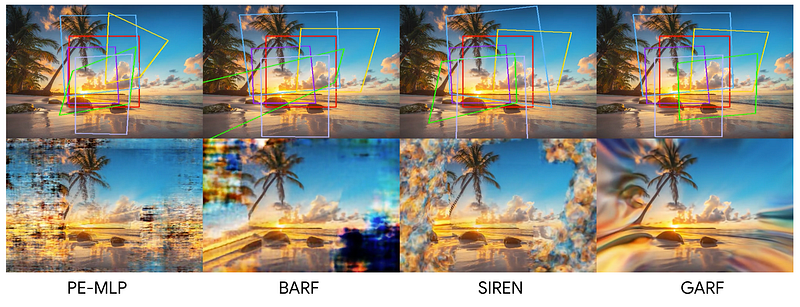
GARF is compared against several network topologies, including PE-MLP, BARF, SIREN. GARF solves for exact geometric transformations and neural picture representation using gaussian activations instead of cumbersome multi-dimensional parameter adjustment and model initialization.

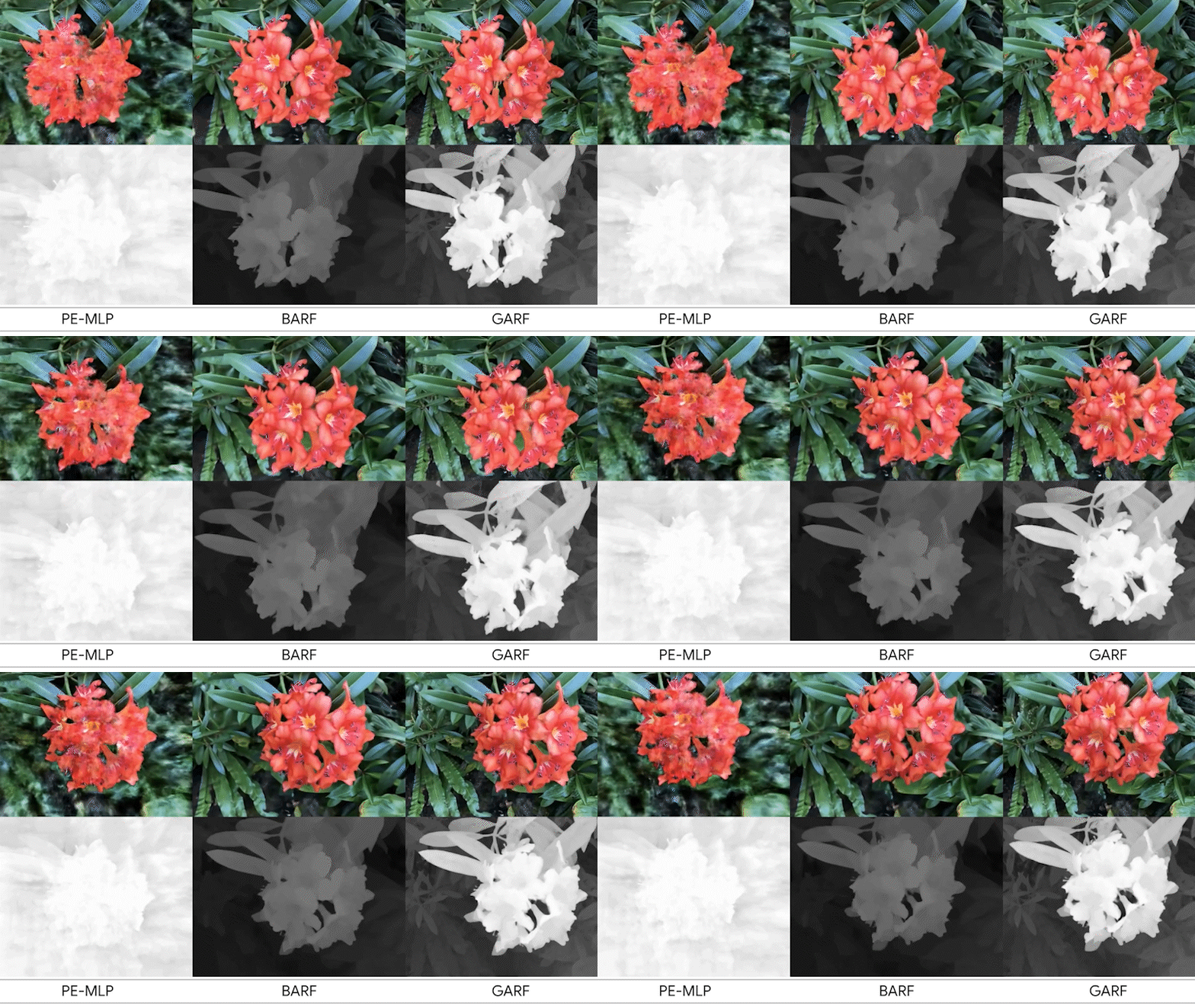
The new method is extremely precise and devoid of the disadvantages of previous solutions, such as artifacts visible in the below photos.
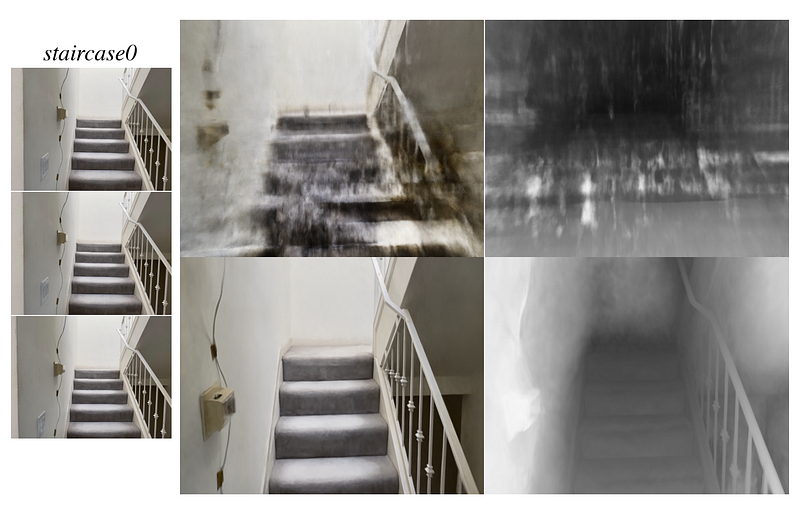
The left scene was captured using iPhone. Top row: Rendered image and depth scene using an old method Bottom row: Rendered image and depth scene using GARF.

robots and self-driving cars

By collecting 2D images or videotape footage of real-world things, the method might be used to educate robots and self-driving cars to grasp their size and shape. It might also be used in architecture and entertainment to quickly build digital replicas of real-world terrains that artists can rework and add to. The new method GARF makes it more efficiency.

title: GARF: Gaussian Activated Radiance Fields for High Fidelity Reconstruction and Pose Estimation
the authors :Shin-Fang Chng, Sameera Ramasinghe, Jamie Sherrah, Simon Lucey
https://arxiv.org/pdf/2204.05735.pdf

Poject page:

https://arxiv.org/pdf/2204.05735.pdf

Colab: an example of NeRF:

https://colab.research.google.com/github/keras-team/keras-io/blob/master/examples/vision/ipynb/nerf.ipynb#scrollTo=o-rC8M34sAQ5

Keywords: 3D, computer vision, Artificial Intelligence, Graphics, Machine Learning, AI art, art, digital art, GARF, AR, VR, inverse graphics, Pattern Recognition, NeRF

I invite you to explore the concept of “AI creativity” by reading and learning from the many articles found on 🔵 MLearning.ai 🟠

Data Scientists must think like an artist when finding a solution when creating a piece of code. Artists enjoy working on interesting problems, even if there is no obvious answer.

All our writers (members) receive the opportunity to be promoted on our social media, which increases the popularity of articles published on MLearning.ai

  1. Linkedin (7.7K+ ML-professionals)
  2. Twitter (4.7K+ followers)
  3. Instagram (2.2K + followers )
  4. Sketchfab * — individual vRooML!
  5. Facebook
  6. Youtube
  7. Apple Podcasts
  8. Substack

🔵 Submission Suggestions

Ai Art
Machine Learning
3d
Artificial Intelligence
Computer Vision
Recommended from ReadMedium