
Part 4 of a 4-part Guide to Meditation
Your Life Is Your Meditation (III): Examples of ACTIVE Meditations
[Updated Dec 28, 2021] My personal review of “Participatory Meditation” practices that are part of the 9 basic types of meditation.
This Is the final article in my meditation series, which started with: Meditation Explainer: the What, Why & How of Meditating. This short introductory section is included in all the articles, so you can go straight to *THIS ARTICLE* below to start what is new information here.
In that first article, I identified 3 Forms of Meditation:
- [1] Self Meditations — meditating independently of any external influences; covered in the 2nd article in the series
- [2] Guided Meditations — meditating while listening to an external source; covered in this article; covered in the 3rd article in the series
- [3] Active Meditations — physically participating in an activity; covered in the next article in this series; covered in this article
Each of these Forms has 3 Types, for a total of different 9 Types.
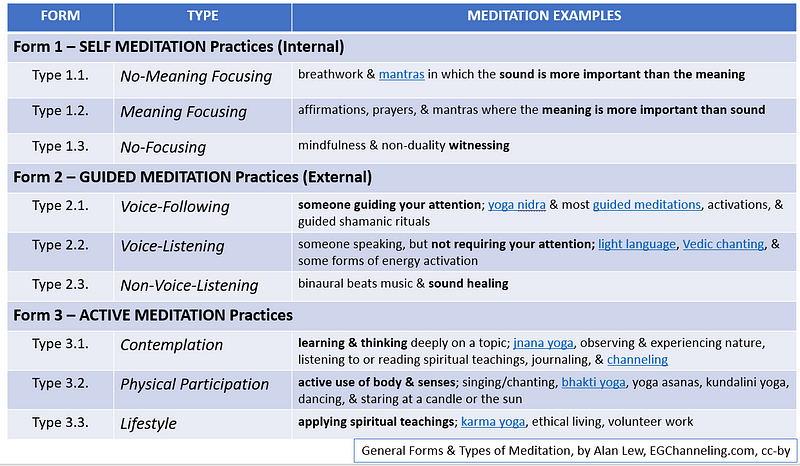
The What, Why, & How of Meditating article describes each of the 9 types in a general overview. This article is a personal review of examples of the 3 types of Active Meditations.
My meditation practices vary, but over the course of a week they will include most of the following. (Note that if I close my eyes, I use the word “meditation”. If my eyes are mostly open, I use the word “practice”.)
[Form 1] SELF Meditation Practices (Internal) — * Previous Article*
TYPE 1.1. No-Meaning Focusing <Example 1> Mantra Meditation TYPE 1.2. Meaning Focusing <Example 2> Chakra Meditation TYPE 1.3. No-Focusing <Example 3> Non-Duality Mindfulness
[Form 2] GUIDED Meditation Practices (External) — *Previous Article*
TYPE 2.1. Voice-Following <Example 4> Channeled Meditation TYPE 2.2. Voice-Listening <Example 5> Activation Meditation TYPE 2.3. Non-Voice-Listening <Example 6> Water Sound Meditation, and — <Example 7> Breathwork Meditation
[Form 3] Active Meditation Practices — *THIS ARTICLE*
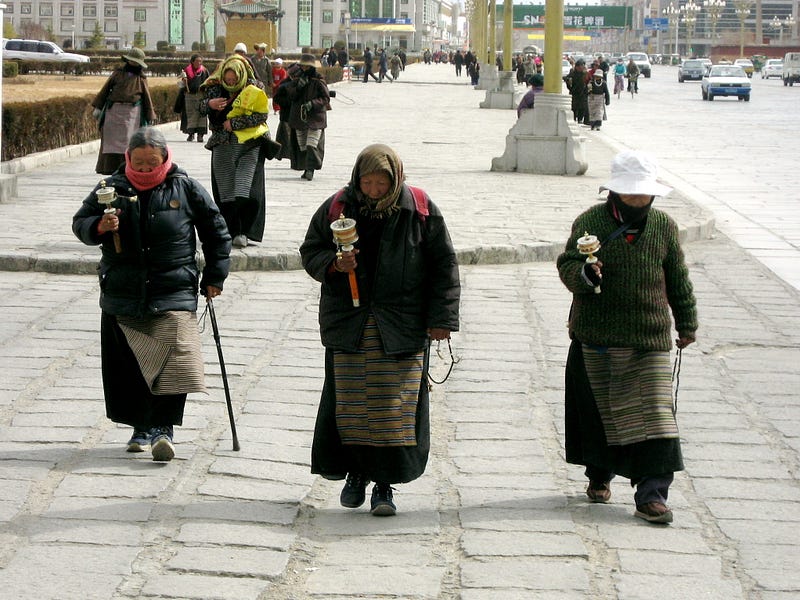
Active Meditation Practices (Form 3) are sometimes not considered “meditation” by contemporary definitions. You are not in a sitting position and your eyes are open for most of these practices. But the most significant thing is that your mind is focused on a task or interaction with the world around you.
The diversity of Active Meditation practices is also greater than for Self and Guided Meditations. This is because we can use anything as a meditation. It is our attitude and perspective that makes it spiritual rather than mundane. For those awakened to that, their entire life and being can be a meditation.
TYPE 3.1. Contemplation — “Contemplation” is the original definition of meditation and is still an important meditation practice. Common forms of contemplation meditation include observing and experiencing nature, listening to or reading spiritual teachings, journaling, listening to or doing channeling, and simply thinking about life and the question, “Who Am I?”. In Hinduism, they call this jnana yoga. But beyond those, we can approach all forms of thinking and learning as a spiritual act, bringing them into our lived experience (see Lifestyle Meditation, below). <Example 8> — An Active, Contemplation, Learning Practice — Writing (on Medium) about spirituality <Example 9> — An Active, Contemplation, Channeling Practice — Channeling my Energy Group / Higher Self
TYPE 3.2. Physical Participation — Some of the many spiritual practices associated with this type of meditation include: yoga asanas, kundalini yoga, breathwork, Tai Chi, Qi Gong, kirtan music (call and response chanting) and other forms of chanting and singing, trance dancing, and cacao ceremonies. Reiki and other forms of energy healing would be participatory for the practitioner as well.
Devotional practices (bhakti yoga in Hinduism) include a wide variety of practices that fall under this type of meditation. This includes attending church services, visiting temples, going on a pilgrimage, and ancestor worship and other rituals.
These meditations differ from contemplation because they require intentional physical or sensory effort with our physical body. A common goal is to reach a flow experience. Taking part in sports, sex, household chores, and almost any other activity can also result in a flow experience and be spiritual, although that is not their original intention. <Example 10> — An Active, Physical Participation, Yoga Practice — Yoga asanas and some kundalini breathwork through my local yoga studio <Example 11> — An Active, Physical Participation, Vocal Healing Meditation — Chakra humming based on the teachings of Jonathan Goldman <Example 12> — An Active, Physical Participation, Sound Healing Practice — My Earth Gongs sound meditations for myself and others
TYPE 3.3. Lifestyle — Lifestyle is a part of Patanjali’s Yoga Sutras (the yamas & niyamas, in particular) and is a core part of the Noble Eightfold Path of Buddhism. It includes behaviors that are environmentally sustainable and socially responsible. These actions are usually voluntary, including volunteer work. In its broader context, it is karma yoga and ethical living. This type of meditation is bringing Self Meditation and Guided Meditation consciousness into our 24/7 daily life. Many spiritual people practice this form of meditation without realizing it. <Example 13> — A Lifestyle, Vegan & Organic Diet Practice
[3] EXAMPLES of ACTIVE Meditation Practices
Here Are six examples of Active Meditation practices.
Thinking about my lifestyle, I do many other activities beyond those below that could be Active Meditations. Washing dishes is something I have long considered a type of meditation. But there are also my morning walks in my neighborhood and nearby forest, the Chinese ancestor worship that my family does, family holiday gatherings, and even vacation holidays to special places.
<Example 8> An Active, Contemplation, “Learning” Practice [Type 3.1]
— Most days, with periodic breaks, times vary — Related to my Spiritual Writings on Medium
This “meditation” centers on the articles I write on spiritual topics on Medium. This article, for example, is a type of meditation practice for me.

I used to write academic articles before I retired. Writer’s block was sometimes a struggle. I was always seeking to get in the flow, which would allow the articles to write themselves. That was heaven, but I wasn’t always there.
Now that I am retired, I am pursuing my passion for spiritual topics. This makes my writing “in the flow” almost all the time.
Also, teaching at a university, I quickly found that the best way to learn a subject was to teach it. That is also true for writing. I learn by writing on Medium about things that interest me. Each article involves my gathering knowledge (my experiences) and intuition (my Higher Self) on a topic.
I consider new knowledge that I pick up from other sources as a kind of message from my Higher Self — telling me, “don’t forget to include this perspective”. These include interviews and talks on YouTube that I am drawn to, and sometimes a book, taking a class, or attending a retreat. I see these as my Higher Self, guiding me to learn certain things. I also take part in spiritual Facebook groups.
All that feeds my spiritual curiosity. What I learn from the sources often becomes part of an article or a potential article. (I have about 60 draft articles in my Medium account, most of which will remain that way forever. 😄)
As noted above, this is jnana yoga — the yoga, path, or meditation of knowledge and learning. Knowledge alone will not get you there, but it can help the ego-mind accept where you are going.
I also take breaks from learning and writing. I recently took 2 weeks off from Facebook and YouTube. And I will sometimes go a month without writing anything.
Unlike many Medium writers, I do not focus on how much money I can make on Medium. Instead, I use the “friends” link to my articles whenever I share them outside of Medium. Those “paywall free” links are here:
LIFE: I have been a writer since I was at least 19 years old, when also I started meditating. It is an integral part of the story of who I am. That story also includes being a student of life. For me, the student and the writer are integral to one another. And that is true for many others, as well. We are all students of the life we are living. Writing is one way of expressing what we are learning.
<Example 9> An Active, Contemplation, “Channeling” Practice [3.1]
— 15 to 50 min, About once a month — Channeling my Energy Group / Higher Self
I Started channeling my “Energy Group” in November 2019. You can read about how I got started here: Channeling My ‘Higher Self’. I do both “voice channeling” and “automatic writing”.
I enter a semi-trance state of consciousness so the message can come through without interference from my thinking mind (or my ego). My other meditations have enabled me to do this quickly. Of course, there is always some interference. But I try to keep it minimal. My eyes may be open or closed.
At first, I only channeled twice a month. As my confidence grew, I channeled weekly. Nowadays, though, I only channel once a month because my writing time (in
I voice channel for myself. When it seems the message might interest a wider audience, I will edit and post the recording on YouTube. And I will turn some of them into Medium articles, as well. That helps me integrate the Higher Self message into outer-ego self.
Besides myself, I have done voice channeling for my wife and one friend. I usually use automatic writing to channel responses to questions I receive from readers of my Medium articles. Many of these have turned into Medium articles, as well.
I put channeling as a type of “Active Contemplation Meditation” because it involves words, knowledge, teaching, learning, and technology. It overlaps with my Medium writing (
That said, my non-channeled Medium writings also feel like a form of channeled message — a more indirect channeling. (I felt this with much of my pre-retirement academic writing, as well.) The dividing line between direct channeling (as described here) and indirect channeling (as described in
See also,
LIFE: Channeling is a kind of learning. How I speak and organize ideas when I channel differs from when I am not channeling. Having my Energy Group (or Guides, or Higher Self) reminds me I am more than my 3D body, mind, and ego. Most of my other meditations have this same message. The more sources this message comes from in our lives, the more we can make a fuller understanding and experience in our daily life.
<Example 10> An Active, Physical Participation, “Yoga” Practice [Type 3.2]
— About 3 to 5 hours a week, times and days vary — Yoga asanas and some kundalini through my local yoga studio
Before the pandemic, I went to my yoga studio almost daily for 1+ hour classes. More recently, I have been doing a 30 minute morning Sadhana practice that is a mix of yoga asanas (positions) and some kundalini breathing. These classes are live over Zoom. I usually do a couple of 1-hour live yoga classes on Zoom each week, as well.
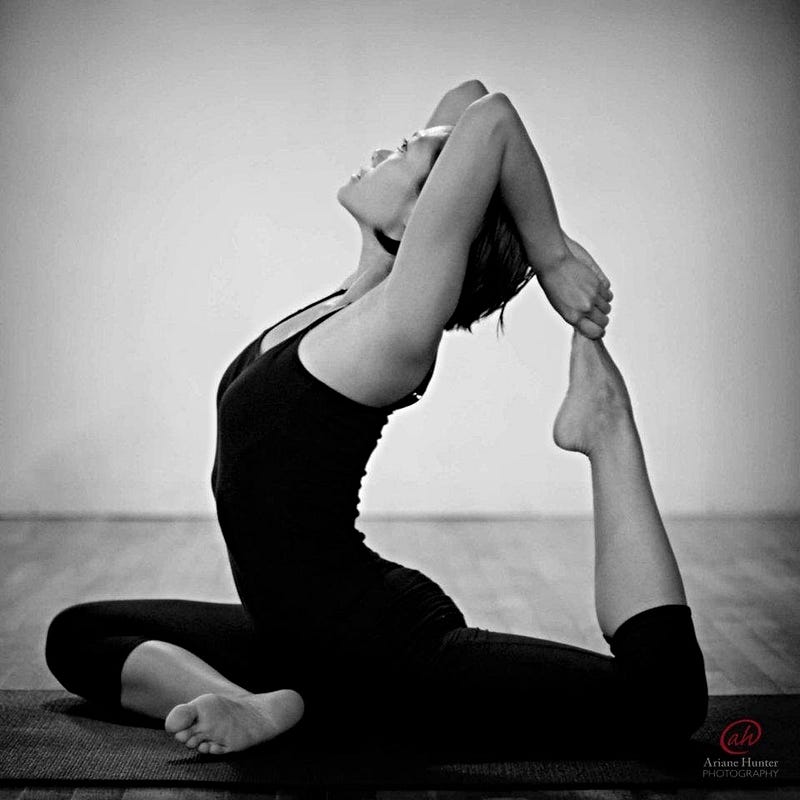
For me, yoga is a spiritual practice first, and exercise second. (For others, it is the opposite.) I see it as a kind of “meditation for my body”. I especially enjoy classes that include chanting and meditation along with the body practices.
I completed a 200-hour yoga teacher certification program in summer 2020. That class was, unfortunately, interrupted by the pandemic, and we held the final few sessions over Zoom. Zoom classes are convenient, but I will return to in-studio yoga classes at some point.
LIFE: Much evidence shows that regular exercise is important to keep one physically and mentally fit. The Bible says that “our body is a temple” that needs to be respected and nourished, both physically and spiritually. I experience the health benefits of yoga in my body throughout the day and in my other meditation practices. There are other ways we can do this, of course. Some get a spiritual experience from running, for example. Few, though, imply spirituality as much as yoga.
<Example 11> An Active, Physical Participation, “Vocal Healing” Meditation [Type 3.2]
— 15 minutes, daily in the early evening — Chakra humming based on teachings of Jonathan Goldman
I Do a meditation practice that I call Chakra Humming. It is roughly based on the book, The Humming Effect, by Jonathan and Andi Goldman. As a gong player (see <Example 10> below), I am familiar with Jonathan Goldman, who many consider the godfather of sound healing. I started this meditation for healing and alignment purposes. It has now become a favorite.
After a meditation retreat in May (2021), I stopped taking my low-dose prostate medicine to see what would happen. I also heard Jonathan and Andi talk about “humming” in an interview. I had learned (or made up?) a Chakra Humming meditation several years ago, about when their Humming book came out in 2017. So I started doing this meditation in May to make my prostate normal without the medicine. It seems to work very well!
My Chakra Humming technique starts with the lowest tone or note that I can comfortably hum (without force). This starting tone is unique for each of us because we are all unique frequencies.
I hum that tone for 2+ minutes while focusing my attention on my Root Chakra. According to Jonathan Goldman, sound healing research shows that the mental intention and focus we give to a sound are more important than the note or tone played.
I then move up the 7 body chakras, increasing the tone/note with each step (like the “do re me” scale). I hum for 2+ minutes on each chakra. So all my chakras get tuned (aligned) in this way.
I end with a shorter and more force high-pitched visit to the 8th chakra (the “Soul Star Chakra” above the head). When I do that, I am reaching my energy above my head. It goes up and expands out like a fountain into the cosmos.
Then I go back down the scale with brief stops at each chakra. I end with a forced low note connecting me to the “Earth Start Chakra” below the body. I am now reaching my energy below my body. It goes down toward the center of the Earth, but also expands out to encompass the entire Earth.
Occasionally, I go in the opposite direction, starting with the Crown Chakra. And I usually play kirtan or other meditative music on my phone while doing this active vocal meditation.
LIFE: I have been Chakra Humming almost daily for over 7 months now. I have noticed the biggest effects in my lower root and sacral chakra area and my upper third-eye and crown chakra area. Besides the prostate issue that it seems to have helped, I feel it is helping with my Non-Duality Mindfulness practice (TYPE 1.3
⬅️ Here is a guided Chakra Humming Meditation (12min on YouTube) that I created as a channeling. It is the same as what I describe above. A friend requested this.
For more on the Chakras, see:
<Example 12> An Active, Physical Participation, “Sound Healing” Practice [3.2]
— 20 to 50 minutes, Usually once or twice a week — My Earth Gongs Sound Meditations for myself and others
When I first heard gongs played in my yoga studio, I knew immediately that I needed to get my own. I bought my first gong a few months before I retired and took lessons both in-person and online.
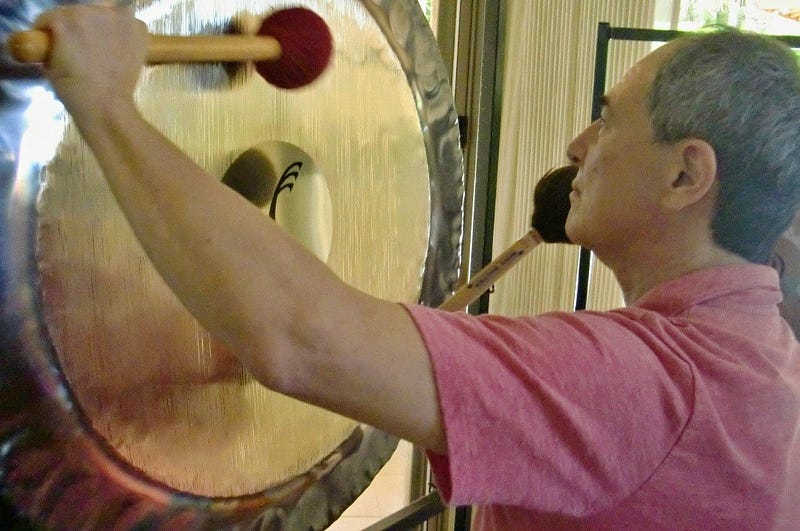
Before the pandemic, I was playing my gongs at my local yoga studio and doing private sound meditations in my home. I recently started playing again for others, as shown on my Earthgongs.com website.
Finding a musical instrument (gongs are a type of percussion instrument) is like experiencing a different dimension of reality. When I play my gongs, I am in the zone. My body resonates with the sound of the gongs, bowls, bells, and chimes that I use. I am one with my gongs, cooperating with them to bring out the best experience for those I am playing for.
I also enjoy practicing and playing for myself, which gives me more freedom to explore new possibilities. For those listening to my gongs, it is a Type 2.3, Guided, Non-Voice-Listening Meditation. I get a lot of positive feedback from them, which is also a pleasant experience.
LIFE: At one level, the effects of my gong and sound playing are identical to what listeners hear and what I feel with my Water Sound practice, which are both Type 2.3, Guided Non-Voice-Listening Meditations. Our physical and non-physical bodies can change (“heal”) because of this form of meditation. Playing the gongs is different since my energy level is extremely high. Actively playing musical instruments helps to bring their vibrating energy into one’s daily life in a more powerful way than listening only. Even so, it is still subtle.
Vibration and frequencies are the essential building blocks our physical universe — according to some versions of quantum theory. Humming (using our vocal chords) and gong playing are two ways of using vibration and frequency. Speaking is a third way, among others. By using these tools, we can both align ourselves to the frequencies of others and the world, and change the frequencies around us to higher vibrational and energy states.
For more on the importance of vibration, see:
<Example 13> A Lifestyle, “Vegan & Organic Diet” Practice [Type 3.3]
— Daily for most of my meals
I Became a vegetarian after a trip to China in 2009. I traveled with a colleague from Singapore who spoke fluent Chinese (mine is very broken) and we took several local tours between our work duties. The tours were for local Chinese and the foods served were vegetables with a tiny bit of meat (and rice, of course). I stuck with a mostly vegetable diet after that trip and eventually lost 50 pounds!
More recently, I did an Ayurvedic Spring Detox through my yoga studio and decided to more or less stay on that diet after the detox ended. I try to stay away from meat, dairy, wheat, and caffeine. I also limit my salt and refined sugar intake, which is harder to do. Alcohol and other mind-altering drugs are also on my avoidance list, but I stopped those in my early 20s.
As far as I know, I am not allergic to these foods (except maybe alcohol). But I felt healthier on my diet. My wife does not follow this diet and so I sometimes stray from it. When we travel, I favor my diet, although I also don’t resist whatever is convenient. (I also prefer to not travel these days because our current modes of travel are detrimental to our planet.)
LIFE: My main purpose for this practice is to support food practices that are good for our planet. It is to change our world by changing my life. Beef production, in particular, is one of the worst sources of greenhouse gases and global warming. But other meats, dairy, and wheat production also have major environmental and ethical problems. So this is a “Lifestyle Meditation” of living in better harmony with our planet.
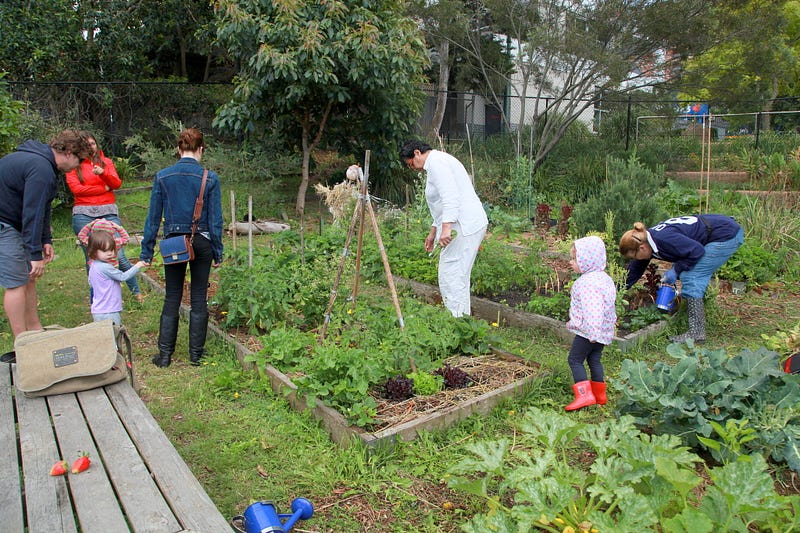
I suggest a long, carefree, refreshing and solitary walk in the afternoon….
As you walk, become sensuously involved with the trees, landscape in general and colors, and if possible lose yourself in their fragrance and vitality. Breathe deeply physically, let your organism feel its involvement, and complicated intertwining, with the physical environment itself.
This is a most enjoyable and beneficial way of psychic relaxation and renewal. Do not be concerned with physical time. Do not overdo. Come home before you are tired. Forget if possible all personal egotistical considerations, feeling only psychic unity. You will be amazed at how this will help.
This sort of experience is much more practical when used before you are really driven to it… Things then will fall into place. — Seth/Jane Roberts, The Early Sessions, vol.2, session 77, August 5, 1964
So That’s What I am “Currently” Doing
I Have the advantage of time allowed by retirement. Before I retired two years ago, I could do my twice-a-day TM practice and attend occasional TM and Vipassana weekend meditation retreats.
Since retirement, and thanks to the pandemic, I have had more time to play with different meditations and took part in different online meditation retreats.
I will do more of that, exploring my shifting interests as new things come into my awareness. A year from now, my meditation practices will probably be quite different — to match our different world.
This is how my retirement is evolving. And this is how our world is evolving.
My Current Meditation Practice is:
- Daily My Morning Meditation includes
& - Daily Afternoon & Evening Meditation includes
, , , & - Almost Every Day includes:
, , , & - Weekly or Monthly includes
, , & - When I am Traveling away from home:
— I almost always do
& — I try to do many of the others but I am often not successful depending on the trip. - When I was Working Full Time I did:
—
twice most days — 4 to 5 days a week — — and I did a variety of other meditations and practices on weekends, vacations, retreats, and whenever I had some free time and interest.
Examples 1 to 3 are in the SELF Meditation article. Examples 4 to 7 are in the GUIDED Meditations article. Examples 8 to 13 are in this article on ACTIVE Meditations.
The Other Articles in this ‘Meditation Series’ are:
- For more on Meditations & Meditating, see this collection of articles:
- Note that the articles in that collection are behind the Medium paywall. For paywall-free access to my articles, go to www.AlanLew.com, linked below.
Contact
- I appreciate comments, questions, and typo corrections. - See the About link in my Medium profile for contact information and related articles.
- Written in collaboration with my Energy Group/Higher Self. This is our perspective of the truth and not the whole truth of reality.
My Medium writings are available “paywall free” at www.AlanLew.com:
- follow my Facebook page linked to my Medium writings
- subscribe to My Medium Writings
- become a Medium member to support my writings
Visit and Follow New Earth Consciousness (NEC) for More Articles like this.
- subscribe to New Earth Consciousness NEWS, the occasional newsletter for NEC
- …and join our New Earth Consciousness Group on Facebook


