

Why I’ve Stopped Pursuing Happiness
Science and a survey reveal the pursuits that really matter
One year ago, on Jan. 1, 2019, I resolved to explore, understand and write about happiness: what it is, what it means, and what we can do about it. I went in with an open mind, hoping to figure out who has happiness and why, and how the rest of us can go out and get some. My wife warned me the premise was faulty. Turns out she was right. The caveats are as clear as the conclusions:
- Exercise might make you happy (or happiness might help you exercise).
- Improving diet might improve happiness (but diet research is all over the place, and frankly, stressing about how to eat doesn’t bring a lot of happiness).
- Time can make you happier than money (if you use the former well, and presuming you still have enough of the latter).
- Giving money away makes people feel good (but the research on this is really thin, and when people suddenly come into money, they get surprisingly stingy).
- And finally: Happiness is rather impossible to define.
I found few convincing scientific studies, new or old, that really say much definitive about what happiness really is, let alone how to become happier. The project was a failure. Well… not totally. By expanding the scope of the quest to look at well-being more broadly, and doing a survey of readers, I learned, indirectly, quite a bit about “happiness” and the things that go into it. And that’s why I’m no longer pursuing it. A sampling of cold, hard facts:
- Optimists live longer.
- It’s never too late to start exercising.
- Walking is really good for your physical and mental well-being.
- So is being in nature.
- Coffee is good for you, too.
- Alcohol is pretty bad for you, even in small doses.
- Processed food is really bad for you.
- So is lack of sleep.
- High blood pressure is a serious problem and bound to make a lot of people miserable.
- Breathing is amazing and most of us do it wrong.
What readers say
Meanwhile, I conducted an anonymous online survey, inviting readers to weigh in on their own level of happiness. The non-scientific survey, taken by 247 people, was presented this way:
“Recent events aside, please rank how well each statement describes your general state of mind over the past year (1 = strongly disagree. 5 = strongly agree).” The first statement was “I’m a happy person,” then there were 26 others about health, friends, family, beliefs, activities and pursuits. The results have been split into three groups, based on how people ranked themselves on the “I’m a happy person” statement:
Happy (4 or 5) — 74.9% of respondents So-So (3) — 19.4% of respondents Unhappy (1 or 2) — 5.7% of respondents
The survey should not be viewed as definitive, but it reveals an interesting pattern: Friends, family, health and purpose (having things to do) all seem to matter in supporting overall self-described happiness.
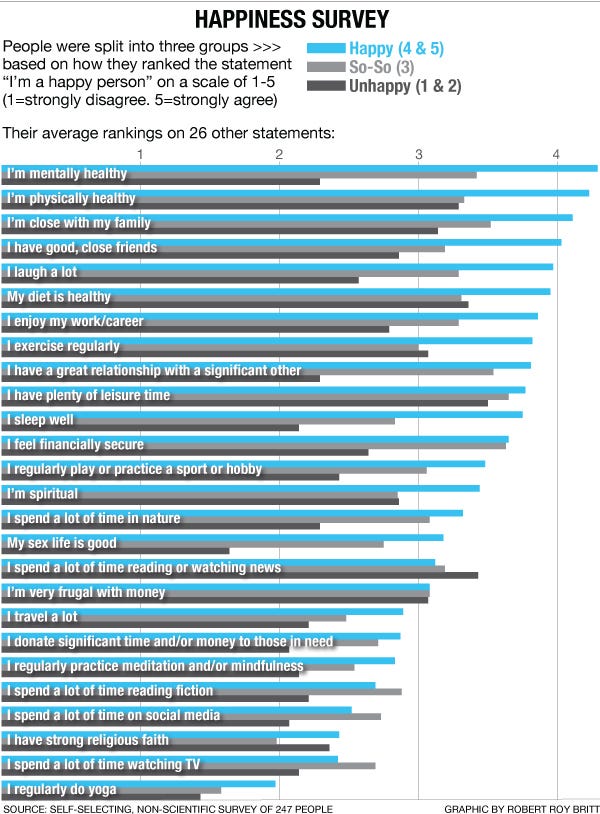
An optional, open-ended survey question asked, “What one thing most brings you happiness?” Among the happiest people (those rating their happiness as a 5) who responded to the question, 78% cited some version of relationships—with family, friends or loved ones.
Disclosure: This survey is not scientific. It was self-selecting (thus may not represent the population at large), involved self-reporting (rather than objective measures), and had a relatively small number of respondents. Further, results from any survey like this can vary significantly based on how questions or statements are framed. Finally, I’m not a professional pollster nor statistician.
What’s not working
During the year, I found some sobering trends. Happiness among Americans has been declining since the turn of the millennium, and the United States is now only the 19th happiest country in the world, according to the annual World Happiness Report, released in March. Among the reasons: pursuit of the wrong things.
“This year’s report provides sobering evidence of how addictions are causing considerable unhappiness and depression in the US,” said Jeffrey Sachs, director of the Sustainable Development Solutions Network. “Addictions come in many forms, from substance abuse to gambling to digital media. The compulsive pursuit of substance abuse and addictive behaviors is causing severe unhappiness.”
Social media plays a role in reduced happiness, the researchers say, but it’s by no means the only cause. Yet with that in mind, I wrote about the joy and angst of Facebook, how hard it can be to quit, and how it messes with peoples’ heads. Among the research findings cited: People who are most addicted to Facebook tend to have feelings of envy and project idealized versions of themselves, and they’re more prone to depression and loneliness, and they even tend to report more symptoms of physical illnesses.
The current climate of extreme partisanship isn’t fostering a lot of happiness, either. In September I wrote that 38% of Americans say they’re stressed out by politics, and among a few of them the stress is so bad it’s making them physically ill.
Loneliness is also creating a growing drag on well-being. One-third of Americans age 50 to 80 are lonely some or most of the time. Meanwhile, 29.2% of college students said they felt lonely at some point in the previous two weeks, while 22.4% said they felt hopeless.
That’s not to say we should expect to never be sad or lonely. In fact, a 2017 study the journal Depression and Anxiety suggests modern social pressures to “just be happy” can have the opposite effect. “Rather than being the by-product of a life well-lived, feeling happy has become a goal in itself,” says study team member Brock Bastian, an associate professor in psychology at the University of Melbourne and author of the book “The Other Side of Happiness.”
“Smiling faces beam at us from social media and happiness gurus flog their latest emotional quick fixes, reinforcing the message that we should aim to maximize our positive emotions and avoid our negative ones,” Bastian says. “Feeling at times sad, disappointed, envious, lonely — that isn’t maladaptive, it’s human.”
What might work
All in all, there still seems to be a lot of happy people around, assuming one accepts everyone’s individual definition of the concept. And yet a lot of people say they are unhappy, and there’s no reason to doubt them. It all seems linked to multiple factors centered around physical and mental well-being, purpose, family and friendships (though nobody has yet determined direct cause-and-effect of any of these factors).
Perhaps most important: What we pursue really matters.
Research finds that the pursuit of happiness, as an overarching goal, sets us up for disappointment. It’s like aiming to be famous instead of perfecting your art, or gunning for fortune rather than finding meaning in your work.
“People who pursue happiness by seeking out pleasant experiences as part of their everyday lives are happier,” writes Lahnna Catalino, PhD, who studies the relationship between emotions and well-being at the University of California, San Francisco School of Medicine. “In stark contrast, people who strive to feel good every possible moment, as if it were possible to will oneself to be happy, appear to be following a recipe for unhappiness.”
Other research finds people who resolve to do specific, concrete, prosocial things, such as increasing their recycling efforts or making someone smile (as opposed to vague goals like saving the planet or improving relationships) are happier.
What we can try to pursue, then, are good health, good work, good friends, good family relations (no matter how difficult!) goodwill, a little time in nature, and a bunch of other “good” things, and then try oh-so-hard to more fully recognize, cherish and be grateful for any satisfaction, joy, amusement or contentment that comes our way.
Aristotle said, “Happiness is a state of activity.” I didn’t quite understand that 12 months ago, but I get it now. And I wish you lots of it.


