
The Amazing Benefits of Being in Nature
Better health. Lower stress. Enhanced creativity. Sheer joy. It’s all out there, and it doesn’t take long.
When my son recently announced he wanted to try fishing, I jumped all over it, dug out my old fly rod, and we headed out beyond the city and suburbs to a stretch of river reputed to have some nice trout. We didn’t catch a thing, and we’ve had little luck on multiple, marvelous return trips.
See, it’s not just about the fish.
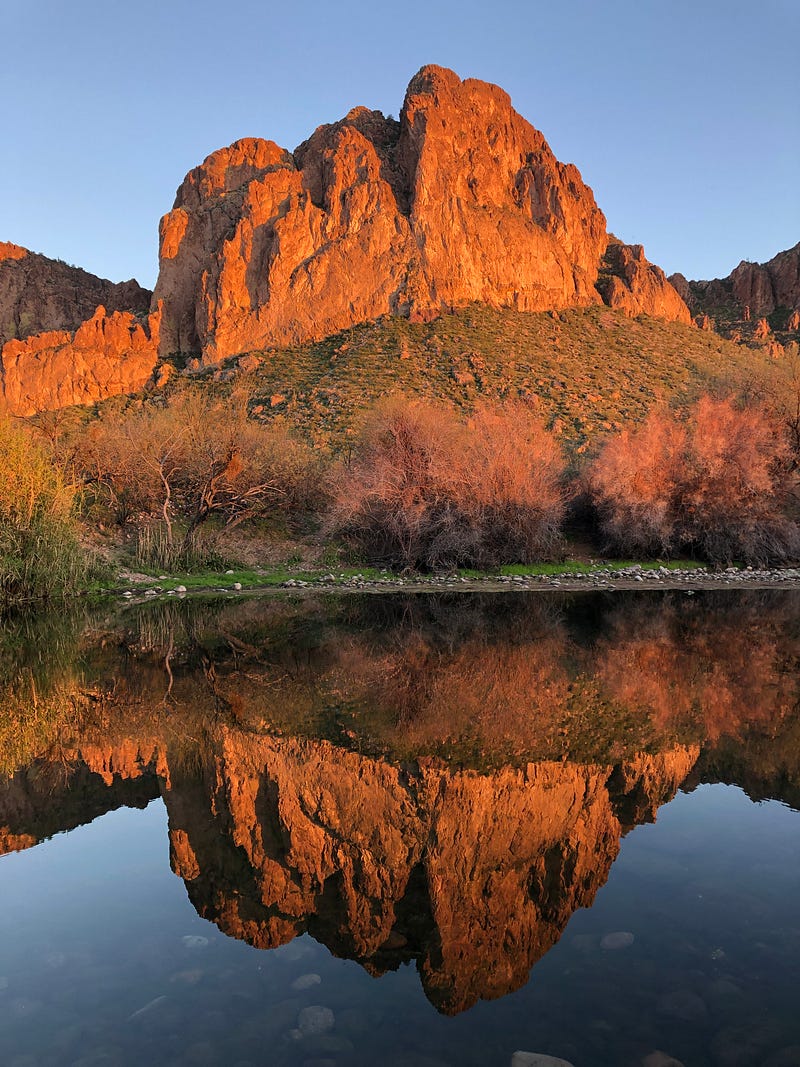
At our favorite little stretch of river, red rock walls rise gloriously from the surprisingly verdant desert canyon, poking into predawn clouds one morning, glowing like fire one evening. The flutter of water lapping over rocks is interrupted by the sharp squawk of a heron. A bald eagle swoops down to outfish us in a real live David Attenborough moment. There’s no cell reception. The mind drifts like the laziest sections of river. Thoughts come unexpectedly, or not at all. The next riffle beckons. We breathe deep and move on.
“Nature holds the key to our aesthetic, intellectual, cognitive and even spiritual satisfaction,” said E.O. Wilson, the Pulitzer Prize-winning Harvard biologist.
That’s what I mean to say. And after decades of accumulating evidence, science suggests he’s onto something.
From hiking in the wilderness to living near urban green spaces, experiences with nature are linked to everything from better physical health and longer life to improved creativity, lower stress levels and outright happiness. One new study even suggests brief interludes in natural green spaces should be prescribed, like a nature pill, for people who are stressed. With the number of people around the globe living in urban areas expected to grow from 54 percent in 2015 to 66 percent by 2050, preserving or creating green space will be a key to overall human well-being.
We know all this intuitively. It’s why so many vacations center around camping, hiking or putting toes in the sand. We crave a connection with nature from deep in our primordial beings. And for good reason.
The Good of Green
In 2012, a group of backpackers set out on a multi-day excursion into the wild, with no phones or other electronics. Before departing, they took a test measuring creativity and problem-solving ability. After four days in the wild, the test was given again. Scores were up by 50 percent, from an average of 4.14 correct answers out of 10 before the hike to 6.08.
Like many psychology studies, this one could not prove cause and effect. It could not determine whether the improvement owed to nature itself, or if the disengagement from technology boosted scores, or if the physical activity perhaps played a role. But the researchers — University of Kansas psychologists Ruth and Paul Atchley and David Strayer of the University of Utah — shared their intuition at the time:
“Our modern society is filled with sudden events (sirens, horns, ringing phones, alarms, television, etc.) that hijack attention,” they wrote in the journal PLOS ONE. “By contrast, natural environments are associated with gentle, soft fascination, allowing the executive attentional system to replenish.”
“Spending time in, or living close to, natural green spaces is associated with diverse and significant health benefits.”
Other studies by then had already shown that the benefits of green space, however they accrue, are not reserved for the likes of Marlin Perkins or Bear Grylls. Any bit of green seems to help.
Back in 2006, research led by Jolanda Maas, a behavioral scientist now at Vrije University Amsterdam, found that the amount of green space within a roughly 2-mile radius “had a significant relation to perceived general health.” The conclusion was based on actual measurements of greenery compared to questionnaires filled out at doctor’s offices by 250,782 people in the Netherlands.
Maas and her colleagues did a similar study in 2009, looking instead at morbidity data. Of 24 diseases considered, the prevalence of 15 was lower for people living in areas with more green space. “The relation was strongest for anxiety disorder and depression,” they reported in the Journal of Epidemiology & Community Health.
Other research has shown that a room with a garden view and other access to green space can reduce stress and pain among hospital patients, boosting their immune systems and aiding recovery.
Likewise, gardening can reduce stress, one small study found in 2011. Interestingly, it outdid reading as a destresser. In the test, 30 people were made to perform a stressful task, then spent 30 minutes outside gardening or indoors reading. Levels of cortisol, a hormone released by stress, were measured repeatedly, and the subjects were asked about their mood before and after.
“Gardening and reading each led to decreases in cortisol during the recovery period, but decreases were significantly stronger in the gardening group,” the scientists wrote in the Journal of Health Psychology. “Positive mood was fully restored after gardening, but further deteriorated during reading.”
Fast forward to last year, when the benefits of nature on physical health were spelled out in a broad review of studies that involved data on more than 290 million people in 20 countries.
“We found that spending time in, or living close to, natural green spaces is associated with diverse and significant health benefits,” said lead author Caoimhe Twohig-Bennett of the University of East Anglia in England. “It reduces the risk of type II diabetes, cardiovascular disease, premature death, and preterm birth, and increases sleep duration. People living closer to nature also had reduced diastolic blood pressure, heart rate and stress,” as measured by cortisol levels, Twohig-Bennett said.
Nature or Nurture?
There’s an important caveat to many of these studies: Being outdoors often means being active.
Whether backpacking, gardening or simply walking briskly through an urban park, the subjects of studies like these may also be engaging in what other scientists call “moderate physical activity,” which even in small doses is known to improve mood, boost cognitive ability, benefit physical health and up the odds of living longer.
“People living near green space likely have more opportunities for physical activity and socializing,” Twohig-Bennett said, acknowledging the struggle to determine cause-and-effect.
The science indeed remains inconclusive on whether it’s nature itself or the physical activity associated with being in nature that brings health benefits, said Douglas Becker, a grad student at the University of Illinois who just published a study on the effects of nature on health care costs.
“Although it is strongly suggestive of both of those things… proximity and contact with nature leading to improved health outcomes and being around nature promoting physical activity,” Becker told me.
Becker examined health and environmental data from nearly all of the 3,103 counties in the continental U.S. He found that counties with more forests and shrublands had lower Medicare costs per person. The difference was not tiny. Each 1 percent of a county’s land covered in forest was associated with $4.32 in savings per person per year, on average.
Becker kindly did some additional math that I don’t fully understand, but it adds up to a boatload of money:
“If you multiply that by the number of Medicare fee-for-service users in a county and by the average forest cover and by the number of counties in the U.S., it amounts to about $6 billion in reduced Medicare spending every year nationally,” Becker said.
So. Plant more trees, right? Well…
The analysis, to be detailed in the May 2019 issue of the journal Urban Forestry and Urban Greening, does not prove that having more trees and shrubs directly lowers health care costs, Becker said. Rather, it’s one more bit of evidence pointing to possible proof that green spaces (especially forests, he notes) are good for our health.
“Being in sight of nature does indeed confer benefits,” he said.
Twohig-Bennett added another potential factor, gleaned from her review of the literature, suggesting trees may have as-yet unrecognized value in promoting well-being.
“Exposure to a diverse variety of bacteria present in natural areas may also have benefits for the immune system and reduce inflammation,” she said, pointed out that research has suggested there may be benefits to “forest bathing,” a popular therapy in Japan that involves just walking or even lying down in a forest.
“Much of the research from Japan suggests that phytoncides — organic compounds with antibacterial properties — released by trees could explain the health-boosting properties of forest bathing,” Twohig-Bennett said. The jury is still out on this therapy, but “our study shows that perhaps they have the right idea,” she said.
All in Your Head
In 2015, researchers at Stanford University added to evidence there are distinct benefits to nature itself, not just the walking that might get you there and back. They looked at the effects of hiking in a natural area (oak trees and shrubs) versus hiking in an urban setting (along a four-lane road). Before and after the hikes, they asked the participants a bunch of questions, and, importantly, they measured participants’ heart rates and respiration and did brain scans.
There were no notable differences in the physiology of the two groups after their hikes, the researchers reported in the Proceedings of the National Academy of Science. But those who hiked in nature had, afterward, less activity in a part of the brain called the subgenual prefrontal cortex. That’s where we ruminate repeatedly on negative emotions. Less is good.
“It demonstrates the impact of nature experience on an aspect of emotion regulation — something that may help explain how nature makes us feel better,” said lead author Gregory Bratman, then a graduate student at the university.
Bratman’s co-author, Stanford psychology professor James Gross, took the interpretation a step further, looking at the flip side of all this:
“These findings are important because they are consistent with, but do not yet prove, a causal link between increasing urbanization and increased rates of mental illness.”
And apparently, it’s never too soon to start an immersion in nature.
People who grew up in greener surroundings have up to a 55 percent lower risk of mental disorders as adults, according to a study of nearly 1 million Danes published earlier this year in the US journal Proceedings of the National Academy of Sciences.
“There is increasing evidence that the natural environment plays a larger role for mental health than previously thought,” said study leader Kristine Engemann of Aarhus University. “With our dataset, we show that the risk of developing a mental disorder decreases incrementally the longer you have been surrounded by green space from birth and up to the age of 10.”
Educators have long recognized the benefits of nature on childhood well-being. And as science increasingly supports the premise, the number of nature-based preschools and so-called “forest kindergartens” in the US has grown 60 percent or more in each of the past two years. More and more children are getting almost their entire early education in the great outdoors.
Nature Pill?
How much time do you need to spend in nature to see benefits? While few would argue that more isn’t better, it doesn’t take much, a new study finds.
Slipping away for just 20–30 minutes to sit or stroll in a natural environment reduces levels of cortisol, the stress hormone, according to a small study published April 4, 2019 in the journal Frontiers in Psychology.
Researchers had 36 urban dwellers take a break for 10 minutes or more, three times a week over eight weeks, and go to a place that “made them feel like they’ve interacted with nature.” Importantly, the volunteers were instructed not to do any aerobic exercise during the breaks and to avoid reading, conversations and using their phones.
The stress-reducing efficiency of the outings was greatest among those who spent 20 to 30 minutes in their happy places, the researchers concluded.
“We know that spending time in nature reduces stress, but until now it was unclear how much is enough, how often to do it, or even what kind of nature experience will benefit us,” said the lead author of the paper, MaryCarol Hunter of the University of Michigan. “Our study shows that for the greatest payoff, in terms of efficiently lowering levels of the stress hormone cortisol, you should spend 20 to 30 minutes sitting or walking in a place that provides you with a sense of nature.”
Hunter and her colleagues suggest healthcare practitioners could prescribe a “nature pill” based on this finding.
Combined with exercise, good sleep and a good diet, a nature pill — or whatever you prefer to call it — could be viewed as a pillar of science-based well-being. For my son and I, trekking to our favorite fishing hole every day isn’t practical. But there’s a hiking trail that starts not far from our home, leading out into the desert and up a mountain. We’ll be out there.


