
The World’s Happiest Countries
Vast differences in well-being exist between the happiest and least happy nations.
Finland maintained its status as the world’s happiest country, while the United States slipped a notch to № 19, according to the latest annual World Happiness Report, released March 20, 2019. Here’s how some of the 156 countries placed, based on Gallup Polls, as analyzed by the United Nations Sustainable Development Solutions Network:
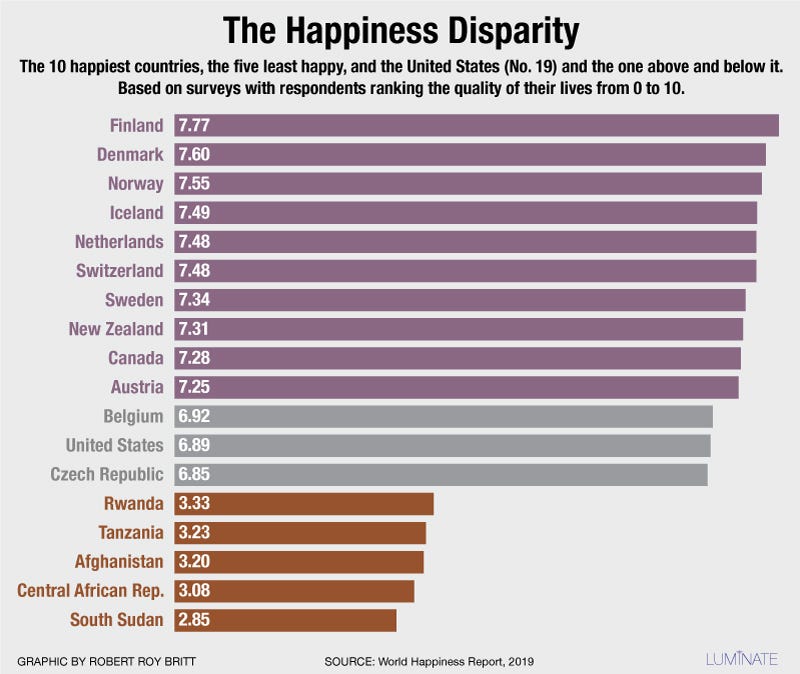
The report — which should be taken with at least a few grains of salt given that it relies on somewhat unreliable self-reporting, and that it reflects averages that don’t speak to any specific individuals’ well-being — revealed several trends. One that jumped out at researchers who analyzed the data:
Happiness in the United States, among both adults and adolescents, has generally declined and is lower now than at the turn of the millennium, the researchers said. Smartphones and other digital technology may be playing a role, but are not the sole cause.
“The compulsive pursuit of substance abuse and addictive behaviors is causing severe unhappiness.”
“This year’s report provides sobering evidence of how addictions are causing considerable unhappiness and depression in the US,” said Jeffrey Sachs, director of the Sustainable Development Solutions Network. “Addictions come in many forms, from substance abuse to gambling to digital media. The compulsive pursuit of substance abuse and addictive behaviors is causing severe unhappiness. Government, business, and communities should use these indicators to set new policies aimed at overcoming these sources of unhappiness.”
The report indicates that the main factors separating the happiest countries from the least happy are income per capita, social support, healthy life expectancy, freedom, perception of corruption, and …
Generosity. The report finds support for other research suggesting that volunteering time and donating money to help others brings happiness to the giver.
“The world is a rapidly changing place,” said John Helliwell, a professor emeritus in economics at the University of British Columbia and co-editor of the report. “How communities interact with each other whether in schools, workplaces, neighborhoods or on social media has profound effects on world happiness.”
Other broad trends revealed in the report, which is based on a three-year average of the survey data (the most recent period being 2016–2018):
- Among the 20 countries where happiness grew the most between 2005 and today, “10 are in Central and Eastern Europe, five are in sub-Saharan Africa, and three in Latin America.”
- The 10 countries with the biggest declines in happiness “typically suffered some combination of economic, political, and social stresses,” the report states. The five largest drops since 2005: Yemen, India, Syria, Botswana and Venezuela.
- Average overall world happiness has fallen in recent years, driven by the sustained downward trend in India and the growing population there.
- Researchers see “a widespread recent upward trend in negative affect, comprising worry, sadness and anger, especially marked in Asia and Africa, and more recently elsewhere.”

My own ongoing Happiness Survey (you can take it here — full results to be reported later this year) has yielded some preliminary, non-scientific results related to individual happiness. So far, those who report being the happiest also most strongly agree with these statements, on average:
- I’m physically healthy.
- I’m mentally healthy.
- I have a great relationship with a significant other.
- I’m close with my family.
- I enjoy my work/career.
- I laugh a lot.
However, I suggest interpreting both sets of results with caution, if for no other reason than this simple fact: Defining happiness is a challenge itself.


