While G7 tackles Global Food Security, Putin flexes at St. Petersburg
I’m writing this story in response to what I read about the G7 Summit being held in Germany this week. With China’s Belt and Road Initiative (BRI) high on the agenda of the G7, they reportedly have also been discussing with other countries — Argentina, India, Indonesia, Senegal and South Africa — on how to solve the current global food security crisis.
This crisis was initially caused by the outbreak of the COVID-19 pandemic but was exacerbated by the war in Ukraine — for which Russia has been ostracized by the rest of the world for restricting grain exports from Ukraine and blocking ports on the Black Sea that are critical to food exports around the world.
Under the backdrop of the G7 Summit, looking at statements made by President Vladimir Putin at the St. Petersburg International Forum is one way to understand how Energy and Commodities are likely going to affect the international system going into 2023. Please read carefully:
Dear friends,
This year marks the 25th anniversary of the St. Petersburg International Economic Forum. I sincerely congratulate the Forum organizers and all those who have taken and are taking part in its work on this significant anniversary.
Over the years, the Forum has become a highly respected and representative international event. Its participants, which include Russian and foreign politicians, scientists and entrepreneurs, focus on a variety of topics concerning the domestic and world economy: from specific areas of industrial cooperation to information security and environmental protection. Mutually beneficial long-term contracts are signed and business experience is exchanged in the course of direct and constructive communication.
The Forum’s anniversary is taking place at a difficult time for the entire international community. The mistakes of Western countries in economic policy over many years and illegitimate sanctions have led to a wave of global inflation, the disruption of usual supply chains, and a sharp increase in poverty and food shortages. Yet, as can be the case, along with these challenges, new prospects are emerging. This is why the Forum’s slogan — New Opportunities in a New World — seems so relevant.
I am confident that for Russia the 2020s will become a period when the country strengthens its economic sovereignty, which involves the accelerated development of its infrastructure and technological base, qualitative upgrades in the level of training for specialists, as well as the establishment of an independent and efficient financial system. In addition, the Russian economy will increasingly rely on private initiatives and, of course, will remain committed to transparency and broad international cooperation.
It is in our common interests to bolster trade and investment, encourage the joint development of technologies, strengthen financial and stock markets, and increase the share of settlements in national currencies. It is crucial to introduce and develop truly mutually beneficial integration models, as is already being done in the Eurasian Economic Union.
I strongly believe that the Forum will continue to make a significant contribution to solving numerous high-priority challenges facing humanity, while mutual trust, meaningfulness and commitment to fruitful dialogue and partnership will invariably remain its distinguishing features.
I wish you every success and all the best.
Vladimir Putin
As both the G7 and Russia are guiding the discussions on Food Security and Energy and Commodities, I argue that these dynamics are becoming a staple of diplomacy and politics, particularly in the developing world.
Here are two examples to demonstrate how Russia is using political and economic leverage against South America’s and Central Asia’s biggest economies: Brazil and Kazakhstan.
Russia’s Key Position in Brazil’s Fertilizer Market
On February 7, 2022, Brazil’s largest state-owned company Petrobras agreed to sell its National Fertilizer Unit III (UFN III) Plant to Russia’s Acron Group.
Russia’s Acron Group has been the target of a Countervailing Duties (CVD) dispute at the United States International Trade Court. The United States’ largest nitrogen and ammonia producer, CF Industries, petitioned the court alleging that Russia’s subsidies of urea ammonium nitrate solutions (UAN) put American producers and exports at an unfair advantage in the marketplace.
It’s likely that Russia will lose the case, because the preliminary determination was already ruled in favor of CF Industries. This effectively will put Acron Group out of the American UAN marketplace, where it was one of the leaders. Russia probably intends to continue exporting as much nitrogen fertilizer as it can to countries who need it. Brazil will be one of its main targets.\
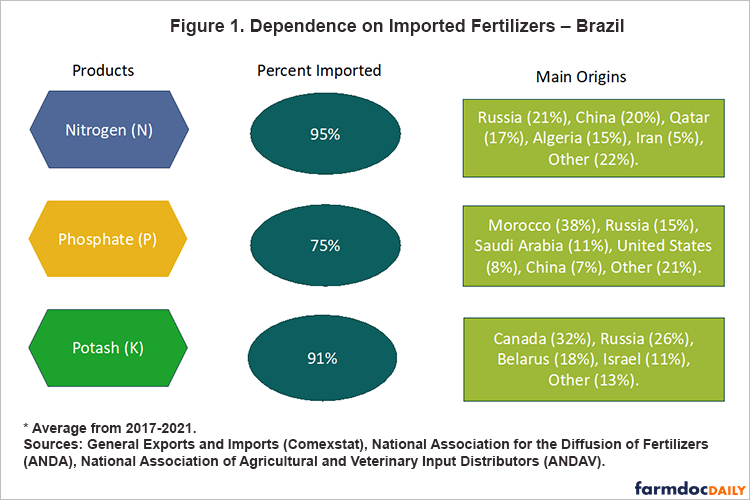
Russia pops up at the top of all three categories — 21% of Nitrogen exports, 15% of Phosphate exports and 26% of Potash exports. It’s also important to point out here that both China and Belarus have been struggling to meet the needs of Brazil’s fertilizer consumption. China restricted exports in 2021 and Belarus’s potash industry has been the target of USA and European sanctions.
It shows in the diagram that Russia leads over all other countries in Brazil’s nitrogen (N) fertilizer import dependency. With China’s fertilizer currently out of the picture, this scenario is likely to see more Russian imports.
The current global fertilizer scenario reveals some intriguing data points about production and supply. Companies like Morocco’s OCP are expanding into Africa to solve many of the countries’ food problems. USA is restricting access to its fertilizer markets, while China looks to shut down many of its export operations for domestic supply and Russia uses its fertilizer diplomacy to achieve political ends.
In addition, countries from the Middle East and North Africa — Morocco, Qatar, Oman, Saudi Arabia and Algeria — have stepped in to fill the void of Brazil’s fertilizer import dilemma. While Jordan hopes to keep its potash fertilizer exports, valued at $70 million in 2021, replacing Russian exports for the foreseeable future.
Russia’s Energy and Commodities Derail Kazakhstan
Iron-ore mining projects in Guinea reveal that strong demand for metals is going to see an upside during the global commodity supercycle, irrespective of geopolitics, as countries like China and Australia compete for supply and demand of iron-ore and other metals.
That’s why this most recent situation between Kazakhstan and Russia should not be taken lightly. Just look at what happened on the Caspian Pipeline Consortium to understand the geopolitical nature of energy and commodities right now.
The St. Petersburg International Economic Forum is being used as a stage for Russia to show countries in its sphere of influence how it is committed to a political agenda to control the supply and production of energy and commodities — in spite of USA and European sanctions.
In the words of Russia President Vladimir Putin:
The Forum’s anniversary is taking place at a difficult time for the entire international community. The mistakes of Western countries in economic policy over many years and illegitimate sanctions have led to a wave of global inflation, the disruption of usual supply chains, and a sharp increase in poverty and food shortages. Yet, as can be the case, along with these challenges, new prospects are emerging. This is why the Forum’s slogan — New Opportunities in a New World — seems so relevant.
“New Opportunities in a New World” sounds like classic revisionism, but it also indicates how important Russia is — or at least thinks it is — to the Global Commodity Supercycle.
Moreover, China’s President and Chairman Xi Jin Ping stood by Russia at the St. Petersburg Forum in claiming that “the era of the unipolar world” being led by the United States was over.
While most people will understandably focus on the inhumane war effort launched by Russia against Ukraine, with the surge of international refugees and internally displaced peoples (IDPs) all over the world, the Global Commodity Supercycle is driving the economic power of countries like Russia, and it should explain how Russia seeks to revise the geopolitical dyanmics in the post-Soviet territories of Central Asia — its sphere of influence.
Kazakhstan is worried. It has had to use the St. Petersburg Forum as a way to commit to the world its territorial integrity in the face of looming Russia threat on its border. This is in many ways of desperate plea to the world — the United States? — for promoting the cause of Kazakhstan’s sovereignty for a country that has much to lose from USA and European sanctions on Russia’s oil and gas industries.
Kazakhstan’s government understands that both Western oil interests and Russian oil exporters matter a great deal to the country’s own ability to export crude oil and increase oil production revenues. Just because Kazakhstan changed the name of its vital oil exports to Kazakhstan Export Blend Crude Oil (KEBCO) doesn’t mean it will be able to avoid the USA’s and Europe’s sanctions on oil originating from Russian sea ports.
What’s Likely to Happen in 2023?
The truth is that this “Fertilizer Diplomacy” seems to be unraveling during the worst times of this century — global pandemic, food crisis, inflation, war.
Today, the governments of the world are already conceptualizing critical global commodities as way to engage in diplomacy — witness the discussions of the G7 Summit and St. Petersburg Forum in 2022.
This not only adds a geopolitical factor to any raw materials company’s supply and production targets. As the dimensions of political leverage grow in their favor, countries like Russia would continue to use leverage over Energy and Commodities as a way to influence important political decisions coming out of South America.
Look no further than how Brazil voted on Ukraine at the United Nations.
The ultimate test of USA and Europe sanctions will be playing out in areas such as Kazakhstan and the wider Central Asia region, where those countries are the most susceptible to Russian influence; they need Western oil imports and international investors to decrease reliance on Russia. This problem will not be solved in the near-term.
For Kazakhstan, the long-term problem is going to come down to the success of Russia’s political leverage and military strength to ensure that their economic interests, particularly crude oil exports from the Kazakhstan’s oil pipeline, stay intact in the future without any interruptions from USA and European sanctions
Energy and Commodities are the biggest concerns of the global economy due to the Russia-Ukraine Conflict, among other factors, as Germany is preparing for more coal plants, the United States is preparing for more mining projects like the Copper World Complex in Arizona, and France’s President Macron is in talks with Romania to revive an old railroad transportation route from Odesa to the Danube River to increase grain exports from Ukraine to international markets.
All of this economic activity is occurring under the backdrop of USA and European sanctions on Russia’s critical LNG industry, such as Novatek’s Arctic LNG 2 project.
It’s essential to point out that even when the largest companies are pushing for ways to successfully carry out Energy Transition around the globe, that commitments to natural gas production and exports via LNG will continue to grow over time.
And as the Global Commodity Supercycle continues to drive demand for offshore oil and iron-ore, among other commodities, there going to be a lot more attention on how Russia extends its political agenda.
The Russia-Ukraine conflict has taught us that the international outlook is no longer as uncertain as before. The G7 has come together in solidarity to to denounce and outmaneuver Russian aggression, while the developing world seeks to cooperate further with a more energy- and commodities-oriented economic power in Russia.
Does Vladimir Putin have enhanced leverage at this critical juncture of the Global Commodity Supercycle?