
Travel, India, Photography
Where the Buddha Sleeps
Buddhism through the ages at the UNESCO World Heritage Site of Ajanta, India
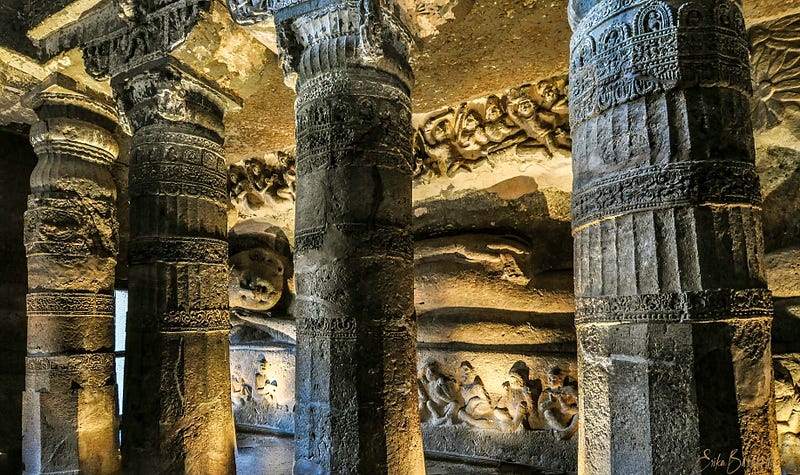
Inside the hushed darkness of the cave, I closed my eyes and could almost hear the tap, tap of ancient chisels carving into stone. All around me, the faces of various deities and Buddhist monks peered back at me. Brightly painted figures from the ancient Jataka tales, about the many births of Siddhartha Gautama Buddha, danced across the walls. And I could just feel the presence of all of the monks and devotees who have traveled here over the centuries, since at least 100 BCE, padding around in bare feet, circumambulating the stupas, in holy reverence.
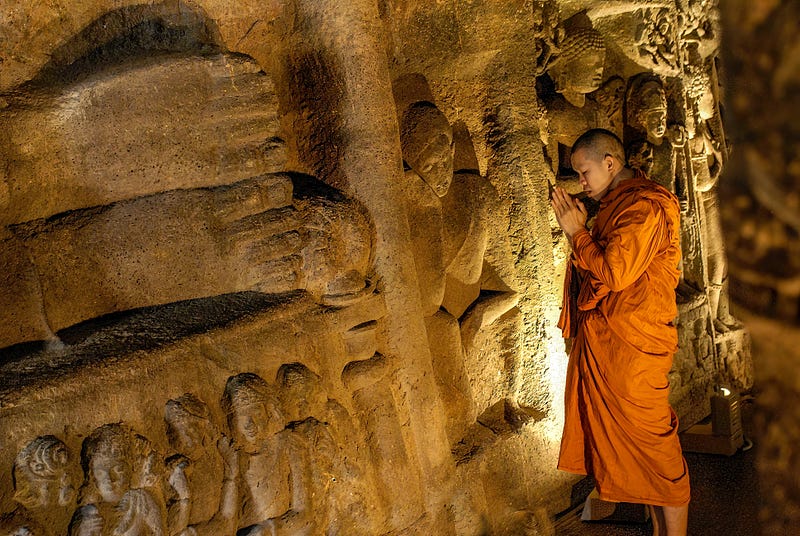
It boggles my mind to think that the monasteries and temples of the Ajanta Caves, now a UNESCO World Heritage Site, near Aurangabad, India in the state of Maharashtra, were, literally, carved out of the side of a cliff. Where once there had been nothing but solid granite and someone’s vision of what needed to be removed in order to leave a temple behind, there now arch beams, high overhead, made to look like wood, but actually hewn out of stone.
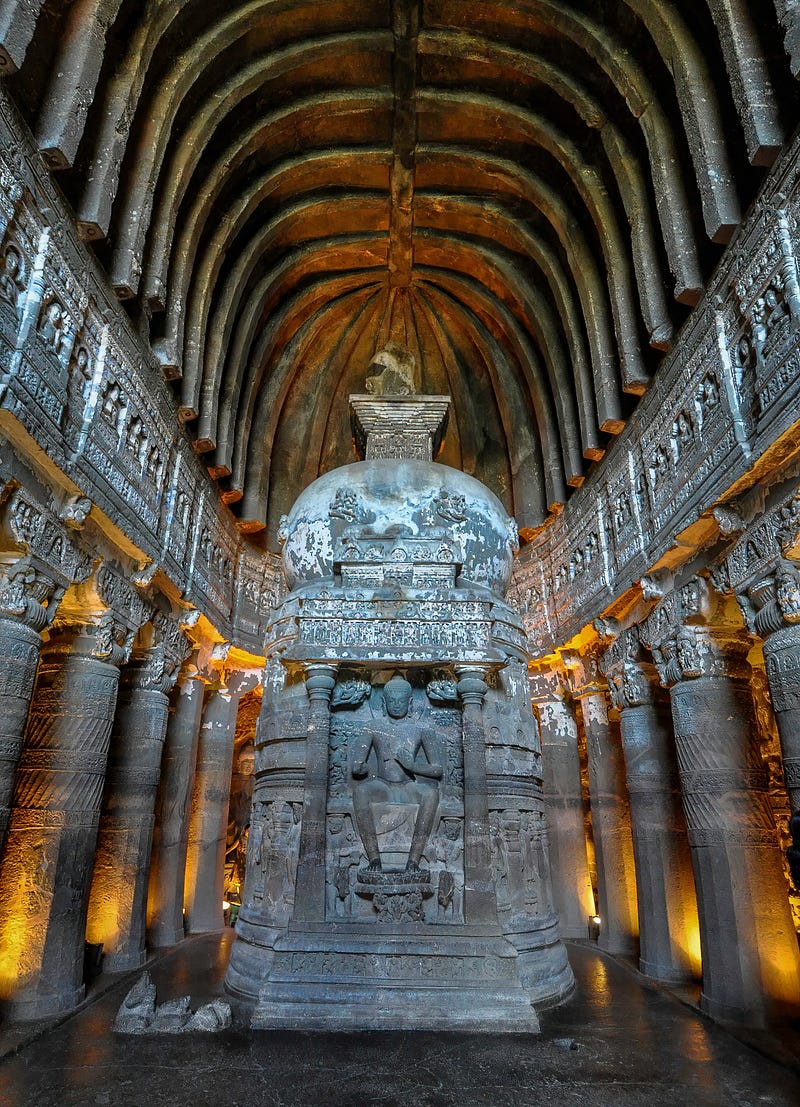
Here, the Buddha sits, enthroned on a stupa, surrounded by apsaras, female spirits of the clouds and waters. All around him, at ceiling level, are Buddhas in various mudras (symbolic hand gestures).
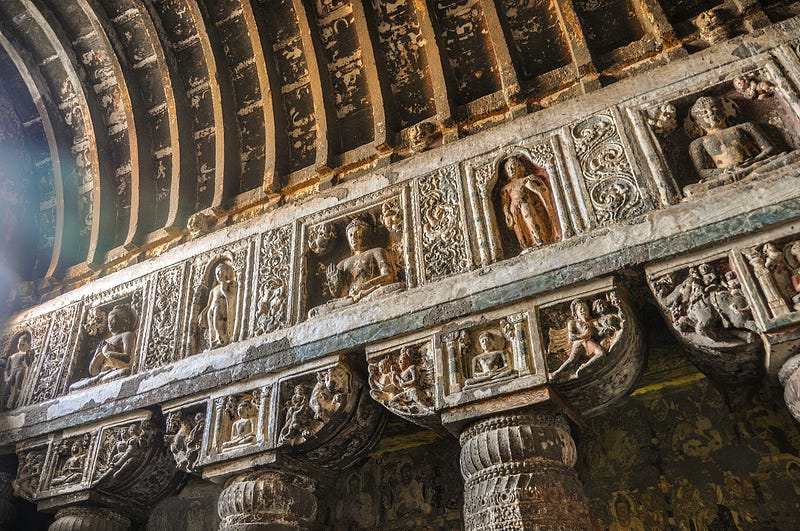
But not all of the caves are this elaborately decorated. The earliest traditions of Buddhism were mostly “aniconic,” meaning that Buddha was not depicted other than in symbols and relics, such as stupas (from around 500 BCE until around 200 CE).
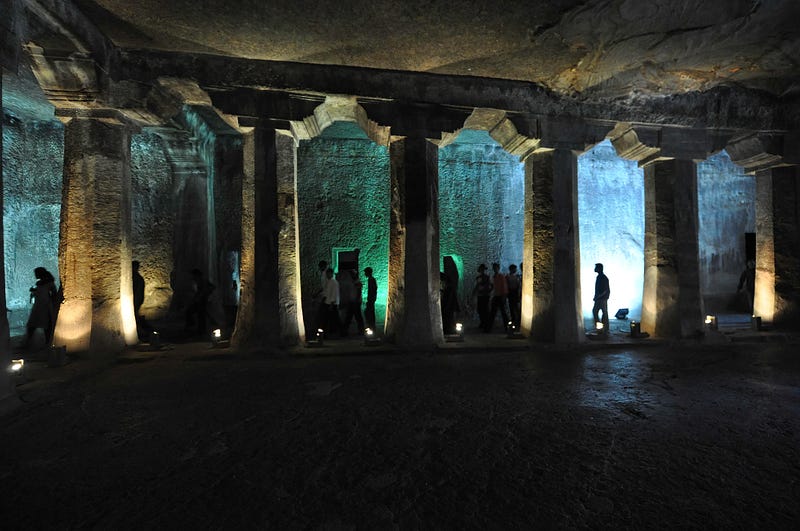
“Cave 10,” a vast prayer hall, dates to around 100 CE and contains a single, simple stupa. The ceiling here probably was once made of wood, but it has long since vanished. In later years (as seen in “cave 26, above), the ceiling decoration was crafted of stone because it was more durable.
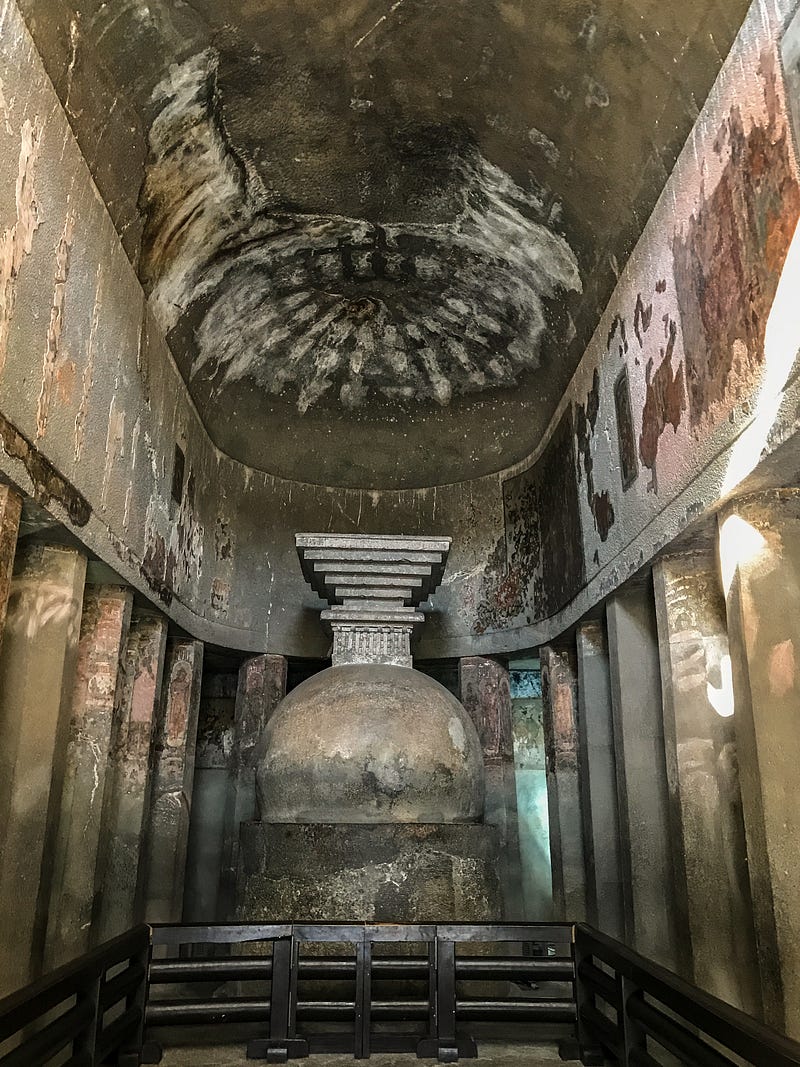
Here and there, in many of the caves, traces of colorful paint still linger on the stone, maybe not as brightly as they had when they were painted in 400–600 CE., but still adding a slight hue to the granite.
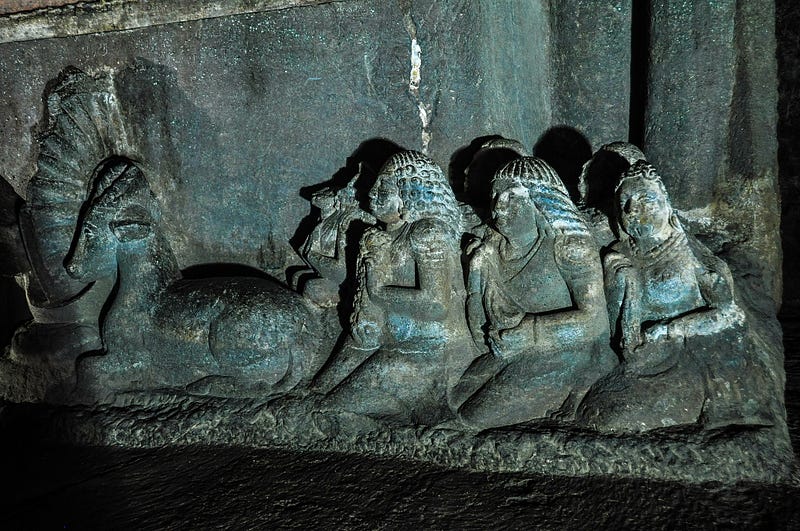
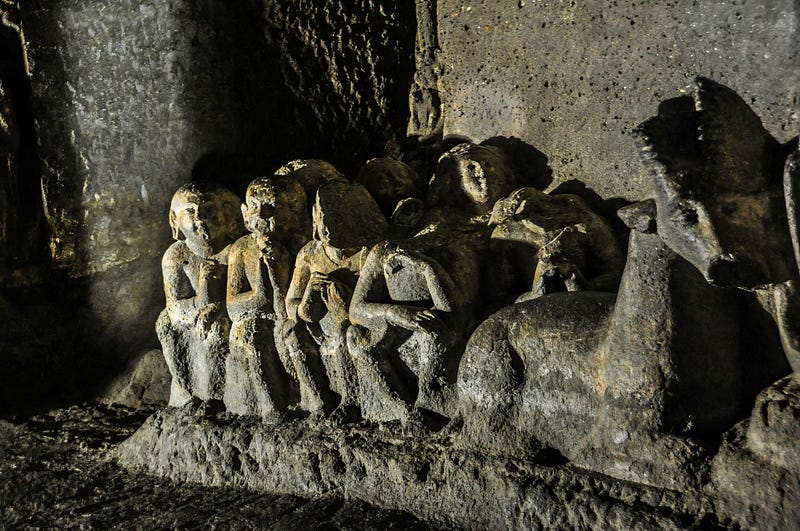
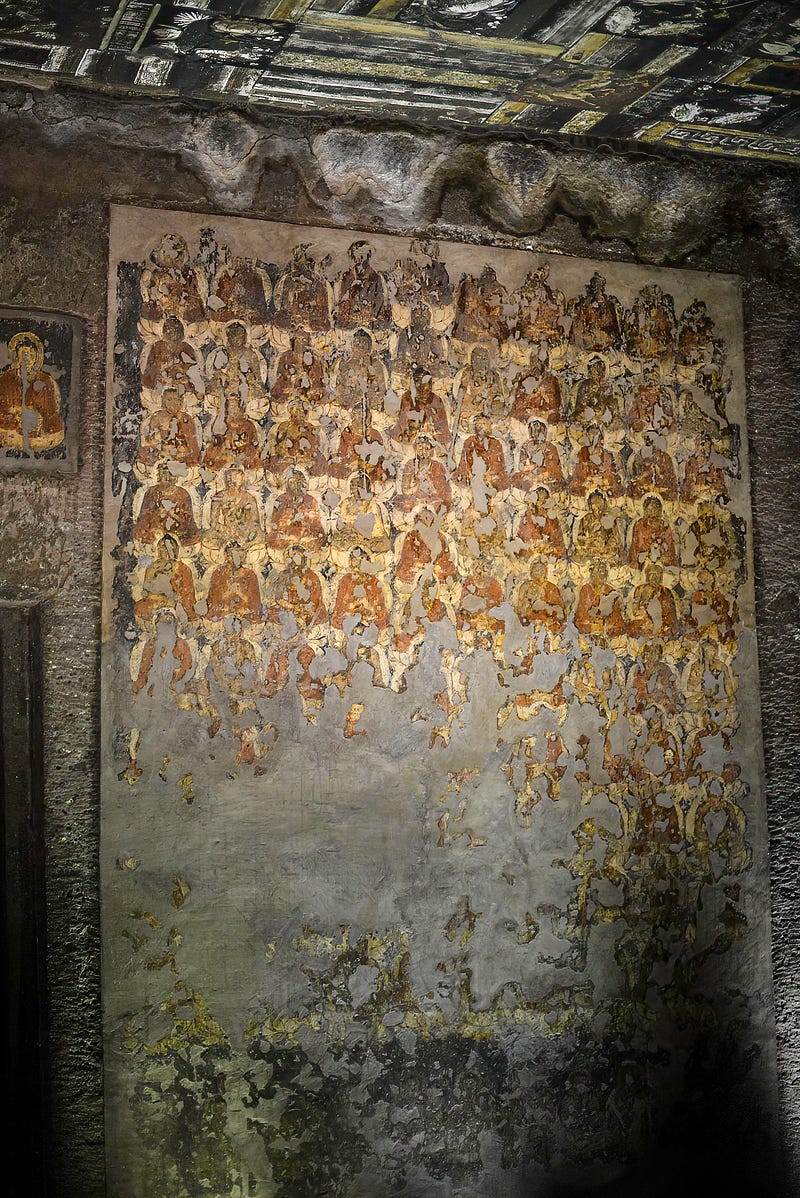
And in other caves, such as “cave 16” and “caves 1 and 2,” still-colorful murals glow with a luminescence you would not imagine would have lasted for almost two thousand years. Most of these are from Ajanta’s “second phase” of development, dating to approximately 400 until 650 CE. Everywhere I looked, the thousand faces of Buddha and many of the characters written about in the famous Jataka tales looked back out at today’s world from an age long ago.
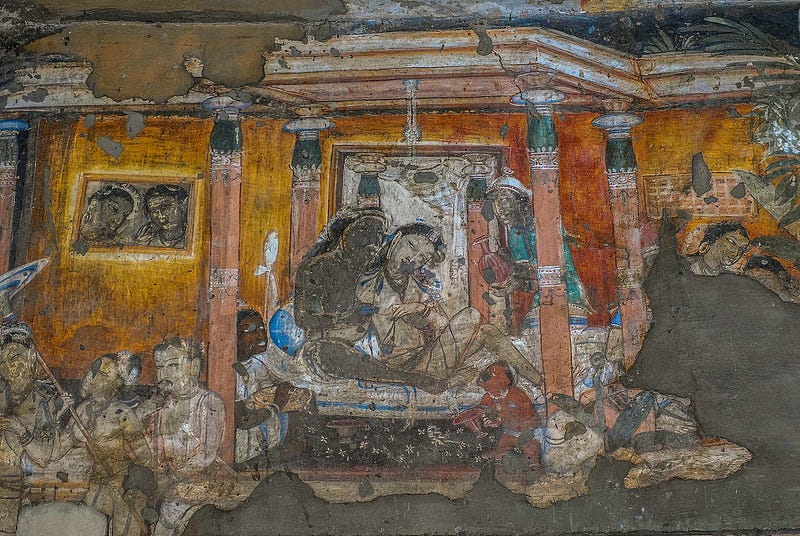
Here, a king and his queen lounge in bed while servants hover on either side with what looks, to me, to be a foot bath and a water pitcher.
Hereis a scene from the Jataka tales.
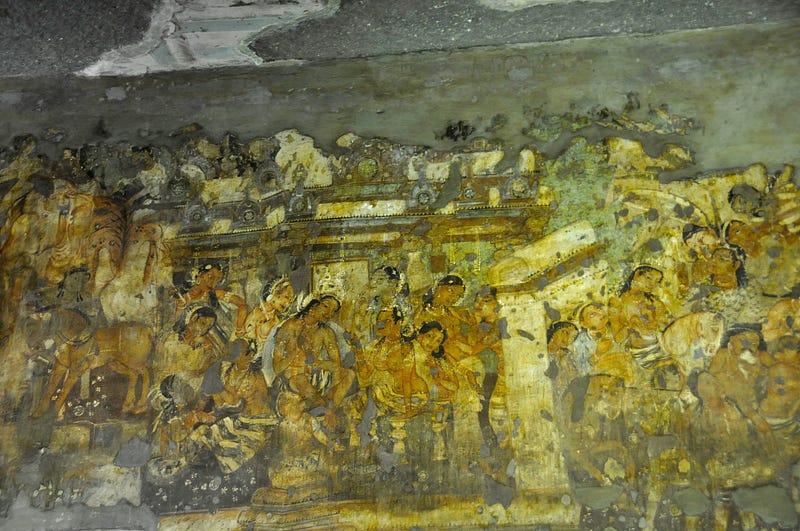
And here, Buddha has reached the state of Tushita (tuṣita), a heavenly realm reachable through meditation. It is said that this is the heaven where the Bodhisattva Śvetaketu existed before being reborn on Earth as Gautama, the historical Buddha. It is also the place where the Bodhisattva “Protector” (Nātha) who will later be born as the next Buddha, Maitreya, currently resides.
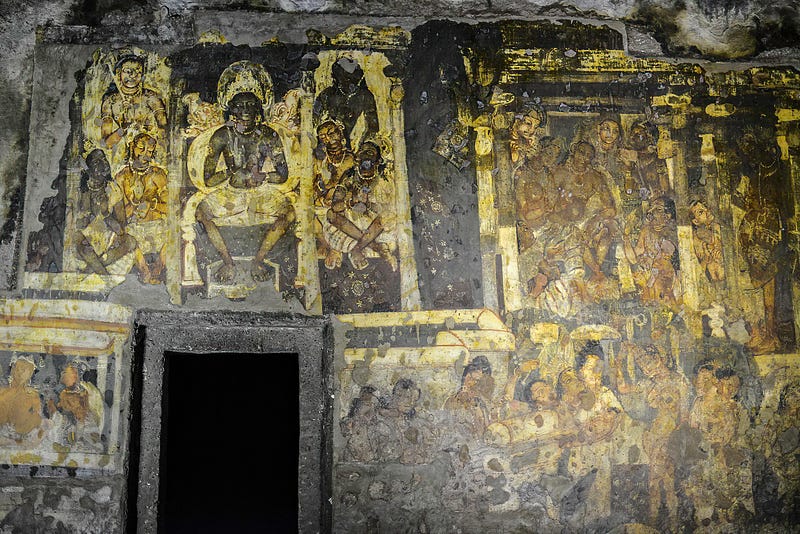
Here, the young Siddharta (Buddha), who was born into luxury and then became a renunciate and then reached enlightenment by finding the Middle Way, approaches with a white elephant.
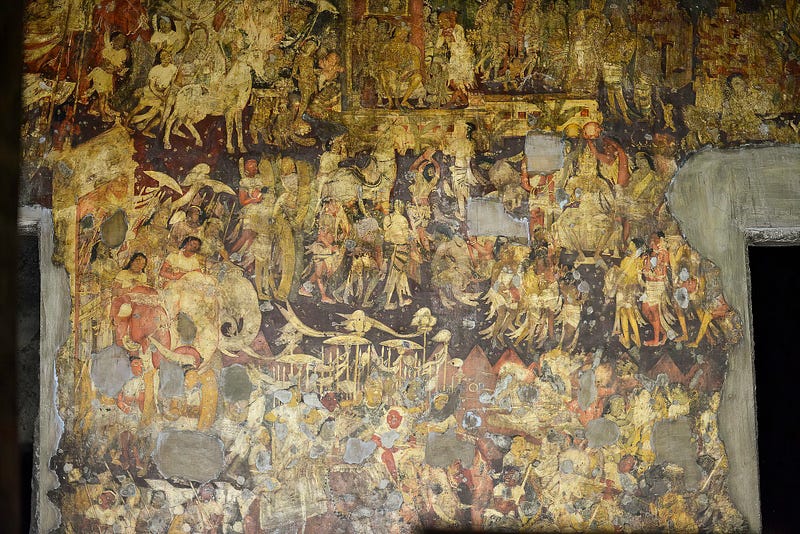
I was fascinated to learn that all of this — every detail of every cave — was created while using light cast into the caves from sunlight reflected off of mirrors.
This is why these frescoes still exist. They were never darkened by the smoke of fires or by natural sunlight, which might have faded them.
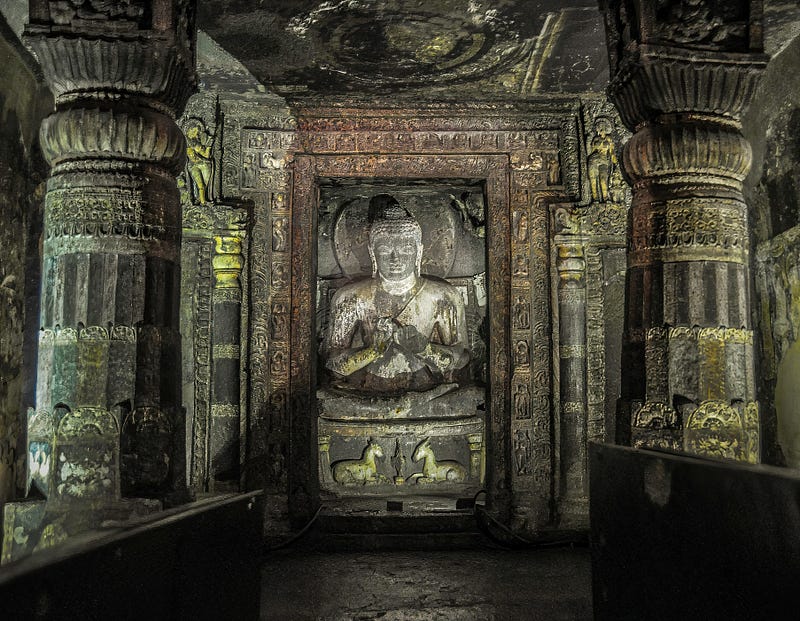
Here, in “cave 2” Buddha greets you from the recesses of an alcove. Some remnants of paint remain on the walls around him.
Not all of the rock in the canyon was suitable for carving though. Some cave projects were begun and then abandoned due to a crack in the floor or wall.
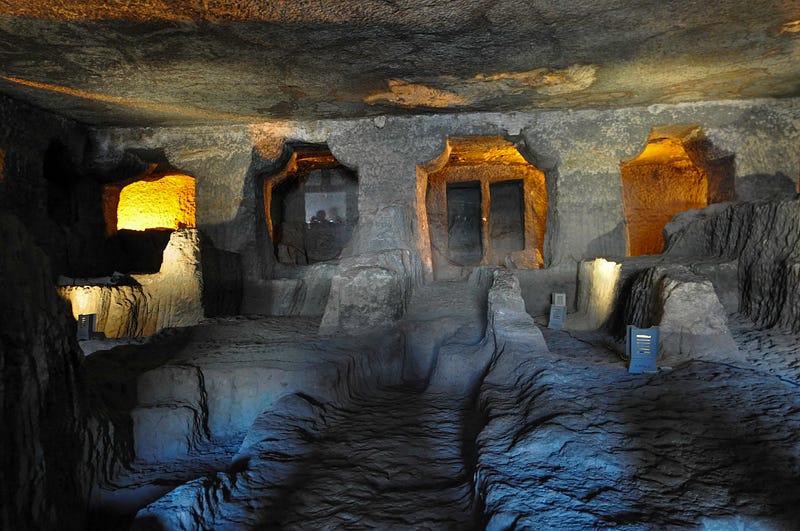
Not all of the rooms were worship halls either. Some contained sleeping quarters for monks, novitiates, and travelers. The cells in the background of the photo below were living quarters.
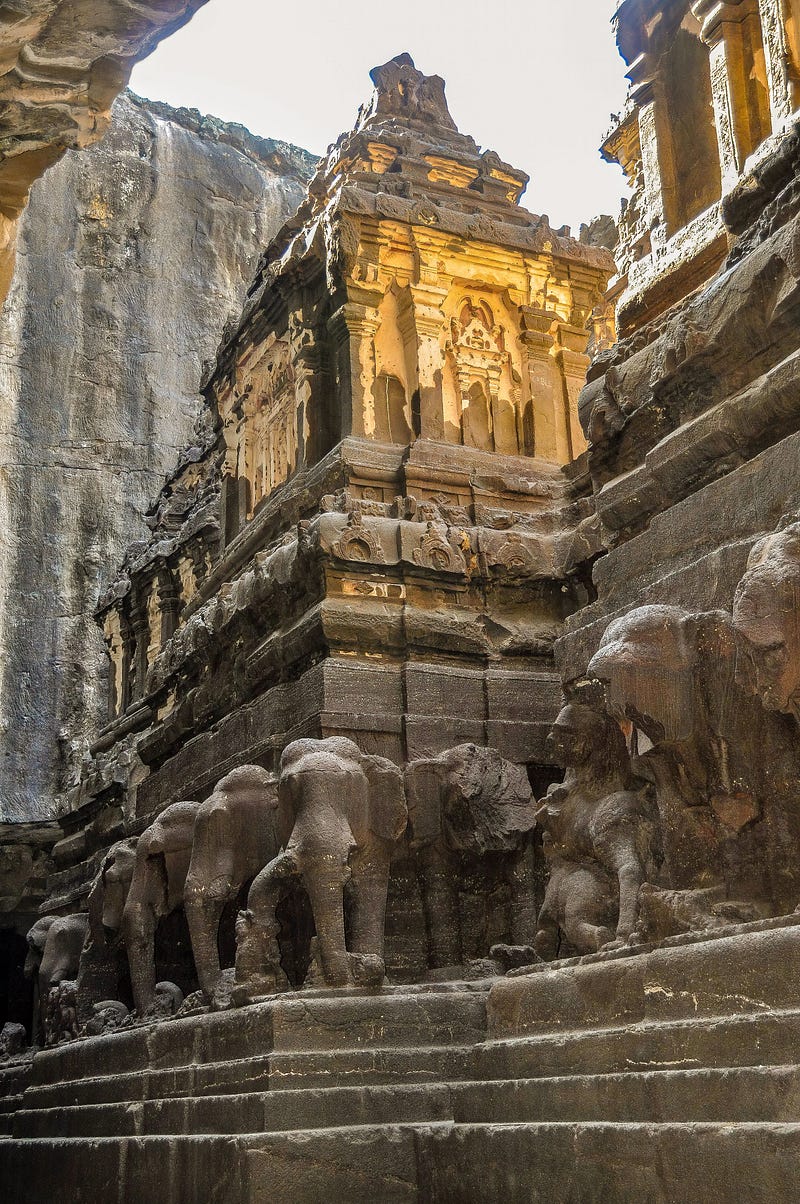
The exteriors of the Ajanta temples are not as intricate as those of the neighboring site of Ellora (about sixty miles away), which cradles Buddhist, Jain and Hindu temples within the palm of a horseshoe-shaped valley. In the center of the crescent of rock an entire mountain has been removed in order to create the incredible Kailasha temple.
Ajanta’s facades are simpler, but still beautiful. My imagination cannot help but wander to the question of what it must have felt like to walk up to these doors in ages past.
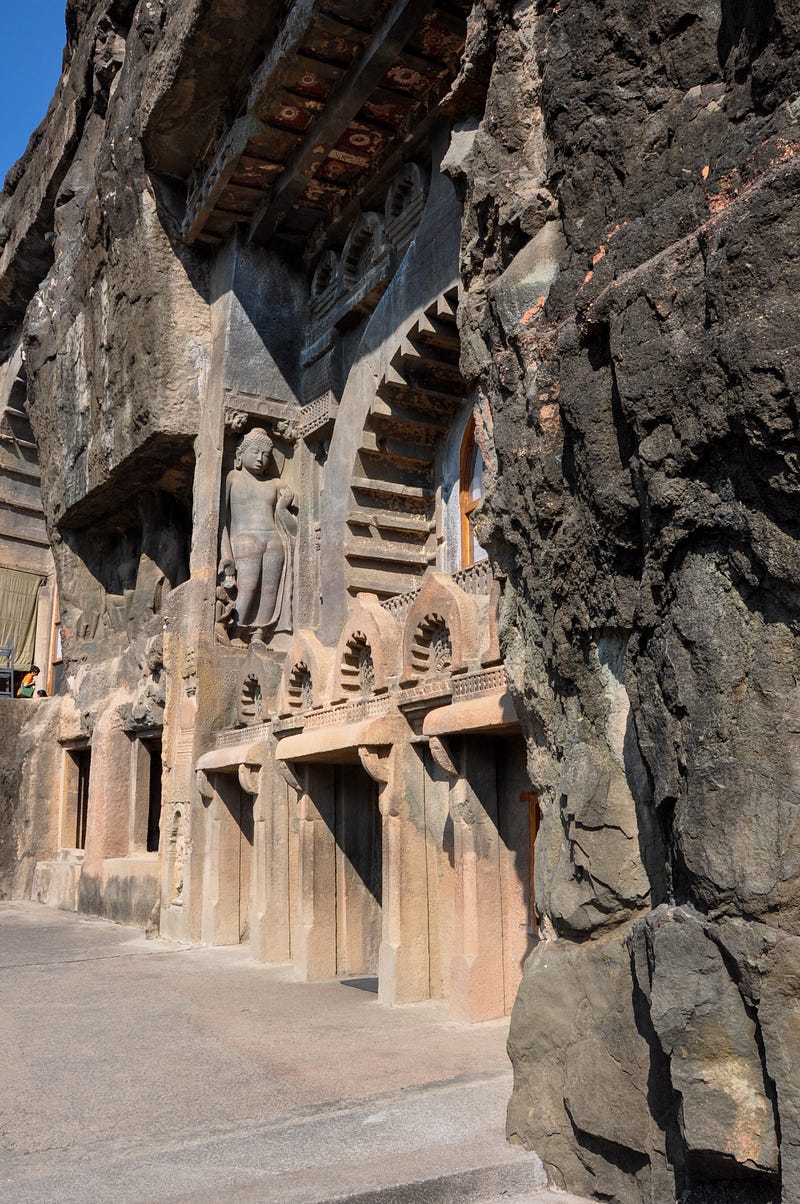
Or this one?
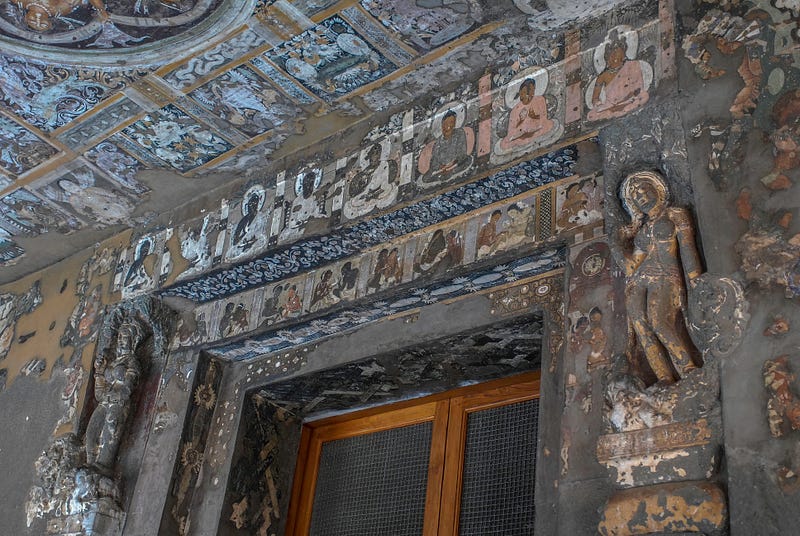
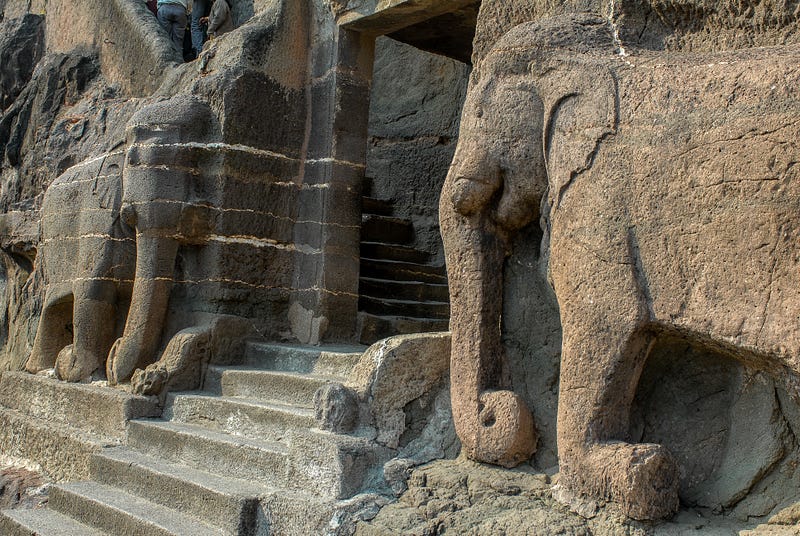
Or beyond these elephants?
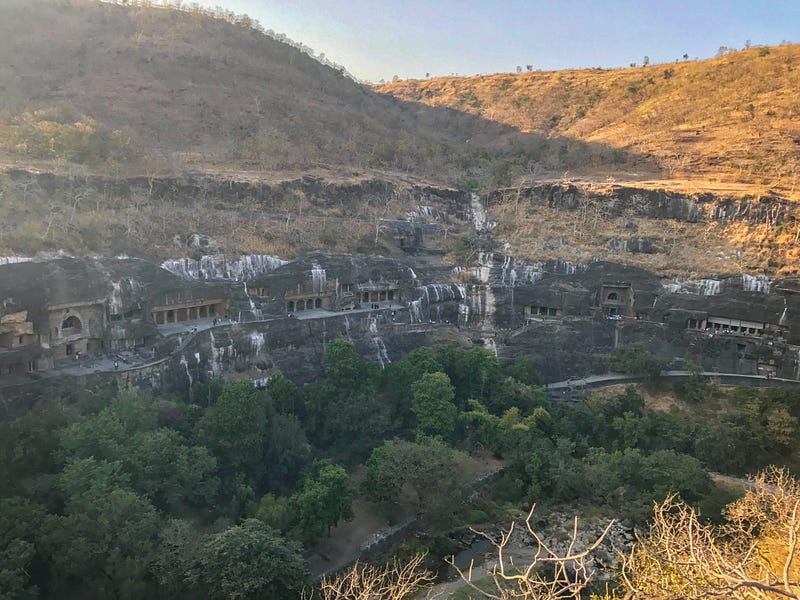
This is the view from across the valley, toward the entrances of the caves.
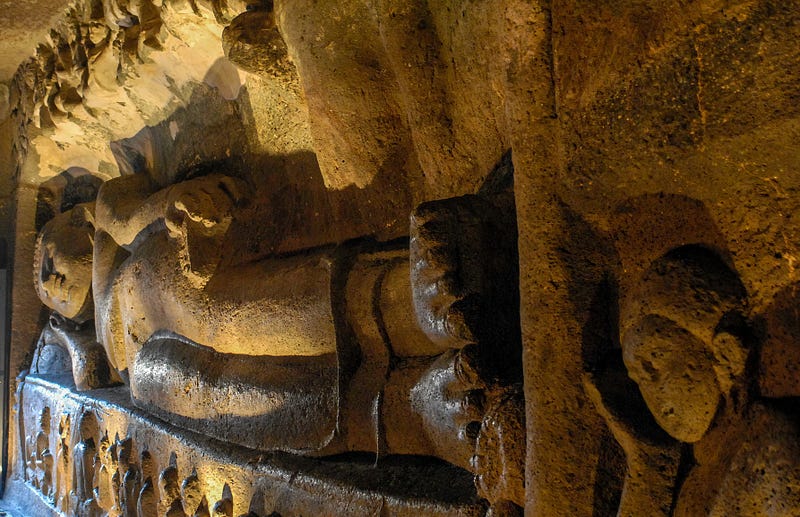
The last cave we visited, “cave 26,” held the “sleeping” or “reclining” Buddha, or Buddha on his deathbed. Something about this scene has haunted me ever since I first saw it. A rawness of emotion seems to ooze from the pores of the rock. The person listening, just around the corner from the dying Buddha — who was it? A trusted friend? A monk? Or just a beloved servant?
Ajanta and Ellora are both located in the heart of India. The closest place to stay to visit them is Aurangabad, which is reachable by flight from the major cities of India.
My husband and I have ventured to this place three times now. And each time we return, we are mesmerized by the passion of the artisans from so long ago. They lived and died for these projects. Many generations worked on these carvings and paintings. These stones are not just emblematic of beautiful craftsmanship, but also of the legacies of the creators of these pieces of ancient art and of their devotions and views, captured without words in these caves.
Erika Burkhalter is a yogi, neurophilosopher, cat-mom, photographer, and lover of travel and nature, spreading her love and amazement for Mother Earth’s glories, one photo, poem, or story at a time. (MS Neuropsychology, MA Yoga Studies).
Thank you to the editors at Globetrotters (JoAnn Ryan, Anne Bonfert, Jillian Amatt — Artistic Voyages, Adrienne Beaumont, Michele Maize) for this month’s challenge on “ruins of the world.”
I have quite enjoyed reading some of the other stories from this challenge:
I particularly liked:
Anne Bonfert’s:
and Jillian Amatt - Artistic Voyages’s:
This also serves as my “A” in my “A to Z” travel destinations, which many other Globetrotters writers have been participating in.
You might also enjoy:
If you enjoyed this piece, you might consider subscribing to my stories. You’ll get an alert whenever a story gets published. While I do normally post my stories with free “friends” links on social media, if you enjoy reading on Medium, you can help the many talented writers here by joining. It helps to support the arts and to keep us writing! And if you are ever interested in acquiring a photograph, just leave me a note.
Photos and story ©Erika Burkhalter. All rights reserved.


