
What We Mean By ‘Oppression Olympics’
Everyone should be able to share their lived experiences, if they decide to…but don’t weaponize it in a deceitful way!
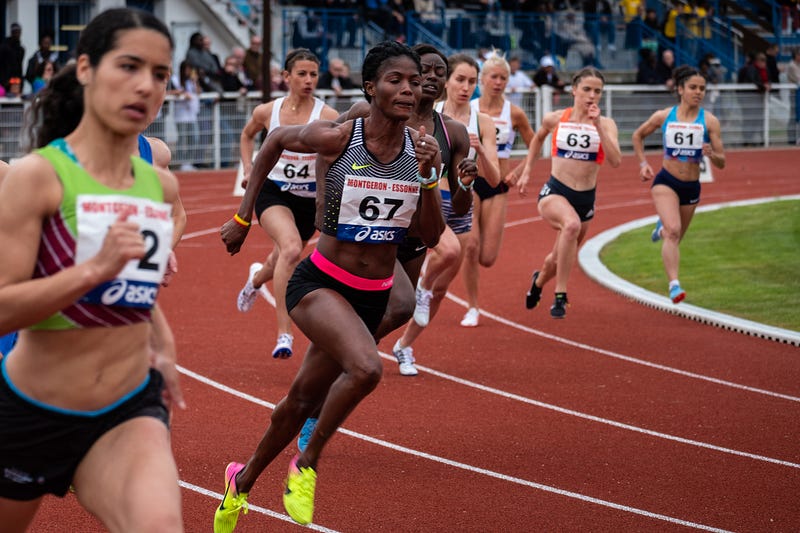
It’s a term used when there’s a mad scramble to make one’s voice heard over a stadium full of roars in favor of social justice. Black people bring up racism. Women bring up sexism. Gay people bring up orientationism. Trans people bring up genderism. People with mental health challenges or physical handicaps bring up ableism. Folks who’ve lived in poverty bring up classism.
And wealthy, able-bodied, neurotypical, heterosexual, cisgender White men are told to shut up altogether.
This is what happens when cultural, interpersonal, and systemic hardships collide. None of us have been given any handbook of absolutism for functioning as “allies” in those scenarios.
“Oppression Olympics.” Many of us warn society against getting bogged down in it.
And the hyperwoke Greek chorus scoffs at us, collectively.
Defining the Term
Crediting community organizer Elizabeth Martínez with coining the term, Tashi Copeland describes the concept of “Oppression Olympics” as follows:
…the idea that marginalization is a competition of determining the relative weight of overall oppression of individuals or groups, based on identity. Simply put, it’s comparing who has it worse…That’s not a solution. That’s a problem in itself. If we’re really going to dismantle these systems and build an equitable community, we have to realize that working together has always been the stepping-stone to success.
In an blog article for the Central Indiana Community Foundation, Copeland calls out instigators of “Oppression Olympics” for trying to pit marginalized groups against one another. She reminds us how people’s lived experiences are intersectional and can set precedents for progress — such as how Loving v. Virginia (in legalizing interracial marriage) helped to make Obergefell v. Hodges (in legalizing same-sex marriage) possible.
Copeland’s central thesis is that hierarchies based on white supremacy succeed when members of underserved groups insist on “outdoing” one another to rank their obstacles above those of other underserved groups.
Amen Gashaw makes a similar case in an October 2021 op-ed piece for the Harvard Political Review. She invokes the unhealthy American culture of competition — how we do ourselves a disservice by trying to invalidate somebody else’s experiences with discrimination when we measure them against our own.
Gashaw urges us to reject the fallacy that progress is a zero-sum game arising from scarcity of available outcomes. She sheds light on how this causes “competing” minority groups to brush off one another’s examples of injustice in order to vindicate themselves and their own causes.
This is inefficient, argues Garshaw, because all of the time and energy spent fighting over who is “most oppressed” could, instead, be utilized to collaborate and form solidarity. In effect, that perceived scarcity of resources turns into a self-fulfilling prophecy.
Both of these women make salient points. An additional problem arises, however, when there can be a lack of universal consensus over who exactly qualifies as “oppressed” across the board.
Measuring Oppression
It’s very common for people to dismiss others with some variation of “Oh, you’re not TRULY oppressed!”
And even well-meaning people have blind spots that can exacerbate these tensions.
Mary Pender Greene — an executive coach, therapist, and consultant — cautions us against building walls to keep out those who haven’t endured our exact same journeys with oppression. She believes the only way to achieve freedom based on equity and equality is to dismantle structural discrimination.
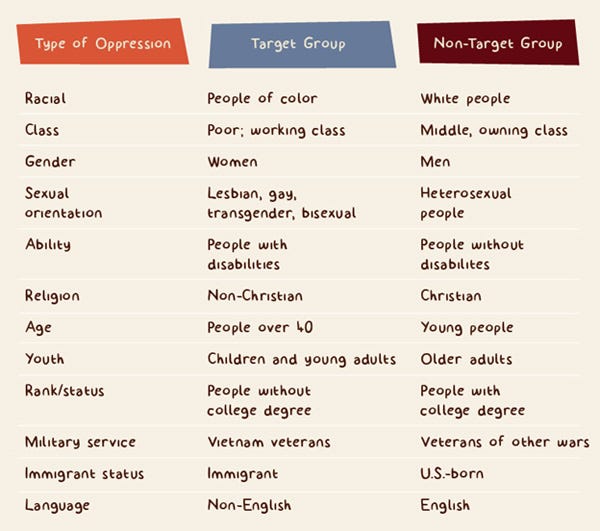
She urges oppressed people to avoid any temptation to engage in one-upsmanship. But when Pender-Greene cites illustrative matrices, even some of the charts and diagrams contain subtle assumptions that are problematic.
For example, one matrix singles out Vietnam veterans over veterans of other wars as being oppressed. Yet, veterans from wars in Iraq and Afghanistan — to name some alternate examples — have reported employment discrimination.
The same diagram implies that, throughout history, people under the age of 40 haven’t experienced ageism. Unfortunately, if that was actually the case, then there would be far more GenXers, Millennials, and Zoomers in political power positions right now.
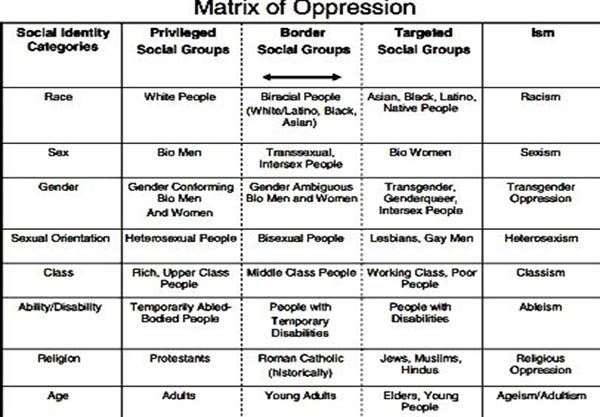
A second diagram labels people as either “Privileged,” “Border,” or “Targeted” when determining if they experience oppression. Such delineations aren’t always clear-cut.
Just look at religion. Protestants are listed as “Privileged.” Jews, Muslims, and Hindus are listed as “Targeted.” Catholics are listed as a “Border” group.
So then how does one explain violence that competing factions direct at one another when it comes to dynamics such as the Israeli-Palestinian conflict? Or warfare between Central Asians and South Asians as exemplified by the Kashmir dispute?
Not to mention the chart rendering atheists, agnostics, pantheists, polytheists, Pagans, Buddhists, Sikhs, and Indigenous practitioners invisible entirely!
That chart also classifies biracial people, intersex people, and gender-ambiguous people as falling into “Border” groups — which, by definition, ranks their oppression below that of members from the “Targeted” groups.
We could take it even further.
Why do some cisgender women reject transgender women from being validated as female?
Why do some BIPOC people reject folks of Middle Eastern descent from being validated as people of color?
Why do some people with disabilities reject those with ADHD, epilepsy, arthritis, or chronic pain from being validated as legitimately disabled?
Why do some homosexual and bisexual people reject those who identify as asexual or genderfluid from being validated within the LGBT+ community?
The Good Trade’s Jess Mally reminds us how different types of oppression manifest distinctly. One doesn’t negate or neutralize the other.
For instance, Mally points to anti-Black racism as being global and unique in its manifestation. But that reality doesn’t diminish the severity of racism experienced by people with racial heritage from outside of Africa.
To live and breathe this solidarity: Mally encourages anyone who has experienced adversity to hold space for others who’ve been through things that each of us, individually, have not.
She invokes models such as Dr. Martin Luther King Jr.’s “Beloved Community” or Nita Mosby Tyler’s notion of “unlikely allies.”
There’s another reason why I echo Mally’s call to examine multiple contexts for oppression. When we fail at solidarity, we fail at life. Refusing to strive to understand another person’s struggles can very easily lead to performative activism or virtue-signaling.
Avoiding Absolutism
Still, oppression-ranking and intimidation and coercion and psychological abuse remain fetishes for several of the loudest voices in the room.
You may make the claim that some oppression is “demonstrably worse” than other oppression. And, if you’re looking strictly at the mechanics of an oppressive act itself, you’d be right.
Obviously, genocide is worse than physical assault.
Physical assault is worse than name-calling.
Name-calling is worse than silently having a prejudicial thought.
Where absolutists get it wrong is by implying that it’s worse to target one TYPE OF person when committing a transgression than it is to target another TYPE OF person for the same transgression.
It’s also inhumane to make excuses for people just because their malicious behavior isn’t quite as severe in magnitude as other people’s malicious behavior is.
Do you claim it was worse to enslave a Black person than it was to imprison an American of Japanese descent in an internment camp?
Would you have said that to Fred Korematsu’s face while he was trapped behind a fence in the desert?
Do you claim it was worse to exile an Indigenous tribe to the “Trail of Tears” than it was to send of group of Jewish refugees to Bergen-Belsen?
Would you have said that to Anne Frank’s face as she was being herded into the gas chamber?
And, while I agree that we should increase the visibility of marginalized groups amidst the public discourse — by what barometer do you center the voices of people who belong to a specific marginalized group when considering how actual members of that group possess a diversity of voices?
I suspect that folks engaging in “Oppression Olympics” want deference shown to the marginalized voices who are ideologically similar to their own.
If we’re asked to “center Black voices”…
Does that mean Michael Eric Dyson gets a bigger bullhorn than John McWhorter?
If we’re asked to “center women’s voices”…
Does that mean Janice Raymond gets a bigger bullhorn than Nadine Strossen?
If we’re asked to “center Queer voices”…
Does that mean Dan Savage gets a bigger bullhorn than Andrew Sullivan?
If we’re asked to “center secular voices”…
Does that mean Greta Christina gets a bigger bullhorn than Bart Ehrman?
Wouldn’t it be a lot more productive — and a lot less stressful — if we just practiced the art of showing compassion to someone who faces adversity?
And if we confronted that adversity, alongside of them…regardless of whether the culprit looks like us, sounds like us, thinks like us, or behaves like us!
Click here to subscribe to my stories.


