Indian Politics
What Are the Consequences of Elections to Five Indian States in 2021?
Elections to Assam, West Bengal, Kerala, TN, Puducherry and their impact on Indian Politics explained
It has been quite some time since India has seen a heated election season after 2019. Sparing Maharastra and Haryana in 2019 we have not seen anything big in 2020 except for Bihar. In 2021, we have an interesting election season where we have totally new and different contents in each contour. It has been quite some time since we have discussed national-level politics. That is why we are here to remove your confusion regarding the effect of these elections on the national picture.
At present the pandemic is raging far and wide, despite that, we could see elections taking place just before that.
Before you proceed ahead with the topic, do read our previous article for a better understanding!
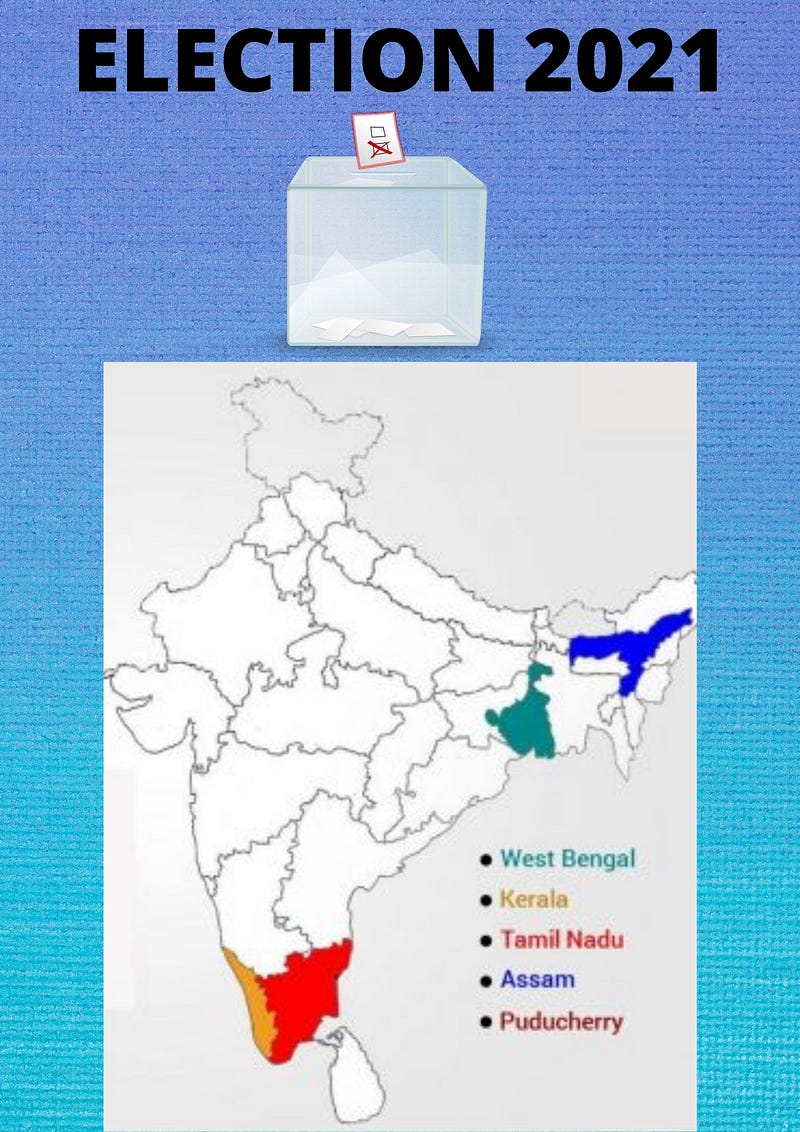
As you must have guessed, these five states which are in the elections right now are West Bengal, Assam, Tamil Nadu, Kerala and the Union Territory of Puducherry which has a legislature. The election phases for Assam, Tamil Nadu, Kerala and Puducherry are over and as of now, we have only a few phases of Bengal elections left. The election results for all the seats are expected by May 2nd. Amidst the pandemic, we can see the polls taking the central stage.
The Importance of these elections
As you know, these are the states where regional players and regional parties are the strongest. These states are the farthest from the capital. They are located in the Southern and Eastern tip having borders or coastal line. Thus we know that they have unique politics and versatile issues to discuss. Usual points that are discussed in and around Delhi or in the Hindi heartland don’t get traction here. So the national parties’ footprint is not so here as expected They have to modify their national stance in these areas too. Most of the opposition parties in Lok Sabha are from this region, thus we must say that these states contribute a lot to opposition parties’ kitty. Thus these elections have a significant impact on the national elections.
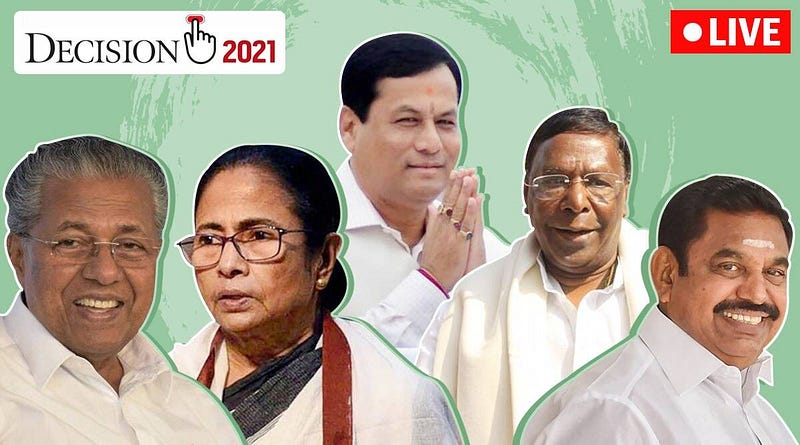
Now we will discuss the ground situation state by state and what all consequences do they present at the state and the national level. Also, we can check its effect in the long run.
Assam
The largest and the most important state in the North East. It had grabbed national attention in 2015 when Assam National Register For Citizens (NRC) was implemented under the lens of the Supreme Court (SC). Also, we had also seen massive protests in 2019 when the Indian Govt. decided to implement Citizenship Amendment Act (CAA).
As per NRC, over 40 Lakh had been out of their Indian Citizenship Register. It was implemented so as to find those infiltrators from Bangladesh. Due to its poor implementation, we can see a lot of protests and anger in the state. The main party on the ground is the BJP which is in alliance with Asom Gana Parishad (AGP) under the leadership of Sarbananda Sonawal. Assam was also the first state where BJP entered the North East. We can see that indigenous people won’t support CAA. The tea workers community of Assam as well as the urban class is now in the hands of the BJP.
The main party before 2016 was Congress. It is now struggling after it lost its Veteran Tarun Gogoi. It lost the elections after Hemanth Vishwas Sharma, the strongman leader of North East left the party for BJP. This had shifted its cadre and vote bank to BJP. Now, Congress is in an unholy alliance with AI-UDF which is seen as a pro-Muslim party. As per poll arithmetic of 2016, we can see that it is advantageous to the Congress while on other hand we don’t know how this alliance will work out this year with the incumbent BJP ready to win again. It was way behind BJP when the elections were declared but now it has built up very well giving BJP a tough contest.
Due to the elections, we can see that BJP is on the back foot with NRC and CAA. BJP has proposed a corrected NRC in its manifesto. The most significant factor for this election will be the support of the Assam Students Union which is pro Assamese and is vocal against CAA.
Assam elections will decide if BJP’s strategy will win or Congress poll arithmetic. If Congress loses the state again, that will lead to more leaders defecting and joining other parties mainly the BJP. If Congress manages to win, that will be a big booster for its nationwide revival. BJP needs to win Assam to maintain its base in the region as well as this election will decide the future of NRC and CAA.
West Bengal
The most looked upon Indian election in these five states. The poll comprises nine phases. West Bengal has also the fourth-largest number of Parliamentary seats and is a significant chunk for any political party. Bengal has been under the control of Left parties unbeaten for 35 years until 2011. In 2011, strong Mamata Banerjee led Trinamool Congress flipped the left bastion and is presently unbeaten. It has always been in news for political violence and conflict between parties.
The BJP which had only three seats in 2016 is looking for a massive flipping of the state. This time it is aiming for nothing less than capturing power. Left parties now have been wiped out completely and the entire cadre has shifted to BJP. Most of the rural belt is now under BJP making it the first state which is leading BJP’s rise from the rural areas. BJP which is an urban party is dramatically shifting its goal post here. The Hindu lower caste makes up a massive chunk of BJP’s rural voters.
Left with identity crisis has tied up with Congress which is also in a bigger identity crisis. Although Congress is performing better than the left, both will fall together if not for the better. The worst thing ever which they could do was to ally with Indian Secular Front (ISF) which is a radical Muslim party. Along with that, we can see how Owaisi’s party AIMIM is also trying its best to open the account. CPIM and CPI this time has fielded a lot of new faces and young candidates hoping to revive their voter base.
The main five factors this time can be explained in 5Ms.
Mamata
Is the main face of Bengal for the past decade and is still the main face even now. She is nicknamed Didi in the local language. She is known for her strong leadership and charisma. She is banking on her administration for the elections and also projecting the Bengal identity. TMC is trying to portray BJP as an outsider party. The biggest problem faced by TMC is that it is centred around Mamata and many senior leaders have left the party. She is up for a tight contest in the Nandigram seat against Suvendu Adhikari of BJP who had left TMC for BJP.
Modi
We all know that there is no one above the Prime Minister of this nation. But we can understand he has been the main face of BJP for years. It is attributed for two reasons. The first one being, BJP has always performed better when Modi is the main face and when there is no other CM face. The second reason is because of lack of a tall leader in the state and a lot of like-minded leaders competing might harm the party in the long run. At present Modi is being presented as Dada of the Bengal population.
Muslim
There is a significant population of Muslims in this region. CAA and NRC have made them nervous and has always made their votes consolidate to either one of the sides. As per ground and media reports, we can find that Muslims this time will favour Mamata Banerjee. Especially at the age of maximum polarisation especially done by the BJP, their votes matter. ISF as we discussed above also will decide how these votes split and may also affect the BJP votes too. Earlier it was Congress and the Left that had votes of the minorities.
Matua
They are a section of backward SC Hindus originally from Bangladesh. Most of the Matuas had migrated from Bangladesh to India due to various reasons including religious persecution. While even today we can see that there are a lot of Matuas who stayed back in Bangladesh. Modi in his March visit to Dhaka had made his effort to reach out to the community and also visited their temples too. This has important political significance in Bengal as well. It is expected that Matua votes will consolidate in favour of the BJP. CAA has also boosted their support for BJP.
Mahila
Stands for the term “Woman” in Hindi. Just as we expect, they have always favoured Mamata Banerjee who herself is a strong woman leader. This time all are curious to understand on which side it will swing. Whether TMC will have the upper hand or the BJP will snatch their votes.
Its do or die battle for the AI-TMC this time while for BJP it's a matter of prestige to conquer one more state where it never had a foothold before. For the Left- INC alliance it is all about survival and revival.
Tamil Nadu
The southernmost state of India and one of the most politically unique state. Almost all the important parties are regional and state parties. National parties like Congress and BJP even though they are present, have minimal effect on the politics of the state. Traditionally the fight has been between the Dravida Munnetra Kazhagam (DMK) and All India Anna Dravida Munnetra Kazhagam (AIADMK). At present, AIADMK is the incumbent party for the past two terms and is waiting to seek a third term. DMK hoping to make a comeback by banking upon anti-incumbency votes is looking to dampen AIADMK. It has formed an alliance with INC, Left front and many small parties. In the 2019 Assembly elections, it had swept 38 out of 39 seats. Even the exit polls look slightly favourable to the DMK-INC alliance.
AIADMK is now all seeking victory by aligning with BJP amidst the fact that the party is marred with factionalism between OPS, EPS and TTV groups. BJP on the other hand is wooing urban and conservative Hindu voters by raising the legacy of Muruga and Velu. While the battle has always been bipolar, we can see a new force ie. Makkal Niti Mayyam under actor Kamal Hassan trying to open its account. AIADMK also has smaller allies like PMK.
Kerala
Has always been know for electing alternative governments for the past four decades. We had already discussed Kerala politics and elections in depth and detail. Following are the links to those articles.
We had also held a podcast on the topic.
Will the pattern decide the new govt? Will that pattern be broken? Will BJP emerge out as a strong third front? Will the new Assembly give a hung verdict? These are the important questions that will be the decisive factor for the consequences of the election results.
Low turnout has hurt the calculations of all the alliances. Now they are going to wait for a surprise. We can see that UDF which had a disastrous start has made amazing progress towards the end of the election lap. The election is now neck on neck.
It’s do or die for the UDF if they have to lose the state. It will also enhance their infighting and also will lead to massive defections. Those defections will also depend on the number of seats BJP is going to get. For the Left, it’s their last bastion in the country. They cannot afford to lose at any cost. If they lose, they can be better opposition and get back to power next time. BJP looks to make a massive entry in the state, and grey has begun with good stone laying this year, maybe by 2026 they can directly look for capturing power. Just like how its President said- If we get 35 seats, we will capture the state.
Do check out my detailed coverage of the Kerala elections.
Puducherry
Electorally it is insignificant as it has only 30 seats in the assembly and also only contributes one MP at the national level. Although with the recent developments, it has grabbed national headlines that will change the political landscape of Southern India.
Always known as a Congress stronghold, Puducherry is experiencing a massive surge of BJP’s backdoor entry. In the last few weeks, we can see a lot of MLAs from the ruling side resign and join BJP. This happened just before Kiran Bedi, the Lt Governor was transferred out.
The contest for the same is between the Congress and the grand alliance between N. R. Congress, AIADMK and BJP. There is massive anti-incumbency against the V Narayana Swamy and BJP now sees the opportunity to capture power. If Congress doesn’t perform well then, the party will almost be wiped out. That will be the end of Congress domination in South India. This will also be the entry point for BJP. Opening accounts in TN, Kerala and Puducherry will be a lottery for BJP and also one step closer to the throne.
Party wise Impact
BJP
Entry into all states is not just the dream of BJP, it is also ready to do whatever it can to achieve it. Now, it is essential for BJP to retain Assam as it wants to portray itself as an election-winning machine even with an incumbent CM face. It also wants Assam to be the main leverage over the North East. Trying to win Bengal is another motive, but we don’t know how far it will be successful. It is giving a tough fight and in most cases, it will capture power at least by the next election. BJP also tried to provide a lot of incentives for these through the Budget, which itself shows how far BJP is giving importance.
Winning the south is more than prestige. Those areas which have never witnessed BJP foothold might change soon as BJP is planning efficiently. Making significant gains in Kerala and TN is essential for its growth and also to weaken the regional parties. Winning Puducherry is almost certain for the party.
Congress
The dying party has no hopes beyond Kerala where it is believing that the govt. will change every five years. It is trying hard in Assam but the only factor that will help INC there is arithmetic and nothing else. Winning Assam would mean the party is reviving. In Bengal party has no hopes as it’s not the main contender. Losing Puducherry will be the biggest loss. In TN it has no stakes and is fully dependant on DMK.
Left Front
Has to retain Kerala else it will face a wipeout. In Bengal, it hopes to revive itself and prepare to win at least for the upcoming elections.
Regional Parties
DMK wants to flip the state while AIADMK wants to retain power. At the national level, DMK stands in opposition and AIADMK with the Govt. The verdict will decide to strengthen the opposition at the national level. For smaller parties, their success will directly depend on the performance of their allies.
This is the nationwide map of this election whose result will come out on May 2nd. This election will channelise the performance of both the Government and Opposition. Given that these elections are a litmus test for opposition, they have to perform better else they are doomed. If the opposition believes that it can challenge the Modi-Shah juggernaut then it must ramp up and reinvent itself. Without that India will be under a one-party rule. Also, given that opposition is weak, people will vote for BJP as long as they don’t find a better alternative.
Given that the election happened during the pandemic time, we are yet to understand how far these elections will decide the effective fight against the pandemic at both the central and the state level. Along with fighting disease, it is essential for the new governments to stimulate economic recovery combined with a speedy recovery and efficient vaccine strategy.
If you have any doubts or are you interested in Assam and W. Bengal elections, do refer to the ground reporting by The Lallantop. No other channel has done such extensive ground reporting in Indian elections.
Suggested Reading
I have started a Telegram Channel which will contain the record of all my articles. Follow my personal blog for behind the scenes and informative content.


