
We Can’t Negotiate Everything With Our Kids
Which is exactly the reason we should be flexible whenever possible

Because I said so
When I say children should be allowed to question authority and adults should role-model flexibility and a willingness to listen, the most common response I hear is,
“But everything can’t be a negotiation! What if it’s a safety issue?”
If children are seen and heard when there is time for conversation, they are more likely to take us seriously when we say “this is a safety issue” or “this one is non-negotiable”.
If we’re constantly expecting unquestioning obedience and compliance, with a don’t question my authority attitude, then children are more likely to be at risk because we haven’t differentiated between situations which allow for flexibility and those which do not.
We cannot expect children to develop and demonstrate cognitive flexibility, adaptability, and a willingness to compromise if we’re not willing and able to role-model what that looks like. We’re the adults, it’s our job to set the example.
Expressing differences of opinion and learning how to disagree respectfully are very important life skills.
It may be inconvenient (and sometimes frustrating) when children argue, disagree, and debate with us. Our feelings and exhaustion are valid, we can acknowledge and make space for that. However it’s not our job to mold children into more adaptable, convenient humans.
It’s our responsibility to guide them as to how to pick their battles and help them develop tact and diplomacy.
We can teach through role-modelling how to disagree politely. Those are not skills children learn if we shut them down for being “disrespectful” simply for voicing their opinion.
We’re the adults, it’s our job to set the example.
Children are people too
It may sound silly, but we often forget that children have rights as fellow human beings. We impede upon their rights all the time. Sometimes we do so in their best interests, but sometimes we do so for the sake of our own needs and wants.
When we teach children through our actions that they have the right to autonomy and participation, they internalize this message, and carry it with them into adolescence and adulthood.
The United Nations Convention on the Rights of the Child (UNCRC) states,
“Children have the right to give their opinions in all matters that affect them and to have their voices heard. Children’s views should always be taken seriously, no matter their age.”
Children who are taught through experience that it’s safe to speak up for themselves develop important self-advocacy skills. These skills will help them when facing peer pressure, and can contribute to keeping them safe when adults ask them to do things they don’t feel comfortable doing.
Children whose rights are respected are more likely to respect the rights of others because children learn by example. If adults don’t run roughshod over them and genuinely offer freedom and choice, kids are more likely to extend this mutual respect to adults as well as peers.
Freedom must be developmentally appropriate
To be clear, I am not saying we let children do whatever they want by any stretch. Their brains are not fully developed yet.
Children do not have the developmental maturity to handle some situations or make certain decisions and will need the adults in their lives to guide them and keep them safe.
We can’t negotiate everything. Sometimes it’s a health or safety issue. My son sure as hell isn’t going to choose to get a vaccination if I offer him the ability to opt out. He doesn’t want to get a needle in his arm.
He’s not likely to choose fruits and vegetables if he’s given the freedom to eat anything he wants and has a bag full of hallowe’en candy sitting in our cupboard.
We control so many aspects of children’s lives, sometimes by necessity, that we really need to pick our battles. Yes, I insist my son eat a balanced meal before digging into a reasonable amount of candy. What is a balanced meal? How much candy is reasonable?
Those factors may be negotiable, such as which vegetable he would prefer to have with his dinner. We don’t have strict rules about what number of treats he’s allowed and we do this intentionally.
Instead of saying “you may only have x number of treats”, whereupon he would choose the largest treats he could find, we let him dig through his hallowe’en loot and pick out what he wants. If we feel he’s chosen reasonable amount, we say okay. If we feel it’s a bit much, we’ll say so, and then begin the negotiations.
“Please put at least two things back.”
“How about one?”
“One larger one.”
“One medium one?”
And so on.
(I think his teachers hate us for this, by the way, because they don’t have the same room for flexibility at school as we do at home. Sorry, teachers).
Why do we do this? It’s not because we’re trying to train a future lawyer (our son already had the art of negotiation encoded into his DNA anyway). There will be many times, and increasingly so as he gets older, when our son has the opportunity to make these decisions for himself.
We want him to have some experience with self-management. To know how to listen to his body and decide when he’s full, to have the ability to make choices based on what he wants, but also what he knows he needs.
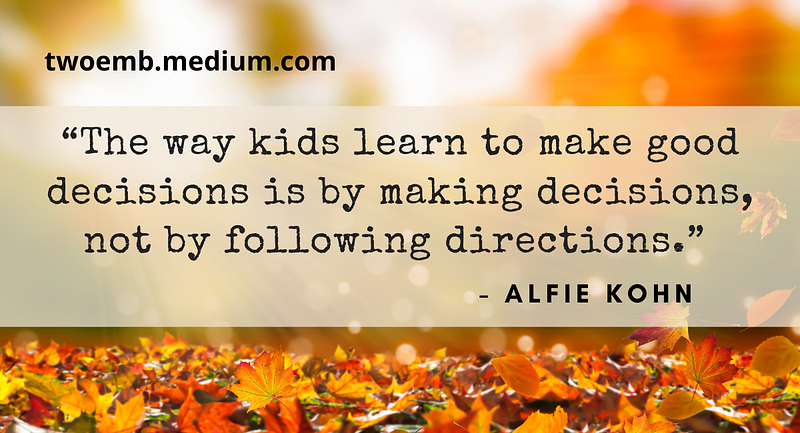
Decision paralysis
Before our son was born, I worked as a youth worker in residential care with adolescent boys. Most of these tweens and teens grew up in the child welfare system where everything was dictated for them, right down to what they ate at every meal, even when they were 17 years old.
One of these young men stayed with us for a year as a place of safety after he “aged out” of the system. We were a transition home for him to find a job, save up some money, and work on independent living skills.
Folks, 18 years old is much too late for a young adult to be learning how to make basic decisions for himself.
The first time we went grocery shopping, I remember walking with this young man down the cereal aisle. I gestured at the huge selection of cereals and asked him to pick whatever he wanted.
I quickly realized that was a mistake on my part, as my offer only served to make him anxious. He looked uncomfortable, telling me he didn’t know, he would just eat whatever I chose.
No one had ever bothered to ask him what he liked before. Going from zero choice to an overwhelming number of options was too much. We got a few different kinds of cereals that day, and over time he figured out his preferences and became comfortable asking for things.
In summary
If we power trip over every single thing and refuse to negotiate with our kids, they will not have the opportunity to learn how to compromise, nor will they learn what it looks like to be flexible.
We will also have a hard time convincing them that something really is important and not up for debate if we treat everything like a must-do, must-listen situation.
Lastly, we need to role-model what it looks like to respect another person’s point of view, and to understand that people don’t have to do what we say just because we said it.
Contrary to popular belief, all people have rights and freedoms, including children.
© Jillian Enright, Neurodiversity MB
Related Articles
Ways to support my work
You can leave a “tip” on Ko-Fi at https://Ko-Fi.com/NeurodiversityMB
Become a paid subscriber to my Substack publication
Check out my online store at https://NeurodiversityMB.ca/shop
Read and share my articles from twoemb.medium.com
Learn more
References
Kohn, A. (2016). The Myth of the Spoiled Child: Coddled kids, helicopter parents, and other phony crises. Beacon Press.
United Nations. (1989). Convention on the Rights of the Child. [Online].


