
Want To go Viral? Top-Writer Tips You Must Follow
From $0 to $10,000… It's real! Create and publish irresistible content by applying these tips.

I can tell you some wonderful stories about writers who became so successful. Ready to be surprised.
A single viral article helped a writer go from $75 to $10,000+ in just 3 months. This is not just one case. Another writer earned $3400 in his very second month! Another one progressed from $20 to $2,300 in 5 months!
How is it even possible? Can we make such an engaging article?
More than consistency they placed that “Hook” 🎣 in the title and introduction of their stories which brought them real “readers”.
So master the title-introduction writing skills, don’t be just being consistent. Like Eve Arnold said. “You should be mindfully consistent”.
How to make an irresistible title?
Hooking a Title plays the key role here, your title should be
- Simple and short.
- Explaining the clear benefit.
- A question that triggers the viewer.
- Spark their interest to know more.
- An exciting news.
- Telling them what to do.
- Add numbers or symbols conveying emotion.
You can even use platforms like Headline Studio to evaluate how good your title is.
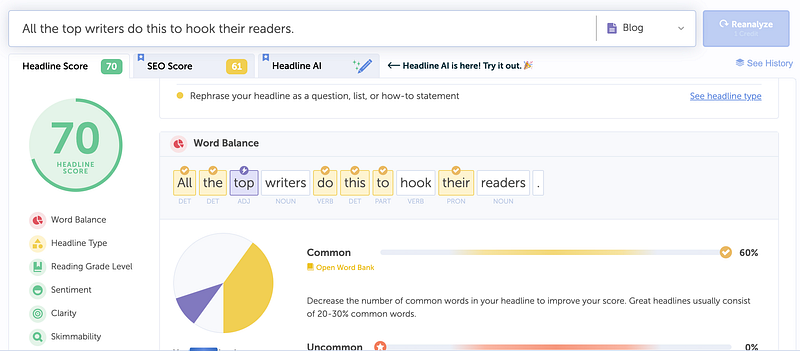
Here are a couple of formulas for the new writers.
Formula : [Number] Secret(s) of [something]
Eg. “7 Secrets of Building a Top Linkedin Profile”
Formula: If you need [This], You must do [This]
Eg. “If You Need to Work 40+ Hours as a Creator, You Must Do This!”
Formula: The one [ — — — ] Extremely/Insanely [— — —] .
Eg. “The One Habit to Become Insanely Productive”
Formula: Here’s How [Somebody] [Does Something]
Eg. “Here is How Top CEOs Manage a Day”
Formula: [Number] Quick Ways (Or Methods, Ways) to [Something]
Eg. “Quick Ways to Reduce Your Weight in a Single Week”
You can build many similar formulas to build an eye-catching title.
A hooking introduction — Analysing popular writer’s blog.
Once you convert a “scroller” to a “clicker” now it's time to learn how to engage them.
Let me analyze the popular writer Sinem Günel in Medium. This is her latest article.

Here is how she introduces her content to the reader.
“Did you ever wonder whether your existence matters? Whether your birth was a complete coincidence or if your death would lead to a change?
If your answer is yes, the butterfly effect could help you find answers and make sense of your life. At least in some ways.
The butterfly effect was first formulated by American meteorologist and mathematician Edward Lorenz in the 1960s.
His theory claims that even a tiny change in the starting of an event (such as the flutter of a butterfly) could lead to drastic differences in the outcome of the particular event.”
Analysis
The introduction can be split into three core parts.
A question that connects with the reader about their life.
Did you ever wonder whether your existence matters? Whether your birth was a complete coincidence or if your death would lead to a change?
An answer He/She might not have heard about before.
If your answer is yes, the butterfly effect could help you find answers and make sense of your life. At least in some ways.
A clear explanation of the solution
The butterfly effect was first formulated by American meteorologist and mathematician Edward Lorenz in the 1960s.
His theory claims that even a tiny change in the starting of an event (such as the flutter of a butterfly) could lead to drastic differences in the outcome of the particular event.
This is how the magic happens. Whoever clicks the title gets hooked by the introduction and gets converted into a reader and engager.
Here is one key advice from her about the content “Put important words at the beginning or end of your sentences” because subconsciously reader will pay more attention to the first and last words.
A checklist to verify if your introduction is worthy.
Your intro should have three important parts.
- Excite readers and give them an irresistible reason to scroll down and read.
- Introduce a new perspective/idea/information on the topic.
- Give them a clear idea about what they are going to learn new from your blog
Also, cross-check with the below criteria.
- Clarity: Is the introduction clear and concise, avoiding unnecessarily complicated language that might confuse the reader?
- Connection: Does the introduction establish a connection with the reader by addressing their needs, interests, or pain points related to the topic?
- Length: Is the introduction an appropriate length, neither too short nor too long, to maintain the reader’s interest without overwhelming them?
- Flow: Does the introduction flow smoothly into the main body of the blog post, guiding the reader seamlessly from the introduction to the next section?
- Credibility and Authority: Have you included relevant information to prove your credibility and authority to build the reader’s confidence?
Experiment and Learn
Even though whatever theories you apply to build your blogs, you can still go out of the box and experiment with new methods that work for you. Share your thoughts here.
Subscribe Here for an Email Reminder of my next Article, thanks.
If you like my article, please don’t forget to support me by clapping and sharing your comments.
Here are some other articles you may be interested in: