
Walking the Line (off the page and into the world)
The playful drawing style of Paul Klee may not have any obvious practical application, yet it led to one of the best known products to come out of the Bauhaus.
Swiss artist Paul Klee’s deceptively fun-and-simple approach to academic painting was seriously influential between the wars. He taught at the famous Bauhaus design school in Germany and pioneered many new techniques that are now fairly commonplace in drawing.
One such technique was to mix light oil with drawing ink, which meant that after a drawing had dried, watercolour could be applied using the wet-on-wet technique, but the soft bleed of the pigment would not cross lines drawn with the water repelling oil-ink. Look carefully at the circle of the sun in They’re Biting (1920).
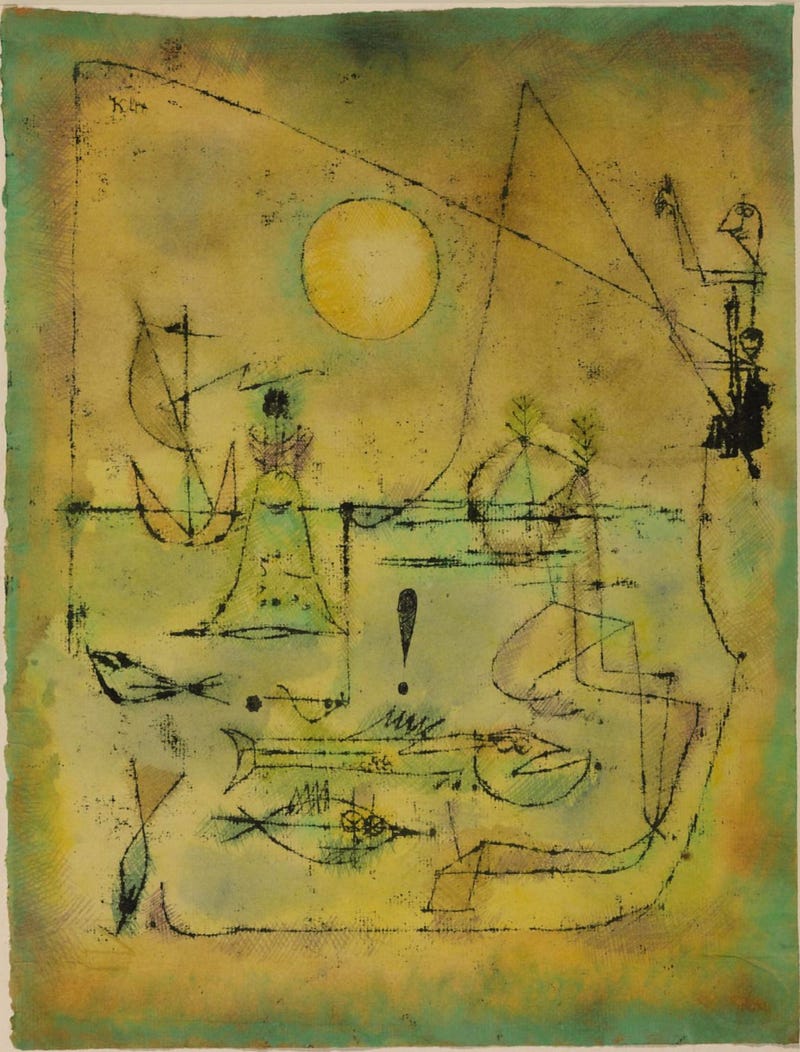
The image shows a cartoonish scenario of a boy fishing with his dad. The boy has caught a fish, a larger fish is about to take the hook of the father’s line. Following the lines from the fishing rods is a little bit like games found in children’s puzzle books, where the loops and curves must be traced from one symbol to another.
Among the symbols for fish we also find two recognisable typographic symbols in the full-stop. And the exclamation mark! These represent methods of indicating much larger concepts, such as conclusion and surprise, in a very simple abstract way. The exclamation is above a fish that is big enough to swallow both father and son! And what do fish do? Big fish eat little fish. A series of events has been set in motion that will reach a final conclusion with the big fish being caught by one of the fishers. The ratio will be reversed and the struggle to land the catch could go either way.
There is a childish sense of fun in They’re Biting and also a more adult, darker humour at work. The narrative also operates on different levels and becomes a metaphor for competition, interaction, team work, our relationship with the natural world, the unknown, invisible factors that may affect us, the choice to use strength to dominate or nurture others… a relatively simple story leads on to more and more complex contemplation.
Klee had similar metaphysical ideas to both Franz Marc (his friend who sadly didn’t survive the First World War) and Wassily Kandinsky (a fellow teacher at the Bauhaus) who saw art as a process of revelation. However, Klee believed that there was no ‘ultimate reality’ to reveal and thought that ‘reality’ should be treated as a child treats a toy — it is ours to imagine how we wish and to enjoy as much as we possibly can.
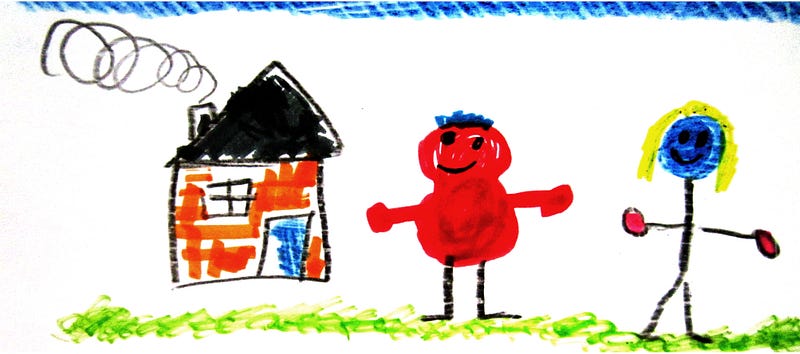
He was very interested in how children intuitively create symbols in their drawings. (A rectangle under a triangle is a house, a square with a cross in it is a window, a spiral is smoke coming from a chimney, a stick figure with a blue head is mummy, a red blob with L-shaped ‘feet’ is daddy.) He attempted to capture this freshness and honesty in his own compositions, and this approach can be seen in many of his drawings and paintings.
They’re Biting remains one of my favourites from Klee’s extensive oeuvre, but flicking through a catalogue of Klee’s work reveals a wide range of media, from the traditional to the experimental. He would sometimes coat paper or board with plaster and similar substances then etch into the surface or polish areas down to the base before rubbing waxes and thicker pigments across the surface and then scraping it back off, leaving residue in the lines and textures. This method was a combination of etching, drawing and printing with an element of sculptural relief.
Klee would also start drawings from random doodles without a clear idea of how the drawing would turn out: Once the pen had begun to move, he would respond to what the random doodles suggested and allow his subconscious to place meaning onto the mark-making. This constituted what would later be termed Automatist Surrealism, where biomorphic shapes are coerced into becoming fantasy creatures within dream-like scenarios.
He is widely known for coming up with an approach of “taking a line for a walk.” This involved attempting to draw a scene without taking the tip of the pen or brush from the surface of the ‘canvas’ and recording the scene in the same order as our eyes may wander across it. The resulting drawings often resembled doodles though in many ways were a more realistic and direct representation of how we see the world and visually respond to it. Evidence of this approach can also be seen in They’re Biting…
Whilst he was teaching at the Bauhaus, this concept of taking a line for a walk exerted an unforeseen influence. The Bauhaus metal shop were the first to produce furniture using tubular steel, most notably the chair designed in 1925 by Hungarian architect, Marcel Breuer that became known as ‘The Wassily Chair’ (its design having been approved by Kandinsky). The frame for this chair was, in essence, devised by taking a line for a walk in three dimensions.
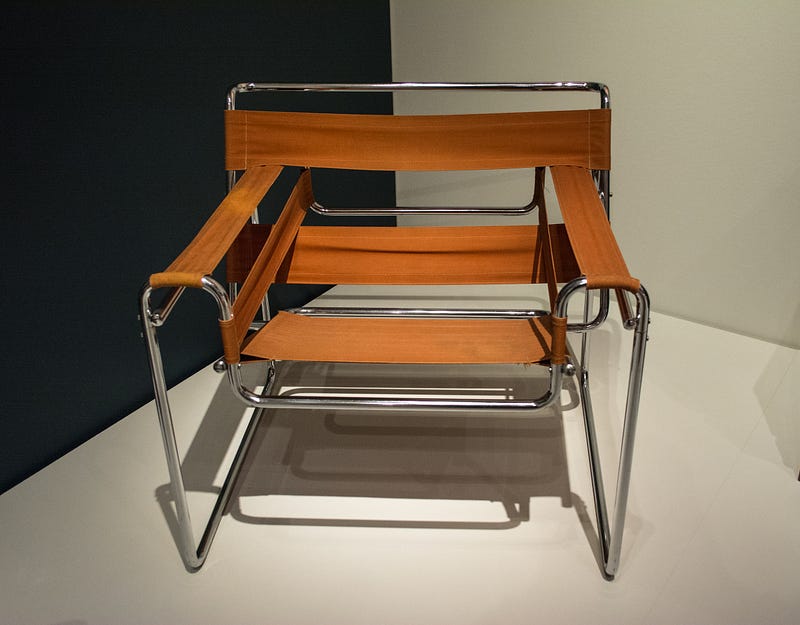
As the Bauhaus celebrates its centenary, the method still pays-off and the B3 chair is still in production. This is a great illustration of how the groundbreaking Bauhaus idea of placing the conceptual and abstract artists alongside the engineers and technicians fosters innovation and original approaches that break new ground in art and industrial design.
*image of They’re Biting used for educational purposes under fair usage policy


.jpg)