
INTERSECTIONAL FEMINISM SERIES
UN Women: How Close are Member Countries to Their 2030 Goals?
International Women's Day is coming March 8
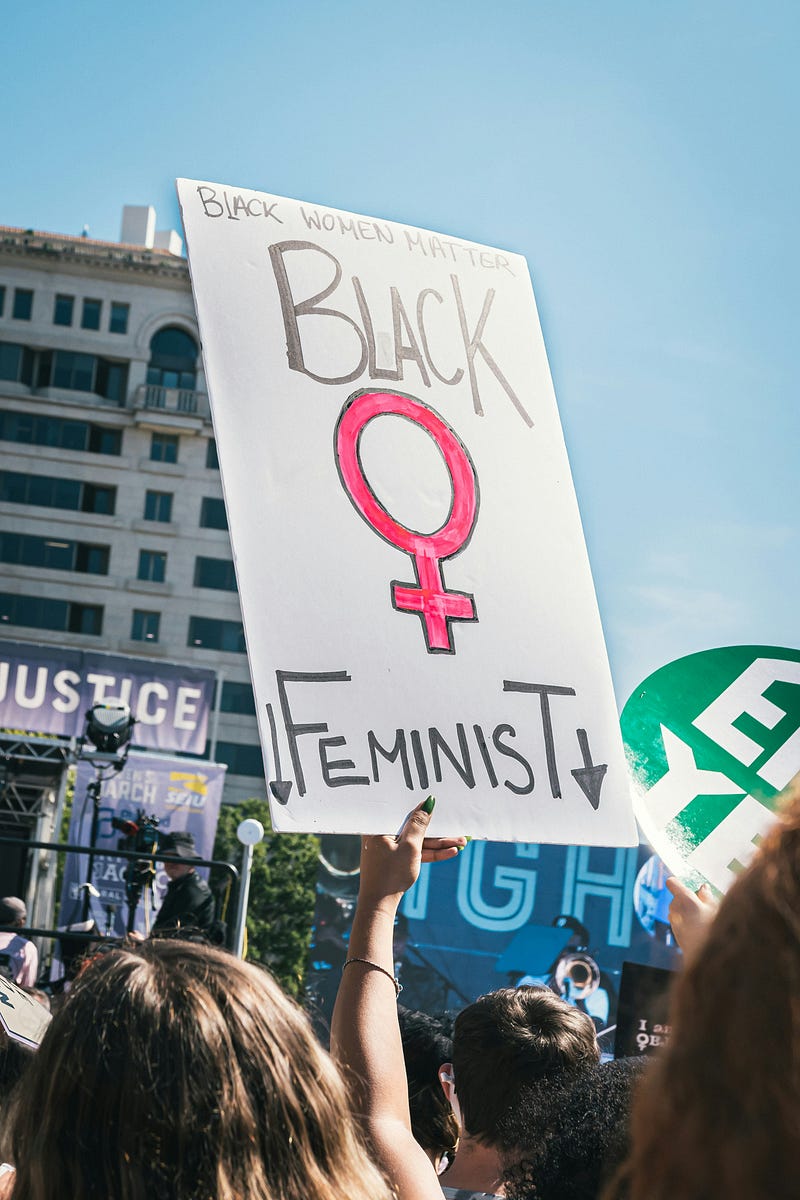
Over the last few months, I have spent a lot of time looking at feminism and women’s rights from an intersectional lens. De-centering the white, female approach is key in this fourth wave of feminism. As we approach International Women’s Day for 2024, I glanced over UN Women’s most recent report, Progress on Sustainable Development Goals, The Gender Snap Shot.
The report gives women worldwide an accurate picture on how United Nations Member States (countries) and their leaders are progressing towards:
- The agreements each United Nations member state signed in 2015, with a deadline of 2030 to achieve them
- Seventeen key areas, known as Sustainable Development Goals (SDGs)
- Progress for women in specific locations worldwide
What’s interesting is if we narrow down the focus to an intersectional view on what, how, and where women who fall outside of the traditional white female viewpoint of women’s rights are being impacted, we see two key themes:
- Poor education
- Poor quality of health, including reproductive health
These themes are part of the seventeen SDGs world leaders agreed to, and can give insight into what March’s next International Women’s Day theme may focus on.
These two areas also highlight where and how those of us who are concerned about and advocate for the rights of women and girls— from an intersectional viewpoint — can lend support with advocacy this year.
The seventeen SDGs world leaders agreed to meet by 2030 are:
1. No poverty
2. Zero hunger
3. Good health and well-being
4. Quality education
5. Gender equality
6. Clean water and sanitation
7. Affordable clean energy
8. Decent work, economic growth
9. Industry innovation
10. Reduced inequality
11. Sustainable cities and communities
12. Responsible consumption and production
13. Climate action
14. Life below water
15. Life on land
16. Peace, justice, and strong institutions
17. Partnerships for the goals

SDG №3: good health and well-being is not being delivered
According UN Women’s latest update report, Progress on Sustainable Development Goals, The Gender Snap Shot, the pandemic hurt women’s health. The report states that the
“Direct and indirect impact of this has been on women’s reproductive health.”
UN Women has noted an increase in the adolescent birth rate for girls worldwide. This would make sense as there was correlation between younger girls not being in school and increased pregnancy. During the pandemic, schools were facing closures.
What this shows us in a general sense is
- Men are more likely to see young women and girls as a target to influence to become more sexually active when the girls are not focused on or engaged in education.
- Also, education is a valuable way to help reduce the likelihood of girls becoming pregnant, and is therefore essential, not only to contributing to the ability of a young women to earn and gain a job, but also to saving her from being an adolescent mother.
The poorest women are affected most
The UN Women’s progress report stated that:
“Stagnating and in some cases increasing adolescent birth rates among girls with no or little primary education and among the poorest girls are apparent in some developing countries.”
Also
“In rural Kenya, adolescent girls were twice as likely to fall pregnant before completing secondary school, or to report that their sex was not desired compared to similar girls graduating just before the pandemic.”
The intersectional issue with this finding
The “poorest girls” and the “developing countries” they mention would logically mean these girls are outside of what we know or consider to be the western world. That means there’s a big chance that the younger girls who are currently facing an increase in the adolescent birth rate are also likely in a double jeopardy of race and gender discrimination.
This conclusion is supported when looking at the women of the Caribbean, as noted in my earlier essay, How Women of The Caribbean Are Devalued, where we saw a clear increase and very high young female adolescent birth rate, which studies showed was partly due to the lack of education and opportunity offered to younger girls and women. It was not because they refused it — they were not provided with it.
UN Women have picked up on this theme in other parts of the world and attributed it partly to the pandemic in their recent update on worldwide SDGs progress.
Reproductive rights and the good health care SDG findings
While this may seem like an issue mainly for younger girls in poor locations, UN Women found that restrictions placed on access to abortion and reproductive health care impacts younger girls, worldwide.
This can include locations in the western world such as the USA, where abortion rights have become limited, as confirmed by the Roe vs Wade reversal in the USA.
Lack of access to abortion negatively impacts health
The report stated that:
“Legal restrictions, including the criminalization of abortion, continue to compound the challenges women face in accessing safe sexual and reproductive health care.”
- 1.2 billion women and girls of reproductive age (15–49) don’t have access to a “safe” abortion.
- 102 million live in countries where it is illegal.
The Centre For Reproductive Rights gives us a clear view worldwide of how countries are doing concerning access to this right.
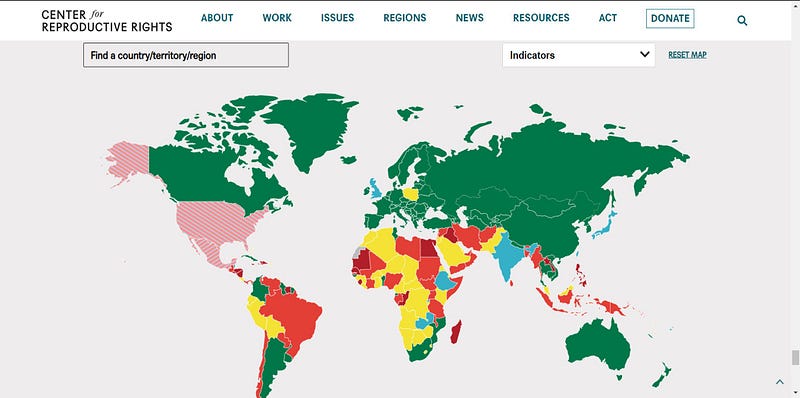
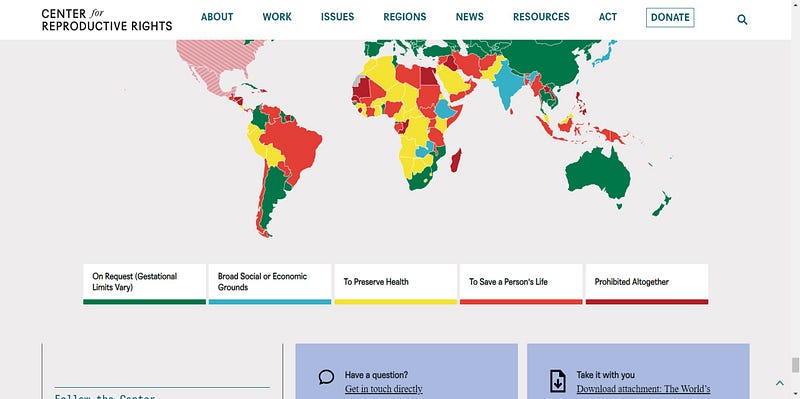
Data break down: where abortion is available worldwide
Southern areas of central America, and parts of Africa, seem to be the only locations where abortion is prohibited all together, as shown above.
A large majority of the world allow women and girls access to an abortion, based on specific needs.
New laws for 2024: we’ve seen France make a bold move regarding reproductive rights — following French feminists’ pressures on the government —making the right to an abortion irreversible from 2024 on, in response to the USA limiting this right for women.
The essay French Feminists Legally Secure Irreversible Abortion Rights From 2024 gives full details.
The Intersectional issues
- The Centre of Reproductive Rights map shows that locations with a high population of black and brown women, or mostly black and brown women (southern central America, south America, Africa), are the areas where women and young girl’s reproductive rights are being withheld.
- It’s also mainly black and brown girls who have had or are currently experiencing an increasing or already high adolescent birth rate. Denying the right to abortion keeps girls restricted in countries where they are already targets for men (when they are not in education), as the data showed.
It could be argued that with many of the United Nation countries off track on the SDG target of good health and well-being for women and girls (which will be covered in a separate essay), advocacy and support in this area is needed in these parts of the world.
Advocacy and support could help with some of the intersectional issues these women and girls face, which are unique from a traditional white, female experience and viewpoint. While there may be restrictions on abortions and reproductive rights that impact non-black and non-brown women, the additional impact and pressure of withdrawing education (which is leading to pregnancy, as UN Women found) puts the bigger burden on women of colour, when we look at the issue from an intersectional lens.
What can be concluded from the report findings in section №3
What this section of the report shows us is that, if young girls are not in education whether this is due to school closures due to the pandemic, or due to general restrictions on education for women, the likelihood of pregnancy increases. Therefore:
- Education and school are vital for young girls in specific parts of the world
- Rights to reproductive health are also key in specific parts of the world
- The data shows us where reproductive health is needed the most, and support from women worldwide to assert women’s rights in specific areas could be needed.
Women’s chances of a healthy life: up close intersectional view
Life expectancy since the pandemic
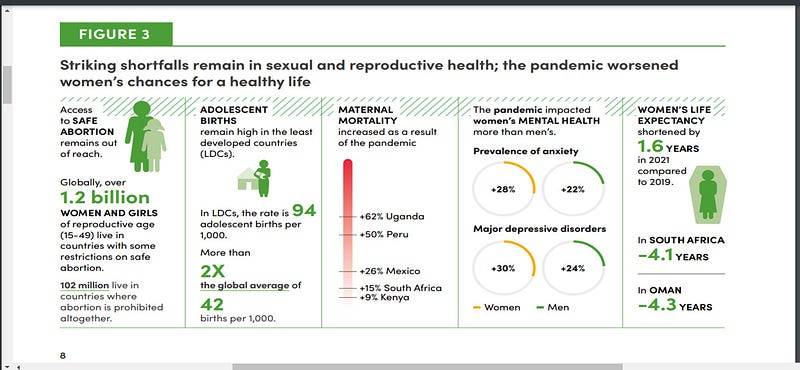
The picture below, taken from page eight of Progress on Sustainable Development Goals, The Gender Snap Shot, shows that women’s life expectancy since the pandemic has been shortened by 1.6 years, compared to 2019. In south Africa it’s 4.1 years and Oman 4.3 years.
Intersectional issue
What we can see is black and brown women are being impacted by the pandemic the most. South Africa and Oman have the largest reduction in life expectancy, worldwide it’s at 1.6 years. Women there face more than double the worldwide statistic for life expectancy reduction.
Maternal mortality rate is also an intersectional issue
It’s been noted in the UK and the USA that there is a higher maternal mortality rate for black and brown women. If we look overseas, the most notable increases for maternal mortality rate,were found in countries with women who are from the black and brown community also:
- Uganda + 62% increase
- Peru +50% increase
- Mexico +26% increase
- South Africa +15 % increase
- Kenya +9 % increase
A few months back, when looking at the intersectional feminism issues for women of the Caribbean for my essay Why Women of The Caribbean are Devalued, research also showed high maternal mortality rates across the islands of Trinidad and Tobago and Jamacia.
Feminism must address the discrepancies
For black and brown girls and women, even those of us in the western world, who are more likely to be swamped with a traditional, white, female perspective on women’s issues, it’s important to remember how intersectional feminism issues are impacting women from other communities.
A key issue that was highlighted in the UN Women’s most recent report is high maternal mortality rates for women who are black and brown.
Advocacy, support, and work around maternal mortality rates is needed to include the women who are often forgotten in the white-centred feminist movement. Especially when restriction on education, or less focus being placed on them (younger girls) for education is subjecting them to giving birth, as was noted in the report from UN Women.
SDG №4: quality of education post pandemic is not being delivered
After schools reopened following the pandemic, UN Women found that:
- For girls in Pakistan, they had larger learning needs/losses than boys across all subjects
- Of the 130 million girls worldwide not enrolled in school, just over half (54%) were in what they define as “crisis struck” countries
- In Afghanistan girls are no longer allowed to attend secondary school
The report also stated that:
“Increased adolescent pregnancy during COVID-19 threatens girls’ education. A study in Kenya, Rwanda, Uganda and the United Republic of Tanzania found that 56 per cent of adolescent girls from hard-to-reach populations who had dropped out of school early in the pandemic were currently or recently pregnant. The pandemic also placed girls at greater risks of gender-based violence, mental health disorders, and food and economic insecurity.”
Intersectional issues
What this shows us is that possibly just like in south Korea, the emphasis is placed on boys for education and advancement, which was discussed in How Patriarchy Oppresses Korean Women. The same could have been happening or is still happening post pandemic in Pakistan.
We can reach this assumption by looking at UN Women’s findings above, that girls had larger learning gaps compared to boys in one significant part of the world. Again it is young girls who are members of the brown community who are experiencing a disadvantage, under the United Nation’s 2030 goals.
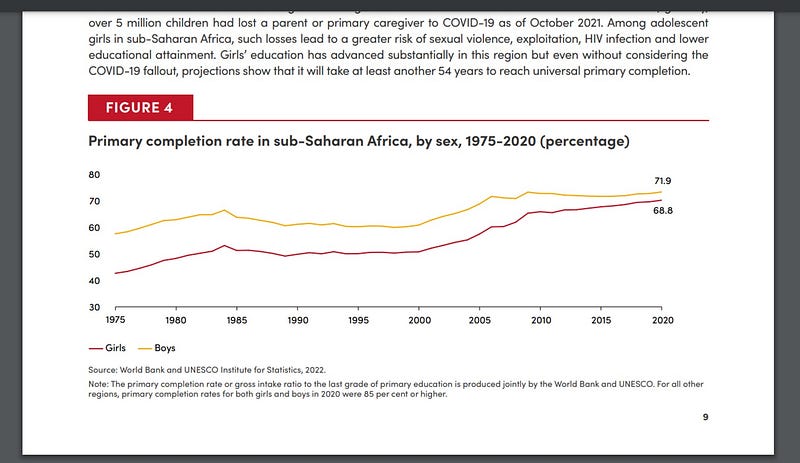
Looking to the findings for the girls in Pakistan and Afghanistan, the chart above taken from page nine of their report, shows how disadvantaged girls in sub-Saharan Africa are compared to boys.
Over the forty-five years between 1975–2020, girls have been less likely to complete primary education.
- Boys have a 71.9% completion rate
- Girls a 68.8% completion rate
When looking at how education is received and taken as a given in the western world for girls, an intersectional lens gives a very different picture. It’s not a given for girls in other locations, this is placing them at an disadvantage under number four of the SDG 2030 goals which world leaders have.
If “crisis struck” countries are less likely to be those in the West, it is also safe to assume these are locations with high populations of ethnic and minority girls and women. This places additional emphasis on the need for women’s rights advocates, feminists, and womanists to examine women’s issues from an international and intersectional view — when it comes to advocacy for women’s needs and rights.
The “out of sight, out of mind” approach leads to ignorance and loss of life chances for fellow women and girls, and strips them of of the support they need just as crucially, or more crucially, than other (white) women.
Moving forward towards International Women’s Day 2024
Placing an intersectional focus on issues that impact women and girls who are outside of the white female cohort, we see that the main areas that need attention within the seventeen SDGs world leaders have are:
- Education
- Health, including and especially reproductive rights
These are the two areas that decrease a young girl’s chance of having a good quality of life, and keep them restricted to being sexual objects for men starting at a very young age. They are areas for advocates for women’s rights to focus on as we head towards International Women’s Day in March.
It could be rightly argued that, “Women in the western world or who are white females face theses issues too.” Okay, yes — but do white females face education and health discrimination at the same rates that women who are black and brown do? That would be the follow up question.
The data presented has shown how women of colour are disadvantaged; logic and observation can show that education and reproductive rights are not withheld for western or white and female women as much as they are for black and brown non-western women. Any of the previous essays I’ve written will also cite plenty of data showing the more negative reality for minority women.
I have a feeling that the next International Women ‘s Day in March 2024, will have a heavy focus on the findings in the report Progress on Sustainable Development Goals, The Gender Snap Shot, as leaders have less than five years to achieve them. The intersectional view should therefore be the focus on International Women’s Day.
What do you think about all this?
Further reading on intersectional feminism and women’s rights:
- Did They Ethnically Cleanse International Women’s Day?
- Is Feminism to Blame For Korean Women Taking Down The Patriarchy?
- Where Culture Meets Feminism: How Patriarchy Oppresses Korean Women
- How Women of The Caribbean are Devalued
- Are The Women of Latin America Classless?
- French Feminists Legally Secure irreversible Abortion Rights From 2024
- Why White Feminists Need To Understand Ellen Pence’s 1982 Essay
Thanks for your readership, I hope my writing gave you something to think about. If I’ve caught you in a good mood or you’re feeling kind, you can buy me a herbal tea here: https://www.buymeacoffee.com/MeAndMyMuse
For more stories about gender and social justice, follow Fourth Wave. Have you got a story or poem that focuses on women or other challenged groups? Submit to the Wave!


