="5bfa" type="7">Major win for the French women!</p><h2 id="83fe">Looking back at France’s history with abortion rights</h2><ul><li>1975 was the year abortion became legal in France. This change was largely down to a key feminist and one of the first women in government in a senior position in the country <a href="https://en.wikipedia.org/wiki/Simone_Veil">Simone Veil.</a></li><li>As of November 2022, in a survey done within France, 89% of respondents favoured the changes<b> </b>to allow abortion to be a legally guaranteed, irreversible right for French women, <a href="https://www.thelocal.fr/20231212/constitutional-right-to-abortion-to-be-presented-to-french-ministers?tpcc=newsletter_member&utm_campaign=serious_political_crisis_in_france_and_understanding_your_mayors_sash&utm_medium=email&utm_source=newsletter&utm_term=2023-12-12"><i>The Local</i></a> reported. They also confirmed as part of their report on the <a href="https://www.thelocal.fr/20231212/constitutional-right-to-abortion-to-be-presented-to-french-ministers?tpcc=newsletter_member&utm_campaign=serious_political_crisis_in_france_and_understanding_your_mayors_sash&utm_medium=email&utm_source=newsletter&utm_term=2023-12-12">12th of December</a>, in France:</li></ul><blockquote id="f1bf"><p>“According to government figures, 234,000 abortions were carried out in the last year.” (2022–2023)</p></blockquote><h2 id="0472">The British and European stance on abortions rights</h2><p id="bc6c">With British women winning the right to over the counter (OTC) access to monthly contraception pills without the need to visit the doctor or obtain a prescription from 2024, which was covered in my recent article <a href="https://readmedium.com/british-womens-right-to-over-the-counter-contraception-is-this-a-win-c6c55747d64e"><i>British Women’s Right To Over The Counter Pill: Is This a Win?</i></a><i>, </i>along with the legal “deadline” to have an abortion at twenty-four weeks (as of 2020), as shown by <a href="https://www.statista.com/statistics/1268439/legal-abortion-time-frames-in-europe/"><i>Statistica</i></a><i> </i>below, we can assume that British women are in a good position with their reproductive rights; they have up to six months to terminate a pregnancy.</p><p id="9d4c" type="7">British women are in a good position with their reproductive rights; they have up to six months to terminate a pregnancy</p><p id="9148">With a quick glance at how the other European countries are doing, we can see that women in the Netherlands, Sweden, and Austria follow behind the United Kingdom. Their “deadline” ranges between eighteen and twenty-two weeks — fair enough, that’s great to see.</p><figure id="09ef"><img src="https://cdn-images-1.readmedium.com/v2/resize:fit:800/1*appgmLcYQpcdTka2d0WFAg.jpeg"><figcaption>Statistics on European countries as of 2020. Image from <a href="https://www.statista.com/statistics/1268439/legal-abortion-time-frames-in-europe/">Statistica</a></figcaption></figure><h2 id="a4eb">Across the rest of the European countries</h2><p id="9cdb"><a href="https://www.statista.com/statistics/1268439/legal-abortion-time-frames-in-europe/"><i>Statistica</i></a> focused on twenty-three other locations in Europe and found the average deadlines for accessing termination were twelve–fourteen weeks (just over three months maximum), as shown above.</p><p id="d75c">Prior to 2024, France is/was in line with the fourteen-week average deadline, as mentioned earlier, following a vote taken by the French government in 2022.</p><p id="4641">Women in Portugal are the most disadvantaged with only ten weeks — two and a half months roughly, to decide about a termination, as shown above.</p><h2 id="3d01">What we can take from this data as fourth wave feminists and advocates for women’s rights?</h2><p id="4887">In Portugal, the women could benefit from extra time to make a decision on termination, bringing the “cut off” date for access in line with the rest of Europe, it could be suggested. This is because an extra four weeks — a whole month — could really help these women with their life choices.</p><p id="e4f8">For France, even though they have made the boldest move by making the right to an abortion irreversible, they are only just catching up with top countries like Austria and Spain who allow fourteen weeks for a woman to decide. They are still very much behind the United Kingdom and the Netherlands.</p><p id="b3f5" type="7">In Portugal the women could benefit from extra time to make a decision on termination, bringing the “cut off” date for access in line with the rest of Europe.</p><p id="ec76">Most of all, the United Kingdom and Austria should be praised for allowing women the most time to make their life choices. However, the health risks associated with terminations around the five-month point, which I spoke about in a <a href="https://readmedium.com/where-culture-meets-feminism-how-patriarchy-oppresses-korean-women-2f6f1a853ab7">previous article about Korean women’s oppression</a>, should be noted — if they are allowing up to twenty-two to twenty-four weeks for women to make choices, there are risks associated with this.</p><p id="83cc" type="7">The United Kingdom and Austria should be praised for allowing women the most time to make their life choices</p><h2 id="3a96">France’s abortion statistics over the last thirty years</h2><p id="b25d">Between 1990 and 2021, the rate of abortions in France have had an up and down trend. The lowest being roughly twelve women per one thousand having a procedure in 1995, compared to around sixteen women per one thousand in 2019. Over a ten year period from 2011–2021, the trend has steadily risen, according to <a href="https://www.statista.com/statistics/749154/abortion-rate-france/"><i>Statistica’s </i>report</a> published in July 2023; a picture of the data is below.</p><figure id="1806"><img src="https://cdn-images-1.readmedium.com/v2/resize:fit:800/1*vOu9IHTJfn4ugAaFIi72Dw.jpeg"><figcaption>Statistics for France image from <a href="https://www.statista.com/statistics/749154/abortion-rate-france/">Statistica</a></figcaption></figure><p id="fa0a">However, when compared to Europe, even if France’s abortion rate has been “steady,” in Europe <a href="https://www.statista.com/statistics/749154/abortion-rate-france/"><i>Statistica</i></a><i> </i>stated in the same report that:</p><blockquote id="5380"><p>“The abortion rate in France remained pretty stable since the nineties, while the estimated abortion rate in Europe decreased significantly.”</p></blockquote><h2 id="267a">What this shows us about France</h2><p id="7dfd">Women here compared to other European women might be<b> </b>more likely to want to access an abortion. This is based on the findings that the rate per thousand women in France has been steady, while other countries have seen a decline.</p><p id="d2d0">This one statistic alone is back up evidence for the French women’s fight with the government. It could be argued that for some reason (that research would need to look at in more detail) within France, women are less likely<b> </b>to want to be mothers — compared to their European counterparts. The question is, why? What is happening in this c
Options
ountry for women to feel this way?</p><h2 id="9c72">Will more women flock to France for terminations?</h2><p id="b62f">If we consider the other side to the coin of the “middle finger” that French feminists gave their government in response to American women losing abortion rights, we remember that women were leaving France to head to the United Kingdom (one of France’s nearest neighbours) for abortions as recently as 2022<i>, <a href="https://www.theguardian.com/world/2022/feb/23/france-extends-abortion-limit-after-year-of-parliamentary-rows">The Guardian </a></i>reported.</p><p id="c6a5">This shows it’s already historically been happening — women leaving their native country to seek a country with more liberal women’s rights on abortion. Given this finding, and the strong argument from French women, why would those of us on the outside looking in at the situation expect anything different? Why would we expect women to <i>not</i><b> </b>head to France? Especially now that in France, a woman’s right to an abortion will be irreversible from 2024.</p><p id="da8e">In this part of the world a woman will always have her reproductive rights, no matter what moves the government makes, no matter who takes over government, or whether it’s a left, right, or centrist political party in power — her rights are untouchable. If this is the situation, of course women will look to this country to terminate a pregnancy, if they can afford the journey, that is.</p><p id="7dd0" type="7">In this part of the world a woman will always have her reproductive rights, no matter what moves the government makes, no matter who takes over government, or whether it’s a left, right, or centrist political party in power</p><p id="1695">To develop this point further, if we consider the rest of Europe with more restrictive time frames for a “cut off” for an abortion, and that some women (like myself) may not have confirmation they are pregnant until very near to the ten week cut off that Portugal has, it could increase the chance of overseas women heading to France for a termination.</p><p id="e430">If we also consider the women of the USA who sadly have had their rights pretty much revoked — France is going to be a place to consider heading to for an abortion. In all of these scenarios, France could look appealing to a woman seeking a termination.</p><h2 id="17a0">Thinking about how the governments may respond</h2><p id="66a1">If governments cotton on to what women are doing, or if they wish to restrict women more, a situation could arise in which France clamps down on allowing terminations from women who are not residents or citizens of France. Or France could place some other restrictions as a barrier to entry for overseas women; this could counteract any increase in foreign women heading to France for a termination of pregnancy.</p><p id="4cbc">Possibly the governments of countries with barriers to abortions may take the absolute liberty, and try to restrict or make it illegal somehow for women to <i>travel outside their country for a termination</i> — if they don’t already do this. The impact of this could be increased unwanted pregnancies around the world, in countries with a lack of access to a termination.</p><p id="650f">For those of us outside of the USA, and countries with short time frames for women to make life choices, we can and should continue to support these women the best way we can, upholding their rights, understanding their plight, and supporting their fight.</p><figure id="bc64"><img src="https://cdn-images-1.readmedium.com/v2/resize:fit:800/1*DcR9jHElq_FodyIusL8OzQ.jpeg"><figcaption>Photo by <a href="https://unsplash.com/@gmalhotra?utm_content=creditCopyText&utm_medium=referral&utm_source=unsplash">Gayatri Malhotra</a> on <a href="https://unsplash.com/photos/a-group-of-people-holding-signs-and-wearing-masks-D3qHSJj_TtA?utm_content=creditCopyText&utm_medium=referral&utm_source=unsplash">Unsplash</a></figcaption></figure><h2 id="a2f6">What fourth wave feminists and women’s advocates can learn from women in France</h2><p id="3a39">What we can take away from this move by the French government, and the pressure the French women applied as fourth wave feminists, is: if we see other counties making moves we don’t like, foresight and being <i>pro-active</i> rather than <i>re-active</i> might pay off.</p><p id="2f12">We must side-eye governments and stop them in their tracks if/when they make announcements about valuing “considerations” over reproductive rights, or revoking or changing access to abortion for women in drastic ways, as it happened in the USA. Foresight is golden for all women. When we hear “talk” about changes that could spread to our native countries, don’t give them (the governments) the chance to revoke women’s rights: protest early, and don’t take the pressure off.</p><p id="44d0"><b>But what do you think about all this?</b></p><p id="b282"><b>Will women leave their native countries to head to Europe, especially France, for terminations? Would you consider it?</b></p><p id="c1c2"><b>What’s the legal time frame in your own country for a termination, if it’s not mentioned?</b></p><h2 id="758d">For further reading:</h2><ul><li><a href="https://readmedium.com/the-intersection-when-race-meets-feminism-the-unfinished-conversation-d39e2dda8062"><i>The Intersection Where Race Meets Feminism: The Unfinished Conversation</i></a></li><li><a href="https://readmedium.com/where-culture-meets-feminism-how-patriarchy-oppresses-korean-women-2f6f1a853ab7"><i>Where Culture Meets Feminism: How Patriarchy Oppresses Korean Women</i></a></li><li><a href="https://readmedium.com/intersection-where-class-meets-feminism-are-the-women-of-latin-america-class-less-dc3ff334e521"><i>Where Class Meets Feminism: Are the Women of Latin America Class-less?</i></a></li><li><a href="https://readmedium.com/why-the-women-of-the-caribbean-are-devalued-83dcb545f7ea"><i>How Women of The Caribbean Are Devalued</i></a></li><li><a href="https://readmedium.com/celebrity-men-accused-of-sexual-assault-why-do-women-identify-with-the-men-a801cd6c3388"><i>Celebrity Men Accused of Sexual Assault: Why Do Women Identify With the Men?</i></a></li><li><a href="https://readmedium.com/how-we-take-back-control-of-black-womens-femineity-1589a31b9568"><i>How We Take Back Control of Black Women’s Femininity</i></a></li><li><a href="https://readmedium.com/british-womens-right-to-over-the-counter-contraception-is-this-a-win-c6c55747d64e"><i>British Women’s Right To Over The Counter Pill: Is This A Win?</i></a></li></ul><p id="4c24"><i>Thanks for your readership, I hope my writing gave you something to think about. If I’ve caught you in a good mood or you’re feeling kind, you can buy me a coffee here: <a href="https://www.buymeacoffee.com/meandmymuse">https://www.buymeacoffee.com/MeAndMyMuse</a>. Why not follow me for more of my thought-provoking muse?</i></p><p id="d90a"><i>For more of the good stuff, follow <a href="https://medium.com/fourth-wave">Fourth Wave</a>. Have you got a story, essay, or poem that focuses on women or other disempowered groups? <a href="https://readmedium.com/submit-to-the-wave-7c92f095e86f">Submit to the Wave!</a></i></p></article></body>
French Feminists Legally Secure Irreversible Abortion Right from 2024
A status report on reproductive rights in Europe and Britain

If you missed the deadline to legally access an abortion, or sadly your right to access one was stripped from you, as we saw with Roe v. Wade in the USA, would you consider going abroad for a termination? This could be a real possibility for many women around the world.
France could be the European country women consider heading to for terminations; laws are changing there to guarantee a woman will always legally be allowed an abortion from 2024. After a year long fight for women’s rights, a French woman’s right to a termination is now irreversible, no matter what government takes over. All hail the women of France!
The sound of French feminism: women against Roe v. Wade law reversal
French women over the last year from the time of writing this, have been giving their government and president Emmanuel Macron the “middle finger” over what happened in the USA. In response to the reversal of the American woman’s right to access an abortion, which has been legal in the USA since 1973, French women have marched in solidarity with American women and at the same time made their own demands.
After a year long fight for women’s rights, a French woman’s right to a termination is now irreversible, no matter what government takes over. All hail the women of France!
According to Le Monde, a French newspaper located in Paris, just hours after the Roe v. Wade law changes were announced in the USA, protests and marches broke out across France. As part of the French women’s protests, feminists and women’s rights advocates demanded what they call a, ‘droit à l’IVG’ (right to an abortion) in France — forever!

The French president’s response to women’s demands
While talks of the changes in the American laws were taking place, across the Atlantic, Emmanuel Macron’s centrist government En Marche!extended the legal time frame to have an abortion from twelve weeks to fourteen weeks. French lawmakers at a National Assembly meeting “voted definitively” for the extension of the “deadline” for an abortion in France, according to The Guardian’s article from 2022.
The pressure to change came from women’s rights advocates
Women advocating for rights in France pointed out that they had to travel abroad to have terminations, to neighbouring countries such as Spain, the Netherlands, or the United Kingdom. This was due to the French “cut off point” for a legal termination being too restrictive, compared to some of France’s closet neighbouring countries.
That said, the French president was not originally in favour of this move. According to an interview he did a year before with the French version of the women’s magazine Elle, he felt:
“There was more trauma for women to have terminations later.”
He went on to express his opposition against legally allowing later terminations. (Note: unless you read French well, you will need to press “translate” on the link above to President Macron’s interview.)

From 2024, French women’s legal right to abortion can’t be reversed
The pressure the French women placed on the French government paid off in 2023. Emmanuel Macron backtracked on his comments to Elle Magazine, and so did the National Assembly of lawmakers for the country.
France24, one of France’s leading news networks confirmed on the 29th of October 2023 that:
“French President Emmanuel Macron said Sunday his government plans to enshrine abortion rights in the constitution to make them “irreversible”
Major win for the French women!
Looking back at France’s history with abortion rights
1975 was the year abortion became legal in France. This change was largely down to a key feminist and one of the first women in government in a senior position in the country Simone Veil.
As of November 2022, in a survey done within France, 89% of respondents favoured the changesto allow abortion to be a legally guaranteed, irreversible right for French women, The Local reported. They also confirmed as part of their report on the 12th of December, in France:
“According to government figures, 234,000 abortions were carried out in the last year.” (2022–2023)
The British and European stance on abortions rights
With British women winning the right to over the counter (OTC) access to monthly contraception pills without the need to visit the doctor or obtain a prescription from 2024, which was covered in my recent article British Women’s Right To Over The Counter Pill: Is This a Win?, along with the legal “deadline” to have an abortion at twenty-four weeks (as of 2020), as shown by Statisticabelow, we can assume that British women are in a good position with their reproductive rights; they have up to six months to terminate a pregnancy.
British women are in a good position with their reproductive rights; they have up to six months to terminate a pregnancy
With a quick glance at how the other European countries are doing, we can see that women in the Netherlands, Sweden, and Austria follow behind the United Kingdom. Their “deadline” ranges between eighteen and twenty-two weeks — fair enough, that’s great to see.
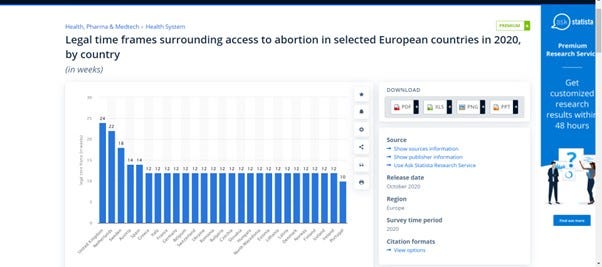
Statistics on European countries as of 2020. Image from Statistica
Across the rest of the European countries
Statistica focused on twenty-three other locations in Europe and found the average deadlines for accessing termination were twelve–fourteen weeks (just over three months maximum), as shown above.
Prior to 2024, France is/was in line with the fourteen-week average deadline, as mentioned earlier, following a vote taken by the French government in 2022.
Women in Portugal are the most disadvantaged with only ten weeks — two and a half months roughly, to decide about a termination, as shown above.
What we can take from this data as fourth wave feminists and advocates for women’s rights?
In Portugal, the women could benefit from extra time to make a decision on termination, bringing the “cut off” date for access in line with the rest of Europe, it could be suggested. This is because an extra four weeks — a whole month — could really help these women with their life choices.
For France, even though they have made the boldest move by making the right to an abortion irreversible, they are only just catching up with top countries like Austria and Spain who allow fourteen weeks for a woman to decide. They are still very much behind the United Kingdom and the Netherlands.
In Portugal the women could benefit from extra time to make a decision on termination, bringing the “cut off” date for access in line with the rest of Europe.
Most of all, the United Kingdom and Austria should be praised for allowing women the most time to make their life choices. However, the health risks associated with terminations around the five-month point, which I spoke about in a previous article about Korean women’s oppression, should be noted — if they are allowing up to twenty-two to twenty-four weeks for women to make choices, there are risks associated with this.
The United Kingdom and Austria should be praised for allowing women the most time to make their life choices
France’s abortion statistics over the last thirty years
Between 1990 and 2021, the rate of abortions in France have had an up and down trend. The lowest being roughly twelve women per one thousand having a procedure in 1995, compared to around sixteen women per one thousand in 2019. Over a ten year period from 2011–2021, the trend has steadily risen, according to Statistica’s report published in July 2023; a picture of the data is below.
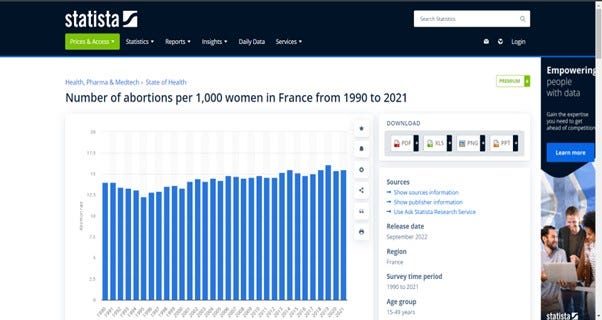
However, when compared to Europe, even if France’s abortion rate has been “steady,” in Europe Statisticastated in the same report that:
“The abortion rate in France remained pretty stable since the nineties, while the estimated abortion rate in Europe decreased significantly.”
What this shows us about France
Women here compared to other European women might bemore likely to want to access an abortion. This is based on the findings that the rate per thousand women in France has been steady, while other countries have seen a decline.
This one statistic alone is back up evidence for the French women’s fight with the government. It could be argued that for some reason (that research would need to look at in more detail) within France, women are less likelyto want to be mothers — compared to their European counterparts. The question is, why? What is happening in this country for women to feel this way?
Will more women flock to France for terminations?
If we consider the other side to the coin of the “middle finger” that French feminists gave their government in response to American women losing abortion rights, we remember that women were leaving France to head to the United Kingdom (one of France’s nearest neighbours) for abortions as recently as 2022, The Guardian reported.
This shows it’s already historically been happening — women leaving their native country to seek a country with more liberal women’s rights on abortion. Given this finding, and the strong argument from French women, why would those of us on the outside looking in at the situation expect anything different? Why would we expect women to nothead to France? Especially now that in France, a woman’s right to an abortion will be irreversible from 2024.
In this part of the world a woman will always have her reproductive rights, no matter what moves the government makes, no matter who takes over government, or whether it’s a left, right, or centrist political party in power — her rights are untouchable. If this is the situation, of course women will look to this country to terminate a pregnancy, if they can afford the journey, that is.
In this part of the world a woman will always have her reproductive rights, no matter what moves the government makes, no matter who takes over government, or whether it’s a left, right, or centrist political party in power
To develop this point further, if we consider the rest of Europe with more restrictive time frames for a “cut off” for an abortion, and that some women (like myself) may not have confirmation they are pregnant until very near to the ten week cut off that Portugal has, it could increase the chance of overseas women heading to France for a termination.
If we also consider the women of the USA who sadly have had their rights pretty much revoked — France is going to be a place to consider heading to for an abortion. In all of these scenarios, France could look appealing to a woman seeking a termination.
Thinking about how the governments may respond
If governments cotton on to what women are doing, or if they wish to restrict women more, a situation could arise in which France clamps down on allowing terminations from women who are not residents or citizens of France. Or France could place some other restrictions as a barrier to entry for overseas women; this could counteract any increase in foreign women heading to France for a termination of pregnancy.
Possibly the governments of countries with barriers to abortions may take the absolute liberty, and try to restrict or make it illegal somehow for women to travel outside their country for a termination — if they don’t already do this. The impact of this could be increased unwanted pregnancies around the world, in countries with a lack of access to a termination.
For those of us outside of the USA, and countries with short time frames for women to make life choices, we can and should continue to support these women the best way we can, upholding their rights, understanding their plight, and supporting their fight.
What fourth wave feminists and women’s advocates can learn from women in France
What we can take away from this move by the French government, and the pressure the French women applied as fourth wave feminists, is: if we see other counties making moves we don’t like, foresight and being pro-active rather than re-active might pay off.
We must side-eye governments and stop them in their tracks if/when they make announcements about valuing “considerations” over reproductive rights, or revoking or changing access to abortion for women in drastic ways, as it happened in the USA. Foresight is golden for all women. When we hear “talk” about changes that could spread to our native countries, don’t give them (the governments) the chance to revoke women’s rights: protest early, and don’t take the pressure off.
But what do you think about all this?
Will women leave their native countries to head to Europe, especially France, for terminations? Would you consider it?
What’s the legal time frame in your own country for a termination, if it’s not mentioned?
Thanks for your readership, I hope my writing gave you something to think about. If I’ve caught you in a good mood or you’re feeling kind, you can buy me a coffee here: https://www.buymeacoffee.com/MeAndMyMuse. Why not follow me for more of my thought-provoking muse?
For more of the good stuff, follow Fourth Wave. Have you got a story, essay, or poem that focuses on women or other disempowered groups? Submit to the Wave!