
Trans and Gender-Nonconforming Elders Need Our Help
Here’s how you can help SAGE help queer elders this Transgender Awareness Week
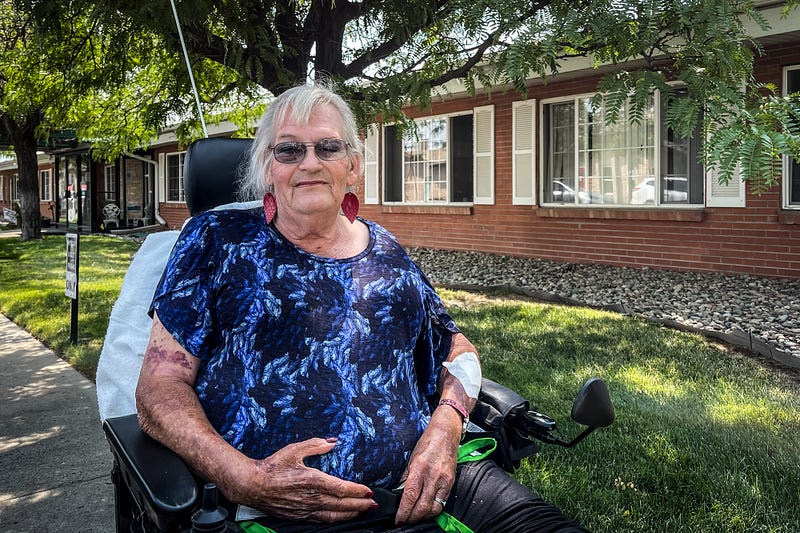
Thanks to President Joe Biden, the U.S. military has stopped barring transgender people from serving. Transgender military veterans, however, often struggle to receive the lifelong medical care all veterans are entitled to. One trans woman veteran in the news recently was unable to find critical care for months, solely because she is trans. Let me tell you about her and my friend Reggie — gender rebel, Native American, and a military vet who faced a choice between medical care and the closet. As a nation, we need to do much better for all our LGBTQ elders. We’re making progress, but we aren’t there yet. You can help.
Trans woman rejected from dozens of care facilities
Let’s start with 68-year-old Lisa Oakley, a U.S. Army veteran rejected by dozens of long-term care facilities in Colorado. She can’t manage chronic illnesses alone any longer, so like many Americans elders she reached out for help, figuring her veteran status would make things easier. She was wrong, and if she had been less stubborn, she’d be like my friend Reggie, who died alone.
“I was turned down by about 60 facilities because I’m transgender,” Oakley told one reporter last month.
As both USA Today and NPR have detailed, Lisa’s trans status led almost all facilities to reject her, despite such rejection being a plain violation of Colorado equality law and federal Medicaid policy. Discrimination against transgender people is so ordinary that several of the facilities told her directly they couldn’t accommodate her because she’s trans.
The law be damned.
The specific issue turned out to be that Lisa, like many trans people, never had gender-confirmation surgery. In other words, she has a penis despite a very feminine appearance, including quite noticeable breasts. Many of the facilities that rejected Lisa told her their policies would therefore require them to place her in a private room, which her benefits don’t cover.
The thought of Lisa being alone in her final days, moments — just she’s deserving of so much more than that.
A representative at one facility spelled it out to Cori Martin-Crawford, Lisa’s hospital care-coordinator: “The patient would require a private room because she still has her boy parts and cannot be placed with a woman.”
Cori says Lisa’s placement is the hardest placement case she’s ever worked, and that includes patients with reputations for selling illegal drugs inside care facilities. Through contacts at SAGE, an LGBT-elder organization I once volunteered for, Lisa eventually found a placement at the SAGE-certified Eagle Ridge of Grand Valley in Grand Junction, a victory even though it’s three isolating hours from her home town.
Cori was thrilled about Lisa’s placement but couldn’t accept the isolation, especially since Lisa’s health issues are life threatening. She told Colorado Public Radio, “The thought of Lisa being alone in her final days, moments — just she’s deserving of so much more than that.”
So, Cori turned to Lambda Legal, an LGBTQ-advocacy organization. Their lawyers reached out to a facility in Lisa’s hometown, explained the law, and then when their explanations produced no result, filed a lawsuit. The facility finally offered a placement, agreeing to obey the law after months of stubborn resistance.
By that time, Lisa had made friends in Grand Junction, and in the face of transportation difficulties to medical appointments, decided to stay in Grand Junction. But she’s happy she made a difference and hopes the next trans patient in her shoes doesn’t face the rejection she did.
Cori says she’s satisfied too. “Seeing Lisa really know her worth and know that she didn’t need to change anything about herself to be deserving of care that treated her with dignity and really own that is so important, because everybody tried to tell her otherwise.”
LGBTQ elders face troubling obstacles at care facilities
As both The Atlantic and SAGE have pointed out, LGBTQ folks who’ve spent their lives out and proud often face a return to the closet toward the end of their lives. Retirement communities and care facilities run by religious organizations often side-step equality laws by claiming religious exemptions. For example, married lesbian couple Mary Walsh and Bev Nance had to move far from their hometown because the only retirement community there that could meet their medical needs refused to accept them on religious grounds.
My friend Reggie, who I met at SAGE-sponsored social events in Greenwich Village, illustrates a more subtle but potentially more pervasive problem.
Reggie was about 70 when she/they/he became my de facto queer auntie and confidant. She was a flamboyantly effeminate gender rebel who was also a Native American and a Korean War vet. They lost several toes and part of their left foot to frostbite in the war and struggled with chronic health conditions stemming from battlefield injuries.
Reggie was entitled to free, lifelong care through the Veteran’s Administration, but hated to go to VA hospitals because of mocking they faced there. They didn’t have a problem with most doctors and nurses, though they did with some. Their biggest problem came from other patients, who bullied them constantly. Living in Greenwich Village, out and proud every day of their life, Reggie wasn’t about to re-enter a world where gender-nonconformity painted a target on their back.
Notice the problem I’m having with pronouns? Reggie used both she/her and he/him — about equally. Would they call themselves nonbinary today? My guess is yes. As my beloved auntie, Reggie was fabulous in thrift-shop silk, known all over the Village for a collection of tattered but once-expensive scarves and throws. If not for her, I’m not sure my late partner Lenny and I would have made it as a couple. She got us over an early rough patch, and I’m so grateful. I didn’t have any blood family to turn to for advice; I needed my queer family, and Reggie was it.
Sometimes he showed up at soup kitchens in denim and flannel instead of fraying silk. Reggie was poor, desperately poor in the way many transgender and gender-nonconforming people are, especially when they are people of color.
I knew her for 7 or 8 years before she passed away alone in a tiny rent-controlled apartment she barely managed to heat with her tiny social security check.
Reggie should have been in a care facility, should have had daily medical attention, should have lived longer, or at least with better food and more warmth. He wasn’t rejected outright like Lisa in Colorado. He just couldn’t bear the idea of going into a facility where being himself would be next to impossible. She couldn’t bear to step back into a gender-conforming closet just because her life was coming to a close.
At least Reggie had friends and companions, many of them thanks to SAGE. Lenny and I met Reggie because of the fabulous work SAGE did in New York City reaching out to queer elders and giving them spaces to hang out in and socialize. SAGE’s monthly tea dances, in fact, were Reggie’s very favorite thing in the final years of her life.
But they should not have had to have been. SAGE is working hard to educate retirement facilities and certify care facilities as LGBTQ-friendly so people like Reggie never again feel driven to choose between living authentically or dying alone and cold.
As Lisa’s recent story show us, progress has been made, but much more work remains to be done. Queer elders remain vulnerable, and like always, transgender and gender-nonconforming people are among the most vulnerable.
This week is Transgender Awareness Week. One way of showing love this week could be helping SAGE help trans elders. You can click this link to learn how.

This story is a response to the Prism & Pen writing prompt, Let’s Show Some Transgender Love.
Other stories so far →
My writing is always free to readers who follow my links from Twitter and Facebook, but if you’d like to browse more, click to join Medium and help support my work. For an email when I publish a new story, Click here.
James Finn is a former Air Force intelligence analyst, long-time LGBTQ activist, an alumnus of Queer Nation and Act Up NY, a regular columnist for queer news outlets, and an “agented” but unpublished novelist. Send questions, comments, and story ideas to [email protected].


