
Thinking Styles for Innovation
Essential thinking modes for novelty & productivity

Innovation, especially for business purposes, requires multiple modes of thinking differently. In our day-to-day activities, most of us commonly think vertically (linearly) and in binary mode in non-creative work environments.
Innovative entrepreneurs need to use a combination of horizontal and vertical thinking at different ratios. While the horizontal type covers breadth, the vertical approach goes into depth.
The vertical type of thinking is also known as linear thinking. Linear thinking goes deep down, layer by layer, in a sequential and logical manner for problem-solving. We can apply linear thinking in an accelerated way in agile projects to come up with some quick, innovative solution options.
Sometimes, business-focused people may need to use binary thinking to assess and validate some immediate situations at work.
Binary thinking consists of simple terms such as yes or no, black and white, and good or bad. Binary Thinking can be useful in a particular innovation context; however, it poses limitations for qualitative assessment requirements.
As opposed to vertical thinking, horizontal thinking covers more breadth rather than depth and aims to generate unpredictable ideas by breaking out rigid thought patterns.
By using horizontal thinking in transformative activities for business, we challenge the assumptions posed in traditional situations. In horizontal thinking mode, we look for alternatives and go beyond the ordinary. Horizontal Thinking can lead to radically creative solutions.
We can usually apply horizontal thinking to modernizing and transformative problems to create innovative ideas. There are various techniques that we can leverage horizontal Thinking in our day-to-day activities at work.
Horizontal thinking was popularized by Bono in a popular book titled 6 Thinking Hats in the late 60s. The framework was called “lateral thinking”. The framework is still used in innovation design workshops as a tool at work. To give you an idea of the representation of the hats in the framework, I provide you with a table summarizing the meanings.
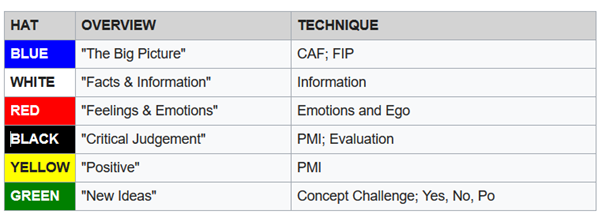
There are many techniques that we can use for horizontal thinking. For example, some commonly used techniques for horizontal thinking are randomization, distortions, reversals, exaggerations, metaphors, analogies, dreaming, theme mining, questioning the norms, and creating contradictions.
Using these techniques effectively and collaboratively can open new opportunities for our creativity leading to innovative design solutions.
Visual thinking is essential for creating innovative ideas and design solutions. There are different methods and techniques for visual Thinking. One of the practical and commonly used visual techniques is mind mapping. Using mind maps, we can articulate our thoughts with representative maps on paper, on a whiteboard, and even on digital devices such as laptops, notebooks, and smartphones.
In innovation design workshops, we use usually use visual representations, such as diagrams, heat maps, and simplified pictures on a whiteboard or storyboard, especially to articulate the context and deep dive into the attributes of abstract ideas.
We can visualize abstract ideas better by looking at the illustrations. The proverbial single picture can tell a thousand words can truly reflect this desirable situation for design ideas.
There are various powerful thinking frameworks, techniques, and tools that we can use for creating innovative ideas and product design solutions at work. One of the best practices to generate innovative and inventive ideas is Design Thinking practice.
Note: this is a sample article for ILLUMINATION writing challenge three as described in this article.
Thank you for reading my perspectives. I wish you a happy and healthy life.
Here’s Why Problem-Solving Is the Most Valuable Skill of the Century.
As a new reader, you might take a look at some of my holistic health and well-being stories reflecting on my reviews, observations, and decades of sensible experiments. Here are sample health improvement articles for new readers:
Metabolic Syndrome, Type II Diabetes, Fatty Liver Disease, Heart Disease and Strokes, Liver Cancer, Lungs Health, Pancreas Health, Kidneys Health, Brain Health, Brain Atrophy, Dementia, Depression, NCDs, Infectious Diseases, Cardiovascular Health, Neonatal Disorders, Skin Health, Dental Health, Bone Health, Leaky Gut, Leaky Brain, Brain Fog, Autoimmune Conditions, Chronic Inflammation, Insulin Resistance, Elevated Cortisol, Leptin Resistance, Anabolic Resistance, Cholestrol, High Triglycerides, Metabolic Disorders, and other Major Diseases.
I also write about valuable nutrients. Here are the links for easy access:
Boron, Urolithin, taurine, citrulline malate, biotin, lithium orotate, alpha-lipoic acid, n-acetyl-cysteine, acetyl-l-carnitine, CoQ10, PQQ, NADH, TMG, creatine, choline, digestive enzymes, magnesium, hydrolyzed collagen, nootropics, pure nicotine, activated charcoal, Vitamin B12, Vitamin B1, Vitamin D, Vitamin K2, Omega-3 Fatty Acids, and other nutrients that might help to improve metabolism and mental health.
I publish my lifestyle, health, and well-being stories on EUPHORIA. My focus is on metabolic, cellular, mitochondrial, and mental health. Here is my collection of Insightful Life Lessons from Personal Stories.
You might join my seven publications on Medium as a writer by sending a request via this link. More than 16,000 writers contribute to my publications. You might find more information about my professional background.