
Design Thinking for Technical Excellence
Consideration of Design Thinking for agile product & service development

Modern business initiatives require adoption of design thinking to their core culture to compete, thrive, and sustain their services with agility. Design thinking can be applied to any discipline.
Background
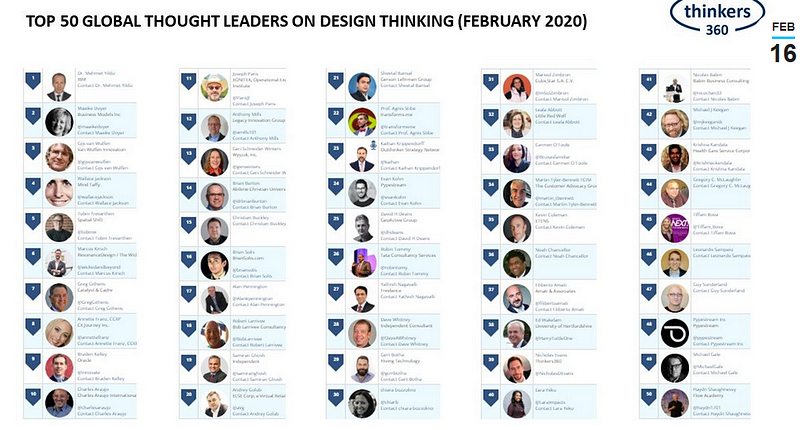
I am inspired to write this article after seeing a pleasant and surprising recognition post on Linkedin this morning. It is about Top 50 Design Thinking Thought Leaders and Influencers Feb 2020.
It is an honor for me to be recognized as a Thought Leader and Influencer in the Design Thinking discipline because it is a critical enabler for client success in my digital transformation solutions.
As an Enterprise Architect, I practice Design Thinking in my daily solution design activities, team interactions, user requirements gathering, and business stakeholder management.
What is Design Thinking

Introduction
Based on my experience, I want to share my definition and understanding of Design Thinking.
Design Thinking is a powerful process and approach focusing on the users and consumers of the solutions.
Design Thinking practice assists the practitioners to understand the uncertain and ambiguous situations in the earlier phase of the solution lifecycle by questioning assumptions, and reviewing risks, issues, and dependencies.
By using Design Thinking, we can define the solutions with clarity or redefine ambiguous points by reframing the problems.
Design Thinking can be considered an innovative problem-solving technique with close interactions with the actual users of the solutions.
Design Thinking includes questioning, brainstorming, prototyping, iterative experiments, sketching, and continuous tests in a user-centric approach.
“Design thinking seems to be an important way of thinking in 21st century business, but I am not sure where to begin.” Saso Kunitake
Phases of Design Thinking
Design Thinking has 5 key constructs which can be considered as phases in the solution lifecycle:
1. Empathy with users and consumers
2. Definition of user needs
3. Ideation to challenge assumptions
4. Prototyping for solution definition
5. Validation of solutions
Importance of Design Thinking
I experienced that Design Thinking allowed my technical and architecture teams to be more intuitive and logical at the same time. This was clearly noticeable by our business stakeholders and greatly appreciated by executive sponsors.
As Design Thinking is closely associated with the agile approach, Design Thinking professionals progress their ideas iteratively with a negligible upfront cost.
The approach has the potential to reduce solution costs, increase return on investment, and contribute to profitability goals for business organizations.
From a practical solution point of view, Design Thinking enables technical team members to be more creative in recognizing new patterns, which are usually difficult using traditional thinking approaches.
Design Thinking in Digital Transformation
Business organizations are facing enormous challenges in responding to the rapid technological changes and growing demands of consumers for digital products and services globally. There is a constant search to find solutions to the growing business problems.
From my experience, architecting enterprise digital transformation requirements and objectives is the most optimal solution to address these problems.
My approach in this article is to propose an innovative model and framework formulated and described in a 12-step architectural method called DTM.
Conclusions
The most valuable and compelling aspect of Design Thinking is to encourage the practitioners and technical leaders to think outside of the box or even beyond the box.
This approach increases creativity, diversity, and innovation. With the Design Thinking approach, the team members can be inventive and add new meanings to the business initiatives.
I plan to write articles about my research and practice in Design Thinking as part of my ongoing technical leadership excellence studies. Stay tuned.
The Importance of Design Thinking Practice and Thought Leadership
Top 50 Design Thinking Thought Leaders and Influencers
This is the link to the profiles. Most of these leaders can be connected and followed on Linkedin.
Related Articles
If you enjoyed this article, you may check some of my other selected articles in the Technical Leadership Excellence stream.
As a new reader, you might check my holistic health and well-being stories reflecting on my reviews, observations, and decades of sensible experiments.
Sample Health Improvement Articles for New Readers
Defeat Metabolic Syndrome and Slim Down Waistline with Three Tips
Why 442 Million People Live Diabetic and What We Can Do About it
Six Tips to Prevent Brain Atrophy and Lower the Risks of Mental Disorders
What Can We Do About NCDs Killing 41 Million People Yearly?.
Reduce the Risks of Neonatal Disorders to Prevent Infant Mortality.
Reduce the Risks of Major Diseases with Healthy Lifestyle Habits
I also write about valuable nutrients. Here are the links for easy access:
Boron, Urolithin, taurine, citrulline malate, biotin, lithium orotate, alpha-lipoic acid, n-acetyl-cysteine, acetyl-l-carnitine, CoQ10, PQQ, NADH, TMG, creatine, choline, digestive enzymes, magnesium, hydrolyzed collagen, nootropics, pure nicotine, activated charcoal, Vitamin B12, Vitamin B1, Vitamin D, Vitamin K2, Omega-3 Fatty Acids, and other nutrients that might help to improve metabolism and mental health.
Useful References for Design Thinking
There are many publications on Design Thinking. To make it useful to my readers, I want to provide links to 20 books that I read and gained insights from different angles.
5. Innovating for People Handbook of Human-Centered Design Methods
6. Applying Design Thinking to Individual and Team Strengths
7. Using Design Thinking to Boost Creativity and Bring Out the Maker in Every Student
14. Health Design Thinking: Creating Products and Services for Better Health
15. Testing Business Ideas: A Field Guide for Rapid Experimentation
17. Design Thinking at Work: How Innovative Organizations are Embracing Design
18. Solving Problems with Design Thinking: Ten Stories of What Works
19. Design Thinking: Integrating Innovation, Customer Experience, and Brand Value
20. Design Thinking Workshop: The 12 Indispensable Elements for a Design Thinking Workshop
You are welcome to join my 100K+ mailing list, to collaborate, enhance your network, and receive a technology newsletter reflecting my industry experience.
Thank you for reading my perspectives. I wish you a healthy and happy life.
I share lifestyle, health, and well-being stories on EUPHORIA.
You might join my publications as a writer by sending a request via this link.


