
Redesigning Work and Private Space
Changes over time.
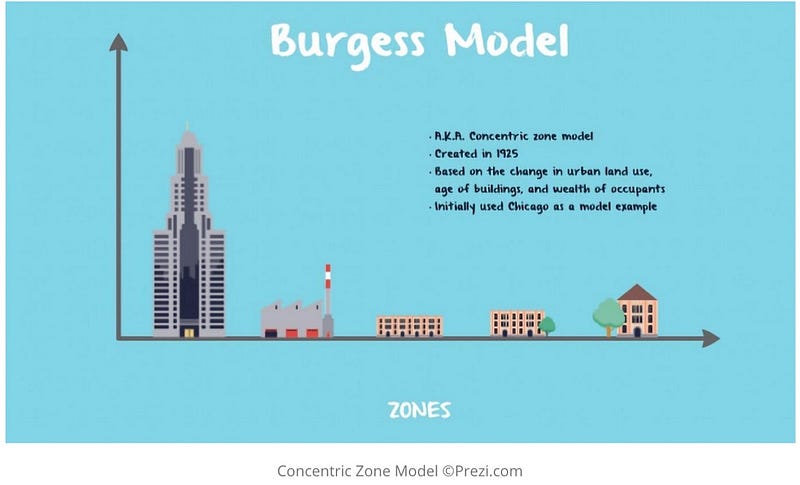
My work and home space were organized by city planners and architects. My city was roughly based on a concentric zone model. Based on the Burgess Model (1925), it comprises concentric rings around a Central Business District.
The Burgess Model was applied initially in Chicago and envisioned a central business area at the core and transitioning to a residential/commercial site. The inner suburbs were the low-income areas. Burgess did not accurately predict the increasing land values of inner suburban space and subsequent gentrification. Higher-income residential spaces were planned as the middle ring and outer suburbs.
The city planners allocated different areas as zones on a town planning map and colored them to delineate the land use. Spaces for other land uses — parks, residential, office, and industrial.
On the town planning maps of the local council, residential areas are pink, industrial areas grey, commercial spaces are purple, parks and recreational zones are green. There is the occasional mixed-use zone with retail downstairs and residential or office upstairs.
My zoning plan was a clear division between my private and public space. I would commute from my private sanctuary to my shared workspace. From the pink zone to the purple zone, it was an ordered sense and use of space represented visually in the town planning zoning map. I would focus on work at work and my private life and projects at home.
My home was a private space for my private persona and personal projects. Work was a public place for my public persona, and the two never met.
Spaces within Residential Spaces
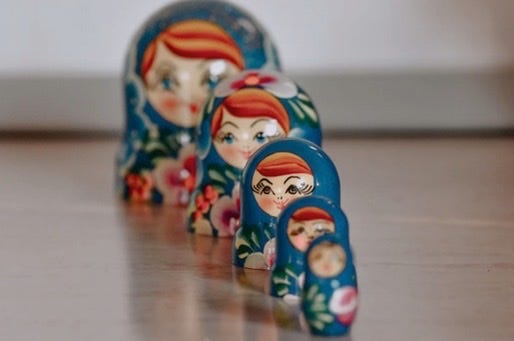
Like a babushka doll or the layers of an onion, there are spaces within spaces. Within these residential spaces, the architects and interior designers compartmentalized or delineated these areas further. Floor plans for a home show the kitchen, the living room, the bedroom, the bathroom, etc.
Inside my home is my studio space, where I create visual art on canvas and make jewelry. Space is one of the seven key elements of visual art. Visual art is a static capture of space. Creating space allows a focus to interpret artwork.
Artists depict space with different techniques, including perspective, negative and positive space. Overlapping shapes or making some smaller than others creates the illusion of depth on a flat surface. The negative is the space created around the subjects of the art. In a two-dimensional form, there is a significant impact on the viewer, fostering a sense of calm and focus.
Within the space of my canvas, I would be sure to make space — positive and negative. I would finish my painting and carefully make space for my installation between the viewer and the artwork. My room was ordered and organized.
A parallel is a space between us and others during the pandemic. We are the subject, and there is negative space all around us created by a virus. The virus has re-configured the land uses of our cities and created a mixed-use zone within my private studio without my permission.
My space for creativity shrunk in my studio as an unwelcome guest (my work) arrived and hovered in my laptop, infected the air, and interfered with my imagination.
My space became harmful and not conducive to creating art, which I made a sanctuary from work. Work in my creative studio confused the use of my room. My studio became a mixed-use zone, and I disapproved of it. There was a general loss of amenity and a land-use conflict in my personal space. It stifled my creativity. My ideas and my paints dried up.
Reversion of My Space
There was no room for both in my space— one had to go. I chose to evict work, and it was the best decision I made.
Initially, work put up a struggle claiming I could not live without it. But work had changed. It was isolating, exhausting and lonely. I embraced creativity, as I know it makes my soul sing, and I have decided to take a sabbatical from the impact of COVID. I will bunker in and create.
I have recreated a sense of calm and focus by using the art technique of positive space around the subject. The original land use of my studio has returned, and I celebrate my creation of a “Before Covid” (BC) living space.
Enjoy more of my stories here or in my Flipboard Magazine.
Join Medium for $5 a month to write your own story. $2.27 goes directly to the writer (me). I will spend it wisely on a cafe latte in my favorite coffee shop, pretend to be JK Rowling, and be inspired to write more.
Briddy is an Australian writer enjoying freedom in her Feisty Fifties. If you enjoyed her writing — sign up for her email list so new stories go direct to your mailbox. She looks forward to connecting with other writers and readers around the world through Medium. Twitter handle is @BriddyBrigid.


