The Tao of Roux
Finding the Om in Omelet, the New Age in Kneading and the Mindfulness in Mornay Sauce.

Thing is, I know I write about food and cooking for people who are out of time, motivation and ingredients.
But that doesn’t mean I don’t love cooking.
I do, actually. I really love it. Nothing makes me happier than rolling up my sleeves, putting some good old pop tunes on that I know all the words to, grabbing my stained, torn, much written in and stuck over and beloved family recipe book and pulling out pans, bowls, cups and ingredients.
If I have an afternoon free or just can’t be bothered doing something I should be doing, I will cook.
My family loves my hobby, of course. They come home from various work or school activities and see a pile of gingerbread shapes or a chocolate self saucing pudding or a tray of steaming baked burritos on the bench as they walk through the kitchen. Their tired, work-worn little faces light up.
I don’t even eat that much of what I cook. Partly because I’m on the weight loss train and coming close to the final station of goal weight (yawn, I know, don’t talk about weight loss). And partly because it’s the making of the food I love the most. The eating of it is a nice bonus, but I’m not about to empty the entire cookie jar myself.
Once, I would have. Once. But now those days are but happy memories.
Nigella Lawson, one of my all time heroes of the kitchen and life in general, once said something like (I’m paraphrasing):
When some people see an overweight person, they say, oh, how did they let themselves get that way? That’s disgusting. But when I see someone who’s overweight, all I think about is, oh, how delicious must that journey have been?
Now, that’s my kind of lady. Shouldn’t we all think like that? Instead of hating on people, including ourselves, for so-called ‘lack of control’ or ‘bad habits’ or ‘no self esteem’, why don’t we celebrate the joys inherent in those choices? Hey, no one gets overweight by hating the taste of food. Ergo, we must have enjoyed ourselves a little bit, surely, to get to where we are?
Which brings me onto mindfulness and meditation.
I was an early skeptic on meditation. I thought it was a bit out there, and that people should just get on with life rather than think about it.
I have changed my tune, if not my habits — I appreciate that meditation can calm the mind and help put things into perspective. And I’m an advocate of mindfulness training for kids and adults. Every now and then I try a simple meditation, and it does settle my mind a bit. If I can’t get to sleep, for example. But I don’t see myself becoming a transcendent being anytime soon.
Cooking is my one exception.
There’s something about the rhythms of the kitchen that just fit with me. It’s my happy place.
A lot of the time, cooking is spent either chopping things or waiting for things, often with some minimal-attention effort required:
- Stirring a bechamel sauce as it thickens.
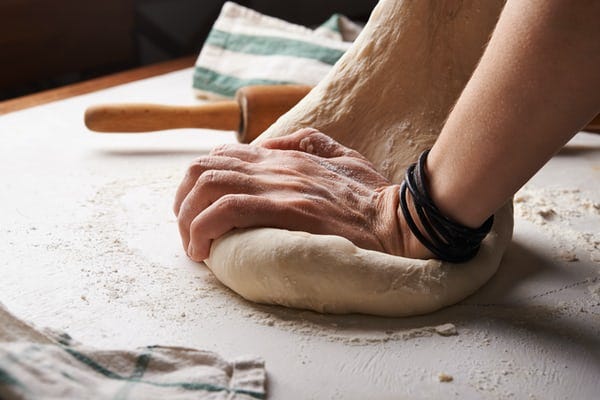
- Kneading bread, scone or pizza dough.
- Stirring a risotto (if you don’t do the cheat’s version!).
- Cooking and flipping pancakes or pikelets.
I don’t really count the actual chopping of vegetables — you have to pay attention to the task or you’ll risk adding meat to your vegetarian dish (ew, sorry). It is a nice way to focus on a physical task, especially if you spend a lot of your day using mental energy. But I find it more of a chore to get through than a fun experience. If ever someone offers to help prep my veg, I’m jumping right on that offer.
I also don’t count the stewing or baking time, during which you’re not actively involved in the cooking process. Generally, I find that time is spent cleaning up and drinking tea. (That’s not how you make tea, by the way, tsk tsk. But if it works for you, who am I to quibble? Go nuts.)
But those slow, rhythmic, repetitive jobs — I actually enjoy them. They are time out of my day. I guess, like the mouse on the wheel, I’m enjoying the process for its own sake. Doesn’t hurt that the end result will be something delicious, of course.
Have you ever kneaded bread? Since the pandemic, I would assume a lot more people can say yes to that question.
I actually don’t make my own bread that often. I have a nifty little bread-maker machine that does it all for me. But every now and then, if I want to make some scrolls or dinner rolls or a rustic loaf to go with soup (you know how I love my soup), then I eschew modern technology and make the dough myself.
It’s about the feel of the dough in my hands, the action of pushing, pulling, pressing, stretching, which is so soothing. And it’s about the way the dough smooths out and springs back and seems to come to life right there in front of me: reader, it’s a trip! I highly recommend it, even if the end result doesn’t work out perfectly the first (or twentieth) time. And bonus: physical sensory stimuli are good for our brains! There’s a real pleasure in our sense of touch, so why not make use of it?
As for stirring, well, that’s in a lot of recipes. You can often do a cheat’s version, thanks to the fabulous microwave. My mother taught me to make custard in the microwave oven, which takes about a third of the time and is equally as smooth, creamy and delicious. I’ll share the recipe with you when I remember it (I never write it down! What’s with that? Thank goodness my mother is still around to remind me).
But whether it is porridge, mornay sauce or risotto, I usually prefer to stand at that stove top and gently stir with a wooden spoon and just enjoy the process of seeing something seriously unthick and watery turn into something smooth, creamy, thick and luscious. I watch, I stir, I sing along to music or just hum to myself. The noise of the house carries on around me, and I am both there and somewhere completely my own.
I make big sauces, often with two or more liters of liquid, and they take a bit of stirring to thicken up. My daughter has magic powers (don’t tell anyone) so if I do happen to get frustrated at a stubbornly watery sauce, I’ll call her in to do her thickening spell. It always works! Nothing to do with the timing, of course…
I think it’s like when you’re having a baby (everyone knows what that feels like, amiright) — just when you think it can’t go on any longer, the action really kicks in. I think sauces sometimes have a little of that perverse nature. Just when you think it’s never going to thicken and it’s time for remedial action — suddenly there it is. Perfect and ready to eat.
Food with personality. I like it!
The repetitive actions of chopping, stirring, tasting, scooping and flipping, the fact that the recipe makes all the tough decisions for you if you need a break from the pressure of life, the fact that you can do something that’s more physical than mental, and has a tangible reward at the end — I think cooking as meditation is a vastly underrated relaxation technique. But it’s not just a way to opt out of the world for a while — you have to be present. Don’t pay attention when you cook and it’s food everywhere, burnt or bleeding fingers and nothing for dinner.
So, cooking really makes you live in the moment. Isn’t that what mindfulness is all about?
Hey, if you enjoyed this article, you might like these as well:


