Lentil as anything!
When soup just isn’t enough: the power of the pea.
Okay, now, before you purists get all pure at me, yes I know that split peas and lentils are not exactly the same. But come on — they’re nearly the same!!! They look the same. They cook the same. They’re both legumes. They’re both good meat substitutes. And they taste pretty similar. Split peas and halved lentils go mushier than whole lentils, and so are good in soups, curries and stews. Whole lentils, once cooked, can go into salads to ‘beef’ them up a bit. Lentils are duller in color. Split peas keep their color more. So there are small differences and if you really want to know more, especially about their nutritional differences, check this blog post out.
Honestly, if you can only find one packet of lentils or split peas on the supermarket shelf, you can sub it into whatever recipe you’re planning to make. All good! I’m going to use the word lentil in my comments below, but be assured I mean split peas too.
If you’re looking at a cold, rainy day or needing a little something more substantial than just another veggie soup, adding a bit of lentil action can be a real treat. It makes the meal better rounded and more textured, fills you up more, and gives you that bit of protein if you’ve been easing off on the meat lately (which we should all be doing as much as we can).
Lentils don’t need a lot of prepping and just a bit of monitoring while you cook them. If you throw them into simmering water, the magic happens without your needing to stir — bonus!
Enough chit-chat — let’s get cooking!
And now for the recipes!
I have gone to town in this post and given you no fewer than four delicious recipes — three soups and a dal, because you can’t talk about lentils without dal, come on! Or maybe you can: if you’re not familiar with dal, it’s an Indian version of, well, split pea soup! Although it’s thicker and more like a curry, usually eaten with flat breads of different kinds. And very, very yum.
We’ll start with the very simplest first — seriously nothing to it!
Simplest Pea Soup Ever
This recipe started out as a pea and ham soup, but I have a non-ham-eater in the house, and so it is now a vegetarian recipe. If you wanted to add in either a ham hock or shredded thick ham or even a bit of fried bacon or sliced ham, go for it! I personally love the combination of pea and ham. Yum, yum! This recipe calls for a nice long simmering time, so you can be sure the ham will be tender and fall-aparty by the time you get to eating it. If using a ham hock, pull it out when it’s tender, shred the meat away with a knife and fork, and put the meat back in (discard the bone) before you serve it up.
Ingredients:
- 1 packet of split green peas. Or red, or yellow, it really doesn’t matter. But the traditional green pea look will require split green peas.
- Lots of celery. I mean, decide how much soup you want to end up with. I used about five or six sticks of celery including the leaves the last time I cooked this. It made an enormous pot, at least three liters.
- Lots of carrot. Same as celery. Cut up two or three carrots and then decide if you want more.
- Lots of onion. At least two.
- 1.5–2 litres liquid stock to start with. You’ll probably add more as you go. The general rule is: 3 cups of liquid for every 1 cup of split peas. Plus a little more to make it a runnier soup. When adding more, you can taste it and decide if it needs more flavor/salt (in which case, make the additional liquid stock) or if it’s fine as it is, or a little too salty (in which case, make the liquid water).
- Pepper (who doesn’t love a bit of pepper in their life?).
Method:
- Chop carrots, onion and celery quite fine. I tend to cut the celery stalks in half or thirds lengthwise, and then chop. This makes the celery pieces really small and that’s good because I have a celery-hater in the house as well as a ham-hater (not the same person!). Aim for half-centimetre pieces, but really it doesn’t matter. They’ll cook and soften no matter how chunky they end up.
- Throw all ingredients into a pot.
- Bring everything to a boil then reduce the heat to just simmering (little bubbles).
- Cook slowly (simmer) till soft. That’s literally it. You might end up cooking this for two or three hours or even more. That’s awesome — the longer the better. But do make sure to check it regularly (every 20 minutes or so) and add more liquid as you need to. It can end up quite a thick, dal-like soup if you don’t keep adding water or stock. Taste as you go, just in case it needs a bit of salty love.
- When you can’t wait any longer, eat! Put some yummy toast on a plate, grab your soup spoon and Bob’s your uncle.
Spinach and Lentil Soup Sensation
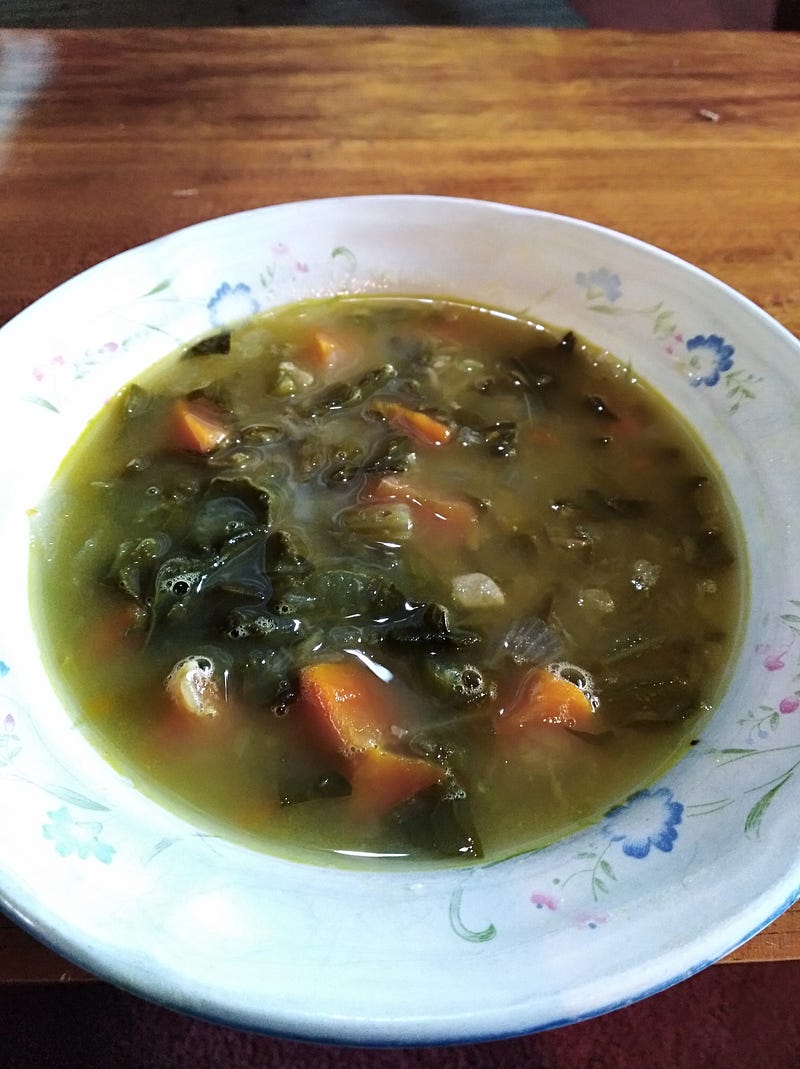
This is the soup featured in the photo at the top of this article. It’s a clear soup, with lots of floaty things in it. And strange though it sounds, it’s a children favorite, despite the visible veggies hanging out in there. It’s a great soup to have in the house for soupy lunches or for a quick weekend dinner that’s also healthy (I’m telling myself this as much as you: we seem to have been eating a lot of fish and chips lately…).
Like all soups, it really doesn’t require a lot of time once the good old chopping component is done with. So, let’s get into it!
Ingredients (for 4 people):
- Celery — 2 sticks, or however many you like.
- Carrots — 2, or ditto.
- Garlic — 2 cloves
- Onion — 2, or one big one.
- Lentils — 120g or more if you want it to be thicker. Any lentils or split peas you like.
- Spinach — around 120g or a few nice big handfuls, chopped.
- 1–2 teaspoons ground cumin (optional)
- Stock — 1.2 liters. Vegetable stock or chicken stock, can be powdered with water or liquid stock.
Method:
- Chop veggies. Don’t stress.
- Fry onion, garlic, carrot and celery in oil for 5 minutes or so, until they soften a bit — medium heat(Remember to put the pan on the heat first, get it hot, before you add the oil and veggies). Try not to get any color on the veggies, but it’s all good if you accidentally do.
- Add cumin, mix it around and fry for a minute or so. This lets out the fragrance of the spice.
- Add the lentils and stock and bring to the boil (you can turn the heat up).
- Once boiling, turn the heat down till the soup is simmering (soft bubbles). Simmer for around 30 minutes.
- Add the chopped spinach and cook for another 5 minutes.
- After tasting it (ALWAYS taste), add salt and pepper if you want.
- Enjoy! It’s delicious, easy, and kid-friendly.
Wendy’s Curried, Slow-Cooked Lentil Soup
My beloved auntie introduced me to this recipe, which I have changed up a bit to suit my family, and I’ve made it milder. But at heart, it’s still my Auntie Wendy’s gorgeous creation and I know you’ll love it.
Ingredients:
- Onion — 2 or 3, depending on the size.
- Carrots — 4!
- Applies — 1 or 2 (if you use more apples, you can use less sugar).
- 450g (2 and a half cups) lentils (or split peas).
- 1 tablespoon of grated fresh ginger or 2 teaspoons of ground ginger.
- 2 teaspoons of curry powder (or change it up according to how spicy you like things).
- 1 teaspoon of ground cumin.
- 1 teaspoon of ground coriander (this is okay even for people who don’t like coriander. You don’t really taste or smell it, but it adds to the overall effect).
- Salt
- 3 teaspoons of sugar (or less if you don’t like things too sweet).
- 8–9 cups of stock or water — stock will add salt and additional taste.
Method:
- Chop the veggies (they will be blended later, so no need to be precious about it).
- Put all ingredients into a slow cooker (or big soup pan). Cook in the slow cooker on High for 8 hours, or cook gently (simmering) on the stove top for 1 hour.
- Blend everything together.
- Taste and check the seasoning.
- Serve with a dollop of plain yogurt if you like.
Roast Veggie Dal with Flatbread
This is a yummy way to add some veggies to your dal and bring a slightly different flavor to it all (which is what roasting does). But if you can’t be bothered roasting the veggies, that’s fine. Throw everything into the pot together, veggies, lentils, curry paste and all, and it will still be yum. Just make sure you stir it really well and repeatedly as it cooks, and as always, taste and taste again!
Ingredients:
- Veggies of your choice to roast. I like to use pumpkin or squash, sweet potato and maybe some cauliflower or broccoli. You could also use eggplant or zucchini (courgette) or whatever you fancy. As for amounts, decide what sized oven tray you’re going to use, and fill it up. Try chopping up half a sweet potato, half a broccoli, a third of a cauliflower and about three inches of squash — that would be enough for around 3–4 people depending on how hungry they are. Seriously, do as much as you like. If you find you’ve chopped up too much veg, celebrate! You’ve just cut out half your prepping time for the next delicious meal you cook! Pop it all into a plastic or silicone bag and make it cold in the fridge or freezer till you want it.
- Onions (2, or one large one). Like anything, it depends how much you want to make.
- 3 or 4 cloves of garlic.
- Ginger — if using fresh, about a thumb-sized piece or a tablespoonful when grated. If using ground, about a teaspoon. If you don’t like the zing of ginger, leave it out!
- 3–4 heaped tablespoons of curry paste (of your choice. They will say on the jar how spicy they’re meant to be, so pick one at your comfort level).
- Salt and olive oil (or other veggie oil. Or butter. Or marge. You get it).
- A 500g packet of split peas or lentils. I use yellow or red, but you can use whatever you like. Match the color to your curry paste!
Method:
- Slice veggies and onions into chunks, around 1 inch square or slightly smaller (but honestly, whatever, Trevor. If they’re bigger, cook them longer) and throw them into a baking tray.
- Add curry paste, ginger, garlic, salt and oil into the tray.
- Mix everything together thoroughly so that the veggies are coated with everything else, and spread evenly around the tray, trying for one layer. Bake at 180 degrees Centigrade or 350 degrees Fahrenheit for around 20 minutes. If they start getting dark, put foil over them and turn the heat down a smidge.
- Meanwhile, start cooking the split peas/lentils with a veggie stock cube or two (or a couple of teaspoons of powdered stock) and 2 litres of water (or 2 litres of liquid stock). Bring it to the boil and then simmer around 1 and a half hours.
- When the roast veggies are close to cooked (softening up), add them to the lentils/peas which are still cooking on the stove.
- When the lentils are cooked, blend the mixture with a hand/stick blender until it’s as smooth as you want it. You can leave some lumps for texture, all good!
- If you want, you can top this with some fresh herbs (doesn’t matter what kind) chopped up roughly and sprinkled over the top just before serving, but you really don’t need to. It’s great just as it is.
- Serve with rice or shop-bought/home made flat bread.
If you really, really want to make your own flat bread, it’s actually fairly easy. You can do it while the dal is cooking. In fact, making any kind of flour-based product (pizza base, pasta, even) is surprisingly simple. It’s all variations of what I’ve written below. Take a look:
- Put 250g (about 2 cups or 8 ounces) of wholemeal flour (or whatever flour you’ve got), a pinch of salt, a splash of olive oil and 150ml (2/3 cup or around 5 ounces) of warm water into a bowl.
- Mix with a fork until it starts to resemble dough, then get in with your hands and shape it into dough. Knead for a minute or so. The trick is to not be afraid to add flour to it, if it’s sticky. You can also put a bit of flour on your hands before you touch it.
- Divide the dough into 6–12 portions, depending on how big you want to make it. You can do this easily by rolling the dough into a long sausage first. Flatten each portion with your hands, dunk it into some flour and roll it out till it’s fairly flat and wide. It won’t rise much, so if you want it thick, roll it out thick. (You’ve basically just made home made pasta. If you were to shape it now and boil it in water and salt and put carbonara or bolognese or something over it, you’d be in heaven!)
- Fry each one in a pan, preferably a dry pan (no oil), but if your pans love your food and insist on sticking to it, a bit of oil won’t destroy the world. Make sure the pan is on medium heat. Each flat bread should take about 1 minute on each side. Taste one if you’re not sure. If they taste a bit floury, give them another 15–20 seconds. They will get some brown patches, which is good. When they’re done, wrap them together in a clean tea towel till you’re ready to serve, or they’ll go hard.
May the spirit of split peas and the love of lentils fill your hearts and stomachs with great satisfaction!


