
The Syrophoenician Woman and Her Little Dog
The secret meaning concealed within the slur
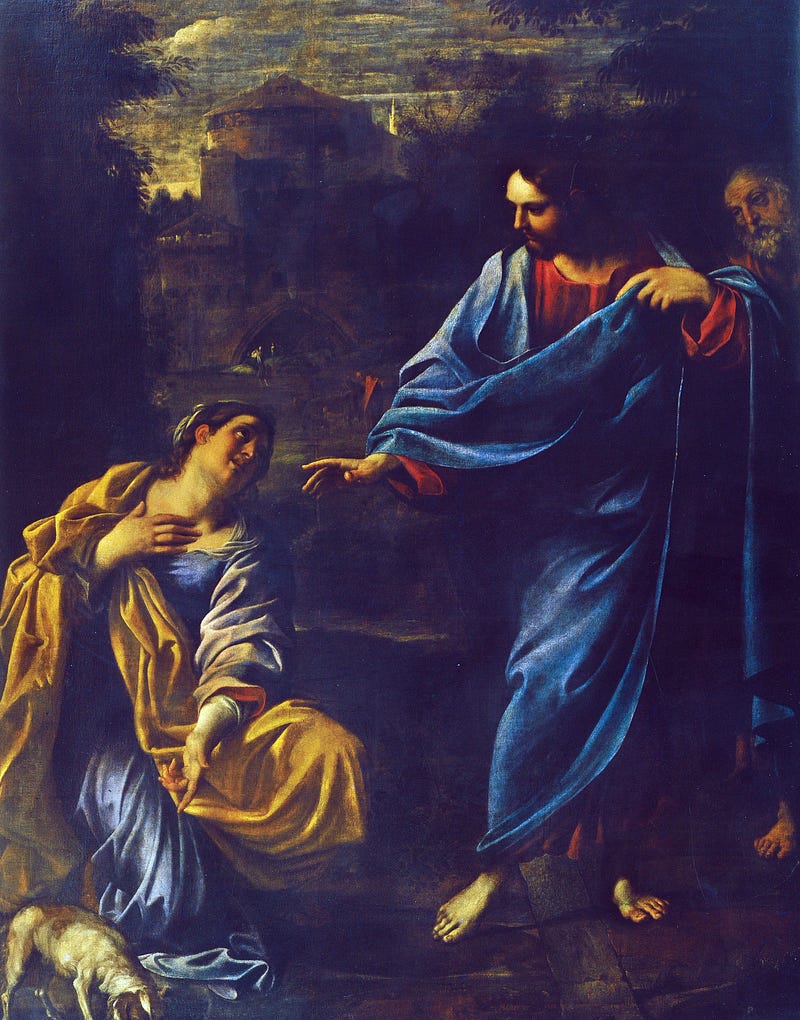

In Did Jesus Just Call That Woman a Bitch? Steven Jones writes about an incident found within two of the synoptic Gospels in which Jesus apparently refers to a woman as a dog. I’m here to provide an alternative explanation based on a careful examination of the texts.
Mark’s version
24 And from thence he arose, and went into the borders of Tyre and Sidon, and entered into an house, and would have no man know it: but he could not be hid. 25 For a certain woman, whose young daughter had an unclean spirit, heard of him, and came and fell at his feet: 26 The woman was a Greek, a Syrophenician by nation; and she besought him that he would cast forth the devil out of her daughter. 27 But Jesus said unto her, Let the children first be filled: for it is not meet to take the children’s bread, and to cast it unto the dogs. 28 And she answered and said unto him, Yes, Lord: yet the dogs under the table eat of the children’s crumbs. 29 And he said unto her, For this saying go thy way; the devil is gone out of thy daughter. 30 And when she was come to her house, she found the devil gone out, and her daughter laid upon the bed. (Mar 7:24–30 KJV)
Notice that in Mark, Jesus does not directly refer to the woman as a dog. He seems almost to be putting himself in the woman’s place and talking his way through her situation in an attempt to understand the source of her daughter’s demonic possession. Then the woman responds in such a way as to signal that she has grasped the significance of his comment and now knows what actions she must take to exorcise her daughter.
There doesn’t seem to be much on the surface layer to suggest that Jesus is actually calling the woman or her child a dog. Admittedly, the woman is identified as a Greek, meaning that she was not Jewish. So it is possible that Jesus was telling her that he is there primarily for the Jews and that she should take her place at the back of the line.
Matthew’s version
The author of Matthew decided to go with that interpretation in his version.
21 Then Jesus went thence, and departed into the coasts of Tyre and Sidon. 22 And, behold, a woman of Canaan came out of the same coasts, and cried unto him, saying, Have mercy on me, O Lord, thou Son of David; my daughter is grievously vexed with a devil. 23 But he answered her not a word. And his disciples came and besought him, saying, Send her away; for she crieth after us. 24 But he answered and said, I am not sent but unto the lost sheep of the house of Israel. 25 Then came she and worshipped him, saying, Lord, help me. 26 But he answered and said, It is not meet to take the children’s bread, and to cast it to dogs. 27 And she said, Truth, Lord: yet the dogs eat of the crumbs which fall from their masters’ table. 28 Then Jesus answered and said unto her, O woman, great is thy faith: be it unto thee even as thou wilt. And her daughter was made whole from that very hour. (Mat 15:21–28 KJV)
Matthew’s version is pretty clear that Jesus is only here to help the Jews. The children would seem to be the Jews and the Gentiles are the dogs. Then her reply would be read as her agreeing that she and her kind are dogs, but even dogs are permitted to eat the crumbs that fall from their master’s table.
She is saying, yes, we are dogs, so toss us some scraps. This apparently convinces Jesus because he then miraculously heals the daughter from a distance.
Matthew takes the ambiguity that existed in Mark’s version and nails it down, making Jesus a bigot but an amendable bigot. That’s what we should expect from Matthew though, right? Matthew is the Gospel for the Jews. It is only natural that it would be slanted in a way that highlights the fact that Jesus was initially a Jewish messiah. It even adds that the woman is a Canaanite.
Mark is the Gospel for the Romans, and the Romans seemed fine with a bit of ambiguity. Maybe Jesus called this Greek woman a dog. Maybe he didn’t. As long as she isn’t a Roman citizen, who cares? Luke, the Gospel for the Greeks, decided, naturally enough, not to provide a version of this parallel.
Matthew playing both sides
However, I believe that Matthew was using a bit of misdirection. In addition to his version of The Canaanite Woman, he also included the following parable.
6 “Do not give dogs what is sacred; do not throw your pearls to pigs. If you do, they may trample them under their feet, and then turn and tear you to pieces. (Mat 7:6 NIV)
Matthew only mentions dogs three times in his Gospel. Twice with the Canaanite woman and once in the parable above. I believe that this was intentional.
“Do not give to dogs what is sacred” is to be merged with, “It is not right to take the children’s bread and toss it to dogs.” When these two images are overlaid it becomes clear that the bread being tossed to dogs is sacred, it is actually consecrated bread.
I have written about consecrated bread in a previous article, The Secret to Feeding Five Thousand With Only Five Loaves.
The consecrated bread was prepared using ergot-tainted grain. It was intended to only be eaten by priests that had maintained their ritual purity. This bread was to be discarded after seven days and replaced fresh every Sabbath.
It is possible that Gentiles may have been involved in this process given the Sabbath prohibition against work. These Gentile servants may have been disinclined to waste the bread and instead took it home to feed their families.
Geographical considerations
Geographically, however, this interpretation is problematic. This event supposedly took place somewhere between the cities of Tyre and Sidon. That is a long way from Jerusalem and the Temple where the showbread was presented. Although, it is probable that sacred bread was produced and kept for priestly consumption outside of Jerusalem.
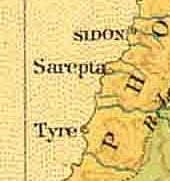
The city midpoint between Sidon and Tyre is Sarepta, known biblically as Zarephath. This is where the widow of Zarephath lived. This was the widow that God sent Elijah to meet.
9 “Go at once to Zarephath of Sidon and stay there. I have commanded a widow in that place to supply you with food.” 10 So he went to Zarephath. When he came to the town gate, a widow was there gathering sticks. He called to her and asked, “Would you bring me a little water in a jar so I may have a drink?” 11 As she was going to get it, he called, “And bring me, please, a piece of bread.” 12 “As surely as the LORD your God lives,” she replied, “I don’t have any bread — only a handful of flour in a jar and a little oil in a jug. I am gathering a few sticks to take home and make a meal for myself and my son, that we may eat it — and die.” 13 Elijah said to her, “Don’t be afraid. Go home and do as you have said. But first make a small cake of bread for me from what you have and bring it to me, and then make something for yourself and your son. 14 For this is what the LORD, the God of Israel, says: ‘The jar of flour will not be used up and the jug of oil will not run dry until the day the LORD gives rain on the land.’ “ (1Ki 17:9–14 NIV)
I have written about this miracle in Surviving the Baptism of John where I suggest that the reason the bread lasted so long was that it was made from ergot-tainted grain.
The Tribe of Asher
Notice also that the nearest of the twelve tribes to Zarephath was Asher. Jacob, on his death bed, said of Asher:

Out of Asher his bread shall be fat, and he shall yield royal dainties. (Gen 49:20 KJV)
Asher was famous for his bread. It seems likely that if sacred bread was being produced outside of Jerusalem that it would be found in this region. There is also the possibility that bread was being made using darnel for grain. Darnel is a weed that resembles wheat. During its lifecycle, it produces a fungus that is related to Claviceps purpurea, the ergot fungus that infects grain. Darnel actually infects itself with this fungus, unlike other grains which are infected due to external exposure.
Darnel is featured in the following parable.
24 Another parable set he before them, saying, The kingdom of the heavens has become like a man sowing good seed in his field; 25 but while men slept, his enemy came and sowed darnel amongst the wheat, and went away. 26 But when the blade shot up and produced fruit, then appeared the darnel also. 27 And the bondmen of the householder came up and said to him, Sir, hast thou not sown good seed in thy field? whence then has it darnel? 28 And he said to them, A man that is an enemy has done this. And the bondmen said to him, Wilt thou then that we should go and gather it up? 29 But he said, No; lest in gathering the darnel ye should root up the wheat with it. 30 Suffer both to grow together unto the harvest, and in time of the harvest I will say to the harvestmen, Gather first the darnel, and bind it into bundles to burn it; but the wheat bring together into my granary. (Mat 13:24–30 DBY)
Jesus and the Syrophoenician woman
Returning to the Syrophoenician woman, my reading is that his words are meant to reflect the thinking of the mother when she was tasked with discarding the sacred bread of the Jewish priests. “Let the children first be filled: for it is not meet to take the children’s bread, and to cast it unto the dogs.”
Jesus is suggesting to the woman that she told herself that it is better for her child to eat the bread than to give it to dogs.
Her reply of, “Yes, Lord: yet the dogs under the table eat of the children’s crumbs,” is her acknowledgment that, in the end, dogs are still going to end up eating sacred bread crumbs.
The missing piece of the puzzle is the prohibition from Matthew 7:6.
6 “Do not give dogs what is sacred; do not throw your pearls to pigs. If you do, they may trample them under their feet, and then turn and tear you to pieces. (Mat 7:6 NIV)
Notice the structure. Do not give A to X, do not throw B to Y. If you do, Y will trample B under their feet, and then (X) will tear you to pieces. The way the parable is written it seems as though the pigs are both trampling the pearls and tearing you to pieces, but structurally it is apparent that while the pigs are doing the trampling, the dogs are doing the disembowelment.

She gave the bread to her child instead of giving it to the dogs, but eventually, dogs are still going to end up eating the bread crumbs. She realizes that it is safer to dispose of the bread in a manner that ensures it will never be eaten by dogs, which means that her daughter will also be taken out of the equation.
As her daughter is no longer eating the sacred bread, her mental problems soon fade into jumbled memories. More importantly, Jesus never refers to the woman as a dog. His focus is on the mother’s concern for her child and her ignorance as to the nature of the bread she had been feeding her. And on the dogs under the table that might be driven mad by the tainted bread and savagely attack the woman and her daughter.
Scriptures taken from the Holy Bible, New International Version®, NIV®. Copyright © 1973, 1978, 1984, 2011 by Biblica, Inc.™ Used by permission of Zondervan. All rights reserved worldwide. www.zondervan.com The “NIV” and “New International Version” are trademarks registered in the United States Patent and Trademark Office by Biblica, Inc.™