
The Synoptic Gospels: Opening Your Mind’s Eye
The secrets of trioptic vision
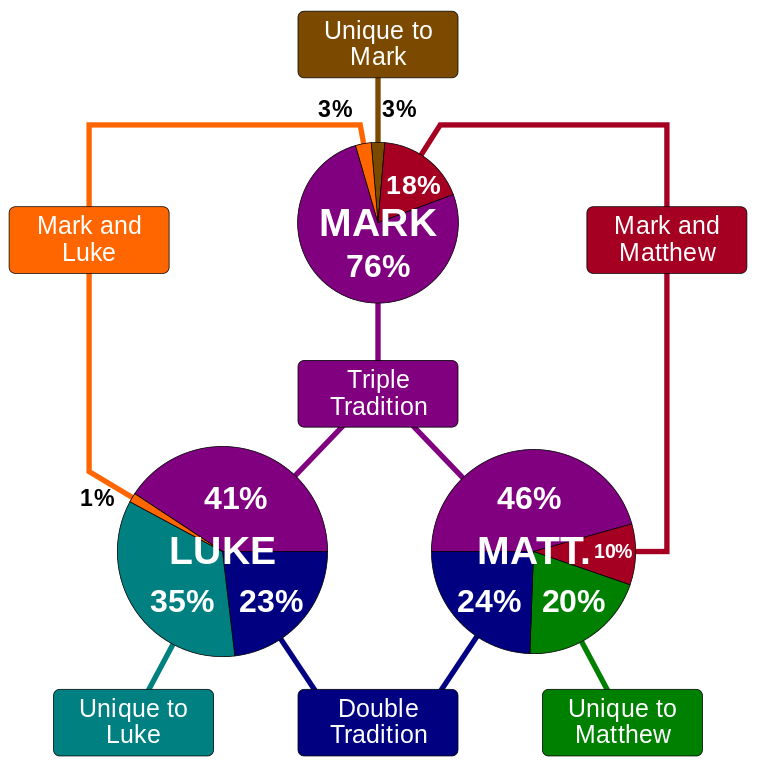

In my previous articles, I wrote about the Gospel of John and how it is considered the most important Gospel by both mystics and traditionalists.
However, all of the focus on the Gospel of John makes me suspicious. Is it because the other three Gospels are truly of lesser importance? Or is it an attempt at distraction? Perhaps the three remaining Gospels contain a secret in need of protection.
Yet, how is it possible that a secret could remain hidden after all these centuries? Could it be that we have never been taught how to properly look?
With a stereogram, the illusion of depth is provided by slight differences among the surface details. The various nearly identical sections within the synoptic Gospels function in a comparable manner. Rather than similar images that must be overlaid visually, the synoptic Gospels provide us with narratives that must be overlaid mentally.
The Synoptic Three
I am speaking about the Gospels named Mark, Matthew, and Luke. These are known as the synoptic Gospels.
The word ‘synoptic’ means ‘to see’ (optic) and ‘together’ (syn). It refers to the fact that near-identical parallel passages can be found in all three texts. Books created specifically for studying the Gospels have been printed up with the various parallel passages arranged on a single page in separate columns. This allows for the three versions to be better compared as they can all be ‘seen together.’
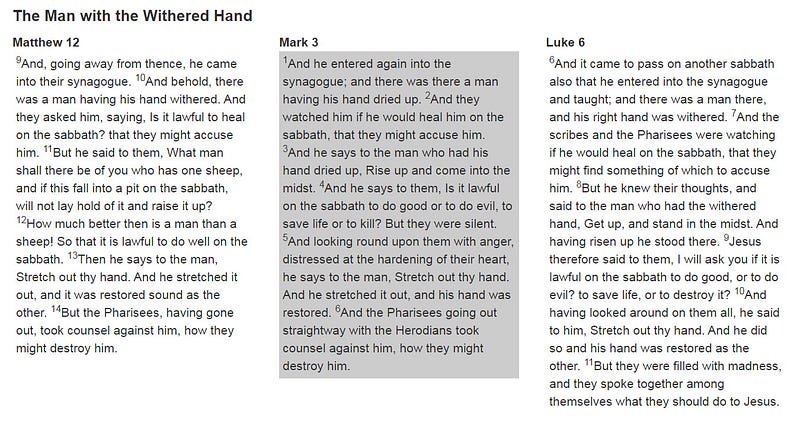
Over the years, there have been a variety of explanations for the literary relationship among these three Gospels, or what is called the ‘synoptic problem.’ We are going to look at the three most popular theories.
The Augustinian Theory
The first solution to the synoptic problem was best put into words by Augustine of Hippo, a 5th-century church father, who wrote:
“Now, those four evangelists whose names have gained the most remarkable circulation over the whole world, and whose number has been fixed as four … are believed to have written in the order which follows: first Matthew, then Mark, thirdly Luke, lastly John …
Of these four, it is true, only Matthew is reckoned to have written in the Hebrew language; the others in Greek… For Matthew is understood to have taken it in hand to construct the record of the incarnation of the Lord according to the royal lineage, and to give an account of most part of His deeds and words as they stood in relation to this present life of men.
Mark follows him closely, and looks like his attendant and epitomizer. For in his narrative he gives nothing in concert with John apart from the others: by himself separately, he has little to record; in conjunction with Luke, as distinguished from the rest, he has still less; but in concord with Matthew, he has a very large number of passages. Much, too, he narrates in words almost numerically and identically the same as those used by Matthew, where the agreement is either with that evangelist alone, or with him in connection with the rest. On the other hand, Luke appears to have occupied himself rather with the priestly lineage and character of the Lord.”
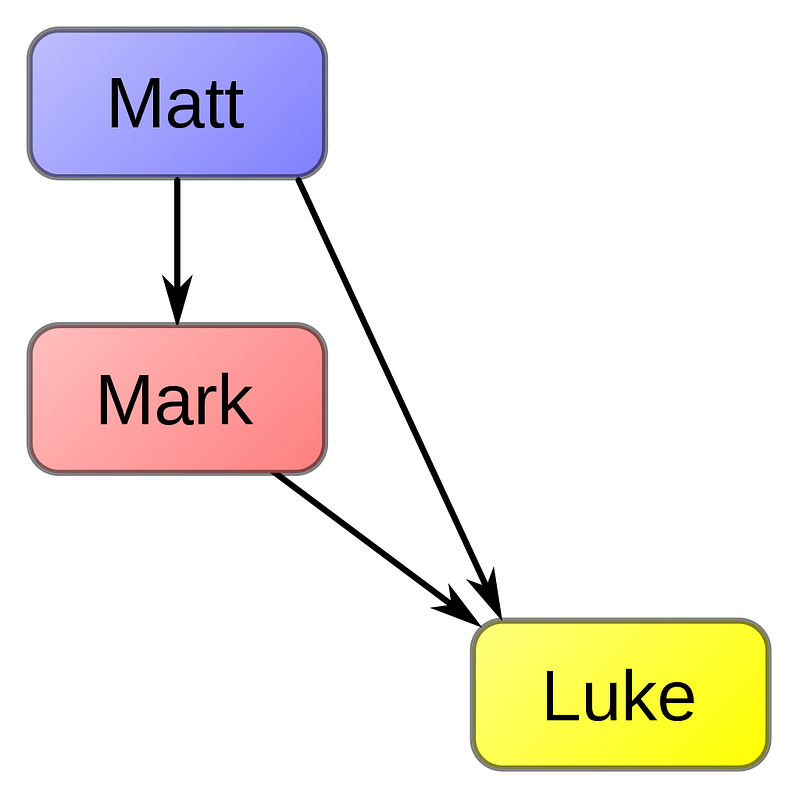

Basically, Augustine believed that Matthew was the first Gospel to be written. Mark then came and gave a summary of what was written in Matthew, combined with what he had learned from Peter's preachings. Luke then apparently used both Matthew and Mark for his version. Augustine also believed that Matthew was originally written in Hebrew.
Generally, the Church Fathers were a gullible bunch, who tended to accept claims with a bit too much faith. Augustine assumed that the order the synoptic Gospels were written was first Matthew, then Mark, and finally Luke because that is the order that they have in the Bible.
Two-Source Theory
According to Biblical scholars, the first of the Synoptic Gospels, Mark, was probably written between 66–70 AD. The second, Matthew, was written between AD 70 to 110, while the third, Luke, was written between 80–110 AD. Matthew and Luke were written independently but both copied from Mark. It is also believed that the authors of Mathew and Luke had access to a collection of sayings that they independently drew from to add to the material from Mark. This document is called Q named for the German word for ‘source’ which is ‘Quelle.’
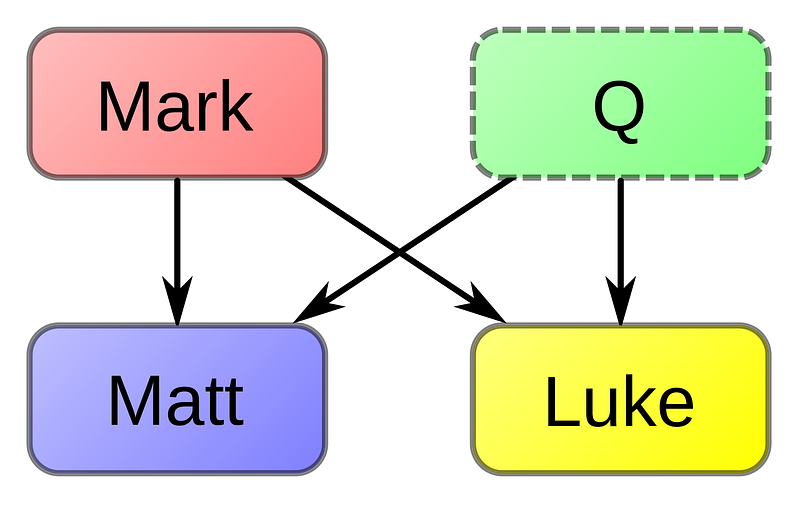

The hypothesis of Q is meant to explain the structure and content of the various Synoptic Gospels. Mark is the shortest Gospel. It contains the basic story told in a simple and direct manner. This is one indicator that it is the earliest because as a story is retold it tends to become longer and more elaborate.
So someone whom we will call Matthew, for convenience only, got ahold of Mark’s text and rewrote it, adding in additional material he had discovered in a copy of Q. Coincidentally another someone, whom we will call Luke, found a copy of Mark as well and, as fortune would have it, also happened to have a copy of Q to refer to. Then Luke, independently of Matthew, decided to go ahead and rewrite Mark while adding sections from Q.
For some reason, that scenario strikes me as improbable. Yes, it explains the Synoptic Gospels' structure and content but for two authors to independently decide to modify the same text using the same external and hypothetical source seems rather unlikely.
Imagine that two thousand years ago there was a contest. The contestants were directed to create an enhanced copy of Mark. This copy was to be supplemented with material found within another document, a proto-Gospel, written in Greek.
The top two entries will be included along with Mark and a fourth Gospel still to be commissioned as part of an all-new collection of Biblical texts. Get your entry in today!
Or perhaps the two authors were monks from separate communities. Each had been given a copy of Mark and Q and was ordered to produce an ‘improved’ version of Mark? For what purpose? The idea itself is absurd.
The Farrer Theory
My own approach is identical to the Farrer-Goulder-Goodacre hypothesis, which is that first Mark was written, and then used to create Matthew. Finally, both Mark and Matthew were drawn from during the writing of Luke.
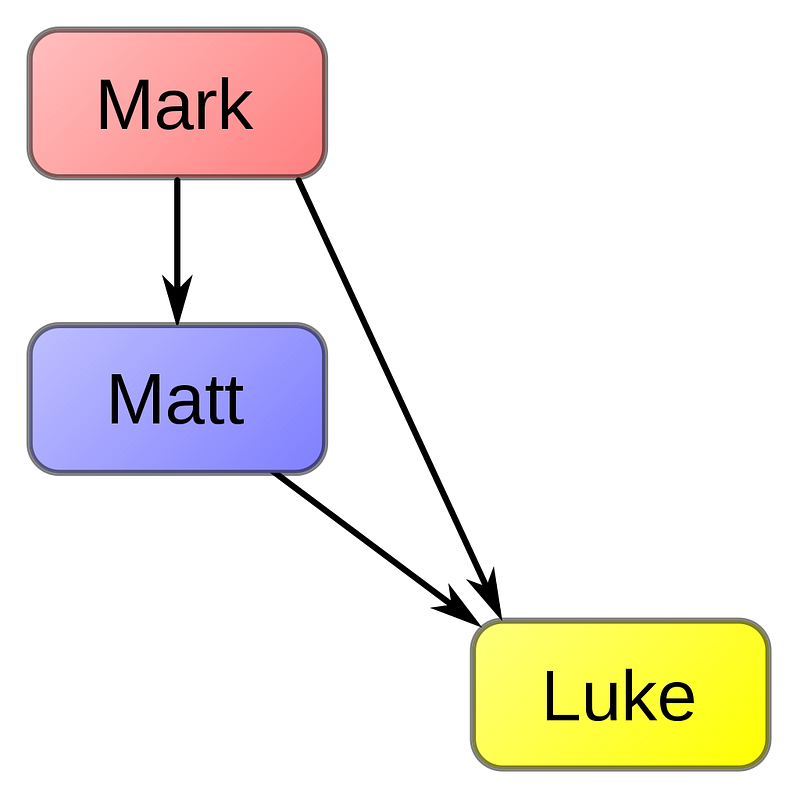

This theory explains the duplication and triplication between versions. However, it does not explain why three such similar Gospels were written only to be packaged together.
My theory is that the duplication and triplication of sections in the synoptic Gospels is designed to encrypt information within the text. But how would such a system function?
An Autostereogram for Your Third Eye
Consider an autostereogram, which is a 3D image puzzle. For example, there is a 3D form of a shark hidden in the random-dot autostereogram below.


The secret to seeing the hidden 3D image is to allow your eyes to focus beyond the surface of the page so that the similar-looking areas near the center of the autostereogram overlap and then merge.


Below you can see a series of diagrams illustrating the different ways of orienting one’s eyes. The diagram on the right shows the proper technique for viewing the hidden 3D image.




Living in Prague, I often take the city’s subway system, which is called the Metro. Several stations have wall panels in regular repeating patterns which I often use to practice merging parallel images.

.jpg)
Below is a somewhat easier version than the hidden shark above. In this instance, there is no hidden 3D form. Rather the various elements within the image are perceived as occupying different depths within the image.
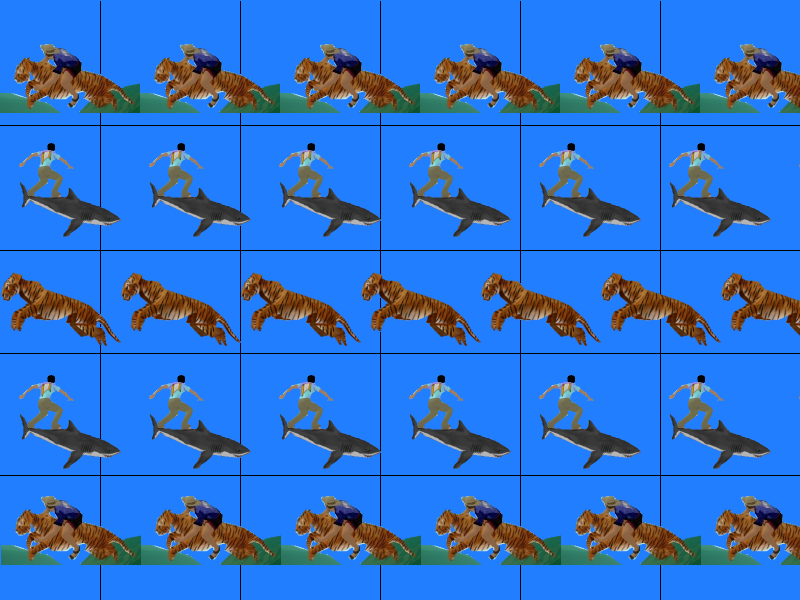

With a stereogram, the illusion of depth is provided by slight differences among the surface details. The various nearly identical sections within the synoptic Gospels function in a comparable manner. Rather than similar images that must be overlaid visually, the synoptic Gospels provide us with narratives that must be overlaid mentally.
The slight differences among the various versions provide clues to help decrypt the passages’ hidden meaning. Also, the Gospels frequently present us with three near-identical scenes rather than two, allowing for even more data to be encrypted.
In my next article, I will provide a detailed guide demonstrating how the encryption system works using the synoptic parallels of Jesus healing a man with a withered hand.
Sections of this article have been taken from my book The Gnostic Notebook Volume Four: On the Fruit of Knowledge and the Precession of the Ages.