avatarTimothy James Lambert

Free AI web copilot to create summaries, insights and extended knowledge, download it at here

5492

Abstract

sts and mystics.</p><h2 id="9e97">The Last Shall Be First</h2><p id="7262">According to the Church Fathers, John the Apostle is the author of all the books credited to John. Most modern scholars argue instead that the Apostle John had nothing to do with the writing of any of them. There are a few, however, who argue that John the Apostle may have written the Gospel while John of Patmos wrote Revelation.</p><p id="9a43">My view is that they were created not by a single author but rather by the same school of Christian thought (Johannine). More importantly, they were written with the same intention.</p><p id="668f">The Gospel of John is the last of the four Gospels and the Apocalypse of John (The Book of Revelation) is the last book in the Bible. What is the significance of these texts being the last texts in their sets?</p><p id="310a">The phrase ‘the last shall be first’ occurs four times in the synoptic Gospels, each time in a different context. I have determined that it also has an esoteric meaning.</p><p id="cb72">Consider several books or movies in a series. The last book in the series has the power to completely change the meaning of everything that has come before. This is called retroactive continuity, or <b>retcon</b> for short.</p><figure id="1517"><img src="https://cdn-images-1.readmedium.com/v2/resize:fit:800/1*uMPP71WTGTfE3Pv-n0PlAw.jpeg"><figcaption>Star Wars The Force Awakens — <a href="https://en.wikipedia.org/wiki/File:Star_Wars_The_Force_Awakens_Theatrical_Poster.jpg">Image Credit</a></figcaption></figure><p id="5faf">For a recent widely known example, take the latest Star Wars trilogy and the mystery surrounding the identity of Rey’s family. In the first film of the trilogy, <i>The Force Awakens </i>(2015), the mystery of Rey’s parentage is introduced, but it seems that director J.J. Abrams had no real answer in mind, though the possibility is left open that she is the daughter of Luke Skywalker.</p><p id="d586">In the followup, <i>The Last Jedi </i>(2017), director Rian Johnson had to come up with a satisfactory solution on his own:</p><figure id="f4e7"><img src="https://cdn-images-1.readmedium.com/v2/resize:fit:800/1*oI8QXcR2mzQHbaIHuBoeeg.jpeg"><figcaption>Star Wars The Last Jedi — <a href="https://en.wikipedia.org/wiki/File:Star_Wars_The_Last_Jedi.jpg">Image Credit</a></figcaption></figure><p id="a273">“I went through all the possibilities of who her parents could be,” Johnson said. “I made a list, with the upsides and downsides” ... He landed where he did because he was fond of “breaking out from the notion that the Force is this genetic thing that you have to be tied to somebody to have. It’s the ‘anybody can be president’ idea, which I liked introducing.”⁴</p><p id="4b66">Johnson decided that Rey’s parents were junk dealers who had sold Rey to a slaver for drinking money.</p><p id="1551">Then, in the trilogy’s final film, The Rise Of Skywalker (2019), Abrams returned as director after skipping the second film. He decided that Rey’s parents being nobodies wasn’t dramatic enough.</p><figure id="111a"><img src="https://cdn-images-1.readmedium.com/v2/resize:fit:800/1*NVbcmV62PUyZG6YYZ9m0ng.jpeg"><figcaption>Star Wars The Rise of Skywalker — <a href="https://en.wikipedia.org/wiki/File:Star_Wars_The_Last_Jedi.jpg">Image Credit</a></figcaption></figure><p id="50ae">Instead, Abrams makes Rey the grand-daughter of the evil Emperor Palpatine. Forget that whole egalitarian idea of everyone, regardless of their bloodline, having the potential for being powerful in the force. Success once again depends on coming from good breeding stock.</p><p id="5185">This last film becomes the window through which the previous two are interpreted. The <b>last</b> becomes <b>first</b> in importance and in dictating what is true within the fictional world.</p><p id="d310">Let’s consider another analogy. Suppose an artist takes a painting by another artist and partial paints over the scene. The usual example is the painting of fig leaves over the genitalia of Adam and Eve in classic Renassaince paintings.</p><p id="b1f3">In the detail from a 1549 copy of Michelangelo’s <i>Last Judgement</i> (1533–41) below, we see a nude Saint Catherine at the bottom left. Saint Blaise is standing above her and is depicted with his head in such a position that he might possibly be looking at her exposed breasts.</p><figure id="3bd2"><img src="https://cdn-images-1.readmedium.com/v2/resize:fit:800/1*NJ4gjZR1ZWx-7xwIqV6W_w.jpeg"><figcaption>Detail from Marcello Venusti’s copy of the original —<a href="https://commons.wikimedia.org/wiki/File:Marcello_venusti,_santi_biagio_e_caterina_prima_della_censura,_1549.jpg"> Image Credit</a></figcaption></figure><p id="18c7">In the photo below, we can see the modifications made to the original by Daniele da Volterra, most probably after Michelangelo died in 1564. Saint Blaise is clearly not gazing at Saint Catherine’s now covered breasts nor at her oddly buff musculature.</p><figure id="db79"><img src="https://cdn-images-1.readmedium.com/v2/resize:fit:800/1*jJ48DUkx6QUp8aMlk7r6EA.jpeg"><figcaption>Daniele da Volterra’s repainted versions of Saint Catherine and Saint Blaise —<a href="https://commons.wikimedia.org/wiki/File:Michelangelo,_giudizio_universale,_dettagli_24_san_biagio_e_santa_caterina.jpg"> Image Credit</a></figcaption></figure><p id="5fe7">Or consider this artist who adds ‘Star Wars’ images to cheap paintings he finds in second-hand shops and yard sales:</p><div i

Options

d="8618" class="link-block"> <a href="https://readmedium.com/an-artist-transforms-paintings-he-finds-on-the-street-by-adding-star-wars-and-got-scenes-7ed29a123ad2"> <div> <div> <h2>An artist transforms paintings he finds on the street by adding ‘Star Wars’ and ‘GoT’ scenes</h2> <div><h3>Artist David Sherrill covers a wide range of fandoms like ”Game of Thrones,” “Halloween,” and “Tiger King” in his work.</h3></div> <div><p>medium.com</p></div> </div> <div> <div style="background-image: url(https://miro.readmedium.com/v2/resize:fit:320/0*bdHiFaWdVpqJZFKs)"></div> </div> </div> </a> </div><p id="9071">Now that we are thinking of paintings and that final defining layer of paint, imagine that we take a painting and lay it on the ground, face up. Now visualize that painting, not as a painting at all, but as a pool of water.</p><p id="6241">Cool, refreshing water.</p><h2 id="7c0c">Shai’tan has tainted the Waters of Saidin</h2><p id="a407">The surface of this pool, however, is covered with an oily slick. To get to the fresh clean water beneath, we must first penetrate this foul substance riding on its surface.</p><figure id="15b7"><img src="https://cdn-images-1.readmedium.com/v2/resize:fit:800/1*qznAr2Z7Nny0X-zup6axtQ.jpeg"><figcaption>The Eye of the World, the first book in The Wheel of Time series —<a href="https://en.wikipedia.org/wiki/File:WoT01_TheEyeOfTheWorld.jpg"> Image Credit</a></figcaption></figure><p id="0c8b">Robert Jordan’s fourteen volume fantasy epic <i>The Wheel of Time</i> (1990 -2013) has a magical system called <i>channeling</i> based around two sources of power. Men channelers use a source called ‘saidin,’ and women use its twin, ‘saidar.’</p><p id="bf82">Unfortunately, evil Shai’tan has ‘tainted’ <i>saidin</i>, with the result that any male channeler drawing power from<i> saidin</i> is driven slowly insane before finally erupting in a cataclysmic world-destroying rage.</p><p id="677f">The taint is described as an oily slick covering the surface of <i>saidin,</i> which is compared to clear water. To access pure <i>saidin</i>, the channeler must first reach through the taint with his mind. The greasy touch of the taint is sickening, but the pure power of <i>saiden</i> washes away the doubt and regret.</p><figure id="afeb"><img src="https://cdn-images-1.readmedium.com/v2/resize:fit:800/1*GX3jOuEPoKGmbArSJJEk-g.jpeg"><figcaption>Images courtesy of Brittany Broski</figcaption></figure><p id="88a0">A legend from the apocryphal book The Acts of John tells the story of Saint John being challenged to drink a cup of poison to prove his faith. This is why Saint John is often depicted holding a cup with a dragon or serpent floating within it.</p><p id="ec7e">Perhaps the iconography is actually a warning as to the true nature of Saint John’s books, while the legend provides an acceptable cover story for the symbolism.</p><figure id="bc53"><img src="https://cdn-images-1.readmedium.com/v2/resize:fit:800/1*DS0YbWstnTr5k9ZxhZ-DsA.jpeg"><figcaption>Saint John and the Poisoned Cup by El Greco, c. 1610–1614 — <a href="https://commons.wikimedia.org/wiki/File:El_Greco_-_St._John_-_Google_Art_Project.jpg">Image Credit</a></figcaption></figure><p id="ea2c">For the majority of people, the books of John are harmless Biblical texts. But for those who approach the Bible as a grimoire of mystical incantations, John’s Gospel and Apocalypse are the poisoned cup from which the seeker must first drink. Only then may one enter the labyrinth hidden behind the veil of encryption.</p><ol><li><i>Esoteric Christianity: The Gospel of St. John and Ancient Mysteries</i> A lecture delivered in Dusseldorf, on November 27th, 1906. Authorized translation from the German of Notes unrevised by the lecturer. GA Unknown <a href="https://wn.rsarchive.org/GA/Unknown/19061127p01.html">https://wn.rsarchive.org/GA/Unknown/19061127p01.html</a></li><li><i>A New Model of the Universe: Principles of the Psychological Method in Its Application to Problems of Science, Religion, and Art. </i>Translated from the Russian by R. R. Merton, under the supervision of the author. New York: Knopf, 1931; London: Routledge, 1931; 2nd revised edition, London: Routledge, 1934; New York: Knopf, 1934.</li><li>Peloubet, F. N., Adams, A. D., & Smith, W. (1925). <i>Peloubet’s Bible Dictionary: Based upon the foundation laid by William Smith</i>. Philadelphia, PA: Winston.</li><li><a href="https://www.vanityfair.com/hollywood/2018/01/the-last-jedi-rey-parents-rian-johnson">https://www.vanityfair.com/hollywood/2018/01/the-last-jedi-rey-parents-rian-johnson</a></li></ol><div id="217f" class="link-block"> <a href="https://timothyjameslambert.medium.com/membership"> <div> <div> <h2>Read every story from Timothy James Lambert (and thousands of other writers on Medium)</h2> <div><h3>As a Medium member, a portion of your membership fee goes to writers you read, and you get full access to every story…</h3></div> <div><p>timothyjameslambert.medium.com</p></div> </div> <div> <div style="background-image: url(https://miro.readmedium.com/v2/resize:fit:320/0*X9JsjGQKtjqHjToX)"></div> </div> </div> </a> </div></article></body>

Saint John Retconned the Bible, and All I Got Was This Cup of Poison Kool-Aid

Confessions of a wannabe cult leader
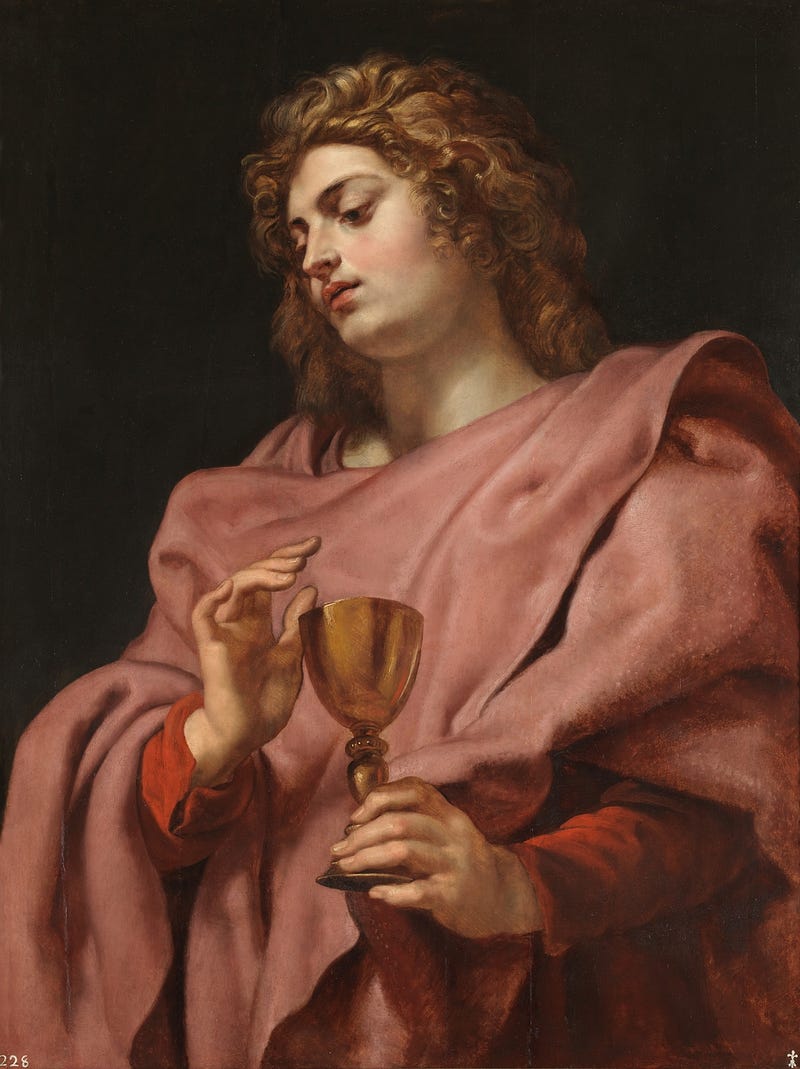
St John by Peter Paul Rubens (c. 1611) — Image Credit

Saint John is credited with the two most influential books in the New Testament. I have written about the Revelation of Saint John in my last three articles. In this article, we will take a look at his other big hit, the Gospel of John.

In the beginning, was the Logos …

Let’s see how a couple of 20th-century mystics describe the Gospel of John.

This first section is from a 1906 lecture on Esoteric Christianity given by Rudolf Steiner:

An esoteric Christianity does exist. This is not admitted in certain circles, with the result that a peculiar place has been assigned to the Saint John Gospel. The Saint John Gospel is looked upon by theologians as a book which emanated out of poetic genius. They have however no understanding for what the Saint John Gospel means.

Whereas the three other evangelists relate the exoteric. Saint John relates what he experiences as an initiated seer, who could look into the Spiritual worlds. The writer of the Saint John Gospel wrote from the point of view of an initiate. Whoever looks upon it as a book that one should read and understand in the same way as one reads and understands any other book knows nothing of the Saint John Gospel.¹

Steiner clearly thinks that the Gospel of John is something special. And he isn’t the only one.

The following is from P. D. Ouspensky’s A New Model of the Universe (1931):

St. John’s Gospel is a quite exceptional literary work. It is written with tremendous emotional upheaval. And it can produce an utterly inexpressible impression on a man who is himself in a highly emotional state. It is not possible to read St. John’s Gospel intellectually. There is a great deal of the emotional element also in the other Gospels, but it is possible to understand them with the mind. St. John’s Gospel cannot be understood by the mind at all. One feels in it an emotional excitement on the level of ecstasy. In this excited state a man rapidly speaks or writes certain words or phrases full of deep meaning for him and full of meaning for people who are in the same state as he, but entirely devoid of any sense for people who listen with ordinary hearing and think with ordinary mind. It is difficult to make such an experiment, but if anyone happens to read St. John’s Gospel while in a highly emotional state, he will understand what is said there and will realise that this is a quite exceptional work, which cannot be measured by ordinary standards or judged on the level of books which are written intellectually and can be read and understood intellectually.²

It isn’t just the esoteric writers. Peloubet’s Bible Dictionary³ gives the qualities traditionally associated with each of the Gospels. Notice how the Gospel of John always manages to outrank the other three in category after category:

MATTHEW is the Gospel for the Jews, MARK is the Gospel for the Romans, LUKE is the Gospel for the Greeks, JOHN is preeminently the Gospel for the church. If you aren’t Jewish, Roman, or Greek, you should stick with reading John.

MATTHEW is the didactic Gospel, MARK is the anecdotal Gospel, LUKE is the historic Gospel, JOHN is the spiritual Gospel. You have the educational Gospel, the Gospel of many small incidents, the Gospel which was written as a history, and above them all, the Gospel of the spirit.

MATTHEW is the Gospel of the past, MARK is the Gospel of the present, LUKE is the Gospel of the future, JOHN is the Gospel of eternity. John beats your past, present, and future Gospels with eternity.

MATTHEW is the Gospel that represents Christ as the Messiah of the Jew, MARK is the Gospel that represents Christ as the Son of God and Lord of the world, LUKE is the Gospel of Jesus as the Good Physician and the Saviour of Mankind, JOHN is the Gospel of Christ as the Eternal Son and the Incarnate Word. Mark’s ‘Son of God and Lord of the world’ seems like it might be hard to outdo, but John manages with ‘Eternal Son and the Incarnate Word.’

The Gospel of John is apparently the most esoteric, poetic, and spiritual of all the Gospels. In fact, you really needn’t bother with the other Gospels unless you are Jewish, Roman, or Greek. John represents a giant leap in Gospel development with all the latest features, making those other earlier Gospels obsolete.

The Gospel of John is the key to both Christianity and esoteric knowledge. At least, that seems to be the consensus among both traditionalists and mystics.

The Last Shall Be First

According to the Church Fathers, John the Apostle is the author of all the books credited to John. Most modern scholars argue instead that the Apostle John had nothing to do with the writing of any of them. There are a few, however, who argue that John the Apostle may have written the Gospel while John of Patmos wrote Revelation.

My view is that they were created not by a single author but rather by the same school of Christian thought (Johannine). More importantly, they were written with the same intention.

The Gospel of John is the last of the four Gospels and the Apocalypse of John (The Book of Revelation) is the last book in the Bible. What is the significance of these texts being the last texts in their sets?

The phrase ‘the last shall be first’ occurs four times in the synoptic Gospels, each time in a different context. I have determined that it also has an esoteric meaning.

Consider several books or movies in a series. The last book in the series has the power to completely change the meaning of everything that has come before. This is called retroactive continuity, or retcon for short.
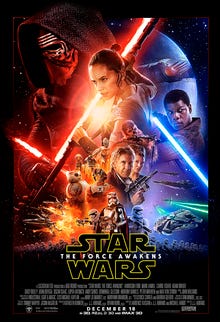
Star Wars The Force Awakens — Image Credit

For a recent widely known example, take the latest Star Wars trilogy and the mystery surrounding the identity of Rey’s family. In the first film of the trilogy, The Force Awakens (2015), the mystery of Rey’s parentage is introduced, but it seems that director J.J. Abrams had no real answer in mind, though the possibility is left open that she is the daughter of Luke Skywalker.

In the followup, The Last Jedi (2017), director Rian Johnson had to come up with a satisfactory solution on his own:
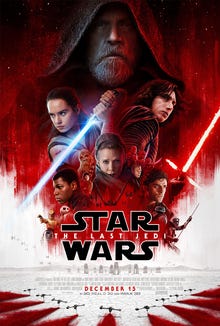
Star Wars The Last Jedi — Image Credit

“I went through all the possibilities of who her parents could be,” Johnson said. “I made a list, with the upsides and downsides” ... He landed where he did because he was fond of “breaking out from the notion that the Force is this genetic thing that you have to be tied to somebody to have. It’s the ‘anybody can be president’ idea, which I liked introducing.”⁴

Johnson decided that Rey’s parents were junk dealers who had sold Rey to a slaver for drinking money.

Then, in the trilogy’s final film, The Rise Of Skywalker (2019), Abrams returned as director after skipping the second film. He decided that Rey’s parents being nobodies wasn’t dramatic enough.
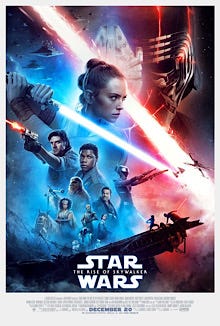
Star Wars The Rise of Skywalker — Image Credit

Instead, Abrams makes Rey the grand-daughter of the evil Emperor Palpatine. Forget that whole egalitarian idea of everyone, regardless of their bloodline, having the potential for being powerful in the force. Success once again depends on coming from good breeding stock.

This last film becomes the window through which the previous two are interpreted. The last becomes first in importance and in dictating what is true within the fictional world.

Let’s consider another analogy. Suppose an artist takes a painting by another artist and partial paints over the scene. The usual example is the painting of fig leaves over the genitalia of Adam and Eve in classic Renassaince paintings.

In the detail from a 1549 copy of Michelangelo’s Last Judgement (1533–41) below, we see a nude Saint Catherine at the bottom left. Saint Blaise is standing above her and is depicted with his head in such a position that he might possibly be looking at her exposed breasts.
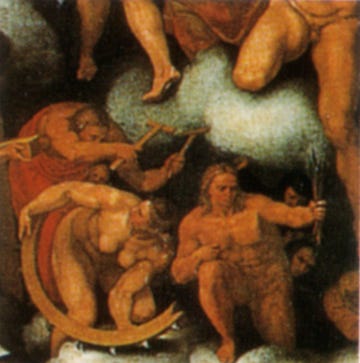
Detail from Marcello Venusti’s copy of the original — Image Credit

In the photo below, we can see the modifications made to the original by Daniele da Volterra, most probably after Michelangelo died in 1564. Saint Blaise is clearly not gazing at Saint Catherine’s now covered breasts nor at her oddly buff musculature.
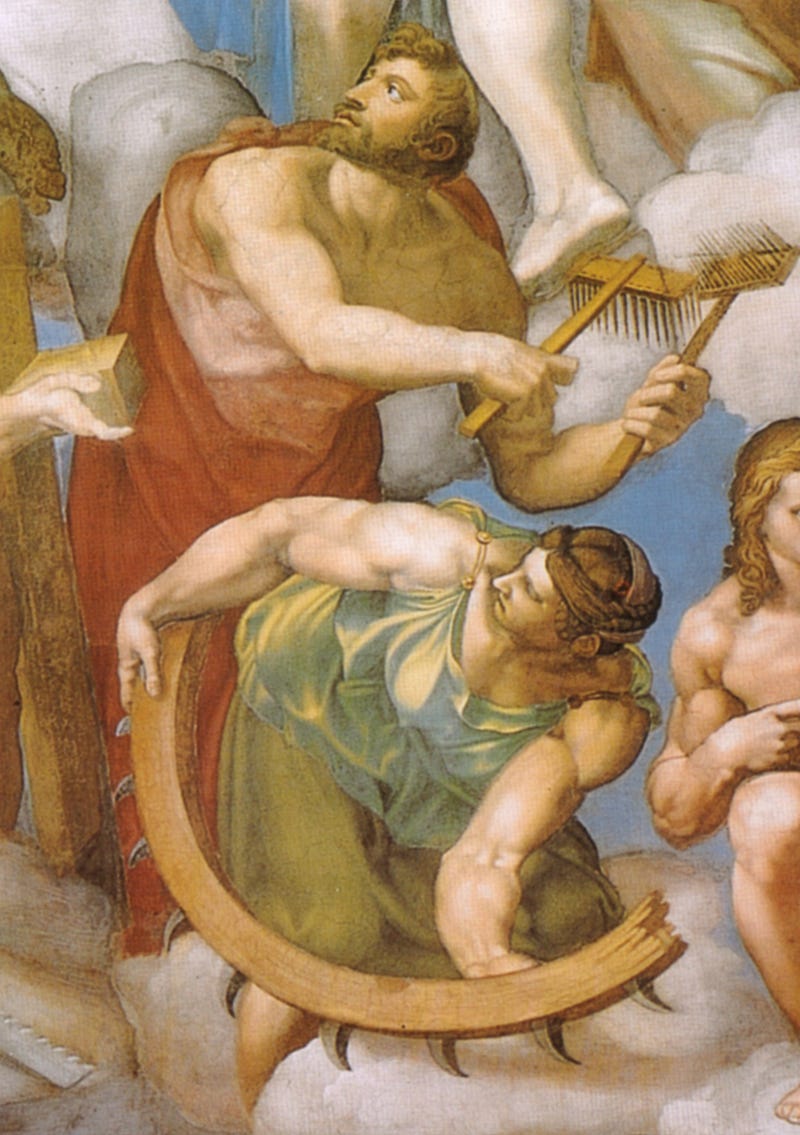
Daniele da Volterra’s repainted versions of Saint Catherine and Saint Blaise — Image Credit

Or consider this artist who adds ‘Star Wars’ images to cheap paintings he finds in second-hand shops and yard sales:

Now that we are thinking of paintings and that final defining layer of paint, imagine that we take a painting and lay it on the ground, face up. Now visualize that painting, not as a painting at all, but as a pool of water.

Cool, refreshing water.

Shai’tan has tainted the Waters of Saidin

The surface of this pool, however, is covered with an oily slick. To get to the fresh clean water beneath, we must first penetrate this foul substance riding on its surface.
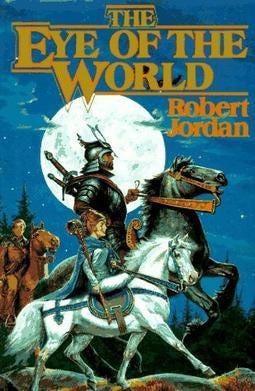
The Eye of the World, the first book in The Wheel of Time series — Image Credit

Robert Jordan’s fourteen volume fantasy epic The Wheel of Time (1990 -2013) has a magical system called channeling based around two sources of power. Men channelers use a source called ‘saidin,’ and women use its twin, ‘saidar.’

Unfortunately, evil Shai’tan has ‘tainted’ saidin, with the result that any male channeler drawing power from saidin is driven slowly insane before finally erupting in a cataclysmic world-destroying rage.

The taint is described as an oily slick covering the surface of saidin, which is compared to clear water. To access pure saidin, the channeler must first reach through the taint with his mind. The greasy touch of the taint is sickening, but the pure power of saiden washes away the doubt and regret.

Images courtesy of Brittany Broski

A legend from the apocryphal book The Acts of John tells the story of Saint John being challenged to drink a cup of poison to prove his faith. This is why Saint John is often depicted holding a cup with a dragon or serpent floating within it.

Perhaps the iconography is actually a warning as to the true nature of Saint John’s books, while the legend provides an acceptable cover story for the symbolism.
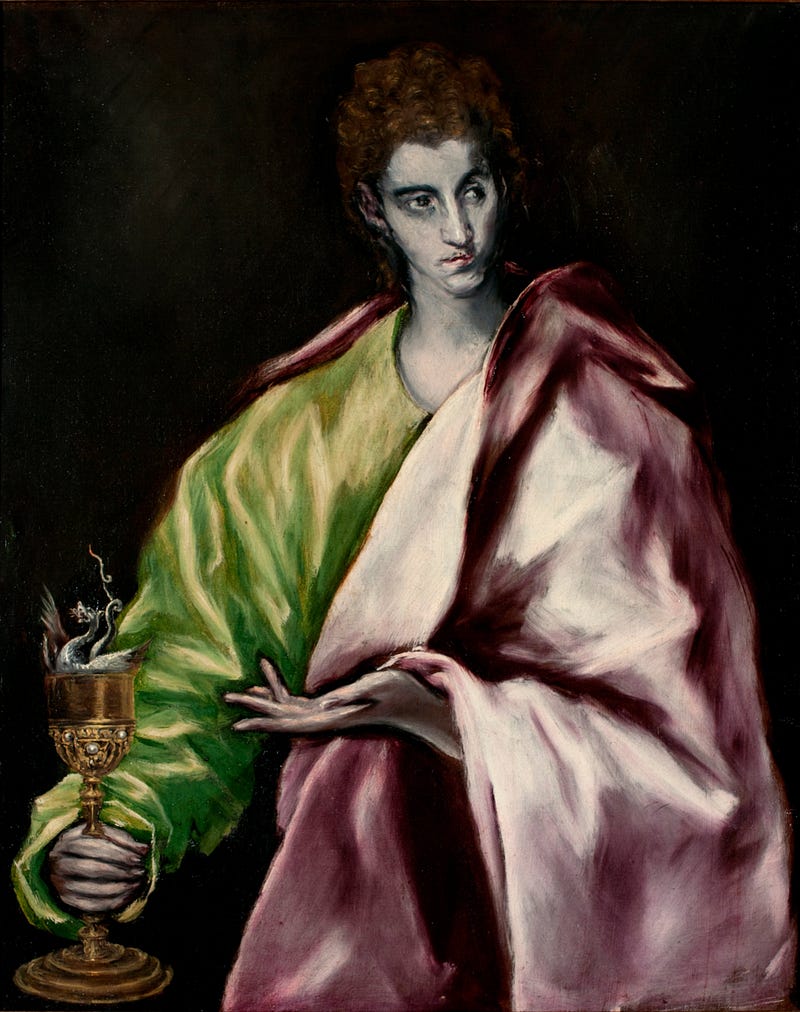
Saint John and the Poisoned Cup by El Greco, c. 1610–1614 — Image Credit

For the majority of people, the books of John are harmless Biblical texts. But for those who approach the Bible as a grimoire of mystical incantations, John’s Gospel and Apocalypse are the poisoned cup from which the seeker must first drink. Only then may one enter the labyrinth hidden behind the veil of encryption.

  1. Esoteric Christianity: The Gospel of St. John and Ancient Mysteries A lecture delivered in Dusseldorf, on November 27th, 1906. Authorized translation from the German of Notes unrevised by the lecturer. GA Unknown https://wn.rsarchive.org/GA/Unknown/19061127p01.html
  2. A New Model of the Universe: Principles of the Psychological Method in Its Application to Problems of Science, Religion, and Art. Translated from the Russian by R. R. Merton, under the supervision of the author. New York: Knopf, 1931; London: Routledge, 1931; 2nd revised edition, London: Routledge, 1934; New York: Knopf, 1934.
  3. Peloubet, F. N., Adams, A. D., & Smith, W. (1925). Peloubet’s Bible Dictionary: Based upon the foundation laid by William Smith. Philadelphia, PA: Winston.
  4. https://www.vanityfair.com/hollywood/2018/01/the-last-jedi-rey-parents-rian-johnson
Christianity
Star Wars
Wheel Of Time
Esoteric Christianity
Religion
Recommended from ReadMedium