
Surviving the Baptism of John
John the Baptist as Elijah resuscitated
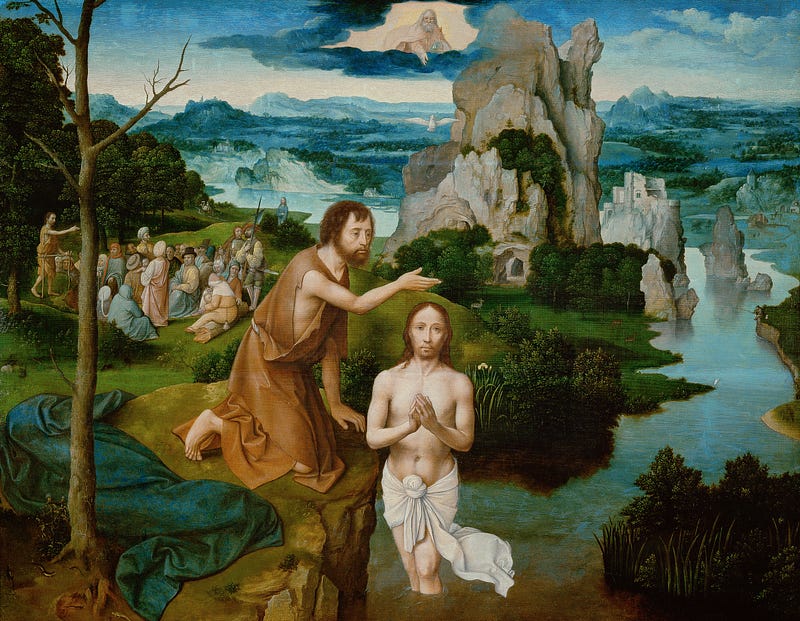
_-_GG_981_-_Kunsthistorisches_Museum.jpg)
John the Baptist as Elijah
Jesus referred to John the Baptist as Elijah.
12 From the days of John the Baptist until now, the kingdom of heaven has been forcefully advancing, and forceful men lay hold of it. 13 For all the Prophets and the Law prophesied until John. 14 And if you are willing to accept it, he is the Elijah who was to come. (Mat 11:12–14 NIV)
This is in reference to a prophecy, the details of which are not of interest. Luke also has a story where Jesus mentions Elijah:
25 I assure you that there were many widows in Israel in Elijah’s time, when the sky was shut for three and a half years and there was a severe famine throughout the land. 26 Yet Elijah was not sent to any of them, but to a widow in Zarephath in the region of Sidon. (Luk 4:25–26 NIV)
I suggest that we examine the story of Elijah and the widow in Zarephath so as to better appreciate the connection between John the Baptist and Elijah.
9 “Go at once to Zarephath of Sidon and stay there. I have commanded a widow in that place to supply you with food.” 10 So he went to Zarephath. When he came to the town gate, a widow was there gathering sticks. He called to her and asked, “Would you bring me a little water in a jar so I may have a drink?” 11 As she was going to get it, he called, “And bring me, please, a piece of bread.” 12 “As surely as the LORD your God lives,” she replied, “I don’t have any bread — only a handful of flour in a jar and a little oil in a jug. I am gathering a few sticks to take home and make a meal for myself and my son, that we may eat it — and die.” 13 Elijah said to her, “Don’t be afraid. Go home and do as you have said. But first make a small cake of bread for me from what you have and bring it to me, and then make something for yourself and your son. 14 For this is what the LORD, the God of Israel, says: ‘The jar of flour will not be used up and the jug of oil will not run dry until the day the LORD gives rain on the land.’ “ 15 She went away and did as Elijah had told her. So there was food every day for Elijah and for the woman and her family. 16 For the jar of flour was not used up and the jug of oil did not run dry, in keeping with the word of the LORD spoken by Elijah. (1Ki 17:9–16 NIV)
Elijah performed a miracle that allowed the widow and her son to never run out of flour and oil. I suspect that this had something to do with ergot infected flour as explore in this article here and here. Still, it seems that eventually, the lack of sufficient food combined with the constant ingestion of ergot-tainted bread led to tragic results.
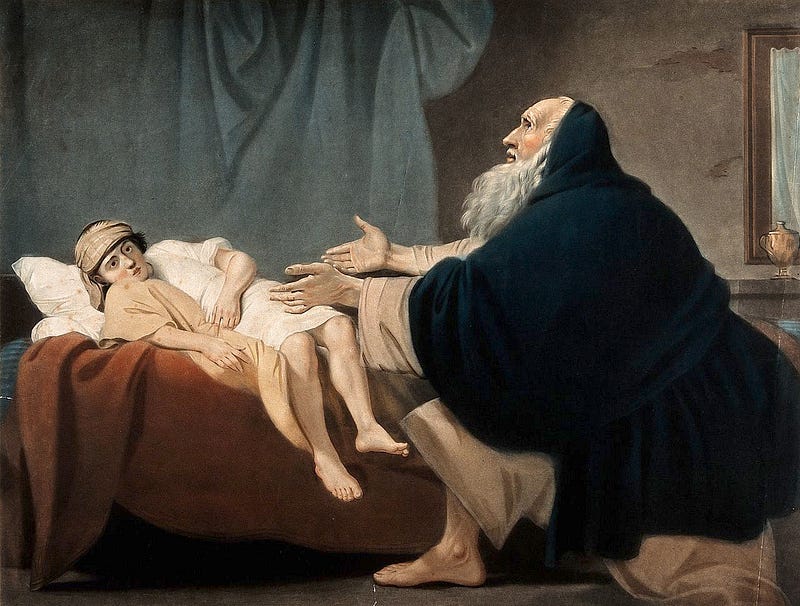

17 Some time later the son of the woman who owned the house became ill. He grew worse and worse, and finally stopped breathing. 18 She said to Elijah, “What do you have against me, man of God? Did you come to remind me of my sin and kill my son?” 19 “Give me your son,” Elijah replied. He took him from her arms, carried him to the upper room where he was staying, and laid him on his bed. 20 Then he cried out to the LORD, “O LORD my God, have you brought tragedy also upon this widow I am staying with, by causing her son to die?” 21 Then he stretched himself out on the boy three times and cried to the LORD, “O LORD my God, let this boy’s life return to him!” 22 The LORD heard Elijah’s cry, and the boy’s life returned to him, and he lived. (1Ki 17:17–22 NIV)
John the Baptist as Elisha
Notice the method Elijah used to revive the son of the widow. Now compare that to the similar act of resuscitation below, performed not by Elijah, but by his successor, Elisha:
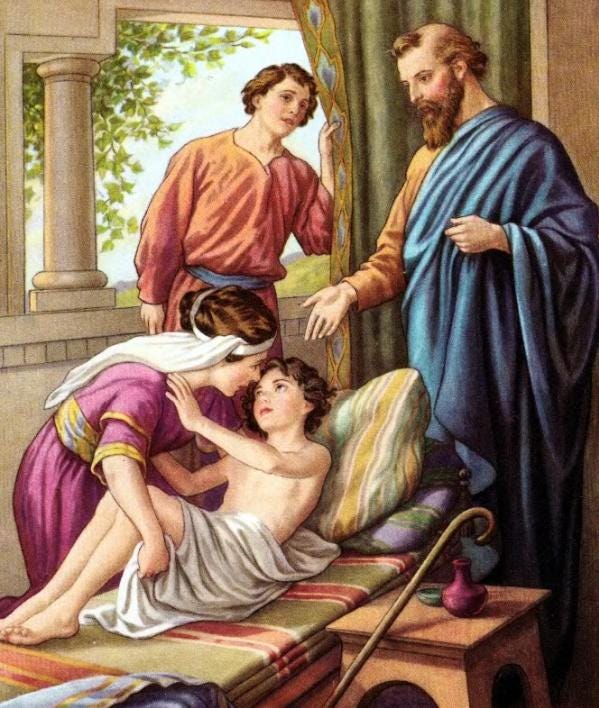

32 When Elisha reached the house, there was the boy lying dead on his couch. 33 He went in, shut the door on the two of them and prayed to the LORD. 34 Then he got on the bed and lay upon the boy, mouth to mouth, eyes to eyes, hands to hands. As he stretched himself out upon him, the boy’s body grew warm. 35 Elisha turned away and walked back and forth in the room and then got on the bed and stretched out upon him once more. The boy sneezed seven times and opened his eyes. (2Ki 4:32–35 NIV)
.jpg)
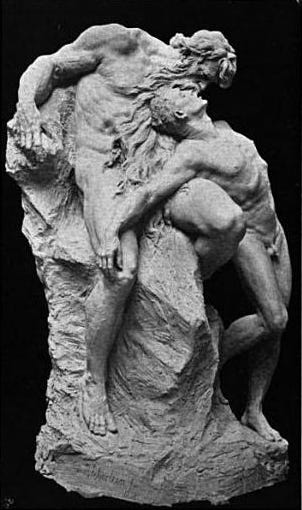
If we merge these two descriptions, and maybe throw in a third of God breathing his spirit into Adam’s nostrils, and we have something that reads like a garbled description of artificial resuscitation. This is John’s primary connection to Elijah/Elisha.
John’s baptism is not exactly as it has been presented to us. John’s baptism likely involved actually drowning the individual being baptized. After this drowning, John or his assistants would then perform whatever passed for artificial resuscitation at the time. This would hopefully work and the person would be born again washed clean of sin.

As I have written about in this article, an angel identified as Gabriel apparently fathered both John the Baptist and Jesus as both Mary and Elizabeth became miraculously pregnant after a visit from Gabriel, though Luke only records the meeting between Gabriel and Elizabeth’s husband, Zechariah.
This angel poses as a man named Simeon and eventually acquires the name, Simon Peter.
A Legion of Simons
Simon spends his time among humans productively. Let’s take a look at all of the activities Simon has been up to.
First, he was Simeon, who blessed the baby Jesus during the Presentation of Jesus at the Temple.
He is also Simon, the brother of Jesus. This is due to Simon being the father of Jesus as well as Mary, through Anne (as told in the Protoevangelium of James). This means that Mary is both the mother and sister of Jesus. Simon, as the ‘mate’ of Mary, is, in some sense, the brother-in-law (though clearly not legally) of Jesus, as well as his father and grandfather.
He is also Simon the Pharisee, host of a meal for Jesus held somewhere in Galilee. In another description of the same meal, he is identified as Simon the Leper, someone who Jesus had previously healed of leprosy.
He is also Simon of Cyrene, an apparent random passer-by who is forced to carry Jesus’ cross, yet is actually, once again, Simon Peter in disguise. He is there to convince Jesus that things are proceeding according to plan.
He is Simon the Zealot when it becomes necessary to bifurcate Simon Peter into yet another separate Simon.
He is Simon the Tanner, a tanner living in Jaffa at whose house Simon Peter stays as a guest. Of course, Simon Peter is just staying at another of his safehouses owned by another of his aliases.
Simon Magus
He is also Simon Magus, a disciple of John the Baptist according to the Clementine Homilies. That is the Simon that concerns us now. Jesus disappeared with Mary years ago, leaving Simon with John and the other siblings of Jesus.
Simon was John’s father, which made John important to Simon’s plans, but not as important as Jesus, who was both the son and grandson of Simon. Jesus was three-fourths angel. John was only half.
During the years when Simon had been training John, refining his son’s performance as the Baptizer, he had also been busy acquiring fishing boats for moving the troupe along the River Jordan. And Simon never failed to remind John of his inferiority to his younger brother Jesus.
7 And this was his message: “After me will come one more powerful than I, the thongs of whose sandals I am not worthy to stoop down and untie.” (Mar 1:7 NIV)
This is what Simon has pounded into John’s head since Jesus and his sister/mother ran off and deserted the Family. Simon promises that one day Jesus will return and then John will do what he has been ceaselessly trained to do. All so that his father will finally be able to realize his master plan.
9 At that time Jesus came from Nazareth in Galilee and was baptized by John in the Jordan. (Mar 1:9 NIV)
Let’s look at this from John’s perspective. He has been told for years that he is not worthy to untie Jesus’ sandals. And finally, Jesus shows up.
13 Then Jesus came from Galilee to the Jordan to be baptized by John. 14 But John tried to deter him, saying, “I need to be baptized by you, and do you come to me?” 15 Jesus replied, “Let it be so now; it is proper for us to do this to fulfill all righteousness.” Then John consented.
Jesus shows up, but he doesn’t want to baptize John, which is what Simon had drilled into John’s head must occur. Jesus was to assume the role of High Priest, being three-fourths angel, and baptize John who was to become the messiah king. Jesus apparently has his own agenda and John agrees to go ahead and baptize Jesus instead because it gives him a chance to channel his anger onto the one person he has learned to hate. And it seems that Simon has his attention directed elsewhere, so now is John’s chance.
John Baptizes Jesus
John puts his hand on Jesus' forehead as they stand in the River Jordan. He guides Jesus backward and down until Jesus is lying on his back suspended beneath the surface of the water. And John uses his leverage to hold him there as he struggles until eventually, Jesus inhales a couple of lungfuls of water and relaxes.
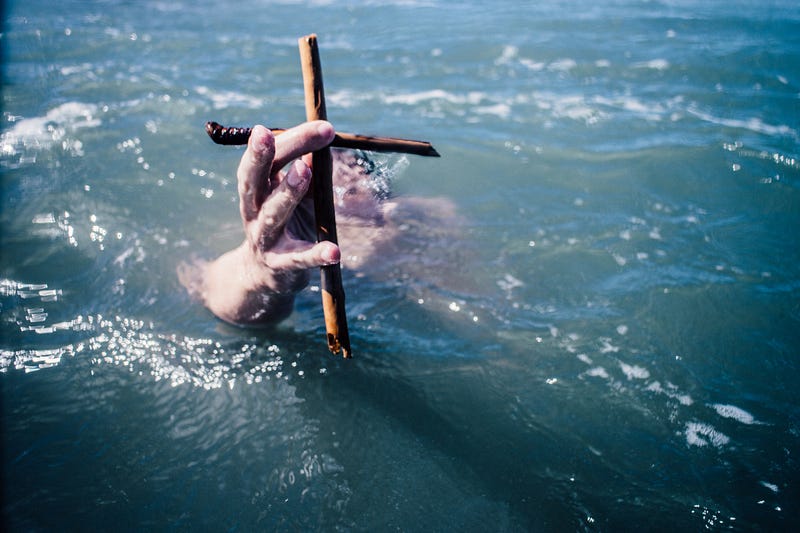
John then releases Jesus’ body to the river’s current.
16 As soon as Jesus was baptized, he went up out of the water. At that moment heaven was opened, and he saw the Spirit of God descending like a dove and lighting on him. 17 And a voice from heaven said, “This is my Son, whom I love; with him I am well pleased.” (Mat 3:16–17 NIV)
Jesus sees the heavens split and the spirit of God descending like a dove as his father, the angel Gabriel disguised as Simon, pulls him from the waters and blows air into his lungs. It is Simon who calls out in anger to John: “This is my Son, whom I love; with him I am well pleased!”
1 Then Jesus was led by the Spirit into the desert to be tempted by the devil. (Mat 4:1 NIV)
Jesus and Simon leave John and the rest of the troupe and retreat into the desert where Simon reveals his plans and the roles he has available for Jesus to fill.
We will consider their discussion in a future article.
Scriptures taken from the Holy Bible, New International Version®, NIV®. Copyright © 1973, 1978, 1984, 2011 by Biblica, Inc.™ Used by permission of Zondervan. All rights reserved worldwide. www.zondervan.com The “NIV” and “New International Version” are trademarks registered in the United States Patent and Trademark Office by Biblica, Inc.™