
Taste the Fruit of Knowledge! Go Ahead, Take a Bite!
It ain’t gonna kill ya
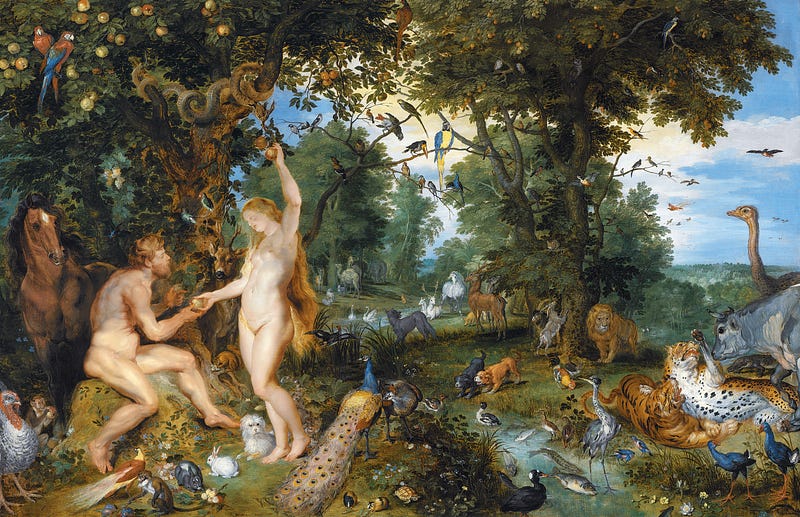

When we think about the fruit of knowledge, we usually assume that it has something to do with sex, if we think about it at all. In this article, I will reveal the actual identity of the fruit based on the details available within Genesis.
As those who follow my writings know, I occasionally post articles on decrypting layers of meaning concealed within the Bible.
The Clues
At this point, I want to gather all of the relevant verses from Genesis so we can determine all of the defining qualities of the fruit of knowledge.
9 And the LORD God made all kinds of trees grow out of the ground — trees that were pleasing to the eye and good for food. In the middle of the garden were the tree of life and the tree of the knowledge of good and evil. (Gen 2:9 NIV)
The first few clues are that the Tree of Knowledge grew in the middle of the garden together with the tree of life. They were also pleasing to the eye and good for food apparently.
16 And the LORD God commanded the man, “You are free to eat from any tree in the garden; 17 but you must not eat from the tree of the knowledge of good and evil, for when you eat of it you will surely die.” (Gen 2:16–17 NIV)
Eating from the tree of knowledge should result in that person’s death.
1 Now the serpent was more crafty than any of the wild animals the LORD God had made. He said to the woman, “Did God really say, ‘You must not eat from any tree in the garden’?” 2 The woman said to the serpent, “We may eat fruit from the trees in the garden, 3 but God did say, ‘You must not eat fruit from the tree that is in the middle of the garden, and you must not touch it, or you will die.’ “ 4 “You will not surely die,” the serpent said to the woman. 5 “For God knows that when you eat of it your eyes will be opened, and you will be like God, knowing good and evil.” 6 When the woman saw that the fruit of the tree was good for food and pleasing to the eye, and also desirable for gaining wisdom, she took some and ate it. She also gave some to her husband, who was with her, and he ate it. 7 Then the eyes of both of them were opened, and they realized they were naked; so they sewed fig leaves together and made coverings for themselves. (Gen 3:1–7 NIV)
Eating the fruit of the tree of knowledge resulted in Adam and Eve realizing that they were naked.
16 Unto the woman he said, I will greatly multiply thy sorrow and thy conception; in sorrow thou shalt bring forth children; and thy desire shall be to thy husband, and he shall rule over thee. 17 And unto Adam he said, Because thou hast hearkened unto the voice of thy wife, and hast eaten of the tree, of which I commanded thee, saying, Thou shalt not eat of it: cursed is the ground for thy sake; in sorrow shalt thou eat of it all the days of thy life; 18 Thorns also and thistles shall it bring forth to thee; and thou shalt eat the herb of the field; 19 In the sweat of thy face shalt thou eat bread, till thou return unto the ground; for out of it wast thou taken: for dust thou art, and unto dust shalt thou return. (Gen 3:16–19 KJV)

Eve’s punishment is that she will suffer more pain during her pregnancies and she will become pregnant more often, as her sorrow and her conception will be multiplied. Adam isn’t punished exactly as it is the earth that is cursed due to Adam’s actions. Basically, Adam is going to have to work at farming for the rest of his life.
22 And the LORD God said, Behold, the man is become as one of us, to know good and evil: and now, lest he put forth his hand, and take also of the tree of life, and eat, and live for ever: 23 Therefore the LORD God sent him forth from the garden of Eden, to till the ground from whence he was taken. 24 So he drove out the man; and he placed at the east of the garden of Eden Cherubims, and a flaming sword which turned every way, to keep the way of the tree of life. (Gen 3:22–24 KJV)
Here we learn that humanity retains the knowledge from eating the fruit of knowledge which seems to indicate that Adam and Eve continued to eat the fruit of knowledge even after being evicted from the garden.
Anyone who has read my previous article will be unsurprised when I tell you what I suspect the fruit of knowledge was.
The fruit of knowledge was grain.
Let’s look back at the description. The tree, or actually the plant, of knowledge, grows in the middle of the garden. If we imagine a clearing in a forest, the clearing is surrounded by trees. The clearing is in the middle of the forest. A grassy field where the grasses are topped with heads of grain.
The second detail is that eating the fruit of knowledge results in death. Obviously, Adam and Eve did not die objectively. However, they likely experienced ego-death from ingesting the ergot-infected grain.
Adam and Eve also became aware that they were naked. They experienced shame, but not because they were told that they were doing wrong. They had realized that it was wrong by themselves without the need for external authority.
The Punishment
Next, we come to the punishment phase. This is where we will need a little background. This section of the Bible is describing events that took place around ten to twelve thousand years ago.
Humanity at this time was in the hunter-gatherer phase of development. The glaciers from the last ice age were falling back, leaving wide grassy plains. These plains provided grazing lands for herds of herbivores.
It was a great time to be a hunter as there was plenty of game to hunt.
But after a thousand years or so, the glaciers slowed their retreat. At first, a few trees popped up in the grasslands, but soon whole forests were swallowing up more and more of the grazing lands. The lack of grazing lands meant that the herds of herbivores became less plentiful.
The gatherer half of the hunter/gatherer pair became more influential. Less meat being hunted meant that the diet required more foodstuffs being gathered.
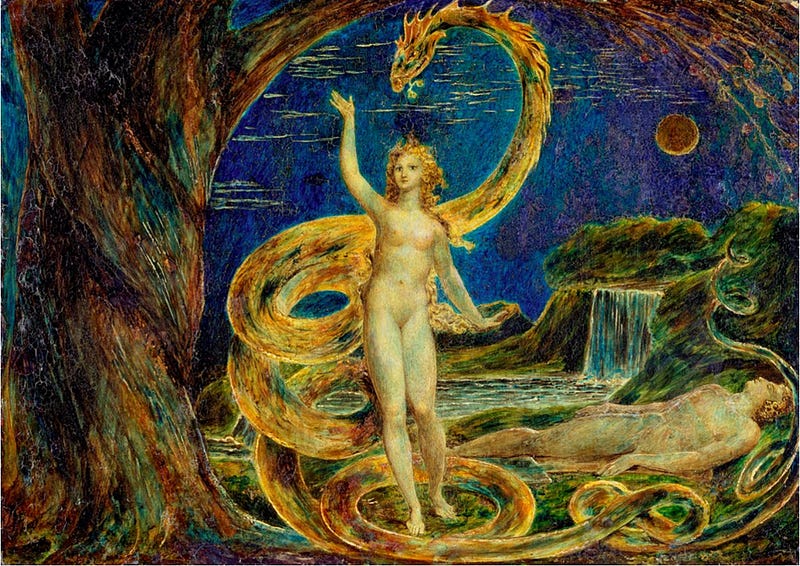

The serpent probably represents the wise. In this instance, the experts in the community suggested that the grain-bearing grasses be harvested and bread baked. This dietary change required a huge societal shift. The semi-nomadic hunter/gatherers would have to build granaries to store the grain, ovens to bake it, and farms in which to live.
The most important change, however, would be the resulting jump in fertility. The following is from Cannibals and Kings: The Origins of Cultures (1991) by Marvin Harris.
The best method of population control available to stone age hunter-collectors was to prolong the span of years during which a mother nursed her infant. Recent studies of menstrual cycles carried out by Rose Frisch and Janet McArthur have shed light on the physiological mechanism responsible for lowering the fertility of lactating women. After giving birth, a fertile woman will not resume ovulation until the percentage of her body weight that consists of fat has passed a critical threshold. This threshold (about 20–25 percent) represents the point at which a woman’s body has stored enough reserve energy in the form of fat to accommodate the demands of a growing fetus. The average energy cost of a normal pregnancy is 27,000 calories — just about the amount of energy that must be stored before a woman can conceive. A nursing infant drains about 1,000 extra calories from its mother per day, making it difficult for her to accumulate the necessary fatty reserve. As long as the infant is dependent on its mother’s milk, there is little likelihood that ovulation will resume... The same mechanism appears to be responsible for delaying menarche — the onset of menstruation. The higher the ratio of body fat to body weight, the earlier the age of menarche. In well-nourished modern populations, menarche has been pushed forward to about twelve years of age, whereas in populations chronically on the edge of caloric deficits it may take eighteen or more years for a girl to build up the necessary fat reserves.¹
Sorrow and Conception Multiplied
The switch from a high-protein nomadic hunter-gatherer diet to a high-starch farmer diet meant that Eve’s fertility increased many-fold. This led to a greater need for bread, which meant larger farms, which required more land, which led to more pregnant women. Eve’s actions were cursed because they led humanity from the garden and its supposed idyllic lifestyle.
The Bible even mentions bread by name in the curse:
19 In the sweat of thy face shalt thou eat bread, till thou return unto the ground; for out of it wast thou taken: for dust thou art, and unto dust shalt thou return. (Gen 3:19 KJV)
Once Eve pushed Adam to begin making bread, it was necessary to farm the grasses. Fields had to be cleared of rocks and unwanted plants. The larger the field, the more bread that could be produced. The more bread, the higher the consumption of calories. The more calories consumed, the higher Eve’s fertility climbed. Instead of four years between births, she would soon be having children every eighteen months.
.jpg)
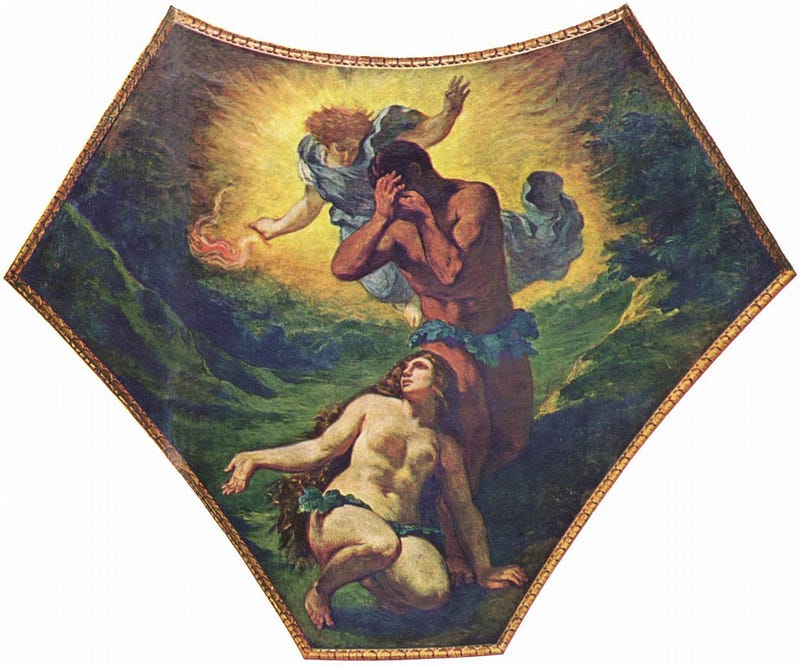
After a few seasons, a field’s soil loses its nutrients. The early farmers would periodically let certain sections of their fields lie fallow and become overgrown with weeds, trees, and vines. After several years of being left unused, the section of land would then be slashed, which is to say everything was cut and left for a year or so to dry out, and then the section was burnt, after which the soil had been rejuvenated and usable for farming once again. This is called slash and burn agriculture, or as the Bible describes it:
24 So he drove out the man; and he placed at the east of the garden of Eden Cherubims, and a flaming sword which turned every way, to keep the way of the tree of life. (Gen 3:24 KJV)
- Harris, M. (1991). Cannibals and Kings: The origins of cultures. New York: Vintage Books.
Sections of this article are excerpts from my book The Gnostic Notebook Volume Four: On the Fruit of Knowledge and the Precession of the Ages.