
On Memory Systems and Gospel Stories
Or how to make a scene so memorable that it will never be forgotten

A Simple Memory System
I have always had an interest in various systems. For example, I have examined various methods for developing a more powerful memory. These memory strengthening techniques are quite varied. However, they all share a common technique. This technique is to create an image encoded with the various elements that you want to remember. The exact system of encoding varies from system to system. In one of the simplest systems described by Derren Brown in his Tricks of the Mind (2006), he employs the following images for the numbers from one to ten:
1 — Bun 2 — Shoe 3 — Tree 4 — Door 5 — Hive 6 — Sticks 7 — Heaven 8 — Gate 9 — Line 10 — Hen
These words rhyme with the corresponding numbers. This system is useful if you want to remember a series of numbered items. For instance, suppose that the fifth word on the list is a rabbit. You would then create an image incorporating a rabbit with the image for five, which is a hive.
Here is the key to every successful memory system. The image you create must be striking somehow, comedic perhaps. My image is that of a long-eared lop rabbit flying around a big honey-filled hive, with its ears buzzing away, acting as wings. There, I believe that is memorable enough.
Purple Cloaks, Crowns, and the Ornamentation of Blood
My intention is not to teach you, the reader, how to develop a super memory, so I will not go much further into the various methods employed. I want to draw your attention to a bit of text from the earliest known Latin work of rhetoric, dating from the 90s BC. The Ad Herennium contains the following instruction concerning the creation of mnemonic images:
We ought, then, to set up images of a kind that can adhere longest in memory. And we shall do so if we establish similitudes as striking as possible; if we set up images that are not many or vague but active; if we assign to them exceptional beauty or singular ugliness; if we ornament some of them, as with crowns or purple cloaks, so that the similitude may be more distinct to us; or if we somehow disfigure them, as by introducing one stained with blood or soiled with mud or smeared with red paint, so that its form is more striking, or by assigning certain comic effects to our images, for that, too, will ensure our remembering them more readily.
When I first read the text above, the words resonated on a very deep level, and I knew intuitively that I had once read something that had apparently been constructed to be in accordance with these same instructions:
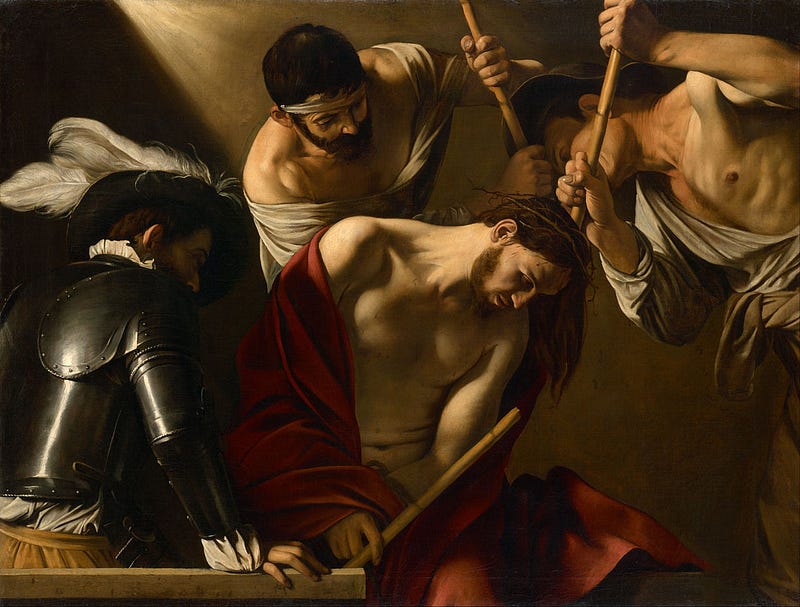
They put a purple robe on him, then twisted together a crown of thorns and set it on him. And they began to call out to him, “Hail, king of the Jews!” Again and again they struck him on the head with a staff and spit on him. Falling on their knees, they paid homage to him. Mark 15:17–19
The Ad Herennium tells us to ornament our figure with a crown or a purple cloak. The author of Mark apparently doubles down and gives Jesus both a crown of thorns and a purple robe. The text also recommends that the figure be disfigured or stained with blood. Then we have Jesus, who had been first given a crown of thorns and was then struck on his head with a staff, which would clearly result in a bloody wound as the scalp tends to bleed profusely. Finally, we have the soldiers taunting Jesus with his identity as the king of the Jews by bowing and paying homage to him, an act which they at least found humorous.
The Gospels: An Ancient Literary Memory System?
It seemed that I had found evidence that the Gospels were actually constructed to act as a type of literary memory system. Indeed, what else is one to think when one of the central images of Christianity is nearly an image for image recreation of the core guiding principle of the Art of Memory as set down in writing around three hundred years before the Gospels had been written?
Could it be that the authors were actually adepts at the Art of Memory? Perhaps the Synoptic Gospels' tri-fold nature is not a historical accident but is actually a method of encrypting the data contained within the miraculous tales of Jesus the Wonder Worker.
And more importantly, perhaps the tableau of Jesus in a purple cloak with a crown of thorns is a message, a signifier to anyone familiar with the Art of Memory, that here is something screaming for attention, begging to be decrypted, promising, knock, and the door will be opened.
But what does it mean to say that a text is a form of literary memory system? What does the transition from a personal memory system to a literary memory system entail? Let’s take a look at the process of encoding information in a personal memory system.
There are essentially three elements. There is the information to be encoded. There is the encoding system. And there is the resulting memory tableau filled with striking images engaged in memorable actions.
When this process is lifted from the personal realm and instituted within a literary text, the process is the same. There is the information to be encoded. There is the encoding system. And there is the resulting literary memory tableau filled with striking images engaged in memorable actions.
The chief difference is that there is no danger that the memory tableau might be mistaken for the message itself in a personal memory system. This is mainly because the person who encodes the data is the same person who decodes the data.
With a literary memory system, the individual who encodes the message is unlikely to be the one who decodes the message. More likely, the surface level of the text will be taken as the entirety of the message. So the message will not be decoded at all, beyond the base neurological decoding, which occurs in the recognition of symbolic marks representing the sounds from which words are formed.
With the example of Mark 15:17–19, let us first consider the information that is being conveyed. This information is simply that the imagery employed in the narrative was designed in accordance with the Ad Herennium. The encoding system, or the key, is the specific section of the Ad Herennium that mentions the crown, the purple cloak, and the ornamentation with blood. The text of Mark contains certain features that are mapped to the text of the Ad Herennium. These features are only revealed when the text of Mark and the key text are brought together. Examining Mark's section in isolation would show no evidence that the text contains any hidden, encoded meaning.
Steganography: Hiding Messages in Plain Sight
We are not simply dealing with a literary memory system. This phenomenon also involves aspects of Steganography, which is the art and science of encoding hidden messages so that no one, apart from the sender and intended recipient, even suspects the existence of the message. So it is not enough that these texts contain a hidden layer of meaning; they are also designed in such a way that no one even suspects that this hidden layer exists.
There is, of course, another possibility, which is that all of this is simply a coincidence, a case of my brain finding a correspondence that does not actually exist. I can tell you only that it seems to be an actual clue, a signpost of sorts, left behind to lead us deeper into the mysteries of the Gospels. Follow me, if you want to see just how deep this labyrinth goes.
Sections of this article are excerpts from my book The Gnostic Notebook Volume One: On Memory Systems and Fairy Tales.