
The Secret to Feeding Five Thousand With Only Five Loaves
Beware the leaven of the Pharisees
_-_Multiplication_of_the_loaves_and_fish.jpg)
In this article, I hope to reveal one of the Bible’s greatest mysteries. This secret isn’t as deeply hidden as some. One need only follow the clues and see where they lead.
Jesus asked them: “Why are you talking about having no bread? Do you still not see or understand? Are your hearts hardened? Do you have eyes but fail to see, and ears but fail to hear?
As those who follow my writings know, I occasionally post articles on decrypting layers of meaning concealed within the Bible.
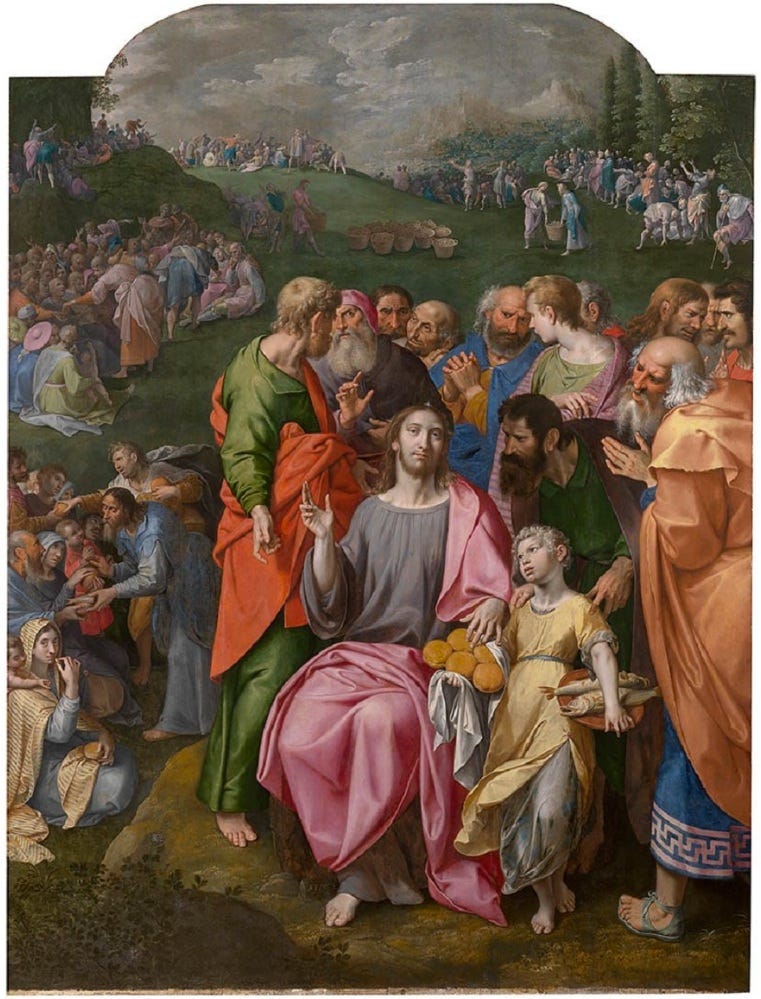
Feeding the Five Thousand
This article is focused on an apparently unknown secret concealed within the miracle of the feeding of the five thousand.
34 When Jesus landed and saw a large crowd, he had compassion on them, because they were like sheep without a shepherd. So he began teaching them many things. 35 By this time it was late in the day, so his disciples came to him. “This is a remote place,” they said, “and it’s already very late. 36 Send the people away so they can go to the surrounding countryside and villages and buy themselves something to eat.” 37 But he answered, “You give them something to eat.” They said to him, “That would take eight months of a man’s wages! Are we to go and spend that much on bread and give it to them to eat?” 38 “How many loaves do you have?” he asked. “Go and see.” When they found out, they said, “Five — and two fish.” 39 Then Jesus directed them to have all the people sit down in groups on the green grass. 40 So they sat down in groups of hundreds and fifties. 41 Taking the five loaves and the two fish and looking up to heaven, he gave thanks and broke the loaves. Then he gave them to his disciples to set before the people. He also divided the two fish among them all. 42 They all ate and were satisfied, 43 and the disciples picked up twelve basketfuls of broken pieces of bread and fish. 44 The number of the men who had eaten was five thousand. (Mar 6:34–44 NIV)
The first part starts like a standard Jesus miracle. No obvious hidden meanings, although the focus on the focus on the number of basketfuls of broken bread pieces is a little anal. The chapter continues with another miracle, where Jesus walks on water.
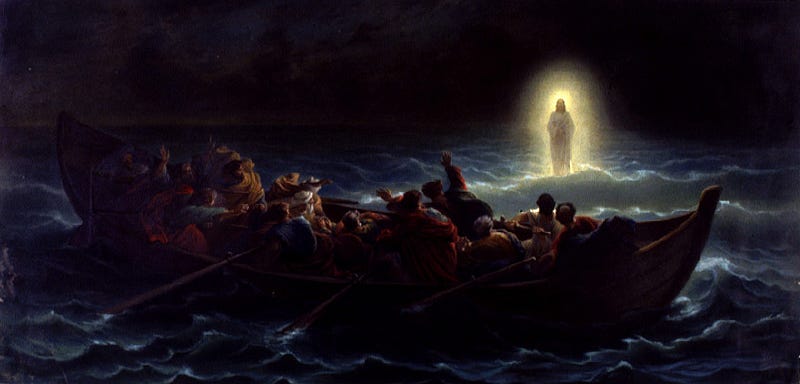

47 When evening came, the boat was in the middle of the lake, and he was alone on land. 48 He saw the disciples straining at the oars, because the wind was against them. About the fourth watch of the night he went out to them, walking on the lake. He was about to pass by them, 49 but when they saw him walking on the lake, they thought he was a ghost. They cried out, 50 because they all saw him and were terrified. Immediately he spoke to them and said, “Take courage! It is I. Don’t be afraid.” 51 Then he climbed into the boat with them, and the wind died down. They were completely amazed, 52 for they had not understood about the loaves; their hearts were hardened. (Mar 6:47–52 NIV)
Again, another standard miracle as performed by Jesus, but notice the last line above in bold. That seems a little strange. The disciples were amazed that Jesus could walk on water, and Mark makes the point that the cause of their amazement is that they didn’t understand about the loaves. Why would a proper understanding of the loaves make Jesus’ walking on water somehow less amazing?
Feeding the Four Thousand
A couple of chapters later, a similar event occurs:
1 During those days another large crowd gathered. Since they had nothing to eat, Jesus called his disciples to him and said, 2 “I have compassion for these people; they have already been with me three days and have nothing to eat. 3 If I send them home hungry, they will collapse on the way, because some of them have come a long distance.” 4 His disciples answered, “But where in this remote place can anyone get enough bread to feed them?” 5 “How many loaves do you have?” Jesus asked. “Seven,” they replied. 6 He told the crowd to sit down on the ground. When he had taken the seven loaves and given thanks, he broke them and gave them to his disciples to set before the people, and they did so. 7 They had a few small fish as well; he gave thanks for them also and told the disciples to distribute them. 8 The people ate and were satisfied. Afterward the disciples picked up seven basketfuls of broken pieces that were left over. 9 About four thousand men were present. (Mar 8:1–9 NIV)
In Biblical critical theory, this doubling of events is supposedly due to there being two variants of a single story. The author of Mark seemingly mistook these two versions for two separate events.
I disagree. I believe that both events were described not because they necessarily occurred but because they were designed to convey a hidden meaning. Let’s read further:
14 The disciples had forgotten to bring bread, except for one loaf they had with them in the boat. 15 “Be careful,” Jesus warned them. “Watch out for the yeast of the Pharisees and that of Herod.” 16 They discussed this with one another and said, “It is because we have no bread.” 17 Aware of their discussion, Jesus asked them: “Why are you talking about having no bread? Do you still not see or understand? Are your hearts hardened? 18 Do you have eyes but fail to see, and ears but fail to hear? And don’t you remember? 19 When I broke the five loaves for the five thousand, how many basketfuls of pieces did you pick up?” “Twelve,” they replied. 20 “And when I broke the seven loaves for the four thousand, how many basketfuls of pieces did you pick up?” They answered, “Seven.” 21 He said to them, “Do you still not understand?” (Mar 8:14–21 NIV)
Jesus warns them to beware of the leaven of the Pharisees and Herod. Leaven is another word for yeast. Jesus is obviously referring to the amazing power of the bread to satisfy the hunger of thousands in these two events.
Still, the disciples just don’t get it. You can tell that Jesus is getting upset. He lays out all the clues, but the disciples fail to understand.
The same happens in Matthew.
5 When they went across the lake, the disciples forgot to take bread. 6 “Be careful,” Jesus said to them. “Be on your guard against the yeast of the Pharisees and Sadducees.” 7 They discussed this among themselves and said, “It is because we didn’t bring any bread.” 8 Aware of their discussion, Jesus asked, “You of little faith, why are you talking among yourselves about having no bread? 9 Do you still not understand? Don’t you remember the five loaves for the five thousand, and how many basketfuls you gathered? 10 Or the seven loaves for the four thousand, and how many basketfuls you gathered? 11 How is it you don’t understand that I was not talking to you about bread? But be on your guard against the yeast of the Pharisees and Sadducees.” 12 Then they understood that he was not telling them to guard against the yeast used in bread, but against the teaching of the Pharisees and Sadducees. (Mat 16:5–12 NIV)
In this version, the disciples come to a solution of sorts. They decide that Jesus was referring to the teachings of the Pharisees and Sadducees. But how does that have anything to do with feeding thousands of people?
Apparently, this answer was concocted by Matthew because some answer is required, even an obviously wrong one. But what could the correct answer be? Are there any examples in the Bible of bread having magical powers?
Daniel in the Lion’s Den
Let’s take a look at the story of Bel and the Dragon from chapter fourteen of the extended Book of Daniel, found within the deuterocanonical scriptures. In the following section, Daniel has upset the king’s priests. The fearful king hands Daniel over to the priests, who throw Daniel into the lions’ den.
29 So they came to the king, and said, Deliver us Daniel, or else we will destroy thee and thine house. 30 Now when the king saw that they pressed him sore, being constrained, he delivered Daniel unto them: 31 Who cast him into the lions’ den: where he was six days. 32 And in the den there were seven lions, and they had given them every day two carcases, and two sheep: which then were not given to them, to the intent they might devour Daniel. 33 Now there was in Jewry a prophet, called Habbacuc, who had made pottage, and had broken bread in a bowl, and was going into the field, for to bring it to the reapers. 34 But the angel of the Lord said unto Habbacuc, Go, carry the dinner that thou hast into Babylon unto Daniel, who is in the lions’ den. 35 And Habbacuc said, Lord, I never saw Babylon; neither do I know where the den is. 36 Then the angel of the Lord took him by the crown, and bare him by the hair of his head, and through the vehemency of his spirit set him in Babylon over the den. 37 And Habbacuc cried, saying, O Daniel, Daniel, take the dinner which God hath sent thee. 38 And Daniel said, Thou hast remembered me, O God: neither hast thou forsaken them that seek thee and love thee. 39 So Daniel arose, and did eat: and the angel of the Lord set Habbacuc in his own place again immediately. 40 Upon the seventh day the king went to bewail Daniel: and when he came to the den, he looked in, and behold, Daniel was sitting. 41 Then cried the king with a loud voice, saying, Great art Lord God of Daniel, and there is none other beside thee. 42 And he drew him out, and cast those that were the cause of his destruction into the den: and they were devoured in a moment before his face. (Bel 1:29–42 KJA)
Daniel is sent into the den of seven hungry lions, where he is to survive for six days. The lions are usually fed two sheep and two carcasses a day, but they will not be fed during the time David is spending with them.
That is all made clear, but then we cut to a prophet who made some stew and had just broken bread into the bowl when an angel takes him by his hair to Babylon. There, the prophet gives his dinner to Daniel. Then, after seven days, when the king goes to the lions’ den, he is surprised to find Daniel alive. The king then feeds his priests to the hungry lions.
It almost reads as though there was something magical in the bread stew. The story also mentioned that the prophet had been taking the stew to the reapers in the field. These reapers were harvesting grain. There is an episode in Mark concerning Jesus and the disciples walking through fields of grain.

23 One Sabbath Jesus was going through the grainfields, and as his disciples walked along, they began to pick some heads of grain. 24 The Pharisees said to him, “Look, why are they doing what is unlawful on the Sabbath?” 25 He answered, “Have you never read what David did when he and his companions were hungry and in need? 26 In the days of Abiathar the high priest, he entered the house of God and ate the consecrated bread, which is lawful only for priests to eat. And he also gave some to his companions.” (Mar 2:23–26 NIV)
The Pharisees accuse the disciples of breaking the law because they were harvesting a bit of grain. Jesus asks them if they had ever read of when David needed some bread. In reality, the author is asking the reader. Do you know the story? Most people don’t.
David and the Holy Bread
1 David went to Nob, to Ahimelech the priest. Ahimelech trembled when he met him, and asked, “Why are you alone? Why is no one with you?” 2 David answered Ahimelech the priest, “The king charged me with a certain matter and said to me, ‘No one is to know anything about your mission and your instructions.’ As for my men, I have told them to meet me at a certain place. 3 Now then, what do you have on hand? Give me five loaves of bread, or whatever you can find.” 4 But the priest answered David, “I don’t have any ordinary bread on hand; however, there is some consecrated bread here — provided the men have kept themselves from women.” 5 David replied, “Indeed women have been kept from us, as usual whenever I set out. The men’s things are holy even on missions that are not holy. How much more so today!” 6 So the priest gave him the consecrated bread, since there was no bread there except the bread of the Presence that had been removed from before the LORD and replaced by hot bread on the day it was taken away. (1Sa 21:1–6 NIV)
The first thing I want to point out is that David specifically requested five loaves, the same number of loaves Jesus had on hand to feed the five thousand.
In this story, David is actually lying. King Saul wants David killed. David is on his way to find refuge with the Philistine king, Achish, king of Gath. But first David needs some supplies. He picks up some holy bread as well as the sword of Goliath.
8 David asked Ahimelech, “Don’t you have a spear or a sword here? I haven’t brought my sword or any other weapon, because the king’s business was urgent.” 9 The priest replied, “The sword of Goliath the Philistine, whom you killed in the Valley of Elah, is here; it is wrapped in a cloth behind the ephod. If you want it, take it; there is no sword here but that one.” David said, “There is none like it; give it to me.” (1Sa 21:8–9 NIV)
Great, so this is the same David who defeated Goliath with his sling many years ago. Now he is a grown man, and he is strapping on Goliath’s sword. And most importantly, he is on his way to meet the king of Gath to ask for his help. Goliath, whom David had slain those many years ago, was also from Gath. That is not going to cause any problems, is it?
10 And David arose, and fled that day for fear of Saul, and went to Achish the king of Gath. 11 And the servants of Achish said unto him, Is not this David the king of the land? did they not sing one to another of him in dances, saying, Saul hath slain his thousands, and David his ten thousands? 12 And David laid up these words in his heart, and was sore afraid of Achish the king of Gath. (1Sa 21:10–12 KJV)
David is about to meet the king of Gath when he overhears the king’s servants, reminding their king of the songs celebrating David and Saul killing Gaths by the thousands. David begins to fear the Philistine king greatly.
13 And he changed his behavior before them, and feigned himself mad in their hands, and scrabbled on the doors of the gate, and let his spittle fall down upon his beard. 14 Then said Achish unto his servants, Lo, ye see the man is mad: wherefore then have ye brought him to me? 15 Have I need of mad men, that ye have brought this fellow to play the mad man in my presence? shall this fellow come into my house? (1Sa 21:13–15 KJV)
David pretends to go mad. He scratches at the door and allows drool run down his beard. King Achish refuses to let him inside. An extraordinary event.
But perhaps he wasn’t acting mad. Perhaps he had eaten some of that consecrated bread. The bread, combined with his state of mind and his environment, caused him to hallucinate and display bizarre behavior. Dosage, set and setting.
When David first asked for bread, he asked for five loaves. There was no regular bread, so he was given however much holy bread they had on hand. The following text from Leviticus reveals how many loaves of holy bread were put before the altar at a time.
1 The LORD said to Moses, 2 “Command the Israelites to bring you clear oil of pressed olives for the light so that the lamps may be kept burning continually. 3 Outside the curtain of the Testimony in the Tent of Meeting, Aaron is to tend the lamps before the LORD from evening till morning, continually. This is to be a lasting ordinance for the generations to come. 4 The lamps on the pure gold lampstand before the LORD must be tended continually. 5 “Take fine flour and bake twelve loaves of bread, using two-tenths of an ephah for each loaf. 6 Set them in two rows, six in each row, on the table of pure gold before the LORD. (Lev 24:1–6 NIV)
Twelve loaves are set out before the Lord at a time. Jesus happened to have twelve loaves (five loaves plus seven loaves) of magical bread that could be broken up into tiny crumbs and still satisfy the hunger of thousands. Just as a bit of bread stew could satisfy the hunger of seven lions if they were each given a small portion every day for six days.
The Dreams of the Cupbearer and the Baker
The point Jesus was trying to make about the leaven of the Pharisees was that it could also serve as poison. Consider the dreams of the Pharaoh’s chief cupbearer and the Pharaoh’s baker:
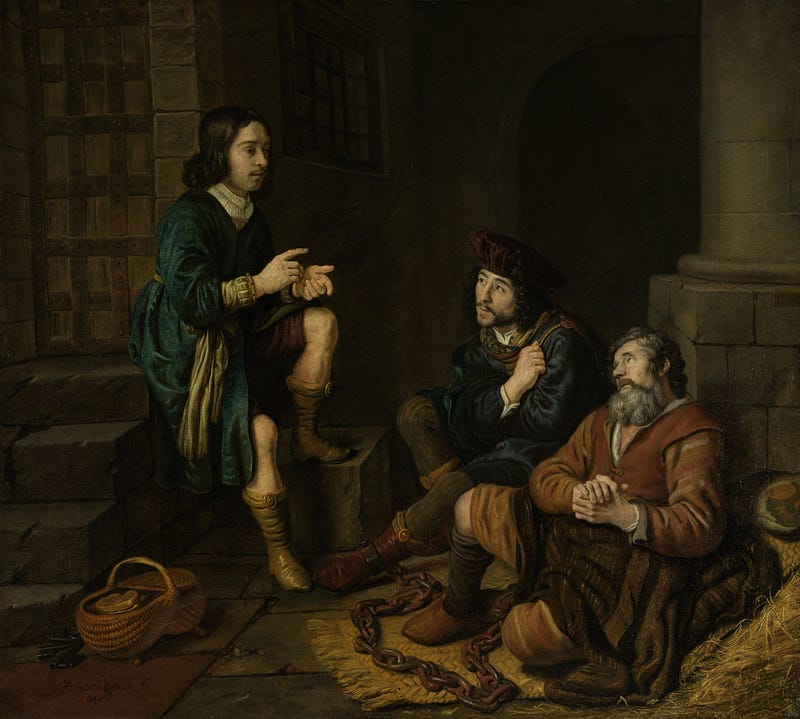

Genesis 40:1 Some time later, the cupbearer and the baker of the king of Egypt offended their master, the king of Egypt. 2 Pharaoh was angry with his two officials, the chief cupbearer and the chief baker, 3 and put them in custody in the house of the captain of the guard, in the same prison where Joseph was confined. 4 The captain of the guard assigned them to Joseph, and he attended them. After they had been in custody for some time, 5 each of the two men — the cupbearer and the baker of the king of Egypt, who were being held in prison — had a dream the same night, and each dream had a meaning of its own. 6 When Joseph came to them the next morning, he saw that they were dejected. 7 So he asked Pharaoh’s officials who were in custody with him in his master’s house, “Why are your faces so sad today?” 8 “We both had dreams,” they answered, “but there is no one to interpret them.” Then Joseph said to them, “Do not interpretations belong to God? Tell me your dreams.” 9 So the chief cupbearer told Joseph his dream. He said to him, “In my dream I saw a vine in front of me, 10 and on the vine were three branches. As soon as it budded, it blossomed, and its clusters ripened into grapes. 11 Pharaoh’s cup was in my hand, and I took the grapes, squeezed them into Pharaoh’s cup and put the cup in his hand.” 12 “This is what it means,” Joseph said to him. “The three branches are three days. 13 Within three days Pharaoh will lift up your head and restore you to your position, and you will put Pharaoh’s cup in his hand, just as you used to do when you were his cupbearer. 14 But when all goes well with you, remember me and show me kindness; mention me to Pharaoh and get me out of this prison. 15 For I was forcibly carried off from the land of the Hebrews, and even here I have done nothing to deserve being put in a dungeon.” 16 When the chief baker saw that Joseph had given a favorable interpretation, he said to Joseph, “I too had a dream: On my head were three baskets of bread. 17 In the top basket were all kinds of baked goods for Pharaoh, but the birds were eating them out of the basket on my head.” 18 “This is what it means,” Joseph said. “The three baskets are three days. 19 Within three days Pharaoh will lift off your head and hang you on a tree. And the birds will eat away your flesh.” 20 Now the third day was Pharaoh’s birthday, and he gave a feast for all his officials. He lifted up the heads of the chief cupbearer and the chief baker in the presence of his officials: 21 He restored the chief cupbearer to his position, so that he once again put the cup into Pharaoh’s hand, 22 but he hanged the chief baker, just as Joseph had said to them in his interpretation. (Gen 40:1–22 NIV)
The point here is apparently the Pharaoh was poisoned, and there were only two suspects, the chief cupbearer and the chief baker. Poison bread or poison wine. It was soon determined that it was the bread that had poisoned the Pharaoh.
Gideon and the Loaf
Bread could serve as a military weapon as well. This brings us to the peculiar story of Gideon from the Old Testament book of Judges.
9 During that night the LORD said to Gideon, “Get up, go down against the camp, because I am going to give it into your hands. 10 If you are afraid to attack, go down to the camp with your servant Purah 11 and listen to what they are saying. Afterward, you will be encouraged to attack the camp.” So he and Purah his servant went down to the outposts of the camp. 12 The Midianites, the Amalekites and all the other eastern peoples had settled in the valley, thick as locusts. Their camels could no more be counted than the sand on the seashore. 13 Gideon arrived just as a man was telling a friend his dream. “I had a dream,” he was saying. “A round loaf of barley bread came tumbling into the Midianite camp. It struck the tent with such force that the tent overturned and collapsed.” 14 His friend responded, “This can be nothing other than the sword of Gideon son of Joash, the Israelite. God has given the Midianites and the whole camp into his hands.” (Jdg 7:9–14 NIV)
Gideon is the leader of the army of Israel, which is about to battle the Midian army. He is sneaking around the enemy’s camp when he hears the soldiers discuss the dream of a barley loaf that rolled into the Midian camp and hit a tent, knocking it over. From this dream, Gideon knows that his army will win the battle. This is especially interesting, given what he had been up to a few days earlier.
11 The angel of the LORD came and sat down under the oak in Ophrah that belonged to Joash the Abiezrite, where his son Gideon was threshing wheat in a winepress to keep it from the Midianites. (Jdg 6:11 NIV)
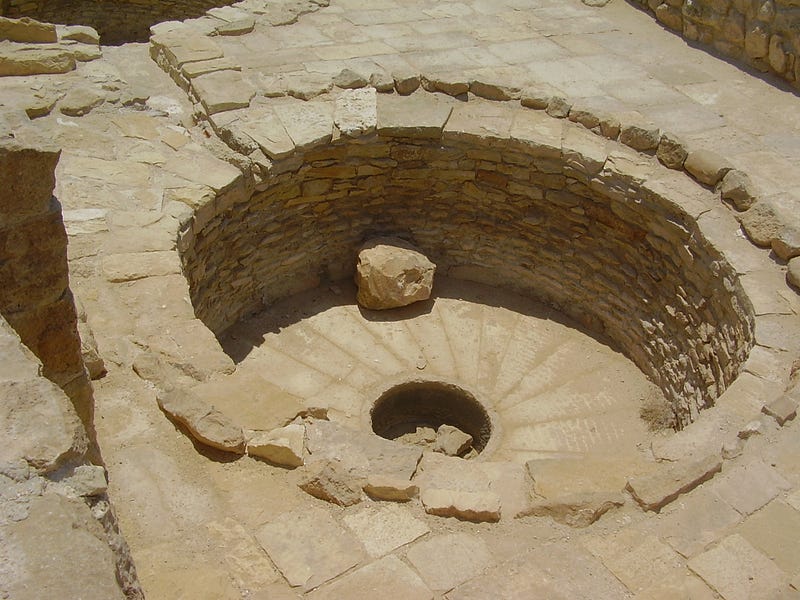

While a threshing floor is a wide round paved area, a winepress is a pit that is dug several feet in the ground. Gideon is using the winepress as a threshing floor so that the Midianites will not be able to see what he is doing. Then, while speaking to an angel of the Lord, he makes the following deal.
36 Gideon said to God, “If you will save Israel by my hand as you have promised — 37 look, I will place a wool fleece on the threshing floor. If there is dew only on the fleece and all the ground is dry, then I will know that you will save Israel by my hand, as you said.” 38 And that is what happened. Gideon rose early the next day; he squeezed the fleece and wrung out the dew — a bowlful of water. 39 Then Gideon said to God, “Do not be angry with me. Let me make just one more request. Allow me one more test with the fleece. This time make the fleece dry and the ground covered with dew.” 40 That night God did so. Only the fleece was dry; all the ground was covered with dew. (Jdg 6:36–40 NIV)
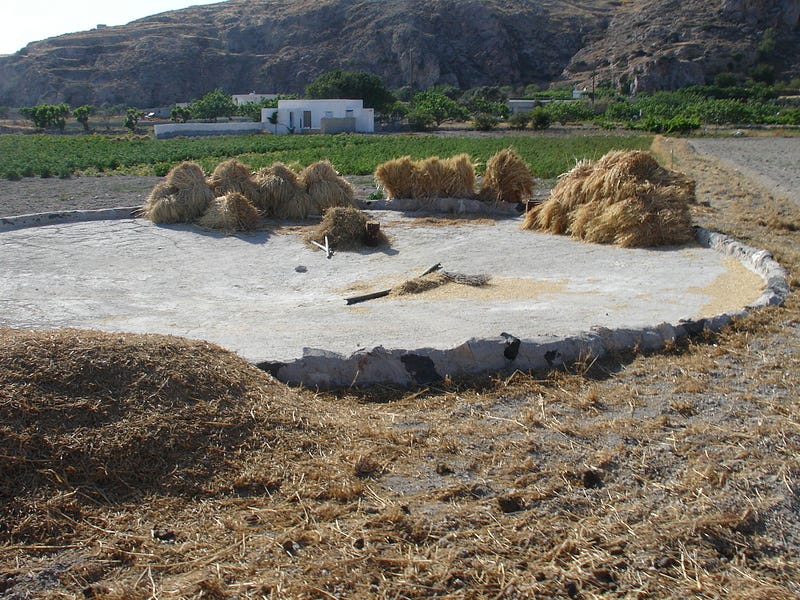

In the above section, we see Gideon spreading wool fleece on the threshing floor. Threshing is usually done on a flat paved area in the open air so that the wind can blow away the chaff. However, in this instance, as mentioned above, Gideon’s threshing floor is in a winepress pit.
He has covered the floor of the winepress with wool fleece, with the understanding that if the fleece is wet from the dew, but the ground is dry, then God has given a sign, but wait, Gideon wants another sign, the next night, he wants God to make it so that the fleece is dry, but that the ground around is wet with dew.
God complies, and Gideon prepares for battle.
My understanding of this is that one component is not mentioned, mainly grain in need of threshing. What I see happening here is Gideon puts wool fleece over the floor, which is first covered in unprocessed grain. Then, most probably, Gideon wets the fleece himself with a bowlful of water.
The next night he repeats the process except that he wets the ground surrounding the winepress pit while covering the unprocessed grain on the floor of the winepress with dry wool fleece.
These actions would create a damp but not too damp environment seemingly designed to facilitate the growth of the ergot fungus Claviceps purpurea on the unprocessed grains.
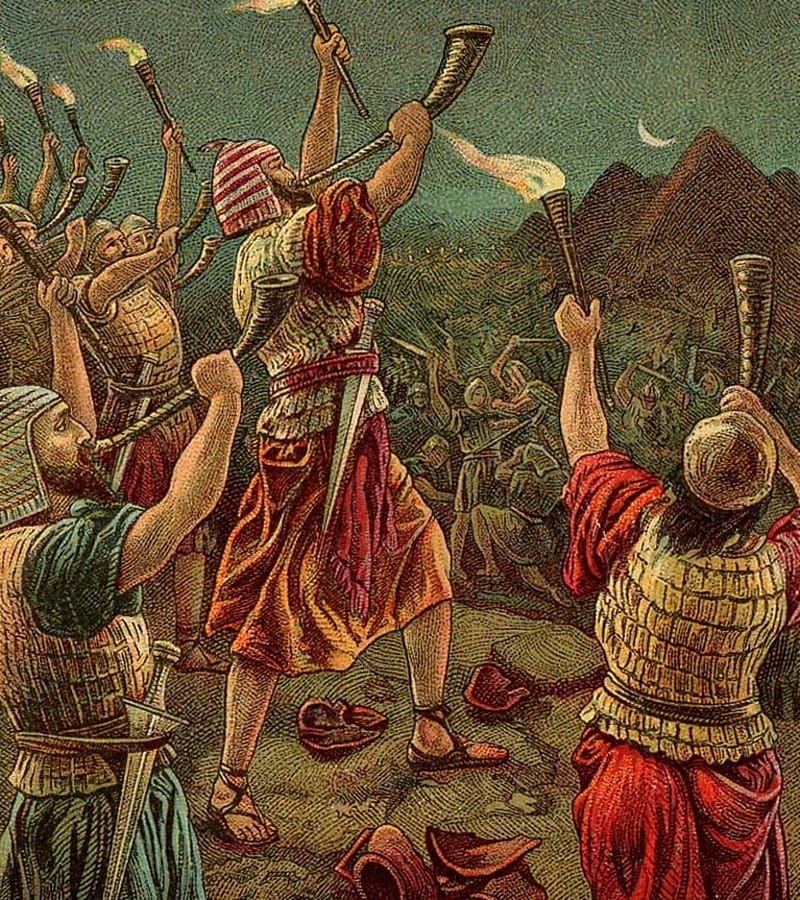
16 Dividing the three hundred men into three companies, he placed trumpets and empty jars in the hands of all of them, with torches inside. 17 “Watch me,” he told them. “Follow my lead. When I get to the edge of the camp, do exactly as I do. 18 When I and all who are with me blow our trumpets, then from all around the camp blow yours and shout, ‘For the LORD and for Gideon.’ “ (Jdg 7:16–18 NIV)
Each man has a trumpet (shofar) and an empty jar with a torch hidden inside.
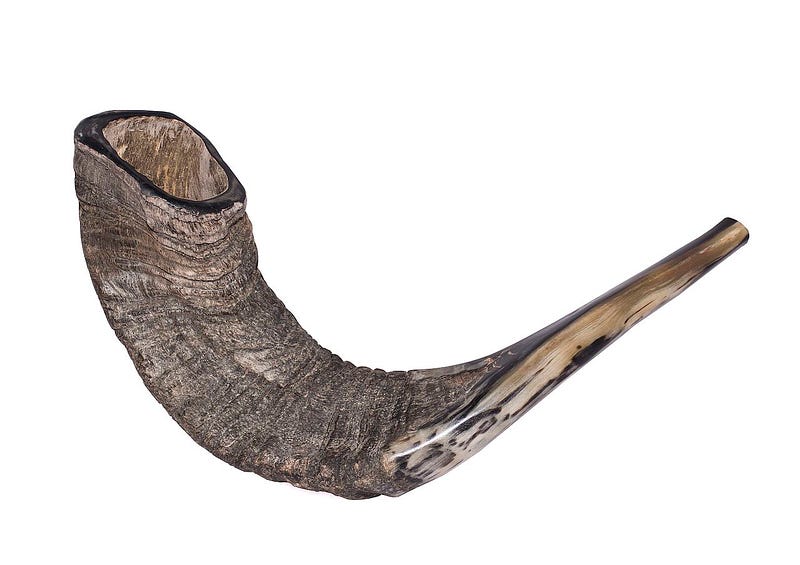

However, suppose that each shofar was packed full of ergot-tainted flour. At the signal, the horn blowers take up their shofars and blow. The dust moves over the camp, entering the enemy soldiers' lungs as they breathe in the night air suddenly alive with the sound of trumpets.
19 Gideon and the hundred men with him reached the edge of the camp at the beginning of the middle watch, just after they had changed the guard. They blew their trumpets and broke the jars that were in their hands. 20 The three companies blew the trumpets and smashed the jars. Grasping the torches in their left hands and holding in their right hands the trumpets they were to blow, they shouted, “A sword for the LORD and for Gideon!” 21 While each man held his position around the camp, all the Midianites ran, crying out as they fled. 22 When the three hundred trumpets sounded, the LORD caused the men throughout the camp to turn on each other with their swords. (Jdg 7:19–22 NIV)
The Midianite soldiers in the camp attacked one another with their swords. They panicked and the powerful hallucinogen inhaled into their lungs did the rest. Naturally, there is the question of how long the effects would take to become manifest, and a certain level of exaggeration and dramatization is to be expected. Still, clearly, some form of chemical weapon is being described cryptically.
This then brings us back to Jesus warning his disciples about the leaven of the Pharisees, which connects to David acting like a madman after eating some of the holy bread.
Beware of the leaven of the Pharisees and the Sadducees. Leaven is yeast. Yeast is a fungus. Claviceps purpurea is also a fungus.
So the leaven that Jesus is warning his disciples about is not normal leaven, nor is it the teachings of the Pharisees and Sadducees. Actually, it is a poisonous fungus with the ability to suppress hunger, as well as induce hallucinations and mass-panic.