
Mask of a Fallen Angel
Identifying the other father of Jesus
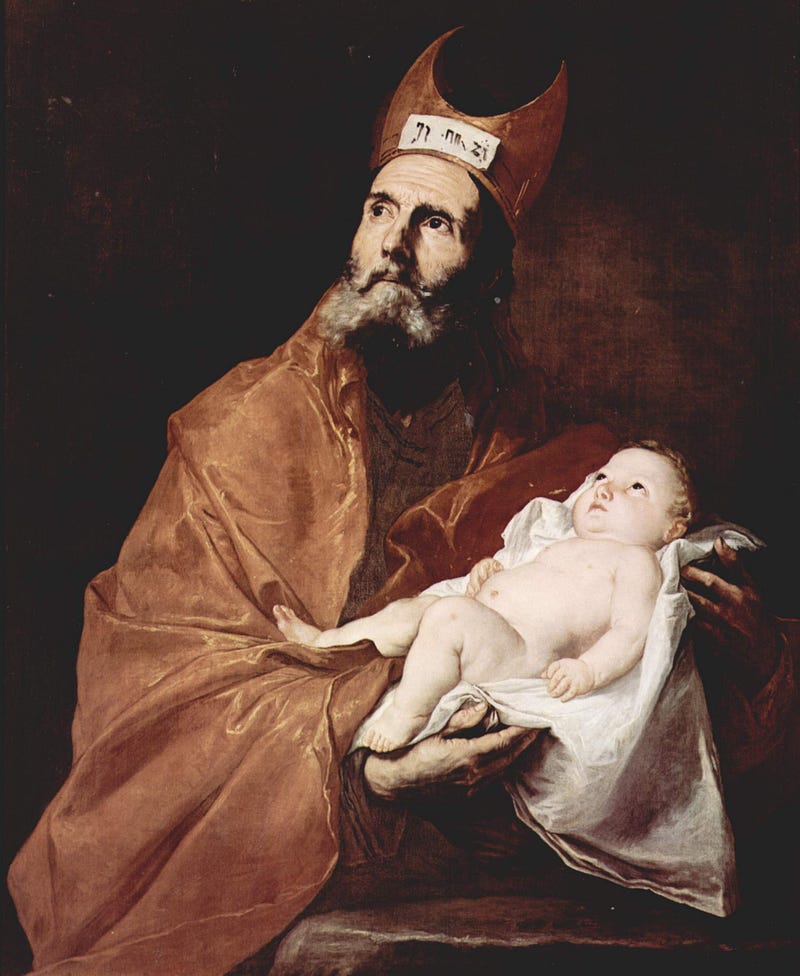

My Father The master [would] not have said, “My [father who is] in heaven,” if [he] did not also have another father. He would simply have said, “[My father].”
This comes from Marvin Meyer’s translation of the Gospel of Philip, a Valentinian text discovered as part of the Nag Hammadi library.
The suggestion is that Jesus may have had an unacknowledged biological father.
Panthera
Celsus, a second-century Greek philosopher, wrote that Jesus was fathered by a Roman soldier named Panthera. We only know of this claim because Origen wrote in response:
Let us return, however, to the words put into the mouth of the Jew, where “the mother of Jesus” is described as having been “turned out by the carpenter who was betrothed to her, as she had been convicted of adultery and had a child by a certain soldier named Panthera”.¹
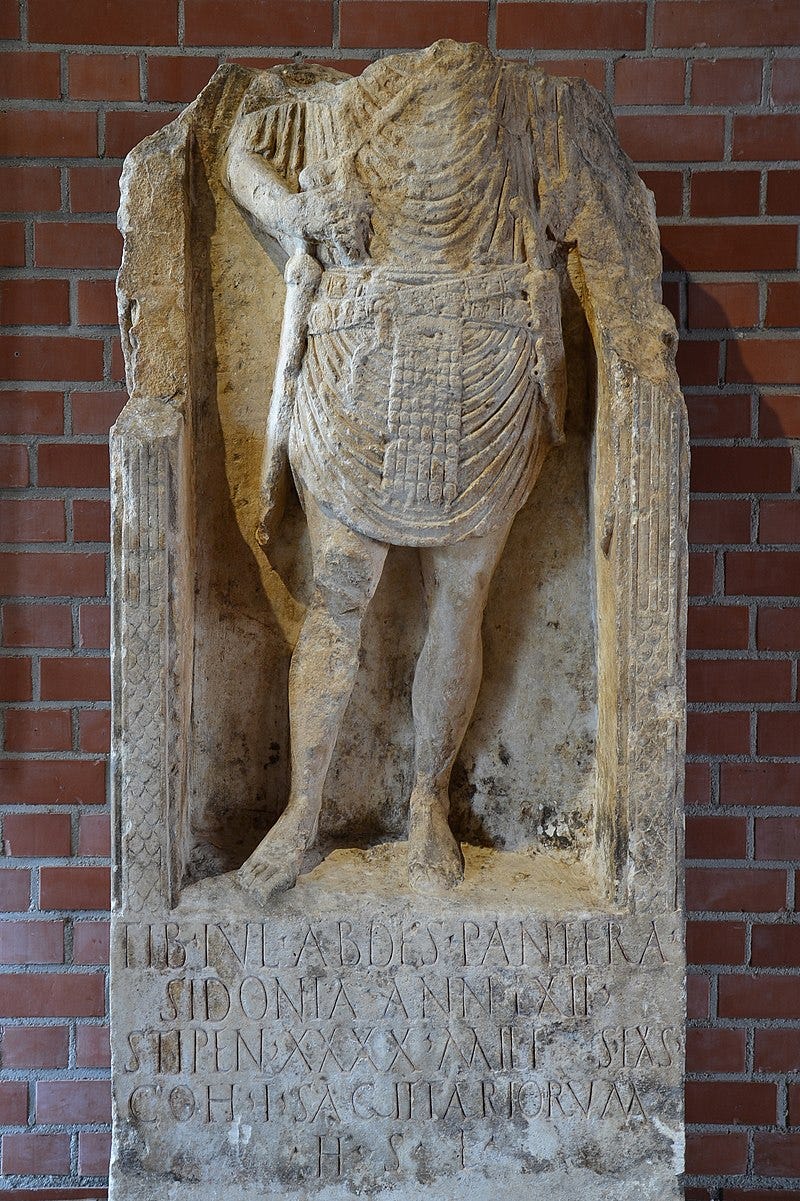

The story is also found in the Talmud, along with numerous other insults concerning the parentage of Jesus. This was likely just anti-Christian propaganda. It is doubtful that the author of Philip had Panthera in mind when he wrote the text about Jesus having another father.
I should explain that the Gospel of Philip was designed to unlock layers of meaning symbolically encoded into the narrative of the synoptic Gospels as well as other Biblical and extra-Biblical texts. Or, at least, that’s how I see it.
We need to keep our focus on the texts that the author of Philip was clearly familiar with, such as the Infancy Gospel of James, or even better, the Gospels themselves.
In His Father’s House
41 Every year his parents went to Jerusalem for the Feast of the Passover. 42 When he was twelve years old, they went up to the Feast, according to the custom. 43 After the Feast was over, while his parents were returning home, the boy Jesus stayed behind in Jerusalem, but they were unaware of it. 44 Thinking he was in their company, they traveled on for a day. Then they began looking for him among their relatives and friends. 45 When they did not find him, they went back to Jerusalem to look for him. 46 After three days they found him in the temple courts, sitting among the teachers, listening to them and asking them questions. 47 Everyone who heard him was amazed at his understanding and his answers. 48 When his parents saw him, they were astonished. His mother said to him, “Son, why have you treated us like this? Your father and I have been anxiously searching for you.” 49 “Why were you searching for me?” he asked. “Didn’t you know I had to be in my Father’s house?” 50 But they did not understand what he was saying to them. (Luk 2:41–50 NIV)
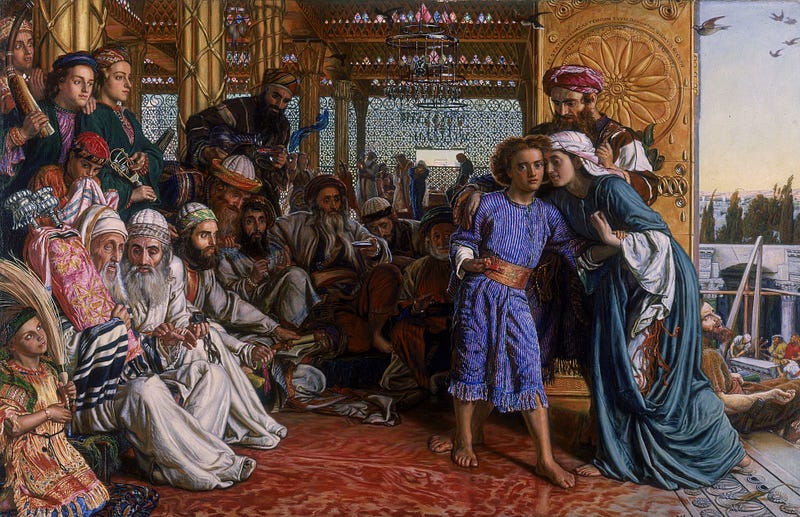

Above we have the well-known story of Jesus who went missing in Jerusalem. After searching for three days they find him in the temple courts, discussing with the teachers. When asked why he would do this to his family, he replies that they should have known he would be in his father’s house. His parents shrug off his comment as being incomprehensible.
The traditional way of understanding Jesus’ reply is that he is referring to God the father. His parents should have realized that he would be in God’s house. But his parents didn’t get it, just like the disciples never understand what Jesus is trying to tell them.
When we look at this story after reading about the possibility of another father hidden in the narrative, the meaning shifts. Rather than referring to the temple being God’s house, Jesus may have meant instead that his father was a priest in the temple where Jesus was found.
Earlier in this chapter, there was mention of the family visiting the temple in Jerusalem when Jesus was a baby. There was a man at the temple, who, while not explicitly identified as a priest, does take baby Jesus in his arm and bless him.
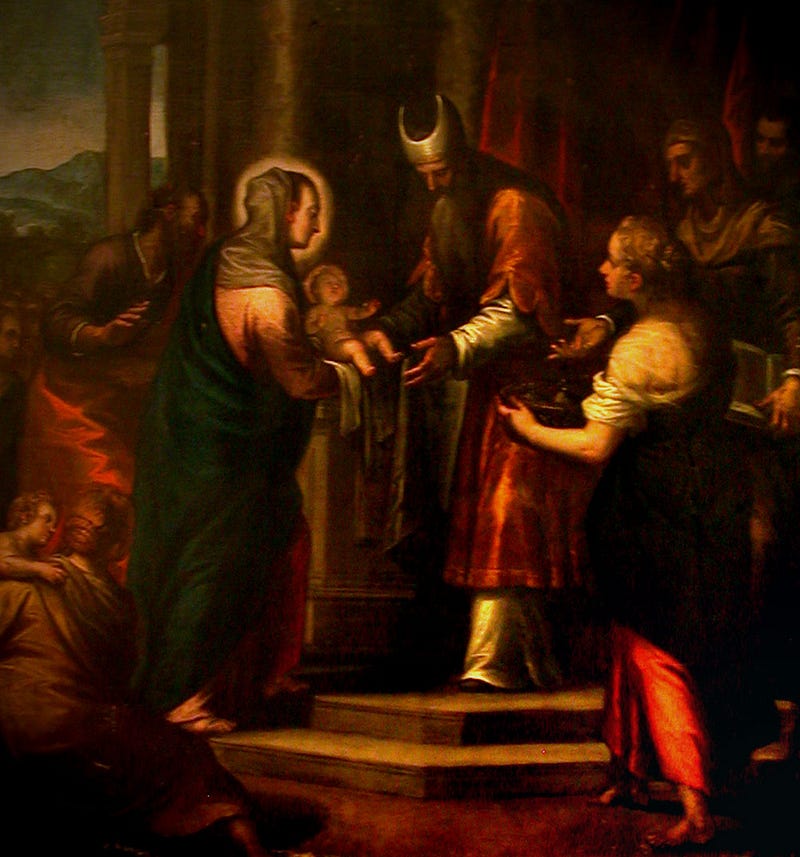

25 Now there was a man in Jerusalem called Simeon, who was righteous and devout. He was waiting for the consolation of Israel, and the Holy Spirit was upon him. 26 It had been revealed to him by the Holy Spirit that he would not die before he had seen the Lord’s Christ. 27 Moved by the Spirit, he went into the temple courts. When the parents brought in the child Jesus to do for him what the custom of the Law required, 28 Simeon took him in his arms and praised God, saying: 29 “Sovereign Lord, as you have promised, you now dismiss your servant in peace. 30 For my eyes have seen your salvation, 31 which you have prepared in the sight of all people, 32 a light for revelation to the Gentiles and for glory to your people Israel.” 33 The child’s father and mother marveled at what was said about him. 34 Then Simeon blessed them and said to Mary, his mother: “This child is destined to cause the falling and rising of many in Israel, and to be a sign that will be spoken against, 35 so that the thoughts of many hearts will be revealed. And a sword will pierce your own soul too.” (Luk 2:25–35 NIV)
Simeon performs the actions of a priest, and it seems possible that this is a clue as to the identity of the father of Jesus, this priest named Simeon. Still, we will need more evidence before we can be certain that this is who Philip had in mind.
Judith, Daughter of Simeon
In an earlier article, I posted some sections from the Protoevangelium of James. This apocryphal text is supposedly an account of what took place before the birth of Jesus, and even before that of Mary.
The following section is about Anne, the future mother of Mary. She is mourning the fact that her husband has gone into the wilderness and has sworn that he will neither eat nor drink until God pays him a visit, which almost certainly means he is going to die, and she mourns her inability to have children, which is what drove her husband to such extreme measures.
2. And his wife Anna mourned in two mournings, and lamented in two lamentations, saying: I shall bewail my widowhood; I shall bewail my childlessness. And the great day of the Lord was at hand; and Judith her maid-servant said: How long dost thou humiliate thy soul? Behold, the great day of the Lord is at hand, and it is unlawful for thee to mourn. But take this head-band, which the woman that made it gave to me; for it is not proper that I should wear it, because I am a maid-servant, and it has a royal appearance. And Anna said: Depart from me; for I have not done such things, and the Lord has brought me very low. I fear that some wicked person has given it to thee, and thou hast come to make me a sharer in thy sin. And Judith said: Why should I curse thee, seeing that the Lord hath shut thy womb, so as not to give thee fruit in Israel? And Anna was grieved exceedingly, and put off her garments of mourning, and cleaned her head, and put on her wedding garments, and about the ninth hour went down to the garden to walk. And she saw a laurel, and sat under it, and prayed to the Lord, saying: O God of our fathers, bless me and hear my prayer, as Thou didst bless the womb of Sarah, and didst give her a son Isaac.
Her handmaiden gives her a headband that likely had something to do with a goddess worshipping cult, and a ritual for drawing down an angel for breeding. This was all covered in the article mentioned above.
Our interest now is in Anne’s handmaid. She is identified as Judith. This name is not just randomly chosen. Every aspect of the story has been carefully designed to convey information to those able to decode the meaning.
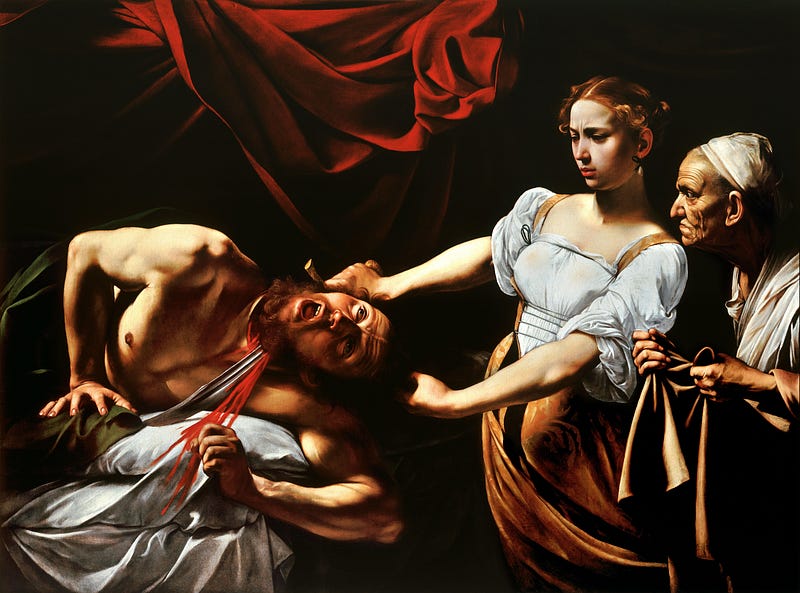
The Book of Judith is an apocryphal, deuterocanonical book included within the Septuagint and the Catholic Bible. It tells the story of Judith, a widow, who, accompanied by her handmaiden, goes to the camp of the enemy. She promises to provide the Assyrian general, Holofernes, information about the Israelites. After she gains his trust, she is allowed into his tent one night where he has collapsed in a drunken stupor. She then beheads him and saves Israel.
.jpg)
Before going on her mission Judith does the following:
1 Judith fell upon her face, and put ashes upon her head, and uncovered the sackcloth wherewith she was clothed; and about the time that the incense of that evening was offered in Jerusalem in the house of the Lord Judith cried with a loud voice, and said, 2 O Lord God of my father Simeon, to whom thou gavest a sword to take vengeance of the strangers, who loosened the girdle of a maid to defile her, and discovered the thigh to her shame, and polluted her virginity to her reproach; for thou saidst, It shall not be so; and yet they did so. (Jdt 9:1–2 KJA)
She identifies herself as the daughter of Simeon.
Judith calls for vengeance by recalling the bloody actions of Simeon, when he and Levi slaughtered all the men of a city after one of its inhabitants, Shechem, raped Dinah, one of Simeon and Levi’s sisters. Judith seems to be claiming that she a member of the lost and scattered tribe of Simeon.
And now, we have Anne with her handmaiden named Judith who gives Anne a headband that brings down an angel identified as Gabriel. This angel seems to also possess the identity of a man named Simeon.
In the Bible, there are only four people identified as Simeon. The son of Jacob mentioned above. The man in the temple who blessed Jesus also mentioned above. Someone in the lineage of Jesus (Luke 3:30). Someone at the church in Antioch (Acts 13:1).
Could Simeon be Simon Peter?
Simeon however is just a variant form of Simon. How many Simons in the Bible? It turns out that there are nine, all in the New Testament. The most important Simon is, of course, Simon Peter.
Could the Gospel of Philip be suggesting that Simon Peter was somehow an angel in disguise, the same angel that fathered both Jesus and Mary?
To answer we need only consider one of the most intriguing sayings from the Gospel of Thomas:
(13) Jesus said to his disciples: Compare me, tell me whom I am like. Simon Peter said to him: You are like a righteous angel. Matthew said to him: You are like a wise philosopher. Thomas said to him: Master, my mouth is wholly incapable of saying whom you are like. Jesus said: I am not your master, for you have drunk, and have become drunk from the bubbling spring which I have caused to gush forth (?). And he took him, withdrew, (and) spoke to him three words. Now when Thomas came (back) to his companions, they asked him: What did Jesus say to you? Thomas said to them: If I tell you one of the words which he said to me, you will take up stones (and) throw them at me; and a fire will come out of the stones (and) burn you up.²
Many have set about trying to determine what the three words that Jesus tells Thomas are. We, however, are more interested in the different descriptions given of Jesus. There is a section from the Gospel of Philip which helps to explain the various descriptions. Below is Marvin Meyer’s translation.
Jesus Tricked Everyone Jesus tricked everyone, for he did not appear as he was, but he appeared so that he could be seen. He appeared to everyone. He [appeared] to the great as great, he [appeared] to the small as small, he [appeared to the] angels as an angel and to humans as a human. For this reason his word was hidden from everyone. Some looked at him and thought they saw themselves. But when he appeared to his disciples in glory upon the mountain, he was not small. He became great. Or rather, he made the disciples great, so they could see him in his greatness.
Jesus was like a mirror. When someone looked at Jesus they saw themselves. Matthew saw a wise philosopher. This is likely a reference to a text from the Nag Hammadi codex called The Book of Thomas the Contender. The book begins with the following, identifying the supposed author as Matthew.
The secret words that the savior spoke to Judas Thomas which I, even I, Mathaias, wrote down, while I was walking, listening to them speak with one another.³
The text has a decidedly Platonic feel, even including captives bound in caverns, which is surely enough to identify Matthew as a philosopher.
Thomas cannot find the words to describe Jesus because Thomas is the twin of Jesus. When Thomas looks at Jesus he sees a reflection of a reflection.


This leaves us with Simon Peter who sees Jesus as a righteous angel. Simon is an angel, though he may not be all that righteous. The key is in the warning from Thomas:
Thomas said to them: If I tell you one of the words which he said to me, you will take up stones (and) throw them at me; and a fire will come out of the stones (and) burn you up.
Firey stones and people being burned up, where have I read something like that?
13 You were in Eden, the garden of God; every precious stone adorned you: ruby, topaz and emerald, chrysolite, onyx and jasper, sapphire, turquoise and beryl. Your settings and mountings were made of gold; on the day you were created they were prepared. 14 You were anointed as a guardian cherub, for so I ordained you. You were on the holy mount of God; you walked among the fiery stones. 15 You were blameless in your ways from the day you were created till wickedness was found in you. 16 Through your widespread trade you were filled with violence, and you sinned. So I drove you in disgrace from the mount of God, and I expelled you, O guardian cherub, from among the fiery stones. 17 Your heart became proud on account of your beauty, and you corrupted your wisdom because of your splendor. So I threw you to the earth; I made a spectacle of you before kings. 18 By your many sins and dishonest trade you have desecrated your sanctuaries. So I made a fire come out from you, and it consumed you, and I reduced you to ashes on the ground in the sight of all who were watching. (Eze 28:13–18 NIV)
The details are slightly skewed as veiled references must be if they are to remain veiled. Still, the connection to Simon Peter, an angel concealing his angelic nature and interfering in the world of men, is clear.
Let us look through the Gospels and see if there are any episodes that profit from reexamination in light of this revelation.
24 After Jesus and his disciples arrived in Capernaum, the collectors of the two-drachma tax came to Peter and asked, “Doesn’t your teacher pay the temple tax?” 25 “Yes, he does,” he replied. When Peter came into the house, Jesus was the first to speak. “What do you think, Simon?” he asked. “From whom do the kings of the earth collect duty and taxes — from their own sons or from others?” 26 “From others,” Peter answered. “Then the sons are exempt,” Jesus said to him. 27 “But so that we may not offend them, go to the lake and throw out your line. Take the first fish you catch; open its mouth and you will find a four-drachma coin. Take it and give it to them for my tax and yours.” (Mat 17:24–27 NIV)
Note the irony. Peter has come to get the money to pay the tax from Jesus. Jesus asks Simon if the kings of the earth collect taxes and fees from their own sons. Peter answers in the negative. Yet, secretly, Simon is the father of Jesus. Jesus is making the point that a real king wouldn’t bother his son with the need to pay a tax. Simon is told in symbolic form to take care of the taxes and fees himself and not bother Jesus with such unimportant matters.
Simon as the Adversary
31 He then began to teach them that the Son of Man must suffer many things and be rejected by the elders, chief priests and teachers and that he must be killed and after three days rise again. 32 He spoke plainly about this, and Peter took him aside and began to rebuke him. 33 But when Jesus turned and looked at his disciples, he rebuked Peter. “Get behind me, Satan!” he said. “You do not have in mind the things of God, but the things of men.” (Mar 8:31–33 NIV)
Both Mark and Matthew (16:21–23) have Jesus comparing Peter to Satan. While Simon Peter isn’t actually Satan, he is a fallen angel that is interfering in the world of men. Notice the closing line. The angel does not have in mind the things of God, but the things of men.
Father is Thirsty
.jpg)
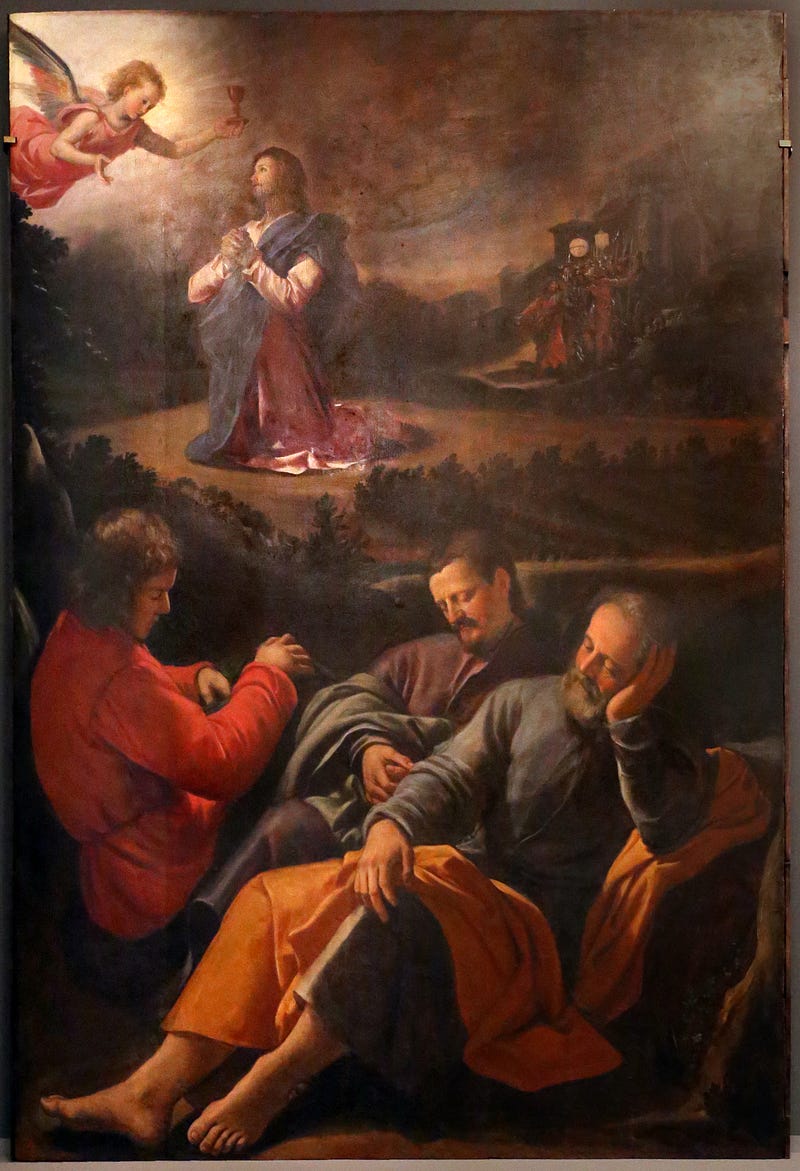
32 They went to a place called Gethsemane, and Jesus said to his disciples, “Sit here while I pray.” 33 He took Peter, James and John along with him, and he began to be deeply distressed and troubled. 34 “My soul is overwhelmed with sorrow to the point of death,” he said to them. “Stay here and keep watch.” 35 Going a little farther, he fell to the ground and prayed that if possible the hour might pass from him. 36 “Abba, Father,” he said, “everything is possible for you. Take this cup from me. Yet not what I will, but what you will.” 37 Then he returned to his disciples and found them sleeping. “Simon,” he said to Peter, “are you asleep? Could you not keep watch for one hour? 38 Watch and pray so that you will not fall into temptation. The spirit is willing, but the body is weak.” 39 Once more he went away and prayed the same thing. 40 When he came back, he again found them sleeping, because their eyes were heavy. They did not know what to say to him. 41 Returning the third time, he said to them, “Are you still sleeping and resting? Enough! The hour has come. Look, the Son of Man is betrayed into the hands of sinners. (Mar 14:32–41 NIV)
Above we have Jesus at Gethsemane. He is with Peter, James, and John. They just had the last supper. Let us suppose that Jesus has brought a big old goblet of wine and maybe a half-eaten loaf of bread from the dinner.
36 “Abba, Father,” he said, “everything is possible for you. Take this cup from me. Yet not what I will, but what you will.” (Mar 14:36 NIV)
This can be understood in two ways. The traditional way, where he is asking God to save him from the painful fate that awaits him. However, there is also a different interpretation, where Jesus is talking to Peter and offering him a drink. Peter comes and takes the goblet of wine from Jesus.
37 Then he returned to his disciples and found them sleeping. “Simon,” he said to Peter, “are you asleep? Could you not keep watch for one hour? (Mar 14:37 NIV)
Then what does Jesus do?
39 Once more he went away and prayed the same thing. (Mar 14:39 NIV)
To pray the same thing means to tell Peter to take the wine, but only if Peter really wants. Clearly, Peter wants because:
40 When he came back, he again found them sleeping, because their eyes were heavy. They did not know what to say to him. (Mar 14:40 NIV)
The biggest difference between Mark and Matthew is that in Matthew, Jesus changes his prayer on the second go around.
42 He went away a second time and prayed, “My Father, if it is not possible for this cup to be taken away unless I drink it, may your will be done.” (Mat 26:42 NIV)
Essentially he is saying that if Peter insists that Jesus drinks from the goblet before Peter takes it away, then he’ll drink. So he drinks first and then passes the wine to Peter who then apparently shares it with James and John.
It should also be noted that the bread used during the last supper was likely bread made with ergot-tainted grain. So bread has the effect of waking one up, while wine has the opposite effect of putting one to sleep.
43 And he came and found them asleep again: for their eyes were heavy. 44 And he left them, and went away again, and prayed the third time, saying the same words. 45 Then cometh he to his disciples, and saith unto them, Sleep on now, and take your rest: behold, the hour is at hand, and the Son of man is betrayed into the hands of sinners. (Mat 26:43–45 KJV)
Every time Jesus asks his father to take the cup from him, Simon Peter turns up asleep.
There are additional episodes that solidify the identification of Simon Peter with a fallen angel that we will consider after we have covered some essential preliminary details.
- Patrick, John The Apology of Origen in Reply to Celsus 2009, pages 22–24.
- Blatz, B., The Coptic Gospel of Thomas, W. Schneemelcher, ed, New Testament Apocrypha, English translation by R. McL. Wilson, James Clarke & Co. Ltd.; Westminster/John Knox Press, Cambridge; Louisville, 1991, 110–133.
- Book of Thomas the Contender, translated by John D. Turner, a selection from James M. Robinson, ed., The Nag Hammadi Library, revised edition. HarperCollins, San Francisco, 1990.
Scriptures taken from the Holy Bible, New International Version®, NIV®. Copyright © 1973, 1978, 1984, 2011 by Biblica, Inc.™ Used by permission of Zondervan. All rights reserved worldwide. www.zondervan.com The “NIV” and “New International Version” are trademarks registered in the United States Patent and Trademark Office by Biblica, Inc.™