
Mary, the Lord’s Sister
Does Jesus have a sister named Mary?

A Sister Named Mary
Among the 52 early Christian and Gnostic texts discovered at Nag Hammadi in 1945, one of the most enigmatic is a Valentinian text called the Gospel of Philip. This is one of several “Gnostic” texts which puts a special emphasis on the relationship between Mary Magdalene and Jesus. One of the more obscure sections concerns three Marys who were always with Jesus.
Three Women Named Mary Three women always walked with the master: Mary his mother,
sister, and Mary of Magdala, who is called his companion. For “Mary” is the name of his sister, his mother, and his companion.
The word his in brackets is uncertain because of damage to the text but is repeated later in the text, so the reconstruction is likely correct. However, there is no record of Jesus having a sister named Mary.
3 Is not this the carpenter, the son of Mary, the brother of James, and Joses, and of Juda, and Simon? and are not his sisters here with us? And they were offended at him. (Mar 6:3 KJV)
Jesus had some unnamed sisters and it isn’t unusual for a mother to give her name to a daughter. Still, beyond the passage from Philip, there is no record of Jesus having a sister named Mary who was always with him.
I think that it is important for us to remember that these Valentinian texts, much like the Thomasine texts that preceded them, were designed as clues to be used when examining other Biblical and extra-biblical texts.
To understand what the Gospel of Philip was trying to tell us, we must go back to before the birth of Mary, the mother of Jesus. We’ll use the Roberts-Donaldson translation of the Protoevangelium of James. I’ll post some opening chapters and provide commentary.
IN THE RECORDS OF THE TWELVE TRIBES OF ISRAEL was Joachim, a man rich exceedingly; and he brought his offerings double, saying: There shall be of my superabundance to all the people, and there shall be the offering for my forgiveness to the Lord for a propitiation for me. For the great day of the Lord was at hand, and the sons of Israel were bringing their offerings. And there stood over against him Rubim, saying: It is not meet for thee first to bring thine offerings, because thou hast not made seed in Israel. And Joachim was exceedingly grieved, and went away to the registers of the twelve tribes of the people, saying: I shall see the registers of the twelve tribes of Israel, as to whether I alone have not made seed in Israel. And he searched, and found that all the righteous had raised up seed in Israel. And he called to mind the patriach Abraham, that in the last day God gave him a son Isaac. And Joachim was exceedingly grieved, and did not come into the presence of his wife; but he retired to the desert, and there pitched his tent, and fasted forty days and forty nights, saying in himself: I will not go down either for food or for drink until the Lord my God shall look upon me, and prayer shall be my food and drink.
Joachim is a rich man and he wanted to make his offering first because it was a real big offering and he felt that he deserved the honor of being first. He was refused the honor by Rubim, a variant of Reuben. Take careful note of the names used, because none are accidental. Reuben was the name of Jacob’s firstborn. Once again emphasizing that honor comes with being a father.
Joachim thinks back on Isaac, which makes little sense as Abraham had fathered Ishmael, the shame was Sarah’s and not Abraham’s. Clearly, Joachim was no expert on Judaism. He retreats into the wilderness and swears he won’t eat or drink until God pays him a visit.
2. And his wife Anna mourned in two mournings, and lamented in two lamentations, saying: I shall bewail my widowhood; I shall bewail my childlessness. And the great day of the Lord was at hand; and Judith her maid-servant said: How long dost thou humiliate thy soul? Behold, the great day of the Lord is at hand, and it is unlawful for thee to mourn.
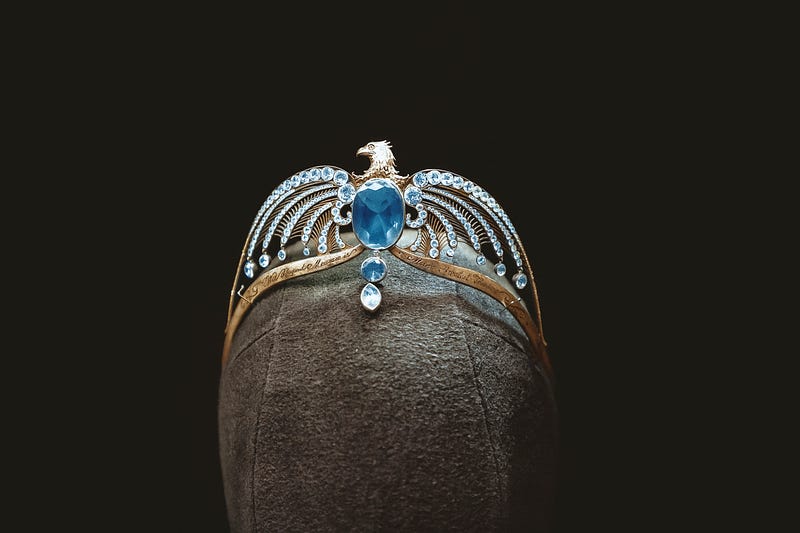
But take this head-band, which the woman that made it gave to me; for it is not proper that I should wear it, because I am a maid-servant, and it has a royal appearance. And Anna said: Depart from me; for I have not done such things, and the Lord has brought me very low. I fear that some wicked person has given it to thee, and thou hast come to make me a sharer in thy sin.
And Judith said: Why should I curse thee, seeing that the Lord hath shut thy womb, so as not to give thee fruit in Israel? And Anna was grieved exceedingly, and put off her garments of mourning, and cleaned her head, and put on her wedding garments, and about the ninth hour went down to the garden to walk. And she saw a laurel, and sat under it, and prayed to the Lord, saying: O God of our fathers, bless me and hear my prayer, as Thou didst bless the womb of Sarah, and didst give her a son Isaac.
Anna is devastated because she is both childless and a widow as her husband is fasting until he gets a visit from God, who is known for having a notoriously busy schedule. Then we see Judith, her handmaid, try to give her a really sweet-looking headband. Judith claims that she can’t wear it herself because she is a servant, but Anna reacts very suspiciously as though Judith is conspiring with others to trick Anna into doing something sinful.
I suspect that Anna had at one time been a follower of the goddess Ashteroth and that her marriage to Joachim had supposedly signaled the end of her involvement with the group. She had hoped to live the rest of her life with this secret forgotten. Yet here was her handmaid giving her a headband that the priestesses of the goddess wear while calling down a Son of God.
Then Judith reminds her that she is childless, so what does she have to lose? Anna then cleans herself up, dresses in her wedding dress, and sits beneath a laurel tree praying that God will do for her what he did for Sarah.
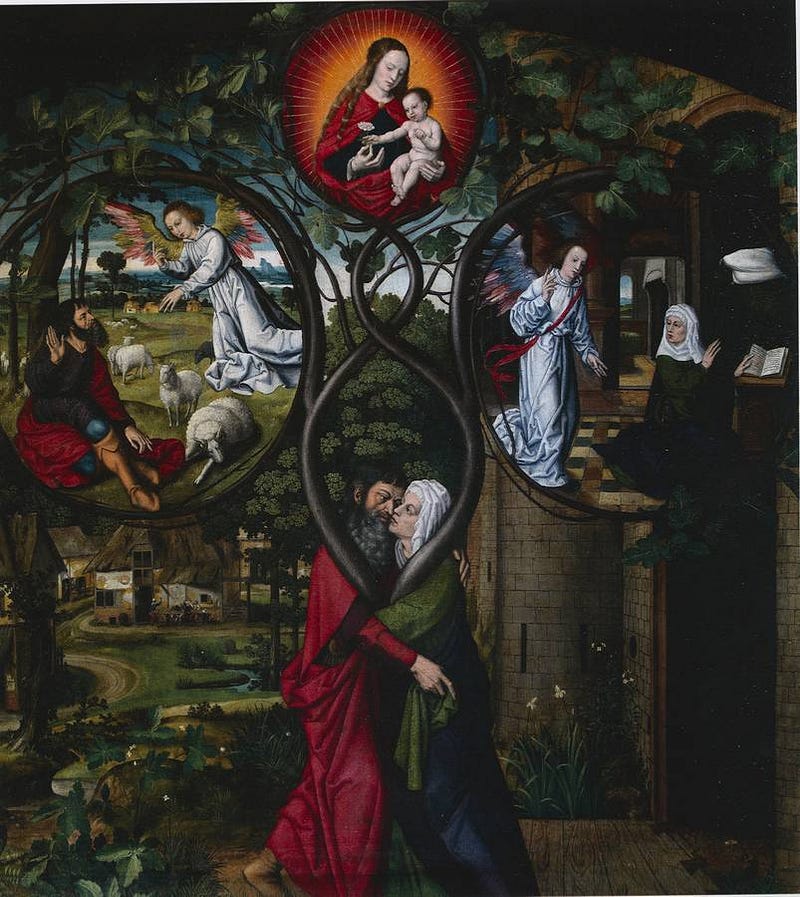
4. And, behold, an angel of the Lord stood by, saying: Anna, Anna, the Lord hath heard thy prayer, and thou shalt conceive, and shall bring forth; and thy seed shall be spoken of in all the world. And Anna said: As the Lord my God liveth, if I beget either male or female, I will bring it as a gift to the Lord my God; and it shall minister to Him in holy things all the days of its life.
_-_Conception_of_the_Virgin.jpg)
And, behold, two angels came, saying to her: Behold, Joachim thy husband is coming with his flocks. For an angel of the Lord went down to him, saying: Joachim, Joachim, the Lord God hath heard thy prayer Go down hence; for, behold, thy wife Anna shall conceive. And Joachim went down and called his shepherds, saying: Bring me hither ten she-lambs without spot or blemish, and they shall be for the Lord my God; and bring me twelve tender calves, and they shall be for the priests and the elders; and a hundred goats for all the people. And, behold, Joachim came with his flocks; and Anna stood by the gate, and saw Joachim coming, and she ran and hung upon his neck, saying: Now I know that the Lord God hath blessed me exceedingly; for, behold the widow no longer a widow, and I the childless shall conceive. And Joachim rested the first day in his house.
An angel arrives and informs her that she will conceive. And then an angel also informed Joachim, who is now on his way back from the wilderness with a huge offering. Anna is joyous because she is no longer a widow and she soon she will conceive.
Nine months later, Anna gives birth to a daughter who she names Mary.
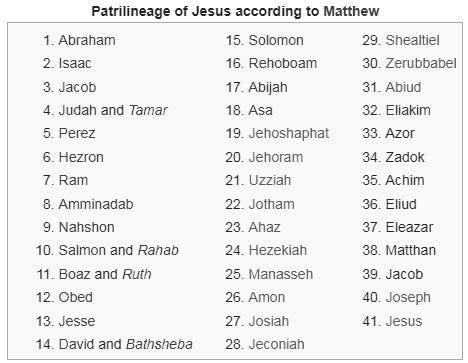
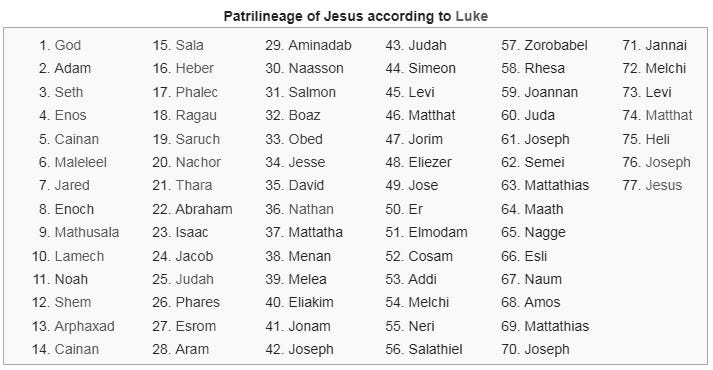
When we look at the genealogies of Jesus found in Matthew and Luke we see that they don’t agree. The theory that I subscribe to is that Matthew shows the line of Joseph while Luke shows the line of Mary.
23 And Jesus himself began to be about thirty years of age, being (as was supposed) the son of Joseph, which was the son of Heli, … (Luk 3:23 KJV)
Note how Joseph is identified as the man believed to be the father of Jesus, and then we get the supposed genealogy of Joseph, whose father is identified as Heli. If this genealogy is actually Mary’s then Heli would be her father.
From Joachim to Heli in Four Easy Steps
In the Protoevangelium of James, the father of Mary is identified as Joachim. Joachim is another form of the name Eliakim. Eli is the short form of Eliakim. Heli is a variation of Eli. A more thorough explanation can be found here.
It seems that the author of the Protoevangelium took pains to conform to Luke’s genealogy while not being too obvious about it.
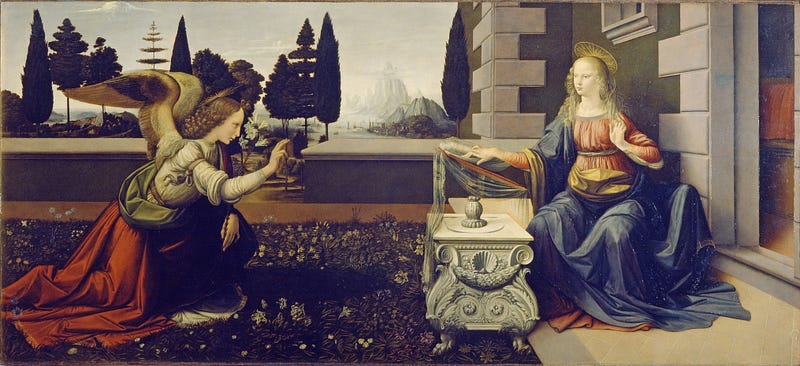
Anna is approached by an angel after she dresses in her wedding gown and prays beneath a laurel tree. Later her daughter Mary is approached by an angel and told that she too would conceive a child of great importance.
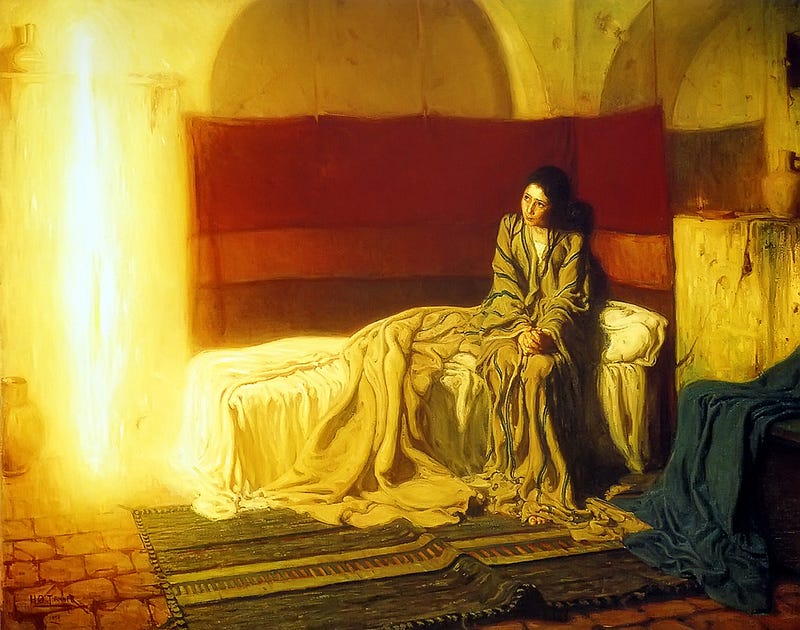

My view is that both Anna and Mary were made pregnant by the same angel.
26 In the sixth month, God sent the angel Gabriel to Nazareth, a town in Galilee, 27 to a virgin pledged to be married to a man named Joseph, a descendant of David. The virgin’s name was Mary. (Luk 1:26–27 NIV)
He is identified as the archangel Gabriel. There is mention of another archangel in Luke connected to the story of Mary and baby Jesus. It involves another Anna.
36 There was also a prophetess, Anna, the daughter of Phanuel, of the tribe of Asher. She was very old; she had lived with her husband seven years after her marriage, 37 and then was a widow until she was eighty-four. She never left the temple but worshiped night and day, fasting and praying. (Luk 2:36–37 NIV)
Anna, a prophetess, is described as the daughter of Phanuel. I prefer to read that as a daughter of Phanuel. The name Phanuel occurs only once in the New Testament and it means Face of God in Hebrew. It does however occur in the Book of Enoch and is the name of the fourth angel that stands before God after Michael, Raphael, and Gabriel.
XL The Four Archangels CHAPTER XL 1. And after that I saw thousands of thousands and ten thousand times ten thousand, I saw a multitude beyond number and reckoning, who stood before the Lord of Spirits. 2. And on the four sides of the Lord of Spirits I saw four presences, different from those that sleep not, and I learnt their names: for the angel that went with me made known to me their names, and showed me all the hidden things. 3. And I heard the voices of those four presences as they uttered praises before the Lord of glory. 4. The first voice blesses the Lord of Spirits for ever and ever. 5. And the second voice I heard blessing the Elect One and the elect ones who hang upon the Lord of Spirits. 6. And the third voice I heard pray and intercede for those who dwell on the earth and supplicate in the name of the Lord of Spirits. 7. And I heard the fourth voice fending off the Satans and forbidding them to come before the Lord of Spirits to accuse them who dwell on the earth. 8. After that I asked the angel of peace who went with me, who showed me everything that is hidden: ‘Who are these four presences which I have seen and whose words I have heard and written down?’ 9. And he said to me: ‘This first is Michael, the merciful and long-suffering: and the second, who is set over all the diseases and all the wounds of the children of men, is Raphael: and the third, who is set over all the powers, is Gabriel: and the fourth, who is set over the repentance unto hope of those who inherit eternal life, is named Phanuel.’ And these are the four angels of the Lord of Spirits and the four voices I heard in those days.
As I understand the text, Anna, the prophetess, is a Daughter of Phanuel, meaning that she came from a line of women bred from the seed of the archangel Phanuel. Phanuel had previously donated genetic material to a breeding project managed by the followers of the goddess Ashteroth. Just as Gabriel has been coaxed into doing so by Anna.
This means that Mary and any female descendants she might have would be Daughters of Gabriel.
Let us return to the topic of this article.

Does Jesus Have a Sister Named Mary?
Yes, according to this view, He does. It seems that Jesus and Mary share the same father, the archangel Gabriel. This makes Mary both the mother and sister of Jesus. That, at least, seems to be the implication that the Gospel of Philip is hinting at. One that requires knowledge of the Protoevangelum of James, an influential second-century apocryphal text that served as the primary source for Mariology, the theological study of Mary, the mother of Jesus.
To review, from the Gospel of Philip:
Three Women Named Mary Three women always walked with the master: Mary his mother,
sister, and Mary of Magdala, who is called his companion. For “Mary” is the name of his sister, his mother, and his companion.
Still, if this claim is to be taken at face value, that the three Marys always walked with Him, then that conflicts with a well-known episode from the Gospels.
31 Then Jesus’ mother and brothers arrived. Standing outside, they sent someone in to call him. (Mar 3:31 NIV)
If Jesus’ mother is outside with his brothers asking someone to summon Jesus, then she clearly can’t be said to have always walked with him. Let’s see the Gospel of Philip weasel its way out of this one. Next time.
Scriptures taken from the Holy Bible, New International Version®, NIV®. Copyright © 1973, 1978, 1984, 2011 by Biblica, Inc.™ Used by permission of Zondervan. All rights reserved worldwide. www.zondervan.com The “NIV” and “New International Version” are trademarks registered in the United States Patent and Trademark Office by Biblica, Inc.™