avatarTimothy James Lambert

Free AI web copilot to create summaries, insights and extended knowledge, download it at here

6679

Abstract

d type of seed. That was the fault of an enemy who sowed the bad seed while everyone was sleeping.</p><p id="d03d">And we might be tempted to leave it there. Only that doesn't seem revelatory enough. Why would the <i>Gospel of Thomas</i> have a parallel to this parable if that is the extent of its significance?</p><p id="c713">There must be something more. What was the name of that weed?</p><p id="9604">The Greek word is <i>zizanion. </i>It is translated as <i>darnel, </i>which is a kind of weed that resembles wheat. Its Latin name is <i>Lolium temulentum. Lolium </i>indicates that it is a member of the ryegrass family. <i>Temulentus</i> is the word for being <b>drunken </b>or <b>intoxicated</b>.</p><figure id="7fe5"><img src="https://cdn-images-1.readmedium.com/v2/resize:fit:800/1*SN1l3UyTu1Si2mpfrrzVQg.jpeg"><figcaption>Satan Sowing Tares —<a href="https://commons.wikimedia.org/wiki/File:Master_of_the_Prodigal_Son_-_Satan_Sowing_Tares.jpg"> Image Credit</a></figcaption></figure><p id="8184">It turns out that darnel is wheat’s intoxicating twin. Studies have shown that it owes its mind-altering and physically debilitating properties due to a fungus that lives within the plant that is related to the ergot organism <i>Claviceps purpurea.</i></p><p id="0459">I dealt with the topic of ergot poisoning in the pieces below:</p><div id="8c9d" class="link-block"> <a href="https://readmedium.com/the-secret-to-feeding-five-thousand-with-only-five-loaves-2e6267ce074"> <div> <div> <h2>The Secret to Feeding Five Thousand With Only Five Loaves</h2> <div><h3>Dropping Ergot With the Son of God</h3></div> <div><p>medium.com</p></div> </div> <div> <div style="background-image: url(https://miro.readmedium.com/v2/resize:fit:320/1*TtTS2ScSOVlLLlimUykS4g.jpeg)"></div> </div> </div> </a> </div><div id="512d" class="link-block"> <a href="https://readmedium.com/taste-the-fruit-of-knowledge-go-ahead-take-a-bite-521e76085b0e"> <div> <div> <h2>Taste the Fruit of Knowledge! Go Ahead, Take a Bite!</h2> <div><h3>It Ain’t Gonna Kill Ya</h3></div> <div><p>medium.com</p></div> </div> <div> <div style="background-image: url(https://miro.readmedium.com/v2/resize:fit:320/1*dQNoObusYz4ZGA8eSZrliA.jpeg)"></div> </div> </div> </a> </div><p id="32d7">The truth is, darnel has been used to make beer and bread for thousands of years. It was for people who wanted their beer or bread with a little extra kick. But that euphoria came with a price.</p><p id="b856">According to a paper entitled: <i>Remembering Darnel, a Forgotten Plant of Literary, Religious, and Evolutionary Significance²:</i></p><p id="ca71"><i>When darnel enters the food chain, most often in bread or ale, symptoms of its consumption include visual impairment, disorientation, headaches, and even (at high concentrations) hallucinations and loss of consciousness.</i></p><p id="155d"><i>Writing in the first century CE, Ovid alludes to “<b>eye-blighting darnel</b>,” and a character in Miles Gloriosus by Plautus (c. 254–184 BCE) asks: “<b>Why do you eat so much darnel? … it’s bad for the eyes</b>”.</i></p><p id="4080"><i>Into the early modern period (1597), John Gerard, in his Herball, notes that <b>darnel causes “drunkennes” and “hurteth the eies and maketh them dim”</b>, and Thomas Cooper, using the Latin name for darnel in 1565, observes that <b>“lolium,” if consumed in “hote bread … maketh the heade giddie”</b>. Perhaps most memorably, Joshua Sylvester, translating Du Bartas, calls it “<b>dizzie Darnell</b>”.</i></p><figure id="ab8e"><img src="https://cdn-images-1.readmedium.com/v2/resize:fit:800/1*Rt147LhI6DstFA6mHtLsmQ.jpeg"><figcaption>Landscape with Satan sowing tares — <a href="https://commons.wikimedia.org/wiki/File:Pieter_Balten_-_Landscape_with_Satan_sowing_tares.jpg">Image Credit</a></figcaption></figure><p id="4aad">It is even possible that some suspected cases of ergot poisoning may have actually been caused by darnel poisoning. The differences are subtle.</p><p id="6d22">Ergot poisoning occurs when grain seed has been infected with the ergot organism <i>Claviceps purpurea</i>. In the case of darnel poisoning, the plant itself grows a fungus which it uses during its development. That endophyte fungus produces alkaloids that are similar to those produced by <i>Claviceps purpurea.</i></p><p id="de10">I am just wondering that if maybe when Jesus couldn’t get any bread made with ergot-tainted grain, he might have resorted to using bread made with darnel wheat.</p><p id="8a42">Anyway, that is the surface story of the parable.</p><p id="3221">Our poor farmer was sleeping when an enemy of his cast darnel among the wheat. Darnel is especially bad because it looks like wheat. Actually, it is a form of wheat.</p><figure id="37af"><img src="https://cdn-images-1.readmedium.com/v2/resize:fit:800/1*Umse57aJjARbCK4NhC3_wg.jpeg"><figcaption></figcaption></figure><figure id="4b69"><img src="https://cdn-images-1.readmedium.com/v2/resize:fit:800/1*YFiy7mColHoeSVad4rgwnQ.jpeg"><figcaption>Darnel — <a href="https://commons.wikimedia.org/wiki/File:Illustration_Leymus_arenarius_and_Lolium_temulentum0.jpg">Image Credit</a>/Common Wheat — <a href="https://commons.wikimedia.org/wiki/File:Illustration_Triticum_aestivum1.jpg">Image Credit</a></figcaption></figure><p id="c136">Let’s look at the description in Mark from the Parable of the Growing Seed:</p><p id="5884"><i>28 The earth bears fruit of itself, first<b> the blade</b>, then <b>an ear</b>, then <b>full corn in the ear</b>. 29 But <b>when the fruit is produced</b>, immediately he sends the sickle, <b>for the harvest is come</b>. (Mar 4:28–29 DBY)</i></p><figure id="9932"><img src="https://cdn-images-1.readmedium.com/v2/resize:fit:800/1*5UuTmWtpytjSpBxgQA3Otg.png"><figcaption>The ear is made up of a spike (green) which bears flowers (red) — <a href="https://commons.wikimedia.org/wiki/File:Inflorescences_Spike_Kwiatostan_K%C5%82os.svg">Image Credit</a></figcaption></figure><p id="1be4">Mark breaks it down into four stages. The<b> </b><i>blade</i> can be understood as the plant’s <i>stalk</i>.</p><p id="3a72">Then comes the <i>ear</i>. In the image to the left, the long green line is the ear’s spike. The red circles are little flowers that bloom and then die.</p><p id="2cc6">The term <i>full corn in the ear </i>refers to individual seeds growing at each locat

Options

ion where one of those tiny blossoms had previously bloomed. Finally, <i>when the fruit is produced</i>, refers to when the wheat has ripened.</p><p id="0fff">Now let’s look again at Matthew.</p><p id="5388"><i>26 But <b>when the blade shot up</b> and <b>produced fruit</b>, then appeared the darnel also. (Mat 13:26 DBY)</i></p><p id="9008">Notice how far from harvest the crop is described as being. In Mark, once the crop <i>produced fruit</i> it was ready to be harvested. In Matthew, the term <i>produced fruit</i> seems to be identical to what Mark describes as <i>full corn in the ear</i>.</p><p id="76f2">In the following two images we can compare darnel to common wheat when in the stage identified as <i>full corn in the ear</i>. Notice the obvious morphological differences between the two plants.</p><figure id="fae7"><img src="https://cdn-images-1.readmedium.com/v2/resize:fit:800/1*okCebch9FSYEg3MkM5W6Dw.jpeg"><figcaption></figcaption></figure><figure id="0125"><img src="https://cdn-images-1.readmedium.com/v2/resize:fit:800/1*Za3Eg3SjdXOlF9fTPGaXTA.jpeg"><figcaption>Lolium temulentum — <a href="https://commons.wikimedia.org/wiki/File:Lolium_temulentum_%E2%80%94_Flora_Batava_%E2%80%94_Volume_v11.jpg">Image Credit</a>/Green wheat, one month before harvest — <a href="https://commons.wikimedia.org/wiki/File:Green_wheat.jpg">Image Credit</a></figcaption></figure><p id="de53"><i>26 But when the <b>blade shot up</b> and <b>produced fruit</b>, then appeared the darnel also. 27 And the bondmen of the householder came up and said to him, Sir, hast thou not sown good seed in thy field? whence then has it darnel?</i></p><p id="42b5">Think fast. Your ranking henchman has discovered the darnel among the wheat. He doesn’t need to know the truth, which is that you are in the process of producing a secret ‘sacred’ flour to make ‘holy’ bread, but you do need to tell him something.</p><figure id="4ccc"><img src="https://cdn-images-1.readmedium.com/v2/resize:fit:800/1*HlRMvVE1KWCTEkNfl8fnaQ.jpeg"><figcaption>An enemy sowed darnel while we slept —<a href="https://commons.wikimedia.org/wiki/File:184_W%C3%BCrttemberg_und_M%C3%B6mpelgard_M%C3%B6mpelgarder_Altar_You_know_who.jpg"> Image Credit</a></figcaption></figure><p id="e516"><i>28 And he said to them, A man that is an enemy has done this. And the bondmen said to him, Wilt thou then that we should go and gather it up? (Mat 13:28 DBY)</i></p><p id="e89a">The guy offers to pull the darnel up. That would ruin your plans.</p><p id="a11d"><i>29 But he said, No; lest in gathering the darnel ye should root up the wheat with it. 30 Suffer both to grow together unto the harvest, and in time of the harvest I will say to the harvestmen, Gather first the darnel, and bind it into bundles to burn it; but the wheat bring together into my granary. (Mat 13:29–30 DBY)</i></p><p id="d5fc">You tell your henchmen that it is too risky to try to pull up the darnel now, but he looks at you like you are an idiot. As the images above make clear, the perfect time for identifying the darnel is now, while the wheat is green, a month before harvest.</p><p id="3b7e">The authors of<i> Remembering Darnel, a Forgotten Plant of Literary, Religious, and Evolutionary Significance³ </i>also noted that:</p><p id="16e7"><i>In reality, few farmers were willing to leave the removal of weeds until the crop was fully grown.</i></p><p id="d334">Instead, you direct your henchman to have the darnel separated from the common wheat during harvest, and put aside to be burnt. You don’t order it burnt, you just want it ready to be burnt for when you give the order.</p><figure id="db23"><img src="https://cdn-images-1.readmedium.com/v2/resize:fit:800/1*jp9Vbn5POSdJ_dXuqUFa2g.jpeg"><figcaption>One of these days, I swear, I am going to get around to burning that darnel — <a href="https://commons.wikimedia.org/wiki/File:De_gelijkenis_van_het_onkruid_onder_de_tarwe_Rijksmuseum_SK-A-862.jpeg">Image Credit</a></figcaption></figure><p id="7e4a">So that’s the disturbing hidden meaning. Except that in this instance Matthew went and supplied an entirely different explanation of the parable.</p><p id="4fae"><i>36 Then, having dismissed the crowds, he went into the house; and his disciples came to him, saying, Expound to us the <b>parable of the darnel of the field</b>. 37 But he answering said, <b>He that sows the good seed is the Son of man</b>, 38 and <b>the field is the world</b>; and <b>the good seed, these are the sons of the kingdom</b>, but the <b>darnel are the sons of the evil one</b>; 39 and <b>the enemy who has sowed it is the devil</b>; and the <b>harvest is the completion of the age</b>, and the <b>harvestmen are angels</b>. 40 As then the darnel is gathered and is burned in the fire, thus it shall be in the completion of the age. 41 The Son of man shall send his angels, and they shall gather out of his kingdom all offences, and those that practise lawlessness; 42 and they shall cast them into the furnace of fire; there shall be the weeping and the gnashing of teeth. 43 Then the righteous shall shine forth as the sun in the kingdom of their Father. He that has ears, let him hear. (Mat 13:36–43 DBY)</i></p><p id="2e77">This interpretation has been used by Christians to justify living among people of different beliefs. It is not for us to separate the darnel from the wheat because we might make a mistake and misidentify a Christian as a heathen. We should instead wait until the end of the age when the Day of Judgement is at hand.</p><p id="65fc">However, with our new understanding, we see that the one who sows the good seed is the same one who is sowing the darnel. And this is apparently all part of His plan to make some powerful Holy Bread in that great bakery oven at the end of time.</p><ol><li><a href="https://www.gospels.net/thomas">https://www.gospels.net/thomas</a></li><li><a href="http://hdl.handle.net/2160/42468">http://hdl.handle.net/2160/42468</a></li><li>Ibid.</li></ol><div id="5ffb" class="link-block"> <a href="https://timothyjameslambert.medium.com/membership"> <div> <div> <h2>Join Medium with my referral link - Timothy James Lambert</h2> <div><h3>As a Medium member, a portion of your membership fee goes to writers you read, and you get full access to every story…</h3></div> <div><p>timothyjameslambert.medium.com</p></div> </div> <div> <div style="background-image: url(https://miro.readmedium.com/v2/resize:fit:320/0*LO2tKPbtXGpLFJ4T)"></div> </div> </div> </a> </div></article></body>

His Enemy Sowed Some Evil Seed

Let me introduce you to my evil friend, Darnel
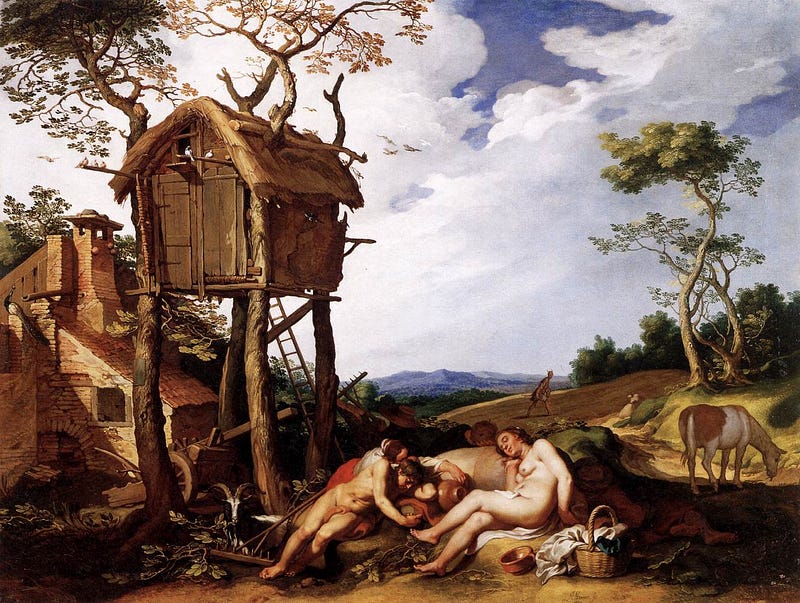
The Parable of the Wheat and the Tares — Image Credit

The truth is, darnel has been used to make beer and bread for thousands of years. It was for people who wanted their beer or bread with a little extra kick. But that euphoria came with a price.

In Search of The Seed

This article follows from one in which a list of seven parables was presented. Each of those seven parables supposedly possesses a secret meaning which can be discerned through careful study. This article will focus on an examination of the second parable from that list: The Seed.

We immediately run into a problem because there are several parables having to do with seed.

One possibility is The Growing Seed, there is also The Weeds, the Parable of the Mustard Seed, and the Parable of the Sower. So four possible parables. When we check with the Gospel of Thomas, we find that it contains parallels to three of the four.

I did notice that all four parables are clustered together.

Mark chapter four begins with the Parable of the Sower, followed by the Lamp under the Bushel, then comes the Growing Seed, and finally the Mustard Seed.

Matthew chapter thirteen begins with the Parable of the Sower, continues with the Tares, and ends with the Mustard Seed.

That was when I decided to compare the parables of the Growing Seed and the Tares. My theory is that Matthew copied Mark’s parable of the Growing Seed and then modified it to create Mathew’s parable of the Tares. Notice, first of all, that the Tares occurs in between the parables of the Sower and the Mustard Seed, just as in the case of the Growing Seed.

You will notice how Matthew copies and paraphrases directly from Mark:

Parable of the Growing Seed

26 And he said, Thus is the kingdom of God, as if a man should cast the seed upon the earth, 27 and should sleep and rise up night and day, and the seed should sprout and grow, he does not know how. 28 The earth bears fruit of itself, first the blade, then an ear, then full corn in the ear. 29 But when the fruit is produced, immediately he sends the sickle, for the harvest is come. (Mar 4:26–29 DBY)

Parable of the Tares

24 Another parable set he before them, saying, The kingdom of the heavens has become like a man sowing good seed in his field; 25 but while men slept, his enemy came and sowed darnel amongst the wheat, and went away. 26 But when the blade shot up and produced fruit, then appeared the darnel also. 27 And the bondmen of the householder came up and said to him, Sir, hast thou not sown good seed in thy field? whence then has it darnel? 28 And he said to them, A man that is an enemy has done this. And the bondmen said to him, Wilt thou then that we should go and gather it up? 29 But he said, No; lest in gathering the darnel ye should root up the wheat with it. 30 Suffer both to grow together unto the harvest, and in time of the harvest I will say to the harvestmen, Gather first the darnel, and bind it into bundles to burn it; but the wheat bring together into my granary. (Mat 13:24–30 DBY)

It seems fairly obvious that Matthew took the first half of the parable from Mark and then added his own section about an enemy coming at night and planting the bad seed. This means, essentially, that there are only three parables that could be identified as the Seed rather than four.

Plus all three of those potential Seed parables have parallels within the Gospel of Thomas. This last point is important because I often use the Gospel of Thomas as a key to unlock some of the more difficult parallels.

With this particular parable, however, it doesn’t seem to have much to tell us.

Saying 57: The Parable of the Weeds¹

Jesus said, “My Fathers’ kingdom can be compared to someone who had [good] seed. Their enemy came by night and sowed weeds among the good seed. The person didn’t let anyone pull out the weeds, ‘so that you don’t pull out the wheat along with the weeds,’ they said to them. ‘On the day of the harvest, the weeds will be obvious. Then they’ll be pulled out and burned.’”

The only significant difference that I can identify is that the Gospel of Thomas uses this parable to make a comparison with the Kingdom of the Father while Matthew uses the identifier Kingdom of Heaven. I don’t think that that is going to be too much help in this case, although I do consider this parable's inclusion within the Gospel of Thomas to be a good indicator that this parable does have some sort of hidden meaning.
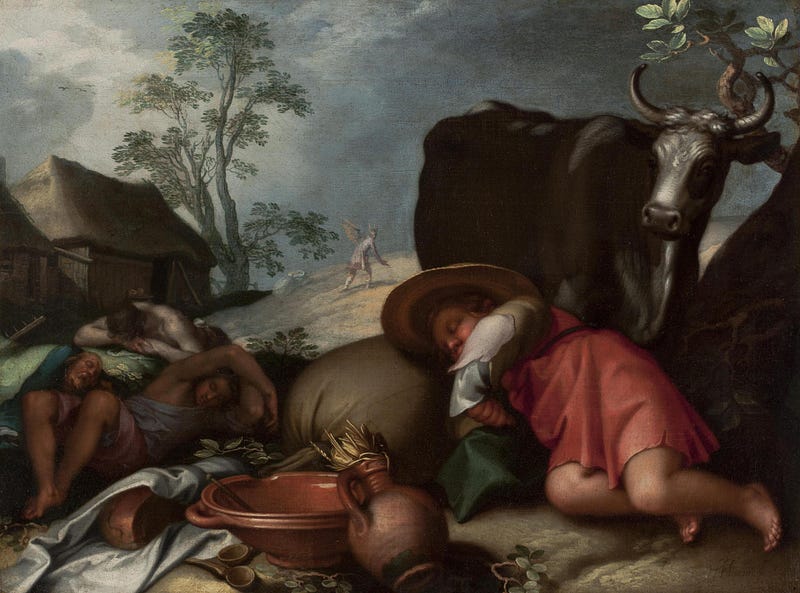
Landscape with Herdsmen and Satan Sowing Darnel — Image Credit

What Is This Parable's Hidden Meaning?

First, we should try to determine its surface meaning. A man sowed good seed in his field. While he slept an evil man came and sowed darnel among the wheat. The word darnel is usually translated as tares or weeds.

The fact that this farmer has land that has been sowed with two different types of seeds is in violation of Biblical law:

19 My statutes shall ye observe. Thou shalt not let thy cattle gender with another sort; thou shalt not sow thy field with seed of two sorts; and a garment woven of two materials shall not come upon thee. (Lev 19:19 DBY)

Of course, in this case, the farmer could argue that he didn’t sow the second type of seed. That was the fault of an enemy who sowed the bad seed while everyone was sleeping.

And we might be tempted to leave it there. Only that doesn't seem revelatory enough. Why would the Gospel of Thomas have a parallel to this parable if that is the extent of its significance?

There must be something more. What was the name of that weed?

The Greek word is zizanion. It is translated as darnel, which is a kind of weed that resembles wheat. Its Latin name is Lolium temulentum. Lolium indicates that it is a member of the ryegrass family. Temulentus is the word for being drunken or intoxicated.
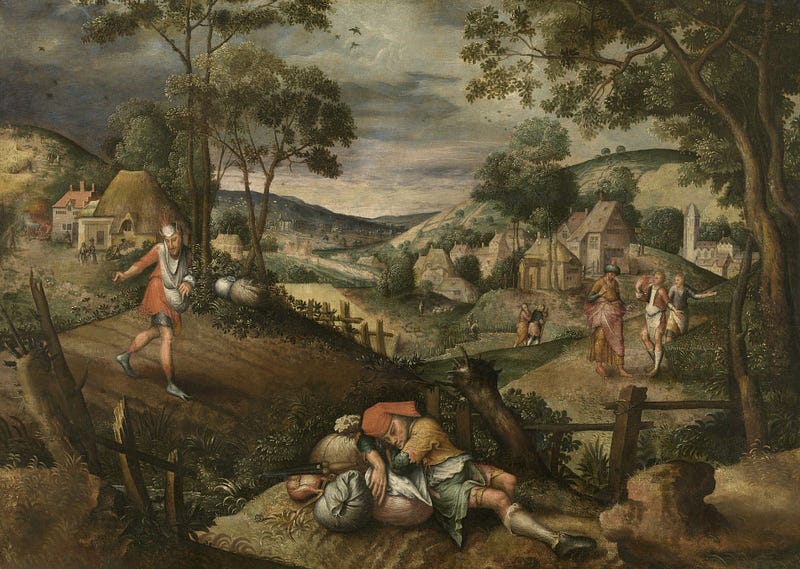
Satan Sowing Tares — Image Credit

It turns out that darnel is wheat’s intoxicating twin. Studies have shown that it owes its mind-altering and physically debilitating properties due to a fungus that lives within the plant that is related to the ergot organism Claviceps purpurea.

I dealt with the topic of ergot poisoning in the pieces below:

The truth is, darnel has been used to make beer and bread for thousands of years. It was for people who wanted their beer or bread with a little extra kick. But that euphoria came with a price.

According to a paper entitled: Remembering Darnel, a Forgotten Plant of Literary, Religious, and Evolutionary Significance²:

When darnel enters the food chain, most often in bread or ale, symptoms of its consumption include visual impairment, disorientation, headaches, and even (at high concentrations) hallucinations and loss of consciousness.

Writing in the first century CE, Ovid alludes to “eye-blighting darnel,” and a character in Miles Gloriosus by Plautus (c. 254–184 BCE) asks: “Why do you eat so much darnel? … it’s bad for the eyes”.

Into the early modern period (1597), John Gerard, in his Herball, notes that darnel causes “drunkennes” and “hurteth the eies and maketh them dim”, and Thomas Cooper, using the Latin name for darnel in 1565, observes that “lolium,” if consumed in “hote bread … maketh the heade giddie”. Perhaps most memorably, Joshua Sylvester, translating Du Bartas, calls it “dizzie Darnell”.
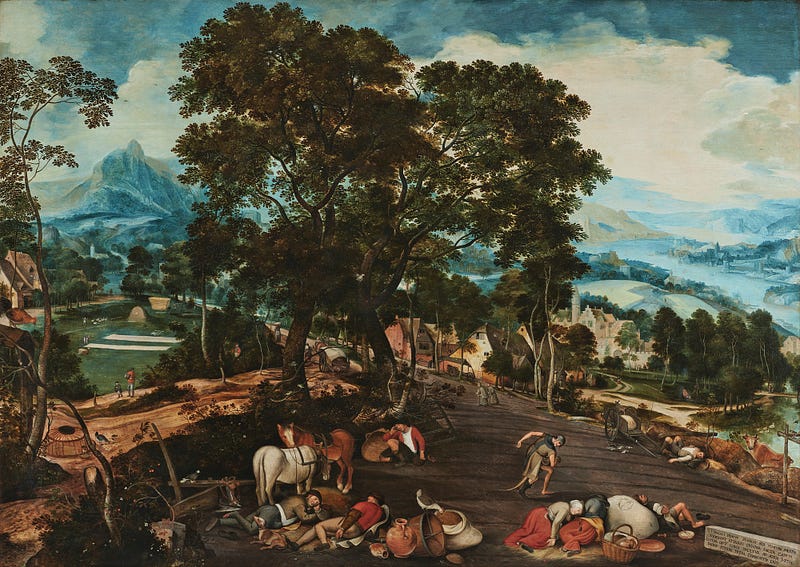
Landscape with Satan sowing tares — Image Credit

It is even possible that some suspected cases of ergot poisoning may have actually been caused by darnel poisoning. The differences are subtle.

Ergot poisoning occurs when grain seed has been infected with the ergot organism Claviceps purpurea. In the case of darnel poisoning, the plant itself grows a fungus which it uses during its development. That endophyte fungus produces alkaloids that are similar to those produced by Claviceps purpurea.

I am just wondering that if maybe when Jesus couldn’t get any bread made with ergot-tainted grain, he might have resorted to using bread made with darnel wheat.

Anyway, that is the surface story of the parable.

Our poor farmer was sleeping when an enemy of his cast darnel among the wheat. Darnel is especially bad because it looks like wheat. Actually, it is a form of wheat.
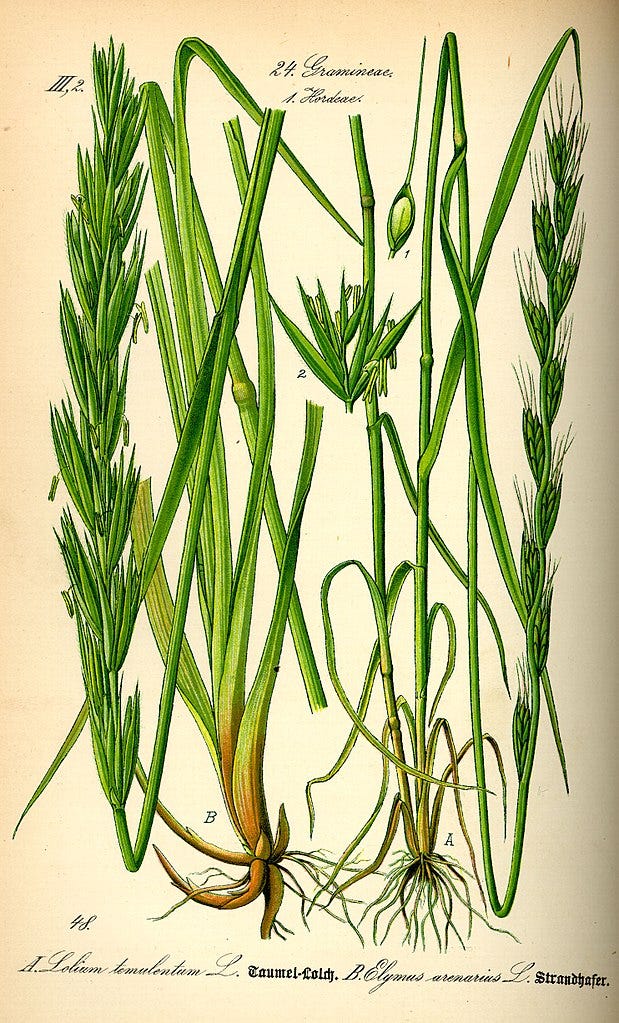
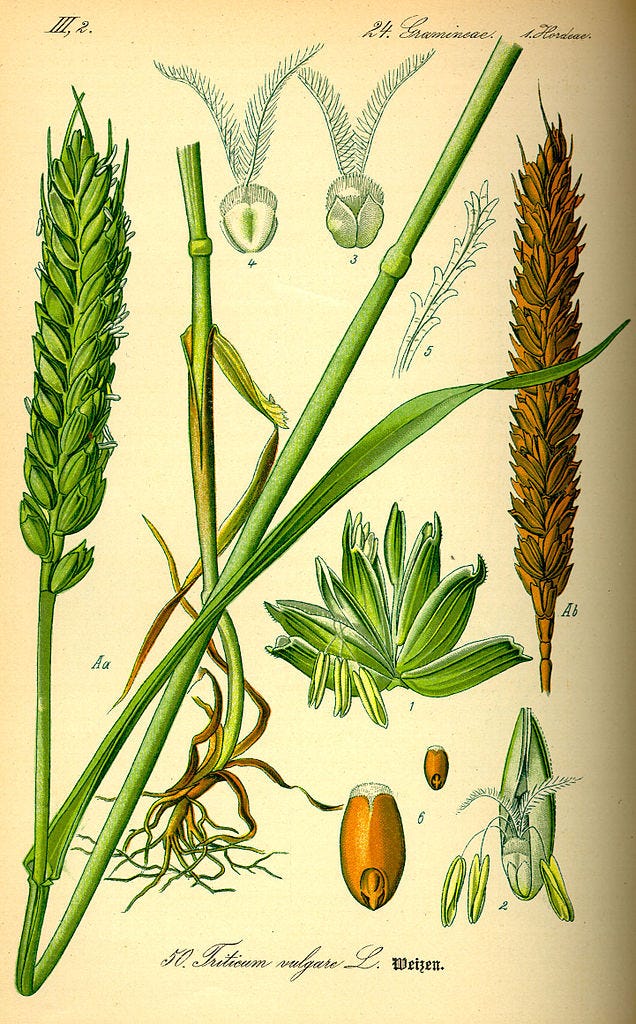
Darnel — Image Credit/Common Wheat — Image Credit

Let’s look at the description in Mark from the Parable of the Growing Seed:

28 The earth bears fruit of itself, first the blade, then an ear, then full corn in the ear. 29 But when the fruit is produced, immediately he sends the sickle, for the harvest is come. (Mar 4:28–29 DBY)

The ear is made up of a spike (green) which bears flowers (red) — Image Credit

Mark breaks it down into four stages. The blade can be understood as the plant’s stalk.

Then comes the ear. In the image to the left, the long green line is the ear’s spike. The red circles are little flowers that bloom and then die.

The term full corn in the ear refers to individual seeds growing at each location where one of those tiny blossoms had previously bloomed. Finally, when the fruit is produced, refers to when the wheat has ripened.

Now let’s look again at Matthew.

26 But when the blade shot up and produced fruit, then appeared the darnel also. (Mat 13:26 DBY)

Notice how far from harvest the crop is described as being. In Mark, once the crop produced fruit it was ready to be harvested. In Matthew, the term produced fruit seems to be identical to what Mark describes as full corn in the ear.

In the following two images we can compare darnel to common wheat when in the stage identified as full corn in the ear. Notice the obvious morphological differences between the two plants.
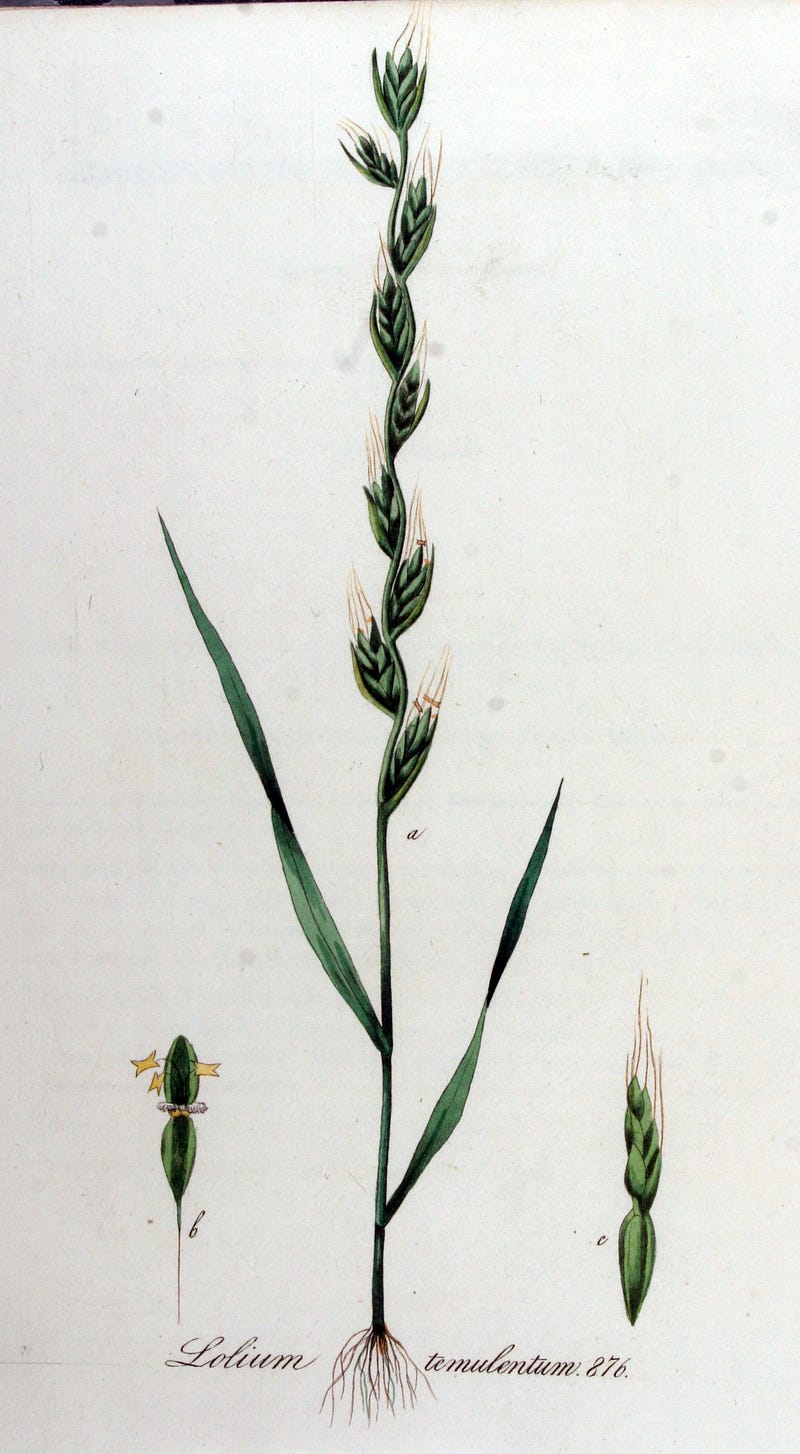
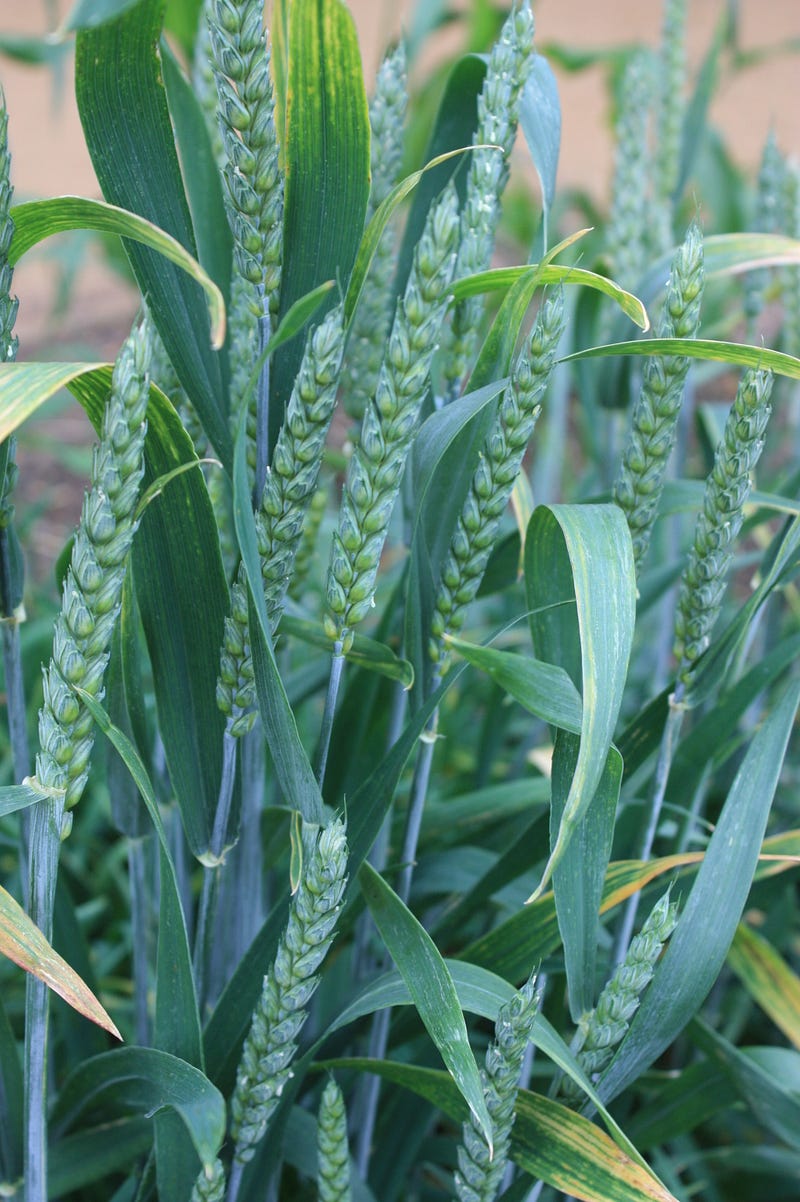
Lolium temulentum — Image Credit/Green wheat, one month before harvest — Image Credit

26 But when the blade shot up and produced fruit, then appeared the darnel also. 27 And the bondmen of the householder came up and said to him, Sir, hast thou not sown good seed in thy field? whence then has it darnel?

Think fast. Your ranking henchman has discovered the darnel among the wheat. He doesn’t need to know the truth, which is that you are in the process of producing a secret ‘sacred’ flour to make ‘holy’ bread, but you do need to tell him something.
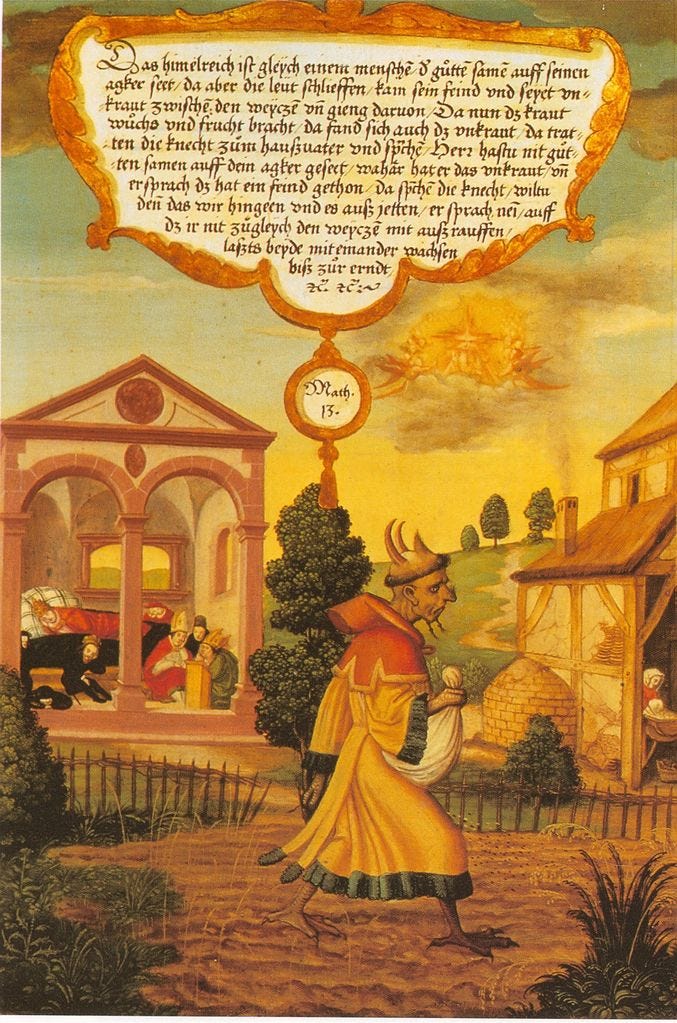
An enemy sowed darnel while we slept — Image Credit

28 And he said to them, A man that is an enemy has done this. And the bondmen said to him, Wilt thou then that we should go and gather it up? (Mat 13:28 DBY)

The guy offers to pull the darnel up. That would ruin your plans.

29 But he said, No; lest in gathering the darnel ye should root up the wheat with it. 30 Suffer both to grow together unto the harvest, and in time of the harvest I will say to the harvestmen, Gather first the darnel, and bind it into bundles to burn it; but the wheat bring together into my granary. (Mat 13:29–30 DBY)

You tell your henchmen that it is too risky to try to pull up the darnel now, but he looks at you like you are an idiot. As the images above make clear, the perfect time for identifying the darnel is now, while the wheat is green, a month before harvest.

The authors of Remembering Darnel, a Forgotten Plant of Literary, Religious, and Evolutionary Significance³ also noted that:

In reality, few farmers were willing to leave the removal of weeds until the crop was fully grown.

Instead, you direct your henchman to have the darnel separated from the common wheat during harvest, and put aside to be burnt. You don’t order it burnt, you just want it ready to be burnt for when you give the order.
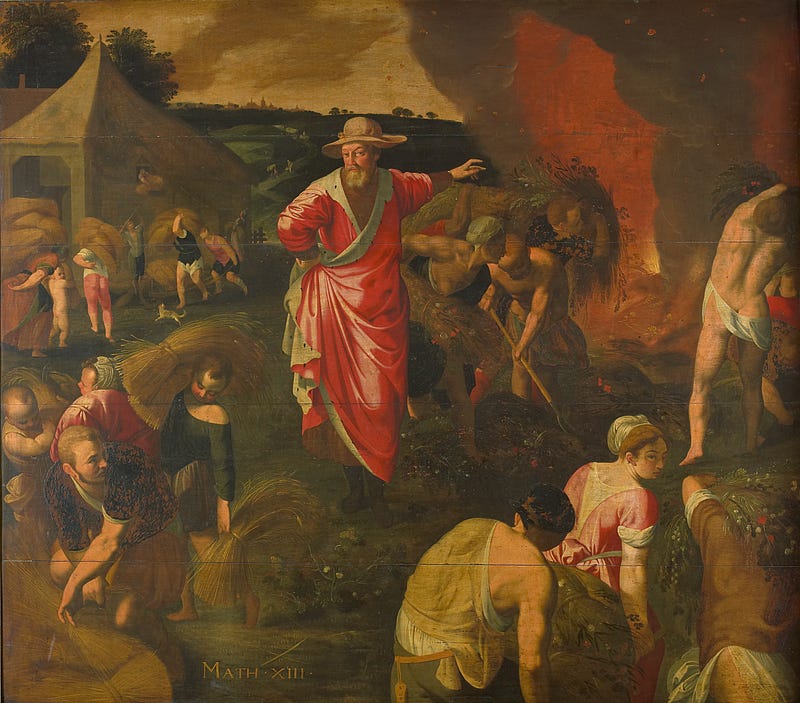
One of these days, I swear, I am going to get around to burning that darnel — Image Credit

So that’s the disturbing hidden meaning. Except that in this instance Matthew went and supplied an entirely different explanation of the parable.

36 Then, having dismissed the crowds, he went into the house; and his disciples came to him, saying, Expound to us the parable of the darnel of the field. 37 But he answering said, He that sows the good seed is the Son of man, 38 and the field is the world; and the good seed, these are the sons of the kingdom, but the darnel are the sons of the evil one; 39 and the enemy who has sowed it is the devil; and the harvest is the completion of the age, and the harvestmen are angels. 40 As then the darnel is gathered and is burned in the fire, thus it shall be in the completion of the age. 41 The Son of man shall send his angels, and they shall gather out of his kingdom all offences, and those that practise lawlessness; 42 and they shall cast them into the furnace of fire; there shall be the weeping and the gnashing of teeth. 43 Then the righteous shall shine forth as the sun in the kingdom of their Father. He that has ears, let him hear. (Mat 13:36–43 DBY)

This interpretation has been used by Christians to justify living among people of different beliefs. It is not for us to separate the darnel from the wheat because we might make a mistake and misidentify a Christian as a heathen. We should instead wait until the end of the age when the Day of Judgement is at hand.

However, with our new understanding, we see that the one who sows the good seed is the same one who is sowing the darnel. And this is apparently all part of His plan to make some powerful Holy Bread in that great bakery oven at the end of time.

  1. https://www.gospels.net/thomas
  2. http://hdl.handle.net/2160/42468
  3. Ibid.
Parables Of Jesus
Wheat And Tares
Religion
Spirituality
Philosophy
Recommended from ReadMedium