

The Spectrum of Humanity
Learn When to Break the Rules to Connect with People
📚 Connect with us. Want to hear what’s new at The Pragmatic Bookshelf? Sign up for our newsletter. You’ll be the first to know about author speaking engagements, books in beta, new books in print, and promo codes that give you discounts of up to 40 percent.
Permanence Recap
This article is the last in a series on remote work, so let’s start with a recap.
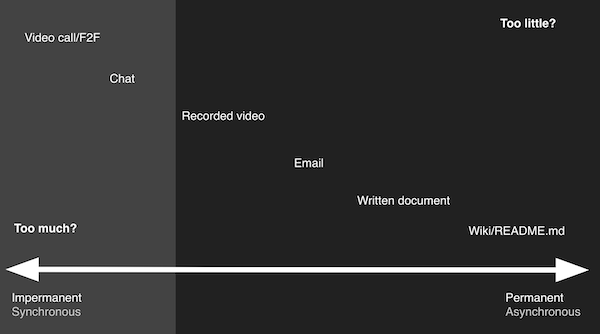
In the last article, we looked at the spectrum of permanence, which showed that:
- A strong correlation exists between the permanence of communication and asynchronousness.
- Permanence can be determined by how relevant, accurate, or useful a particular artifact is with time.
- Shifting to be more asynchronous means that you should leave an audit trail, maintain indexes of important information, and ensure that you regularly mark, file, tidy, and delete your artifacts.
Being Human

In this article, we’re going to look at what it means to feel connected to other people by considering the spectrum and how it maps to humanity.
Whether you like it or not, you are a human. (If you’re reading this and you’re not a human, science would be quite interested.) We are social creatures, regardless of those days where we’d rather lock ourselves inside and never see another human ever again. Our strength as a species is built on understanding each other, mirroring others’ behaviors, and working together toward altruistic goals. We’ve evolved to be around each other because it brings us many positive benefits.
Humans working together can achieve great things, such as building a society, innovating in science, and creating technology. For example, humans made the best video game ever: Dark Souls. (If you disagree, please close this tab.) Here, the protagonist is one of the undead in the mysterious city of Lordran. If not careful, they go hollow by losing their humanity — resulting in a zombie-like state. Players can restore their humanity by resting at the warmth of various bonfires dotted around Lordran.
Despite everything that we’ve covered in this series, simply being asynchronous all of the time isn’t the solution to all of our remote working problems. Yes, it may make communication more concise and efficient. Yes, it may allow us to better think through problems. And yes, it may also create better opportunities for people regardless of their location to be a part of consensus and decision-making. But remote work benefits come at a price. If we spend too much time away from interacting with other humans, it may have a detrimental effect on our mental health and our happiness. Being alone means we are fighting against our humanity: the core human trait that we have used over time to excel as a species.
Remote Work: Human or Hollow?

At the start of the mass transition to working from home during the COVID-19 pandemic in 2020, reports indicated that the replacement of in-person meetings with video calls was making many people suffer from a feeling of false intimacy that was leaving them grieving for face-to-face life.
Various theories speculated that our brains were finding it difficult to shift so suddenly from a physical world of connection through presence, voice, and body language to one that was a lower resolution and sometimes jittery alternative.
Too much time spent away from humans, especially when the number of humans that we see in our personal lives is small, can be detrimental to our mental health. So if this article wasn’t part of the series, you may have come to the conclusion that remote work would be best if you were able to efficiently exchange ideas and make progress entirely asynchronously. However, as time went on, you would feel less and less connected to other humans. And there’s a high likelihood that you would feel less happy too.
We can add a final property to our spectrum, with a nod to Dark Souls. As brave warriors in our remote-working adventure, are we making ourselves feel human or hollow?
The Fix: Break the Rules
What you have to do in order to feel happier and more human is occasionally break the rules.
😲 Yes, you ignore everything I said in the other two articles.
There’s a balance to being efficient and also feeling part of a community of other humans. You have to ask yourself each day whether you are feeling more or less connected to others. You need to check in with yourself regularly and make sure, dear adventurer, that you are not going to go hollow on us. It turns out that you can rest in the warmth of the proverbial bonfire in a number of ways.
What you should do is:
- Encourage goofing off.
- Use the wrong communication formats on purpose.
- Meet up in person with other human beings.
Let’s have a look at these in turn.
Encourage Goofing Off

Let’s face it, not everyone spends all of their time in the office working solidly. Other activities that take place during the office include having a chat with your colleagues in the kitchen, going out and grabbing a coffee, and maybe even playing a game of table tennis. So why should remote work be any different?
If you are a diligent and hardworking person, which you most likely are, then it is easy to fall into the trap of overworking while you are at home. Since there are fewer opportunities to have ad-hoc interactions with your colleagues, you can potentially end up grinding away even harder than you would if you were in the office.
So you need to goof off. But how? It turns out that there are a great number of ways, and they don’t need any expensive setup or tools.
For example, you could:
- Openly encourage opportunities for conversation. Create chat channels or mailing lists for sharing information, stories, and pictures of pets, family, or hobbies. You’ll create a welcome distraction from the day to day, and enable colleagues who work in different parts of the company to get to know each other better. — like they would while hanging out in the kitchen. Create channels around office locations, different animals, sports, video game consoles, or even pop stars. You can keep these channels listed in an index and link to them in your onboarding documentation.
- Book social time into the calendar. Perhaps you could end your Fridays with a virtual happy hour that starts at 4:30 PM. Maybe you could hang out with your colleagues at lunch, but virtually. No work talk, just fun talk. Perhaps you could end the day on Thursdays with a quick online game of chess or Rocket League — whatever takes your fancy.
- Collaborate for fun. For example, every Friday you could all build a shared playlist around a theme using whichever music streaming service you prefer. You could arrange a trivia game on a subject of your choice once a quarter. Or why not have your team watch a recorded conference talk or lecture together while discussing it in a chat channel?
Even though goofing off isn’t actually doing your work, it still is an integral part of your work. It’s easy to default into execution-only mode when working remotely, but in the long run, all work no play is going to drain your batteries and make you feel much less connected to others. After all, we work to make money, to master particular skills, and serve our customers, but there is a lot of good in knowing and serving each other as well.
Use Synchronous Communication Formats on Purpose
Given that synchronous communication allows you more opportunities to feel connected to other humans, sometimes you’ve just got to be more synchronous, even if it is more inefficient. (Yes, you need to be purposefully inefficient. I know that’s difficult.)
Here are some ideas for encouraging more synchronous interactions:
- Hold regular virtual office hours. This tactic works especially well if you’re a senior engineer. Block out some of your focus time in the week to work openly on a video call that anyone can join. Less experienced engineers can learn a lot from watching you work, and they can ask you questions while you do so. Additionally, others can screen share their own work and discuss it and get assistance if required.
- Pair program remotely. Pick a ticket every iteration and pair up with someone else on your team. Many IDEs now offer remote pair programming features.
- Review a pull request synchronously. Rather than sticking to the usual asynchronous method of reviewing a pull request, why not invite a couple of reviewers to come and look at it over a video call with you? Working together allows you to step through the code, discuss issues and solutions, and connect with others while doing so. If you can’t arrange a live collaboration, a neat option is to record a video stepping through your approach to the code changes and embed it in the description of the pull request.
- Have a silent meeting about a written document. If you have written a document with an idea or design for others to review, consider holding a silent meeting. In a silent meeting, everyone joins and reads the document together, in silence, while on the call. Then, once everyone is done, the discussion happens synchronously with one person taking notes. As well as feeling more connected to others, silent meetings can stimulate more productive behavior among the group, since everyone is on the same page when the discussion begins.
If you want to inject a bit of positive chaos into proceedings, then occasionally find ways to get people working together synchronously in real time. For example, the whole team could use mob programming for some of their tasks, or you could write a design document together while on a call. At the very least, this exercise will be fun. Just don’t tell them that I suggested you occasionally change the font color to white and claim that there are strange technical issues occurring.😈
Meet Up in Person with Other Human Beings

No matter how you try to simulate human interaction, it’s impossible to replicate it. So if you can’t beat them, join them in person. If you work remotely but in a location nearby some of your colleagues, try to find some time to meet up.
However, here are some rules I would like you to enforce:
- Meet up on work time. You’d chat in the kitchen while people ate their lunch, so you can do this remotely as well. Forcing social activities into the early mornings or late evenings sets a bad example by principle, by saying, “this is a social thing, and we don’t do social things during the workday.” Well, you would do social things in an office. Building relationships and rapport with your colleagues is an important activity that should take place during work time as well.
- Do something enjoyable. You don’t need to spend much money by eating out or paying for admission to somewhere unless you want to. Instead, explore free things to do such as going for a walk in nature, investigating a cool landmark in your city, or going for a run or a bike ride together.
- Try not to talk about work, unless it’s useful. Since you work together, it’s probably going to be natural to talk about work a little. However, try not to make it the main focus of meeting up — the choice of activity can have a real impact here. Meeting up outside of work when you work remotely is primarily about getting to know each other as human beings, not just as analysts, engineers or researchers. See if you can get to know your colleagues on a deeper and more human level. It’ll make your interactions at work while remote better. It’s harder to get frustrated at Steve the human being as opposed to Steve the chat handle who always manages to phrase things in a seemingly passive-aggressive manner.
If you happen to not live near any of your colleagues, then you can do all of the above activities with your family, friends, or pets. If that’s not an option, then just make sure that you’re regularly getting away from your computer during the workday and surrounding yourself with other people. Getting away might mean working in a coffee shop or co-working space occasionally, or attending meetups and talks in your area. As much as we may have dreamed of just being able to stay in our rooms forever as teenagers, there are times when we need to redress the balance as well.
Takeaways
That ends our three-part series on the spectrum of synchronousness. We’ve learned all about:
- The spectrum between synchronous and asynchronous communication, and what methods to communicate with and when.
- The correlation between asynchronous communication and permanence of artifacts and some best practices around managing them.
- The continual tension in remote working between wanting to be efficient and needing to feel connected to other humans. We sometimes need to break the rules on purpose.
I hope you’ve found this series useful.
If you enjoyed this article, be sure to pick up James Stanier’s books from The Pragmatic Bookshelf:
Further Reading
Also by James Stanier:
The Spectrum of Synchronousness
How to Shift Communication for More Effective Remote Work
medium.com
Become An Effective Software Engineering Manager on Medium:
Originally published at https://www.theengineeringmanager.com on March 17, 2021.