

Giving Feedback
Easy, Right?
The concept of giving feedback is simple: you want to let people know when they are doing a stellar job so that they can receive praise, and conversely, let people know when they are not performing to your standards so that you can begin to help them improve.
The truth is that giving feedback well is very difficult to do. It’s easy to see why giving negative feedback is tough: it might not land well, it might upset the other party; it essentially creates conflict. Yet, giving positive feedback can also be challenging. It’s awkward telling people they’re amazing!
Mastering the art of giving feedback has a number of benefits. Your employees know where they stand — both star performers and those who need to do better. Practiced regularly, feedback also strengthens the emotional bond between you and your staff because giving honest feedback requires honesty and trust.
What Happens When You Don’t Give Good Feedback

Let’s start with an example. Susan is leading a team of engineers, and something seems to be up with one of her staff, Ann. It seems that Ann just doesn’t seem to be giving it her all in recent weeks. She’s been turning up slightly late every day, and a lot of the features that she’s worked on have had some gnarly bugs found in QA. Something’s not quite right.
In their next 1 to 1, Susan asks whether she’s okay as a way of trying to get her to open up about whatever is bothering her. “I’m doing fine,” is Ann’s reply. The issue gets skirted this time. Fast forward to next week. Susan prods at the situation a little more by asking how her feature is going, as a way of getting her to open up about the recent issues that were found in QA. “It’s just been complicated to develop,” is Ann’s reply.
Weeks go by, and the situation is getting worse. Other members of the team have approached Susan because they are finding it increasingly frustrating to rely on Ann to deliver to the expected standard, and progress in the team is slowing down as they move closer to their launch date.
In the next 1 to 1, Susan decides to ask whether Ann needs any additional support as she seems a bit under the weather. She uses this as a way to slowly steer towards the problem. “I’m OK, but I find working with the API difficult sometimes.” Susan decides to pair Ann up with a mentor within the team so that she can pair program on the parts of the work that build on the API.
One week on, and Ann’s mentor, Robert, sends Susan a message. “I’m finding it really frustrating trying to pair program with Ann. She seems really distracted and doesn’t seem to want to learn.” Now you have your team looking for answers.
As the end of the quarter approaches, Susan prepares Ann’s performance review. It isn’t great. She writes up all of the aspects of her role that haven’t been performed to the expected level, incorporating the feedback from the team. She sends over the performance review ahead of the meeting. Ann turns up to the meeting looking distraught. Susan asks if she has read the feedback. Ann asks a reasonable question, but with considerable anger in her voice, “If I wasn’t performing well enough, why didn’t you tell me?”
People Actually Like Feedback. So Give It!

Good or bad, people want to hear how they’re doing. Get into the habit of giving good or bad feedback whenever you can. Your 1 to 1s are an obvious place to provide feedback, but keeping it front of mind when having meetings or informal interactions can uncover many more places to fit in feedback. You can give positive feedback pretty much anywhere and to anyone: an informal chat around the coffee machine can become an opportunity to congratulate a colleague on their recent feature launch and to tell them how much you like it. However, save the frank and constructive criticism for people with whom you have a stronger and more open relationship, such as your direct reports, peers, and manager. (Yes, your manager too!)
Your best performers will want consistent feedback that they are doing well and that you appreciate the effort that they are putting in. You know how superstars in the classroom become frustrated at the disruptive children who are getting all of the teacher’s negative attention? Top performers can get frustrated in a similar way. Make sure you are praising and pushing your stars to perform at the best of their ability. They will be happier and feel appreciated, and it will keep them contributing at a higher level.
For staff who require improvement, they absolutely need to know. In our example, Susan was not tackling the problem with Ann directly. Instead, she was trying to gently approach the issue from different angles, but with little success. At review time, Ann was surprised that she had negative feedback. Instead, Susan should have been direct as early as possible. Timely direct feedback can be challenging but becomes easier with experience.
Four Keys to Constructive Feedback
Try to be direct, compassionate, and open to solutions. Focus on future improvement rather than dwelling for too long on past events.
- Be direct: “Ann, I’d like to talk to you about your performance. I have noticed that recently it is not up to standard and one of your colleagues has also approached me about it.”
- Be compassionate: “I really want you to be awesome in this role so that you are able to continue to level up in your career. You’re a very smart person, and I worry a lot if you’re not able to perform well.”
- Be direct again: “If you’re unable to perform in your current role then we will have to look more formally at the options available for you. In the worst-case, this could be a conversation about whether this company is the right place for you to be.”
- Be open: “How can we identify and work on what you need to improve?”
Radical Candor
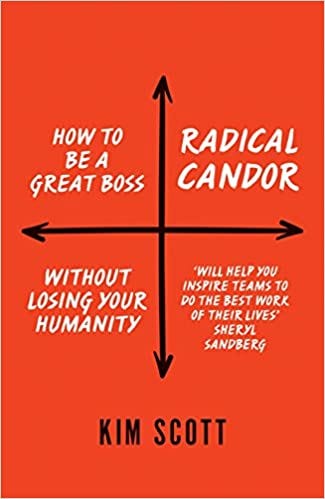
Kim Scott’s excellent book Radical Candor distills the traits of giving good feedback into two simple categories: Care Personally and Challenge Directly. When these two traits are combined in the relationship between a manager and direct reports, the right atmosphere is in place to criticize, praise, and push people to perform at a high level.
Being able to challenge directly requires an extremely high level of trust and emotional rapport between two people. Scott argues that the core of this trust is simply giving a damn, personally. Two people that care personally about each other can challenge each other directly with positive consequences. Think of a sports coach. This rapport also works in both directions — the direct report should have a level of trust that allows them to care and challenge upwards as well.
Radical Candor is well worth reading. Kim is a smart author and has some great ideas.
Getting Practice: An Exercise
Here’s an exercise that you can try with your peer group. Depending on your organization, this activity will either be extremely positive or extremely awkward (shifting to positive, though, as people get more comfortable).
One session I took part in began with everyone feeling very nervous, but by the end of it, we all felt much closer, and there were a lot of laughs too.
Book a meeting and invite your peer group. Before the meeting, ask each attendee to prepare one piece of praise and one area to improve for every person attending. In the meeting, pair off and have each person deliver these pieces of feedback. Swap partners every couple of minutes until all feedback has been delivered.
Gather back together at the end.
- What did everyone find easy?
- What did they find difficult?
- How did they react to receiving positive and negative feedback?
- Do they feel relationships have changed with everyone in the room?
Your turn to share. Was there a time when more direct feedback would have helped you achieve your goals or further your career? Leave a comment about your own experience.
If you enjoyed this article, be sure to pick up James Stanier’s book from The Pragmatic Bookshelf:
Through the end of October 2021, you can save 35% on the ebook version using promo code jsengman_medium_35. Note that promo codes are not valid for prior purchases.
Further Reading
Also by James Stanier:
Become An Effective Software Engineering Manager on Medium:
Stay in Touch
A great way to stay in touch with The Pragmatic Bookshelf is to sign up for our newsletter. You’ll be the first to know about new books for programmers, books in beta, and promo codes that give you discounts of up to 40 percent.